Fireworks are used worldwide for recreation, religious, cultural, and patriotic celebrations. However, injuries from consumer-grade fireworks can be devastating, leading to permanent vision loss, limb amputation, or death.
Firework-related injuries account for approximately 2% of all eye injuries. According to the 2021 report by the U.S. Consumer Product Safety Commission (CPSC), 11,500 firework-related injuries were treated that year, with an estimated 8,500 occurring around the Independence Day period from June 18 to July 18.
Proportion of eye injuries: 20% of all firework-related injuries (American Academy of Ophthalmology; AAO), some studies report over 31%
Age distribution: 65.9% occur in individuals aged 18 or younger. The highest injury rate is in the 10–19 age group
Sex: 71.9–89% are male
Source of injury: 99% are caused by consumer-grade or homemade fireworks
Bystander risk: Children are more often injured as bystanders than as users. Bystanders account for 65% of injuries
Effect of regulations: Regions with stricter firework laws have 87% lower rates of eye injuries (systematic review)
Professional fireworks: Eye injuries from professional displays account for only 1% of all firework-related injuries
In explosion and shrapnel injuries, the eye is also a high-risk organ. Up to 28% of explosion survivors sustain eye injuries, and secondary blast injuries (from flying debris) account for about 80% of eye injuries in military combat 1).
QWhich age group is most affected by firework-related eye injuries?
A
65.9% occur in individuals aged 18 or younger, with the highest injury rate in the 10–19 age group. It is important to note that children are more often injured as bystanders than as users, and bystanders account for 65% of injuries.
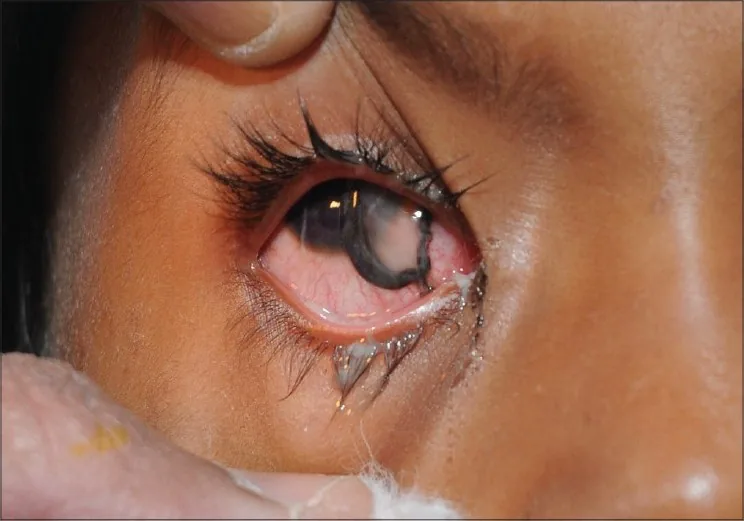
Kumar R, Puttanna M, Sriprakash KS, et al. Firecracker eye injuries during Deepavali festival: A case series. Indian J Ophthalmol. 2010;58(2):157. Figure 5. PMCID: PMC2854452. License: CC BY 2.0 (https://creativecommons.org/licenses/by/2.0/).
Clinical photograph of an open-globe penetrating firecracker injury. The image gives a clear example of the kind of severe ocular trauma caused by fireworks and shrapnel.
In case of large explosions: surface injuries from flying debris (eyelid lacerations, eyebrow lacerations, corneal injuries) are most common, with an open globe injury rate reaching 20.8%1)
Aerial fireworks cause both blunt trauma and burns simultaneously, leading to corneal erosion, hyphema, and elevated intraocular pressure in the acute phase, and potentially severe vision loss in the chronic phase due to corneal opacity, traumatic cataract, and secondary glaucoma. Additionally, the gunpowder residue becomes alkaline after combustion, so burns and chemical injuries may occur together.
Main injuries: Significantly associated with globe rupture, severe hyphema, and corneal damage.
Characteristics: Because high-speed projectiles directly hit the eye, they are most likely to cause severe trauma.
Firecrackers
Main injuries: Associated with ocular burns (thermal injury).
Characteristics: The high heat and shock wave from the explosion directly damage the ocular surface. Residue after combustion may also cause alkaline chemical injury.
Aerial Fireworks
Main injuries: Associated with intraocular foreign bodies.
Characteristics: Descending burning residue or fragments may enter the eye. Bystanders may also be injured while watching professional fireworks displays.
Lack of protective eyewear: Without proper protection, flying debris can directly reach the eye.
Close proximity to fireworks: Malfunctions (abnormal flight path, premature explosion, tip-over) are the most common danger patterns.
Use of consumer or homemade fireworks: Homemade or illegal fireworks contain larger amounts of explosive material and cause more severe injuries.
Lack of parental supervision: This is the main reason for high rates of bystander injuries in children.
Use of alcohol or recreational drugs: Impaired judgment leads to risky behavior.
Most injuries occur at home
QHow can eye injuries from fireworks be prevented?
A
The most effective prevention is to watch professional fireworks displays from a safe distance. When handling consumer fireworks, wearing protective eyewear is essential, and it is also important to avoid approaching duds. A systematic review found that regions with stricter regulations have 87% lower rates of eye injuries.
Optic nerve function: Pupillary light reflex, color vision, confrontation visual field test
Eye movement and ocular misalignment: Useful for identifying the entry site of a foreign body
Slit-lamp examination: Evaluate the location and depth of the foreign body
Seidel test: Use fluorescein staining to identify full-thickness corneal, scleral, or conjunctival lacerations and determine the presence of aqueous humor leakage
Ocular Trauma Score (OTS): A tool for predicting visual prognosis based on initial examination findings
Life-threatening injuries or extraorbital injuries should be managed in collaboration with relevant departments (neurosurgery, otolaryngology, oral surgery, orthopedics).
Suspected open globe injury: Protect the eye with an eye shield; avoid pressure on the globe and further examination
Systemic antibiotics: Administer cefazolin, vancomycin, or moxifloxacin
Tetanus prophylaxis: Confirm and administer after injury
Post-combustion gunpowder becomes alkaline, which may result in combined thermal and chemical injury.
Assess pH; if outside the range of 7.0–7.4, perform copious irrigation with normal saline or lactated Ringer’s solution
Continue irrigation until the pH reaches neutral (7.0–7.4). Irrigation should ideally be performed for at least 20 minutes; early irrigation is most important.
After ruling out open globe injury, wash away or manually remove particulate matter (foreign bodies).
Eyelid laceration: First assess for globe injury (corneal perforation, laceration, scleral laceration, globe rupture); if present, treat the globe injury before the eyelid.
Irrigation and debridement: After infiltrative anesthesia with 0.5–1.0% lidocaine with epinephrine, remove foreign bodies such as sand, mud, or glass fragments with saline. If many small foreign bodies are present, perform under an operating microscope.
Suturing of globe lacerations: Watertight closure. For corneoscleral lacerations, first suture the limbus with 9-0 nylon, then close the corneal wound with 10-0 nylon and the scleral wound with 9-0 nylon using interrupted sutures.
Corneal foreign body removal: After topical anesthesia, remove by lifting tangentially with a foreign body spud or 27G disposable needle. A rust ring drill is useful.
Removal of intraocular foreign body (IOFB): Perform bacterial and fungal culture of intraocular fluid, and add antibiotics to the irrigation fluid. Surgical removal is performed by a specialist.
Endophthalmitis: The incidence of endophthalmitis in open globe injuries is 2–7%. If suspected, manage according to standard guidelines.
Secondary intervention/reoperation: To prevent sequelae such as proliferative vitreoretinopathy (PVR), set a low threshold for early intervention.
Management of hypotony: Atropine eye drops (1%) once daily at bedtime + Flumetholone eye drops (0.1%) four times daily. Surgically, consider argon laser photocoagulation, cryotherapy, scleral buckling, etc.
Non-salvageable eye: Perform enucleation or evisceration, with primary orbital implant and socket reconstruction.
In the Beirut port explosion, 21 of 39 patients (53.8%) required surgical intervention, and 14 (35.9%) required emergency surgery on the day of injury1).
QWhat should be done first when injured by fireworks?
A
If there is a possibility of chemical injury (alkali injury from burnt gunpowder), immediately irrigate the eye with copious amounts of water for at least 20 minutes. If an open globe injury is suspected, protect the eye with an eye shield and seek immediate ophthalmological evaluation without applying pressure to the eye.
Fireworks trauma is not a single mechanism but a complex injury involving the following three components occurring simultaneously.
Blunt Trauma
Mechanism: Mechanical damage from direct impact of fireworks or fragments.
Consequences: Globe rupture, hyphema, lens damage, retinal detachment, orbital fracture. High-velocity fragments cause extensive damage to the globe and adnexal structures1).
Thermal Burn
Mechanism: Direct thermal injury from hot explosive gases and combustion residues.
Consequences: Thermal burns of the corneal and conjunctival epithelium, eyelid skin burns. Severe cases may result in corneal opacities.
Chemical injury
Mechanism: The gunpowder becomes alkaline after combustion, causing chemical injury to the cornea and ocular surface.
Result: Alkali has high tissue penetration and can cause severe damage due to rapid intraocular penetration.
Ocular injuries in large explosions (terrorism, industrial accidents, etc.) are classified into four stages.
Primary blast injury: Direct damage from the blast wave
Secondary blast injury: Damage from flying debris (glass shards, metal fragments, etc.) — the most common form of ocular injury, accounting for approximately 80% of military combat injuries1)
Tertiary blast injury: Displacement or impact of the body due to blast wind
Quaternary blast injury: Combined damage from fire, chemicals, building collapse, etc.
In the Beirut port explosion, people watching the fire through windows were injured by glass shards from the explosion. Most injuries were caused by flying debris from glass windows and building exteriors, a typical example of secondary blast injury1).
Ocular siderosis: Long-term retention of iron-containing foreign bodies leads to iris heterochromia, fixed dilated pupil, cataract, retinal degeneration, and secondary glaucoma
Ocular chalcosis: Copper-containing foreign bodies with high purity can cause panophthalmitis; chronic cases may result in Kayser-Fleischer ring and anterior subcapsular cataract.
Double perforation of the globe: A penetrating foreign body may become an orbital foreign body.
Visual prognosis ranges from minor corneal abrasion (usually good) to permanent blindness.
Kheir WJ et al. (2021) analyzed 39 patients (48 eyes) after the Beirut port explosion. At initial presentation, best-corrected visual acuity (BCVA) was less than 20/200 in 13 eyes (27.1%), of which 4 eyes (8.3%) had no light perception (NLP). Final BCVA less than 20/200 improved to 7 eyes (14.5%), and all 4 NLP eyes underwent enucleation or evisceration1). Initial BCVA was the most important predictor of visual prognosis1).
In a report of globe rupture due to fireworks, 10 of 18 eyes (59%) had NLP at final follow-up, indicating the severity of open globe injury prognosis.
Disfiguring blind eye: Significant psychological and social impact.
QWhat is the visual prognosis for ocular trauma caused by fireworks?
A
Visual acuity ranges widely from 20/20 (normal) to NLP (no light perception). Reports indicate that 59% of eyes with globe rupture from fireworks result in NLP, and the prognosis for open-globe injuries is poor. The best-corrected visual acuity at initial examination is considered the most important predictor of visual prognosis 1). Because delayed complications such as angle-recession glaucoma can occur after injury, regular follow-up is important.
Kheir WJ, Awwad ST, Bou Ghannam A, Khalil AA, Ibrahim P, Rachid E, El Salloukh NA, Yehia M, Torbey J, El Zein L, Jabbur NS, Noureddin B, Alameddine RM.. Ophthalmic Injuries After the Port of Beirut Blast-One of Largest Nonnuclear Explosions in History. JAMA Ophthalmol. 2021;139(9):937-943. doi:10.1001/jamaophthalmol.2021.2742. PMID:34351374; PMCID:PMC8343520.
Kuhn F, Morris R, Witherspoon CD, Mester V. The Birmingham Eye Trauma Terminology system (BETT). J Fr Ophtalmol. 2004;27(2):206-10. PMID: 15029055.
González-Martín-Moro J, Contreras-Martín I, Muñoz-Negrete FJ, Gómez-Sanz F, Zarallo-Gallardo J. Cyclodialysis: an update. Int Ophthalmol. 2017;37(2):441-457. PMID: 27392912.
Copy the article text and paste it into your preferred AI assistant.
Article copied to clipboard
Open an AI assistant below and paste the copied text into the chat box.