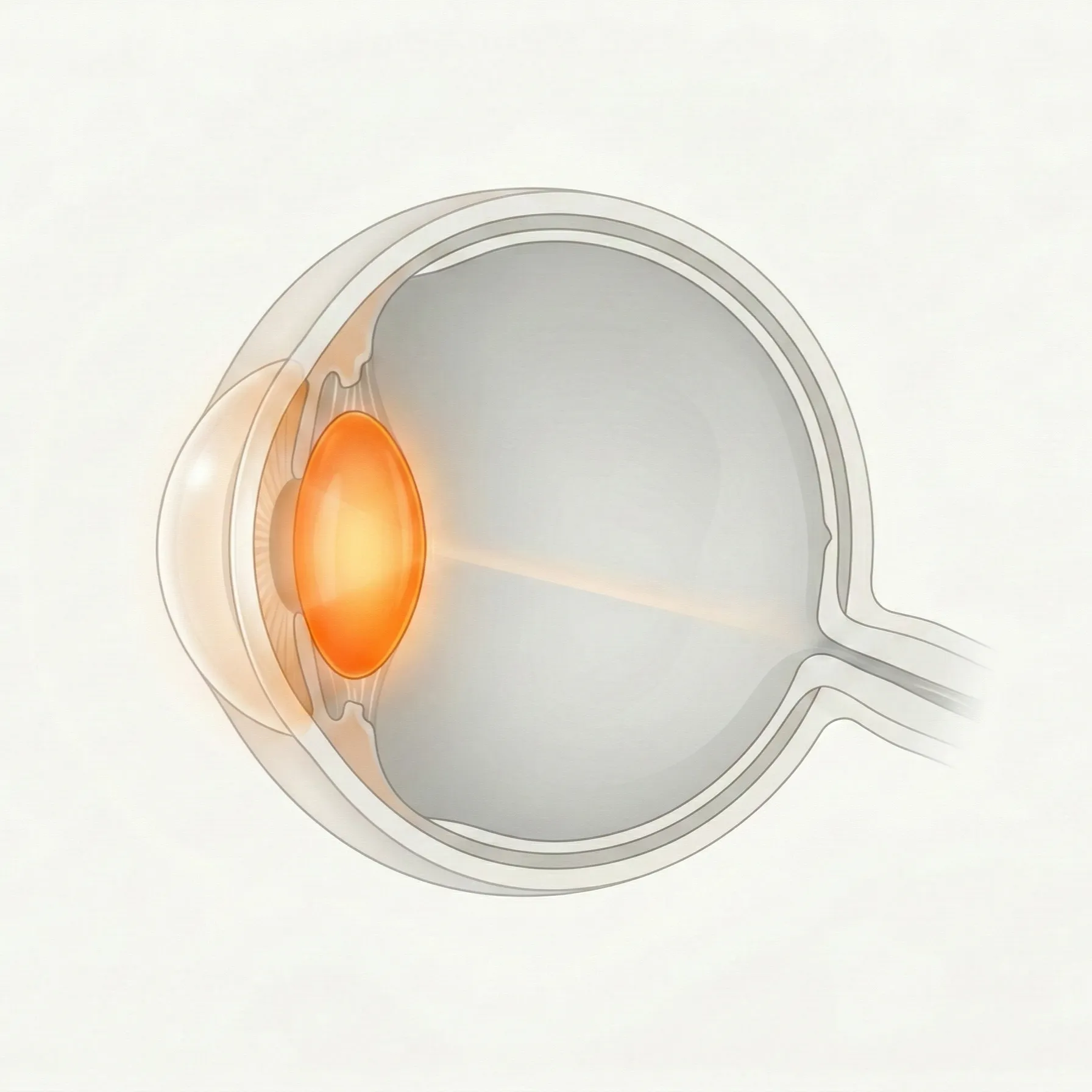
Cataract & Anterior Segment reference image

Cataract & Anterior Segment

The lens focuses light inside the eye and can become cloudy with age or other causes. The anterior segment includes the region from the cornea to the lens. This category covers cataract, lens position abnormalities, iris disease, and anterior chamber conditions.

35 English articles

Frequently referenced diseases

A

1 articles

B

1 articles

C

4 articles

F

1 articles

H

2 articles

I

6 articles
Intraocular Lens Dislocation

A complication after cataract surgery where the intraocular lens shifts from its normal position. Exfoliation syndrome and zonular weakness are major risk factors, causing decreased vision and increased intraocular pressure.

Intraocular Lens Opacification

A complication in which the optic part of an intraocular lens (IOL) becomes cloudy after cataract surgery. There are several mechanisms, including calcium deposition and glistening. If visual function is impaired, IOL removal and exchange is required.

Intraoperative Floppy Iris Syndrome (IFIS)

A syndrome characterized by iris flaccidity, prolapse, and progressive miosis that occurs during cataract surgery in patients with a history of taking α1-adrenergic receptor blockers (such as tamsulosin). Preoperative medication history review and appropriate intraoperative management are important.

IOL Power Calculation in Eyes with Corneal Ectasia

This article explains the challenges and solutions for IOL power calculation during cataract surgery in patients with corneal ectasia, such as keratoconus and post-refractive surgery ectasia. The use of corneal tomography and keratoconus-specific formulas is key.

Iris Coloboma

Iris coloboma is a congenital condition caused by incomplete closure of the embryonic fissure, resulting in a defect in the lower part of the iris. It is characterized by a keyhole-shaped pupil and may be associated with choroidal or optic nerve involvement. This article explains the classification, diagnosis, treatment, and genetic background.

Iris Repair (Iris Suture and Pupilloplasty)

Detailed explanation of indications, techniques (Siepser method, McCannel method, SFT method), and postoperative outcomes of iris suture (pupilloplasty) for congenital iris coloboma, trauma, and iris damage after cataract surgery. Also explains the criteria for choosing between iris repair and artificial iris devices.

L

2 articles

M

4 articles

P

8 articles
Persistent Pupillary Membrane

Persistent pupillary membrane (PPM) is a congenital anomaly resulting from the persistence of the anterior tunica vasculosa lentis. This article details its epidemiology, classification, clinical findings, diagnosis, and treatment (mydriatics, laser, surgery).

Phacodynamics

Fluid dynamics and physical principles of ultrasonic energy in phacoemulsification (PEA). Explains the parameters and mechanisms that surgeons should control for safe and efficient cataract surgery.

Phakic Posterior Chamber Lens (ICL)

Phakic posterior chamber lens (ICL) is a refractive surgery that corrects myopia and astigmatism by inserting a Collamer lens into the eye. It does not involve corneal ablation, is reversible, and can treat a wide range from moderate to high myopia.

Posterior Capsule Opacification

The most common postoperative complication after cataract surgery, caused by proliferation and migration of residual lens epithelial cells leading to opacification of the posterior capsule. It can be effectively treated with Nd:YAG laser posterior capsulotomy.

Postoperative Endophthalmitis

A review of postoperative endophthalmitis occurring after cataract surgery. It covers both acute-onset (within 1 week post-surgery) and delayed-onset (after 1 month, typically caused by Cutibacterium acnes) forms. Topics include epidemiology, causative organisms, clinical features, diagnosis, stepwise treatment, EVS recommendations, and prevention strategies.

Pupil Abnormalities (Summary of Miosis and Mydriasis)

A comprehensive review article covering the causes, differential diagnosis, and diagnosis of miosis (small pupil) and mydriasis, including management of small pupils during cataract surgery. It organizes the differential diagnosis and treatment of Horner syndrome, Adie pupil, oculomotor nerve palsy, IFIS, and others.

Pupil Expansion Devices and Mechanical Pupil Dilation

Explanation of techniques and devices for securing the pupil using iris retractors, pupil expansion rings, and mechanical stretching in cataract surgery for small pupils and intraoperative floppy iris syndrome (IFIS).

Pupillary Capture of Intraocular Lens (IOL Capture)

A complication after cataract surgery where the optic part of the intraocular lens prolapses in front of the iris. It is more likely to occur after sutured IOL or intrascleral fixation IOL, with an incidence of about 3.6% for scleral-sutured IOL. Characterized by glare and photophobia, and attention should be paid to recurrence due to reverse pupillary block.

S

2 articles

T

2 articles

U

1 articles

Z

1 articles