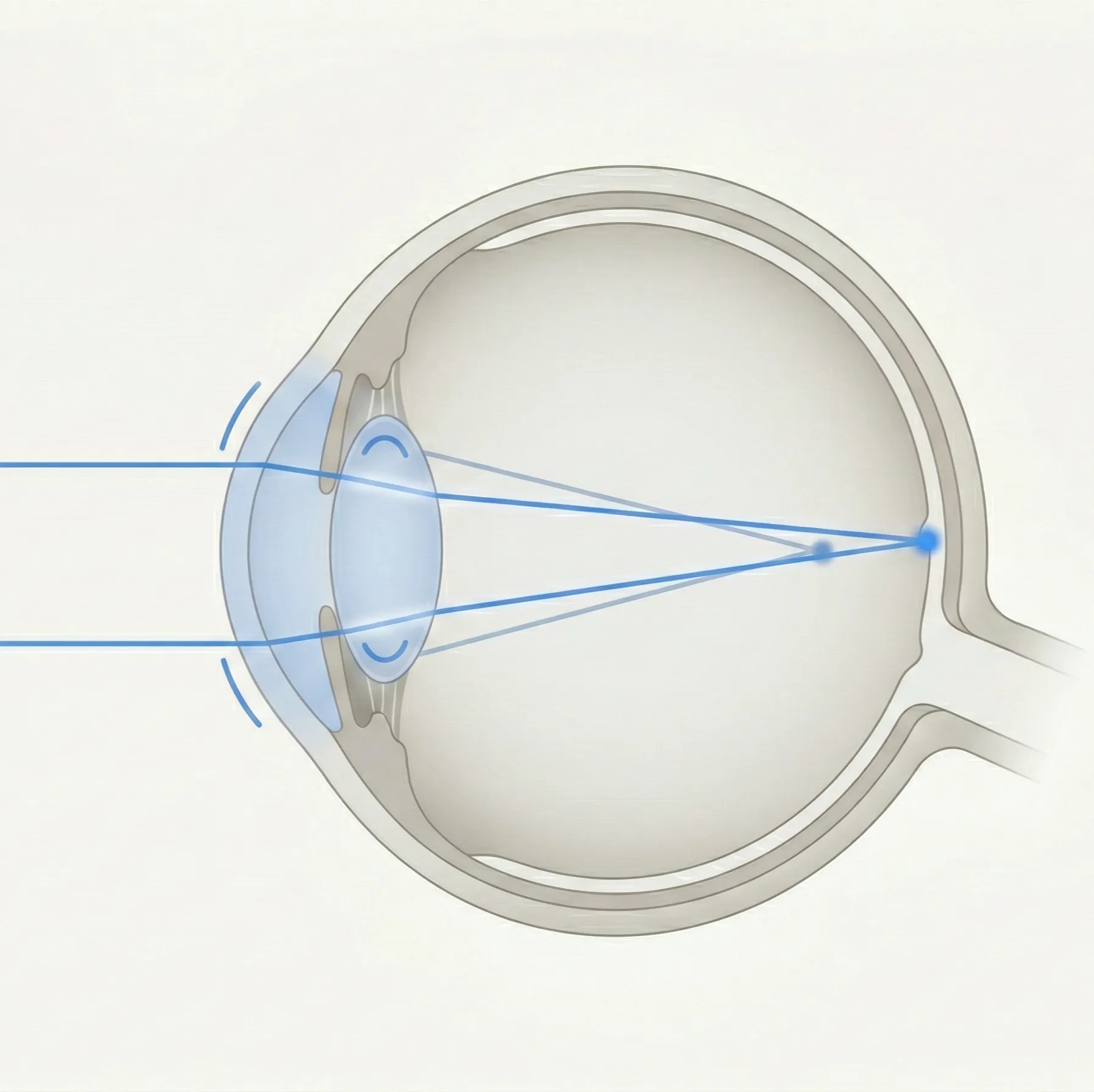
Refractive Correction reference image

Refractive Correction

Refractive error occurs when light entering the eye does not focus correctly on the retina. This category covers myopia, hyperopia, astigmatism, presbyopia, glasses, contact lenses, and refractive procedures.

27 English articles

Frequently referenced diseases

A B C D E F G H I J K L M N O P Q R S T U V W X Y Z #

A

6 articles
Accommodative Insufficiency

Convergence insufficiency (CI) is a binocular vision disorder in which the ability to turn both eyes inward for near vision is reduced, causing eye strain, double vision, and headache. Convergence training and prism glasses are the mainstays of treatment, but when accommodative dysfunction is also present, environmental improvements and appropriate spectacle prescription take priority.

Accommodative Insufficiency and Accommodative Weakness

Accommodative insufficiency is a condition in which accommodative power is lower than expected for age, while ill-sustained accommodation is a condition in which repeated measurements show recession of the near point. With the increase in VDT work, it is also increasing in young people, and environmental improvement and appropriate spectacle prescription are the basis of treatment.

Accommodative Spasm (Pseudomyopia)

Accommodative spasm (pseudomyopia) is a condition in which excessive tension of the ciliary muscle causes transient myopia. Prolonged VDT work or near work are the main triggers. Differential diagnosis by cycloplegic refraction and environmental improvement with appropriate spectacle prescription are the basis of treatment.

Aniseikonia

Aniseikonia is a condition where the size or shape of the retinal image differs between the two eyes. When it exceeds 5%, it can cause eye strain, and when it exceeds 7%, fusion becomes impossible. This article explains diagnostic methods and selection of correction methods.

Anisometropia (Difference in Refractive Power Between Eyes)

Anisometropia is a condition in which there is a difference in refractive power between the two eyes. This article covers early detection and treatment of anisometropic amblyopia, selection of correction methods (Knapp's law), and refractive surgery for anisometropia in adults.

Astigmatism (Regular and Irregular)

Astigmatism is a refractive error caused by differences in refractive power along the meridians of the cornea or lens. This article explains the classification into regular and irregular astigmatism, diagnostic methods, and correction with glasses, contact lenses, refractive surgery, and toric IOLs.

C

5 articles
Contact Lens Intolerance

Contact lens intolerance is a general term for a condition in which ocular surface disorders caused by contact lens wear become chronic, making continued lens wear difficult. Diagnosis is key by estimating the cause based on fluorescein staining patterns, and the mainstays of treatment are discontinuation of lens wear, improved lens care, and appropriate eye drop therapy.

Contact Lens Peripheral Ulcer (CLPU)

Contact lens peripheral ulcer (CLPU) is a non-infectious immune-inflammatory corneal infiltration that occurs in the peripheral cornea associated with contact lens wear. It is based on the host response to bacterial components such as Staphylococcus aureus. This article systematically explains the differentiation from microbial keratitis, discontinuation of contact lenses, use of antibiotic eye drops, and management with low-concentration steroids.

Contact Lens-Induced Acute Red Eye (CLARE)

Contact lens-induced acute red eye (CLARE) is a non-infectious inflammatory reaction characterized by acute onset of hyperemia, pain, and corneal infiltration during or after contact lens wear (especially overnight extended wear). The most important step is to differentiate it from infectious keratitis. Immediate discontinuation of contact lens use and steroid eye drops are the mainstays of treatment.

Contact Lens-Induced Dry Eye (CLIDE)

This article explains the definition, causes, diagnosis, and treatment of dry eye induced by contact lens (CL) wear (CLIDE). Based on the Dry Eye Clinical Practice Guidelines (Jpn J Ophthalmol 2019), TFOS DEWS III treatment algorithm, and TFOS Lifestyle report, it comprehensively describes tear film-oriented diagnosis (TFOD), tear film-oriented treatment (TFOT), CL material changes, and care improvements.

Corneal Warpage (Corneal Shape Change Due to Contact Lenses)

Corneal warpage is a change in corneal shape caused by mechanical compression and hypoxia due to long-term wear of contact lenses (especially hard CLs). It becomes an issue during screening before refractive surgery, and confirming shape stability after discontinuing CL use is key to evaluating surgical eligibility. Differentiation from intentional warpage due to orthokeratology is also important.

D

1 articles

H

2 articles

I

1 articles

L

2 articles

M

4 articles
Monovision (Correction of Interocular Difference with Contact Lenses or Surgery)

Monovision is a method to compensate for presbyopia by correcting one eye for distance and the other for near vision. This article details its application with contact lenses, LASIK, and cataract IOLs, dominant eye setting, effects on stereopsis, and the trial wear procedure.

Multifocal Contact Lenses (Bifocal/Progressive)

Multifocal (bifocal/progressive) contact lenses are contact lenses designed primarily for presbyopia correction, integrating multiple focal points for distance and near vision into a single lens. This article explains the differences in design (concentric, EDOF, HCL), actual prescription procedures, selection of candidates, and management of complications.

Myopia (Summary of Simple Myopia, High Myopia, and Pathological Myopia)

Myopia is a refractive error in which the refractive power is excessive relative to the axial length, resulting in decreased distance vision. This article provides a comprehensive explanation from simple myopia to pathological myopia, including the latest evidence for myopia progression control treatment including low-concentration atropine eye drops (Rijusea® Mini 0.025%).

Myopia Progression Control with Orthokeratology

Orthokeratology (OK) is a treatment that uses specially designed hard contact lenses worn overnight to reshape the cornea, restoring uncorrected visual acuity and slowing myopia progression in children. This article explains indications, prescribing procedures, safety management, and combination with low-concentration atropine.

P

3 articles

R

1 articles

S

2 articles