Multifocal contact lenses (MFCLs) are a general term for contact lenses that integrate different focal distances, such as distance and near, into a single lens. Their main use is for correcting presbyopia (age-related decline in accommodative ability), but they are also used for myopia control (mainly in children and young adults).
Presbyopia is often perceived as difficulty with near vision from middle age onward, and when contact lens users transition to presbyopia, bifocal/multifocal CLs become an option.
The visual acuity, contrast, stereopsis, subjective visual quality, and preference of multifocal CLs vary depending on the design and comparator. In trials comparing a single multifocal SCL product with monovision, monovision showed better distance and near visual acuity and contrast in some aspects, while subjective evaluations were generally similar, with no significant difference in preference 3).
Multifocal contact lenses for myopia management have a different design philosophy from those for presbyopia; they intentionally create myopic defocus on the peripheral retina to suppress axial elongation. The global myopic population is projected to reach 4.9 billion by 205015), increasing the public health importance of myopia progression control.
The following products and designs are being studied for multifocal contact lenses aimed at suppressing myopia progression.
Dual-focus design (e.g., MiSight 1 day): central distance correction zone + concentric plus addition zone (+2.00D)
EDOF (extended depth of focus) design (e.g., MYLO): controls peripheral defocus by broadening the depth of focus
Power gradient design: power gradually changes from the center to the periphery
Multifocal design (multi-zone type): has three or more focal zones
QHow are multifocal contact lenses different from regular single-vision contact lenses?
A
Multiple focal distances from distance to near are incorporated into a single lens, designed to allow those who have difficulty seeing near without glasses due to presbyopia to cover both distance and near vision in a state close to naked eye. However, compared to single-vision lenses, image sharpness is somewhat inferior, and contrast sensitivity in low-light conditions is reduced.
The main clinical findings to be checked when prescribing multifocal contact lenses are as follows.
QWill wearing multifocal contact lenses worsen my night vision?
A
Due to the optical properties of multifocal designs, contrast sensitivity tends to decrease in low-light conditions compared to single-vision lenses. This may cause inconvenience in situations requiring fine vision in dim light, such as nighttime driving. If you drive frequently at night, we recommend consulting your doctor before prescription and preparing backup glasses as needed.
Clinical trials have mainly studied myopic children under 18 years of age. Actual indication is determined by confirming the product’s approval conditions, myopia progression, and the management ability of the individual and their guardians. 4)
In presbyopia, accommodative amplitude decreases with age. The correction amount is not fixed solely by age but is determined by evaluating residual accommodation, working distance, and required visual acuity. Classically, the add power is estimated on the principle of supplementing the remaining demand after leaving about half of the residual accommodation as a reserve from the demand at the primary working distance (e.g., at 40 cm there is a demand of 2.50 D, and if objective accommodation is 1.00 D, approximately +2.00 D is needed). In practice, adjust according to the product’s fitting guide based on binocular vision and satisfaction in daily life.
Before determining the prescription, have the patient try multifocal contact lenses and confirm how they see in actual daily life. Evaluation in situations that match the patient’s lifestyle, such as desk work, reading, driving, and smartphone operation, is important. The focus of evaluation is not on visual acuity numbers but on “whether the patient can comfortably see what they want to see.”
QIf a patient has dry eye before surgery, can they still use multifocal contact lenses?
A
Dry eye can cause unstable wearing comfort and vision, and may lead to corneal epithelial damage. After evaluating and treating the ocular surface condition, perform a trial fitting and assess symptoms, corneal findings, and wearing time to determine suitability. Do not assume that the lens material alone will improve the condition; consider lens exchange or switching to glasses as well.
The designs of multifocal SCLs are broadly classified into concentric ring type and EDOF type. Since different designs result in slightly different visual experiences, select the CL type that best matches the patient’s needs: a type that provides stable distance vision, stable intermediate vision, or stable near vision.
Principles of prescribing procedure:
Prescription of multifocal SCLs should be performed after clarifying the goals of presbyopia correction.
Select the distance power and add power according to the fitting guide for each product
Check lens position and movement, and binocular vision at distance, intermediate, and near
Evaluate at the patient’s primary viewing distances, such as PC, smartphone, reading, and car driving
Compare options such as multifocal, monovision, and glasses combination based on visual performance and lifestyle preferences3)7)
After the trial, confirm patient satisfaction and discomfort, and adjust power or design if necessary
Night driving check: Multifocal designs may cause issues with contrast and halos. If adequate vision is not obtained at night, avoid driving and use driving glasses as needed.7)
Precautions for prescribing multifocal SCLs for myopia control:
When prescribing CLs to children, confirm that the parents have an appropriate management system in place.
Regularly measure refractive error and axial length according to the treatment plan to evaluate efficacy4). The International Myopia Institute (IMI) clinical management guidelines recommend follow-up visits at least every 6 months for patients undergoing myopia management treatment to evaluate safety and efficacy.
If the effect is insufficient, consider other myopia management methods based on approval status and individual risks10).
Myopia management CLs such as MiSight have a completely different purpose from presbyopia-correcting multifocal SCLs; this must be clearly stated on the prescription.
Prescription of Multifocal HCLs (Hard Contact Lenses)
Multifocal RGP/HCLs include both simultaneous vision and alternating vision types. Simultaneous vision types have multiple designs such as center-distance and center-near, while alternating vision types are designed so that the lens moves during downward gaze to use the near portion7).
Guidance on gaze usage:
In alternating vision RGP/HCLs, during downward gaze the lens moves upward, bringing the near portion in front of the pupil. This explanation is unique to alternating vision types and does not apply to simultaneous vision RGP/HCLs7).
Simultaneous Vision Type (SCL, RGP/HCL, etc.)
Design: Concentric ring type, EDOF type, etc. Light from both distance and near reaches the retina simultaneously.
Features: Can be designed regardless of material; multiple designs exist such as center-distance, center-near, concentric, and aspheric.
Points to note: Since light from multiple foci reaches the retina simultaneously, contrast and visual quality may vary depending on design and pupil diameter.
Prescription tips: Set the dominant eye for distance. Start with a low addition power.
Alternating Vision Type (mainly RGP/HCL)
Design: The lens moves during downward gaze, positioning the near portion in front of the pupil.
Features: Switches between distance and near viewing areas depending on the direction of gaze.
Disadvantages: Requires adaptation to wearing. Posture and gaze guidance are important.
Prescription tips: When looking downward, the HCL moves upward, allowing use of the near portion.
Do not reuse daily disposable lenses; for reusable lenses, perform rubbing, rinsing, and disinfection as specified by the product. Neglecting care can lead to serious eye disorders such as infectious keratitis. Clean and dry the lens case after use, and for soft lenses, replace it with a new one every 1.5 to 3 months as a general guideline. 16)
Care for daily disposable lenses (e.g., MiSight): Since they are discarded daily, no lens case or disinfection steps are needed, reducing the care burden. However, the risk of microbial keratitis remains, and it cannot be concluded that the overall incidence is lower than with planned replacement lenses 17). Hand washing before insertion/removal, single use, and adherence to wearing time are necessary.
Care for planned replacement lenses:
Perform daily rubbing with a multipurpose contact lens care solution.
Clean and dry the lens case daily, and replace it regularly.
Discard promptly if discoloration, deformation, or noticeable scratches appear.
Do not use tap water or well water for rinsing lenses or cases 16).
Regular check-ups:
All contact lens wearers, regardless of whether they use multifocal CLs, need regular eye examinations. The examination interval should be set according to age, ocular surface, lens type, and myopia management plan; for myopia management, refractive values and axial length should also be evaluated. 4)16)
QHow is the addition power determined for multifocal contact lenses?
A
The residual accommodation, working distance, and priority of distance, intermediate, and near vision are assessed, and trial fitting is performed according to the fitting guide for each product. The addition power is not determined solely by the numerical value; adjustments are made while checking binocular vision and satisfaction in daily life.
Selection of Addition Power for Myopia Control Contact Lenses
In multifocal contact lenses for myopia management, the selection of addition power (+ADD) affects the treatment effect. Key clinical data are summarized below.
Addition Power
Representative Product
Key Study
Axial Length Suppression Effect
+2.00D
MiSight 1 day
Chamberlain 20195)
52% (3 years)
+2.50D
BLINK study CL
BLINK RCT18)
36% less axial elongation than the single-vision group (3 years)
+1.50 D
BLINK study CL
BLINK RCT18)
Suppression effect was smaller than the high addition group
In the specific product used in the BLINK study, the +2.50 D group suppressed myopia progression more than the +1.50 D group and the single-vision group18). However, there was no significant difference in low-contrast distance visual acuity between the high and moderate addition groups, and a general dose-response relationship between addition power and visual quality has not been established. Decisions should be made based on product design, visual performance, age, and lifestyle4,18). Bullimore et al. (2021) comprehensively reviewed the benefits of myopia management interventions and risks such as infectious keratitis8).
Selection criteria for various optical therapies in myopia management
In the systematic review by Yam et al. (2025), soft myopia management contact lenses are considered an alternative when orthokeratology is not indicated or unsuccessful, or for patients who do not wish to wear glasses10). In actual selection, the approval conditions for each product, the range of power and astigmatism, and the ability to handle insertion/removal and hygiene should be confirmed.
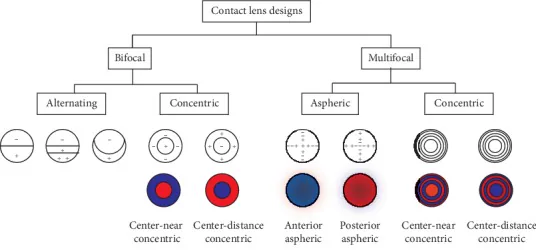
Diagram illustrating the main design variations of concentric multifocal contact lenses (red: near zone, blue: distance zone). Corresponds to the optical characteristics of simultaneous vision designs discussed in section “6. Pathophysiology and detailed mechanisms”.
Optical mechanisms of simultaneous vision and alternating vision types
Simultaneous vision type (SCL, RGP/HCL, etc.): Both distance and near light reach the retina simultaneously. The brain applies neural suppression and selects the primary focus according to viewing distance. Contrast and visual quality vary with pupil diameter and lens design7).
Alternating vision type (mainly RGP/HCL): When the gaze is directed downward, the lens moves upward, bringing the near portion in front of the pupil. Since RGP/HCL also have simultaneous vision types, the material alone does not determine whether it is an alternating vision type7).
Concentric SCL: The distance and near portions each have a weak progressive power design, with a steep progressive power connecting them (design a), or a design where the power progresses from distance to near (design b). There are two types: center-distance and center-near.
EDOF type (extended depth of focus type): Concentric progressive power lenses are arranged aperiodically with varying powers, designed to extend the depth of focus. There is no concept of central distance or near zones, and stable vision is obtained from distance to intermediate distances.
Presbyopia is a condition in which near accommodation becomes difficult, primarily due to hardening and loss of elasticity of the crystalline lens and age-related changes in the accommodative system. Reports indicate that the contractile function of the ciliary muscle is relatively preserved even in older adults, suggesting that the mechanism cannot be explained solely by simple muscle weakness 19). Multifocal CLs optically compensate for the loss of accommodation and do not treat the crystalline lens itself.
On the other hand, multifocal SCLs for myopia progression control (peripheral myopic defocus design) have a completely different optical design from those for presbyopia correction. The central part provides distance correction, and concentric treatment zones have a positive addition power (+2.00 to +2.50 D), creating myopic defocus on the peripheral retina to suppress axial elongation. This design principle is based on the same “peripheral retinal myopic defocus hypothesis” as orthokeratology and DIMS spectacles. A comprehensive review by Remón et al. (2020) details the diversity of designs and their impact on clinical outcomes for bifocal and multifocal CLs in presbyopia and myopia control 7).
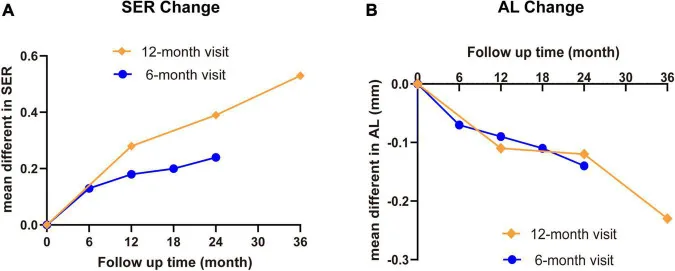
Chen M, et al. Myopia Control With Multifocal Lens in School-Aged Children: A Meta-Analysis. Front Pediatr. 2022;10:889243. Figure 7. PMCID: PMC9251339. License: CC BY 4.0. License URL: https://creativecommons.org/licenses/by/4.0/.
Meta-analysis summary diagram summarizing changes in spherical equivalent refraction and axial length in school-age children with multifocal lenses (including multifocal contact lenses and multifocal spectacles) compared to single-vision lenses. This corresponds to the studies on myopia management using multifocal optics discussed in section “7. Latest Research and Future Perspectives.”
Multifocal soft CLs for myopia progression control, with a design different from presbyopic distance-near SCLs, have been developed and studied. A mechanism has been proposed in which a central distance and peripheral near design reduces hyperopic defocus in the peripheral retina, thereby suppressing myopia progression.
In the AAO Ophthalmic Technology Assessment (Cavuoto 2025), a review of 12 studies (11 Level I and 1 Level II) was conducted4). SE change was −0.22 to −0.81 D in the treatment group (control −0.50 to −1.45 D), and axial elongation was 0.05 to 0.39 mm in the treatment group (control 0.17 to 0.67 mm), with statistically significant differences confirmed in 11–12 trials. No serious adverse events were reported4). Bullimore et al. (2021) examined the risks and benefits of myopia management overall, comparing the benefits of multifocal CLs with risks such as infectious keratitis8). A meta-analysis by Haarman et al. (2020) showed that the risk of myopia-related complications increases with higher myopic refractive error9). The global myopia population is projected to reach 4.9 billion by 205015), highlighting the growing public health importance of myopia progression control.
In the 3-year double-masked RCT of MiSight 1 day (dual-focus design) (Chamberlain 2019), significant suppression was shown: refraction −0.51 D (control −1.24 D, p<0.0001) and axial elongation 0.30 mm (control 0.62 mm, p<0.0001)5).
In the Cochrane systematic review by Walline et al. (2020), it was evaluated that bifocal SCLs may have a small benefit in suppressing axial elongation, but the certainty of evidence at that time was low1). This should be interpreted separately from the subsequent AAO assessment4) in terms of included studies and evaluation timing.
In the RCT using dual-focus CLs by Aller et al. (2016), significant myopia progression control was shown over 1 year: SE change −0.22 D (control −0.79 D, p<0.001) and axial elongation 0.05 mm (control 0.24 mm, p<0.001)6). A systematic review by Yam et al. (2025) also confirmed the role of multifocal CLs in myopia progression control10).
The myopia management spectacle lens guidelines (1st edition, 2025) cover segmented spectacle lenses and are not a prescribing guide for multifocal CLs. 11) The low-concentration atropine guide also targets eye drop treatment and does not establish evidence for combination effects with multifocal CLs. 12)Orthokeratology has separate efficacy data 13), and combination trials with low-concentration atropine have been reported 14), but superiority or combinability with multifocal CLs must be judged based on direct comparative evidence and approved conditions for each treatment. Global surveys report regional differences in the choice of myopia management methods; confirm domestically approved products and clinical guidelines. 2)
Bifocal/multifocal CLs include several designs such as center-distance, center-near, concentric, and EDOF. Remón et al. (2020) comprehensively reviewed the design and optical characteristics of bifocal and multifocal CLs for presbyopia and myopia control, showing that visual performance and clinical outcomes vary by design. 7)
Walline JJ, Lindsley KB, Vedula SS, et al. Interventions to slow progression of myopia in children. Cochrane Database Syst Rev. 2020;1(1):CD004916. doi:10.1002/14651858.cd004916.pub4. PMID:31930781; PMCID:PMC6984636.
Wolffsohn JS, Calossi A, Cho P, et al. Global trends in myopia management attitudes and strategies in clinical practice - 2019 Update. Cont Lens Anterior Eye. 2020;43(1):9-17. doi:10.1016/j.clae.2019.11.002. PMID:31761738.
Woods J, Woods C, Fonn D. Visual Performance of a Multifocal Contact Lens versus Monovision in Established Presbyopes. Optometry and vision science : official publication of the American Academy of Optometry. 2015;92(2):175-82. doi:10.1097/OPX.0000000000000476. PMID:25525891.
Cavuoto KM, Trivedi RH, Prakalapakorn SG, Oatts JT, Nallasamy S, Morrison DG, Pineles SL, Chang MY. Multifocal Soft Contact Lenses for the Treatment of Myopia Progression in Children: A Report by the American Academy of Ophthalmology. Ophthalmology. 2025;132(4):495-503. doi:10.1016/j.ophtha.2024.09.031. PMID:39503665; PMCID:PMC11930616.
Chamberlain P, Peixoto-de-Matos SC, Logan NS, Ngo C, Jones D, Young G. A 3-year Randomized Clinical Trial of MiSight Lenses for Myopia Control. Optometry and vision science : official publication of the American Academy of Optometry. 2019;96(8):556-567. doi:10.1097/OPX.0000000000001410. PMID:31343513.
Aller TA, Liu M, Wildsoet CF. Myopia Control with Bifocal Contact Lenses: A Randomized Clinical Trial. Optometry and vision science : official publication of the American Academy of Optometry. 2016;93(4):344-52. doi:10.1097/OPX.0000000000000808. PMID:26784710.
Remón L, Pérez-Merino P, Macedo-de-Araújo RJ, Amorim-de-Sousa AI, González-Méijome JM. Bifocal and Multifocal Contact Lenses for Presbyopia and Myopia Control. Journal of ophthalmology. 2020;2020:8067657. doi:10.1155/2020/8067657. PMID:32318285; PMCID:PMC7152962.
Bullimore MA, Ritchey ER, Shah S, Leveziel N, Bourne RRA, Flitcroft DI. The Risks and Benefits of Myopia Control. Ophthalmology. 2021;128(11):1561-1579. doi:10.1016/j.ophtha.2021.04.032. PMID:33961969.
Haarman AEG, Enthoven CA, Tideman JWL, et al. The Complications of Myopia: A Review and Meta-Analysis. Invest Ophthalmol Vis Sci. 2020;61(4):49. doi:10.1167/iovs.61.4.49. PMID:32347918; PMCID:PMC7401976.
Yam JC, Zhang XJ, Zaabaar E, Wang Y, Gao Y, Zhang Y, et al. Interventions to reduce incidence and progression of myopia in children and adults. Progress in retinal and eye research. 2025;109:101410. doi:10.1016/j.preteyeres.2025.101410. PMID:41109517.
Si JK, Tang K, Bi HS, et al. Orthokeratology for myopia control: a meta-analysis. Optom Vis Sci. 2015;92:252-257. doi:10.1097/OPX.0000000000000505. PMID:25599338.
Kinoshita N, Konno Y, Hamada N, et al. Efficacy of combined orthokeratology and 0.01% atropine solution for slowing axial elongation in children with myopia: a 2-year randomised trial. Sci Rep. 2020;10:12750. doi:10.1038/s41598-020-69710-8. PMID:32728111; PMCID:PMC7391648.
Holden BA, Fricke TR, Wilson DA, et al. Global prevalence of myopia and high myopia and temporal trends from 2000 through 2050. Ophthalmology. 2016;123:1036-1042. doi:10.1016/j.ophtha.2016.01.006. PMID:26875007.
Stapleton F, Naduvilath T, Keay L, Radford C, Dart J, Edwards K, et al. Risk factors and causative organisms in microbial keratitis in daily disposable contact lens wear. PLoS One. 2017;12(8):e0181343. doi:10.1371/journal.pone.0181343. PMID:28813424; PMCID:PMC5558933.
Walline JJ, Walker MK, Mutti DO, Jones-Jordan LA, Sinnott LT, Giannoni AG, et al. Effect of High Add Power, Medium Add Power, or Single-Vision Contact Lenses on Myopia Progression in Children: The BLINK Randomized Clinical Trial. JAMA. 2020;324(6):571-580. doi:10.1001/jama.2020.10834. PMID:32780139; PMCID:PMC7420158.
Tabernero J, Chirre E, Hervella L, Prieto P, Artal P. The accommodative ciliary muscle function is preserved in older humans. Sci Rep. 2016;6:25551. doi:10.1038/srep25551.
Copy the article text and paste it into your preferred AI assistant.
Article copied to clipboard
Open an AI assistant below and paste the copied text into the chat box.