A ruptured globe is an open-globe injury in which the eye wall is torn due to a sudden increase in intraocular pressure from blunt external force, leading to prolapse or incarceration of intraocular contents. Typical mechanisms include blunt trauma from a fist or ball, and it is one of the ophthalmic emergencies that significantly impairs visual function.
The site and extent of injury vary greatly from case to case, and details of examination, surgery, and infection prevention also differ between institutions. In accordance with the basic principles of protecting the globe and closing the wound early, this article introduces the main clinical considerations and options. Individual procedures are not intended to be applied to all cases using the same steps4, 5).
Open-globe injuries are broadly classified into lacerations, in which the eyewall is directly damaged, and ruptures caused by blunt external force. Lacerations include penetrating injuries with only an entry wound and perforating injuries with both entry and exit wounds; an intraocular foreign body may also remain4). In addition to the mechanism of injury and the mechanism of wound formation, the injury site and presence or absence of a foreign body are relevant to treatment planning.
The BETT (Birmingham Eye Trauma Terminology) is widely used for classifying ruptured globes.
Classification
Mechanism of Injury
Formation of Open Wound
Laceration
Direct injury from a sharp object or similar
The object directly damages the eyewall from outside and forms an open wound
Ruptured globe
Blunt external force (e.g., fist, ball)
Indirect rupture at the thinnest part of the eye wall due to increased intraocular pressure
In a ruptured globe, increased intraocular pressure and shock waves create a scleral open wound parallel to the limbus. It is characterized by the absence of surface wounds on the cornea or conjunctiva, and it may be overlooked.
Zone Classification (International Ocular Trauma Classification)
The estimated incidence of open-globe injuries is 3.5 to 4.5 per 100,000 population5). Severe ocular trauma in children occurs at a rate of 11.8 per 100,000 children per year, and children (mostly under 12 years old) account for more than 35% of severe ocular trauma. Common causes include sports, toys, falls, and violence.
QWhat is the difference between globe rupture and penetrating injury?
A
Globe rupture is an indirect break of the eyewall due to increased intraocular pressure from blunt trauma such as a fist or ball. Penetrating injury is a direct perforation of the eyewall by a sharp object such as a knife or nail. In the former, the open wound may be hidden under the conjunctiva and easily missed, making diagnosis difficult.
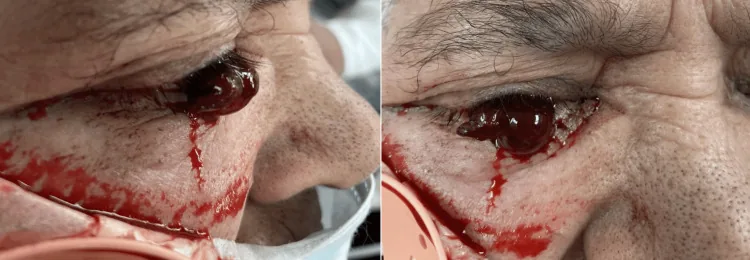
Guilherme S, et al. Globe Rupture – A Case Report and Review of Emergency Department Diagnosis and Management. Cureus. 2022. Figure 1. PMCID: PMC9637430. License: CC BY 3.0 (https://creativecommons.org/licenses/by/3.0/).
In the right eye of an elderly patient, dark red uveal tissue protruding from the corneal limbus and extensive periorbital hemorrhage are seen. This corresponds to ocular content prolapse and uveal prolapse discussed in the section “2. Main symptoms and clinical findings”.
Clinical findings of globe rupture are diverse. Acute vision loss and eye pain after trauma are common chief complaints, but findings vary greatly depending on the severity and location of the injury.
Typical findings of globe rupture
Severe conjunctival hemorrhage and edema: One of the most important findings suggesting globe rupture.
Marked hypotony: An important clue suggesting aqueous humor leakage or ocular content prolapse due to eyewall rupture. It is diagnostically significant even in cases where the wound is difficult to see externally. Whether to measure it should be determined in light of the risk of additional injury, as described below in “Significance of hypotony and intraocular pressure measurement.”
Ocular collapse and extrusion of intraocular contents: Severe cases with prolapse of the uvea, vitreous, and lens.
Subjective symptoms typically include sudden vision loss and severe eye pain immediately after trauma. In severe cases with extrusion of intraocular contents, vision often becomes light perception or worse.
Clinical features: It is often difficult to fully assess the injury through outpatient examination alone. Especially in blunt trauma, even if no external wound is apparent, the presence of extreme hypotony, severe conjunctival hemorrhage, edema, hyphema, or vitreous hemorrhage should strongly raise suspicion for open globe injury.
Specific signs of globe rupture include pupillary distortion and deformation (D-shaped pupil due to iris prolapse).
QCan globe rupture be missed?
A
Yes. In blunt trauma, the open wound may be hidden under the conjunctiva, making its location and size unclear. It may be covered by severe conjunctival hemorrhage and edema, and only present with hyphema and hypotony, leading to missed diagnosis. Significant hypotony after trauma is an important clue to suspect open globe injury and should be evaluated together with other examination findings and imaging studies when necessary.
Globe rupture is caused by blunt trauma. Understanding the mechanism of injury and risk factors is important for developing preventive measures.
Causes of blunt trauma:
Sports-related: Boxing (fist), baseball/softball (ball), tennis/squash (ball/racket), martial arts
Traffic accidents: Impact to the face from airbag deployment, collision with dashboard/steering wheel
Falls: Especially in the elderly
Explosive trauma: In the Beirut port explosion (2020), 48 eyes of 39 patients were analyzed, and 10 eyes (20.8%) were diagnosed with open globe injury. Surgical intervention was required in 53.8% 2)
Children: Accidents with toys (especially those with sharp points), playground equipment, collisions with peers
Risk factors:
Conditions that cause thinning and weakening of the sclera make the eyeball prone to rupture even with relatively minor trauma.
High myopia: Scleral thinning due to axial elongation
Aging: Scleral weakening
History of eye surgery: Cataract surgery wounds, corneal transplant wounds, and glaucoma surgery wounds are relatively fragile and may rupture with minor blunt trauma
Explosive trauma involves a combination of primary injury (pressure wave from blast), secondary injury (fragments and debris), and tertiary injury (body displacement by blast wind), often accompanied by open globe injury, optic nerve damage, and orbital fractures 2).
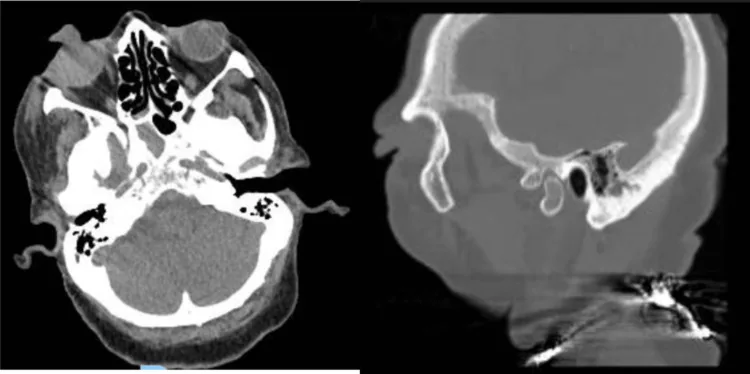
Guilherme S, et al. Globe Rupture – A Case Report and Review of Emergency Department Diagnosis and Management. Cureus. 2022. Figure 2. PMCID: PMC9637430. License: CC BY 3.0 (https://creativecommons.org/licenses/by/3.0/).
The axial (left) and sagittal (right) views show uveal tissue protruding anteriorly from the right globe. This corresponds to the CT evaluation of globe rupture discussed in section “4. Diagnosis and Examination Methods.”
Globe rupture is diagnosed comprehensively based on the mechanism of injury, visual acuity, and anterior segment findings. When the full extent of the injury is difficult to assess through outpatient examination, imaging studies serve as an adjunct. When an obvious open wound or extrusion of intraocular contents is present, preparation for repair should not be delayed to perform additional examinations 4).
Assessment of intraocular pressure: Hypotony is an important diagnostic finding. Assess the need for measurement and the risk of additional injury, and avoid additional procedures to obtain an intraocular pressure value in eyes with an obvious open wound
Care during eyelid opening: Avoid pressing on the globe or forcibly opening the eyelids; assess only within the range that can be observed without applying pressure
Slit-lamp examination: Perform if possible. Check for hyphema, iris prolapse, and lens dislocation.
Significance of Hypotony and Intraocular Pressure Measurement
The diagnostic value of hypotony is high, and it should be emphasized as a clue to suspect globe rupture. In particular, when a wound is hidden beneath the conjunctiva, a combination of findings including hypotony, rather than external findings alone, helps guide the assessment.
On the other hand, in an unclosed open wound, pressure during measurement or deformation of the wound may promote extrusion of intraocular contents. Therefore, the review describes avoiding intraocular pressure measurement in principle during the initial management when open globe injury is suspected 4). Finger palpation also involves pressure and cannot be uniformly recommended as a safe alternative.
Usually avoided with an unclosed open wound. Take care to avoid additional injury from pressure on the globe
CT is excellent for confirming metallic foreign bodies and assessing ocular morphology, and is the first choice when imaging is needed. However, its sensitivity is limited, and globe rupture cannot be excluded even when CT shows no obvious abnormality. MRI may be considered in cases involving non-metallic foreign bodies, but should not be performed when a metallic foreign body is suspected 4).
Prognosis Prediction Using the Ocular Trauma Score (OTS)
OTS is used for prognostic prediction at the initial presentation of open globe injuries. It is calculated using initial visual acuity together with the presence or absence of globe rupture, endophthalmitis, perforating trauma (injury with an entry wound and an exit wound), retinal detachment, and RAPD. Zone classification is related to prognosis but is not included among the OTS calculation items 4). The score serves as a reference for explaining visual prognosis at the population level and does not alone determine the recovery potential or treatment plan for an individual eye.
Hyphema only, integrity of the eyewall is preserved
QWhat is the most important test for diagnosing a ruptured globe?
A
It is important to integrate the mechanism of injury with examination findings such as vision loss, hypotony, hyphema, subconjunctival hemorrhage, and extrusion of intraocular contents. CT is the first-choice imaging study, but a negative result cannot rule out rupture. Select examinations by considering the burden on the globe and the diagnostic need, and do not perform MRI when a metallic foreign body is suspected 4).
Treatment is based on protecting the globe while evaluating the patient’s systemic condition and closing the wound as early as possible. Subsequent recovery of visual function is also greatly influenced by the injury sustained at the time of trauma. There are multiple options for antibiotic administration, anesthesia, and the timing of vitreous surgery, and a detailed protocol common to all cases has not been established 4, 5).
Until surgery, the following measures are combined according to the patient’s condition.
Rigid protective shield placement: Protects the globe without touching it and prevents additional injury. Avoid a pressure eye patch.
Analgesic administration: Intravenous or oral (e.g., acetaminophen). Reduces intraocular pressure elevation due to pain.
Antiemetic administration: Used according to the presence of nausea or vomiting and the patient’s systemic condition to suppress intraocular pressure elevation due to vomiting.
Infection prevention: Systemic antibiotics are widely used, but the drug, route of administration, and duration vary by institution and case. The use of topical eye drops in combination also varies by institution 5)
Tetanus prevention: Confirm wound contamination and vaccination history, and select the necessary preventive measures.
NPO (nothing by mouth): Start promptly in preparation for general anesthesia.
Main option
Example of use
Purpose and considerations when selecting
Systemic antibiotics
Intravenous or oral
Prevention of endophthalmitis. Consider contamination, allergies, systemic condition, and other factors
Antiemetics
Intravenous, etc.
Management of nausea and vomiting
Analgesics
Intravenous or oral
Pain management. Also consider the planned anesthesia and systemic condition
Gas or silicone oil
Intraocular filling during vitreous surgery
Tamponade according to retinal status and other factors
In primary surgery, the aim is to close the wound and preserve the shape of the globe in order to prevent infection and further extrusion of ocular contents. The following are general principles, and techniques are adjusted according to the shape of the wound and the condition of the tissues4).
Primary surgery (wound closure)
Anesthesia selection: General anesthesia is generally selected, but local or regional anesthesia may also be considered in selected cases, such as small wounds limited to the anterior segment. The decision is made in consultation with the anesthesiologist, taking into account the risk of pressure on the globe and the patient’s systemic condition4).
Suture materials: 10-0 nylon for corneal wounds and 8-0 or 7-0 nylon for scleral wounds are examples of choices. The type and thickness of the suture should not be fixed uniformly; they are selected according to the wound location, tissue thickness and fragility, and the materials used at the facility. The aim is to close the wound while minimizing stress on the tissues4).
Management of prolapsed tissue: Viable iris and uveal tissue should be preserved and repositioned as far as possible. Prolapsed or incarcerated vitreous is managed according to the type and condition of the tissue, such as by using a vitreous cutter while avoiding traction4).
Wound exploration: If the wound is unclear, incise the conjunctiva and systematically explore near the extraocular muscle insertions, the thinnest part of the sclera.
Complicated cataract and lens injury: Consider lens removal according to findings such as rupture of the lens capsule or leakage of lens material. Whether this is performed at the time of wound closure or as an additional surgery depends on the injury and the condition of the surgical field4).
Second Surgery (Vitrectomy)
Indications and timing: Consider it according to findings such as retinal detachment, intraocular foreign body, and vitreous hemorrhage. It may be performed concurrently with wound closure or as a separate procedure at a later date; the conditions for intraocular observation, infection risk, and the availability of surgeons and equipment are taken into account4, 5).
Procedure: Removal of opaque vitreous gel and incarcerated vitreous gel via 3-port vitrectomy.
Tamponade: Intraocular filling with gas or silicone oil is selected according to the condition of the retina and other factors.
Lensectomy: Add lensectomy for concurrent cataract or lens subluxation.
A systematic review including 15 studies and 8,497 eyes mainly involved cases of penetrating trauma and intraocular foreign bodies. Among 6,469 eyes analyzed for endophthalmitis, endophthalmitis was less common in the repair-within-24-hours group (11% vs 28%; odds ratio [OR] 0.39, 95% confidence interval [CI] 0.19–0.79, P=0.01)1). These percentages are aggregate values from the included studies and cannot be directly applied as the infection rate for individual globe rupture cases.
On the other hand, no significant difference in visual prognosis was found between the two groups (OR 0.89, 95% CI 0.61–1.29, P=0.52). All studies were retrospective and nonrandomized, there were substantial differences between studies, and the certainty of the evidence was assessed as low. Analyses distinguishing globe rupture from laceration were also not possible, so the extent of visual improvement attributable to early repair cannot be determined conclusively1).
Clinically, the aim is to close the wound as early as possible, generally using within 24 hours as a guide. However, 24 hours is not a boundary at which the effect changes abruptly; timing is determined based on the systemic condition, transport, and the availability of surgeons and facilities1, 5).
Systemic antibiotics are widely used, and adding intraocular antibiotic administration at the time of primary repair is another possible approach. There is no standardized method regarding the drug, route of administration, or duration; contamination status, intraocular foreign bodies, presence or absence of infection, drug toxicity, and the risk of resistant bacteria are considered. Because the supporting studies differ between systemic and intraocular administration, a single regimen should not be applied to every case5).
QBy when should surgery be performed?
A
Aim to close the wound as early as possible, generally using within 24 hours after injury as a guide. A meta-analysis of open globe injuries found an association between early repair and a lower incidence of endophthalmitis, but it was based mainly on retrospective studies of penetrating trauma and intraocular foreign body cases1). Systemic status may take priority, and the decision should account for transport and the surgical setup.
QWhat is the prognosis for globe rupture?
A
Visual recovery is difficult in many cases, but prognosis varies and is influenced by visual acuity at the initial examination, the location and extent of the injury, and complications. Some severe cases may recover part of their visual function, and the extent of recovery is difficult to determine from the initial findings alone5). Explain separately the preservation of globe anatomy and recovery of visual function, and monitor patients long term for endophthalmitis, retinal detachment, sympathetic ophthalmia, and other complications.
When blunt trauma is applied to the eye, intraocular pressure rises sharply. Since the eye is a closed space, pressure is transmitted in all directions, and rupture occurs at the thinnest part of the ocular wall. The thinnest areas are the limbus (corneoscleral junction) and the sclera near the extraocular muscle insertions, where open wounds are likely to form.
A key difference between blunt trauma and penetrating trauma is that in penetrating trauma, a sharp object creates an open wound directly at the site of external pressure, whereas in globe rupture, the rupture occurs indirectly at the thinnest part of the ocular wall. Therefore, the open wound in globe rupture is often located away from the impact site, especially in subconjunctival areas that are difficult to see.
Shock waves from blunt trauma propagate throughout the eye and may cause retinal and choroidal damage on the side opposite the impact site. Thus, retinal damage, choroidal rupture, and optic nerve injury may occur at sites distant from the direct open wound.
Ocular contents (uveal tissue, vitreous, lens) may extrude and become incarcerated in the open wound. Management differs by tissue type: viable uveal tissue is preserved and repositioned when possible, whereas prolapsed or incarcerated vitreous is excised while avoiding traction. Not all prolapsed tissue is uniformly repositioned into the eye4).
Globe rupture due to explosion presents with complex injury mechanisms. Analysis of the Beirut port explosion showed a combination of primary injury (blast pressure wave), secondary injury (fragmentation), and tertiary injury (body displacement). Among 48 eyes of 39 patients, 10 eyes (20.8%) had open globe injuries, and 53.8% required surgical intervention 2). The presence of foreign bodies and multiple traumas are characteristic of explosive injuries, requiring systematic evaluation and multidisciplinary collaboration.
In the cited meta-analysis, all studies on the timing of primary repair were retrospective, and the certainty of the evidence according to GRADE was low. Further investigations that take the severity and type of injury into account are needed. The article noted that trials intentionally delaying repair beyond 24 hours raise ethical issues, while mentioning room for comparisons such as immediate repair at night versus repair the following morning1).
Prospective data collection through the IGATES registry
The IGATES (International Globe and Adnexal Trauma Epidemiology Study) registry is a project aimed at international prospective data collection on open globe injuries. The accumulated data is expected to enable the construction of more accurate prognostic models and the establishment of optimal treatment strategies 1).
Improvement of OTS and enhancement of prognostic accuracy
Further refinement of the Ocular Trauma Score (OTS) and validation of its external validity are underway. Improving prognostic accuracy at the initial examination is important for both treatment decision-making and patient counseling.
Optimal regimen for prophylactic antibiotic administration
There is a lack of unified evidence regarding the optimal type, dose, and duration of antibiotic administration before, during, and after surgery, and this remains a topic for future research.
Development of ophthalmic response protocols for disasters
The report on the Beirut port explosion highlighted the importance of ophthalmic trauma response in large-scale explosion disasters. Establishing disaster medical systems involving ophthalmologists and developing protocols for managing explosive eye injuries are recognized as international challenges 2).
Research on prevention of proliferative vitreoretinopathy (PVR)
Proliferative vitreoretinopathy (PVR) is a major complication after globe rupture. Research on drugs and surgical techniques aimed at preventing PVR is ongoing, with efforts to improve functional outcomes.
McMaster D, Bapty J, Bush L, Serra G, Kempapidis T, McClellan SF, Woreta FA, Justin GA, et al. Early versus Delayed Timing of Primary Repair after Open-Globe Injury: A Systematic Review and Meta-analysis. Ophthalmology. 2025;132(4):431-441. doi:10.1016/j.ophtha.2024.08.030. PMID:39218161.
Kheir WJ, Awwad ST, Bou Ghannam A, Khalil AA, Ibrahim P, Rachid E, El Salloukh NA, Yehia M, Torbey J, El Zein L, Jabbur NS, Noureddin B, Alameddine RM. Ophthalmic Injuries After the Port of Beirut Blast-One of Largest Nonnuclear Explosions in History. JAMA Ophthalmol. 2021;139(9):937-943. doi:10.1001/jamaophthalmol.2021.2742. PMID:34351374; PMCID:PMC8343520.
Mahmoud TH, Govindaraju VK. Primary Repair of Ruptured Globe on No Light Perception Eyes and the Role of Vitreoretinal Surgery. Ophthalmol Retina. 2024;8(7):615-616. PMID: 38969437.
Zhou Y, DiSclafani M, Jeang L, Shah AA. Open Globe Injuries: Review of Evaluation, Management, and Surgical Pearls. Clin Ophthalmol. 2022;16:2545-2559. doi:10.2147/OPTH.S372011. PMID:35983163; PMCID:PMC9379121.
Blanch RJ, McMaster D, Patterson TJ. Management of open globe injury: a narrative review. Eye (Lond). 2024;38(16):3047-3051. doi:10.1038/s41433-024-03246-3. PMID:39085596; PMCID:PMC11543839.
Copy the article text and paste it into your preferred AI assistant.
Article copied to clipboard
Open an AI assistant below and paste the copied text into the chat box.