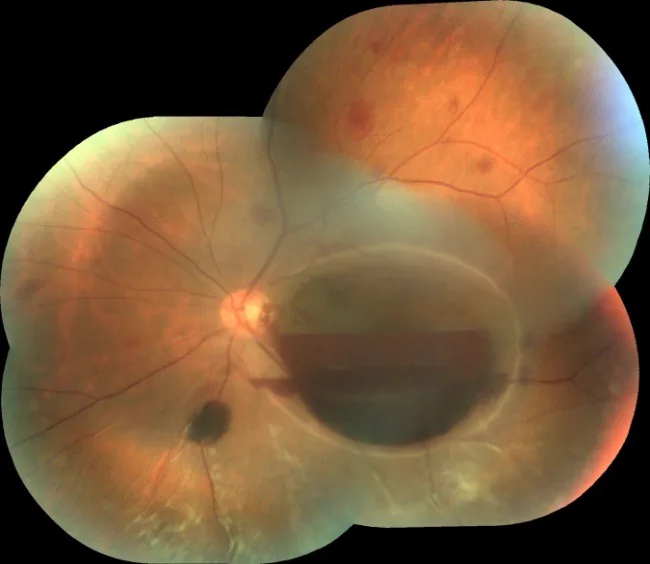
Terson syndrome refers to a condition in which intraocular hemorrhage occurs after subarachnoid hemorrhage (SAH), subdural hemorrhage, or intracerebral hemorrhage. The most common forms of intraocular hemorrhage are vitreous hemorrhage and subinternal limiting membrane hemorrhage, and bleeding can also occur in various layers of the retina around the optic disc and macula (preretinal, intraretinal, subretinal). 1)
In 1900, French ophthalmologist Albert Terson first reported vitreous hemorrhage associated with subarachnoid hemorrhage. Since then, intraocular hemorrhage accompanying intracranial hemorrhage has been known as Terson syndrome.
The incidence after traumatic brain injury (TBI) is reported to be approximately 3.1%, which is lower than that of SAH (19.3%) and intracerebral hemorrhage (9.1%), but due to the large number of TBI patients, the absolute number cannot be ignored. 1)
The amount and location of hemorrhage vary among patients, ranging from mild preretinal hemorrhage alone to massive vitreous hemorrhage that prevents fundus visualization. Hemorrhage can occur in the preretinal, intraretinal, subretinal, and vitreous spaces. 1)12)
QDo all patients with subarachnoid hemorrhage develop Terson syndrome?
A
Not all. In prospective studies, intraocular hemorrhage was observed in 19.3% of SAH patients. Associations with severity and increased intracranial pressure have been reported, and ophthalmologic evaluation is important if visual loss or floaters occur after SAH. 1)9)12)
Moraru A, et al. Terson’s Syndrome – case report. Rom J Ophthalmol. 2017;61(1):44–48. Figure 2. PMCID: PMC5710052. License: CC BY 2.0 (https://creativecommons.org/licenses/by/2.0/).
Wide-angle fundus photograph of the left eye showing a double hemorrhagic level with retrohyaloid hemorrhage and sub-internal limiting membrane hematoma overlapping in the macula.
The main subjective symptom of Terson syndrome is visual loss that occurs after intracranial hemorrhage. When vitreous hemorrhage is massive, it causes sudden and severe visual loss, making fundus visualization impossible. Patients may also complain of floaters. Since symptoms of intracranial hemorrhage (severe headache, impaired consciousness, nausea) are prominent, ocular symptoms are often overlooked. 12)
It can occur unilaterally or bilaterally. In SAH patients with impaired consciousness, complaints of visual loss are often absent, making ophthalmologic screening important.
Subinternal limiting membrane hemorrhage (preretinal hemorrhage): Observed around the optic disc and macula in the early stage. The hematoma appears as a well-demarcated, dark red elevation.
Mild vitreous hemorrhage: The amount of bleeding may allow fundus visualization. This stage is expected to resolve spontaneously.
Intraretinal and subretinal hemorrhage: Hemorrhage may be seen in various layers from the optic disc to the macula.
Advanced Findings
Massive vitreous hemorrhage: Extensive bleeding into the vitreous cavity may prevent fundus visualization and cause significant vision loss.
Epiretinal membrane: Organization of hemorrhage can lead to epiretinal membrane formation. It is the most frequent complication of Terson syndrome, reported in 15–78% of cases. This complication greatly affects visual prognosis.
Sub-internal limiting membrane hemorrhage and subhyaloid hemorrhage
Their simultaneous presence can form a double ring sign
Sub-internal limiting membrane and subhyaloid
Retinal hemorrhage
Appears as flame-shaped or dot hemorrhages
Intraretinal
Double ring sign is a fundus finding where sub-internal limiting membrane (sub-ILM) hemorrhage and subhyaloid hemorrhage coexist, forming a double contour13). Long-term complications such as epiretinal membrane, retinal detachment, and proliferative vitreoretinopathy have been reported, so follow-up is necessary even after hemorrhage absorption12). Depending on reports, frequencies are noted as epiretinal membrane 15–78%, retinal/perimacular folds approx. 20%, retinal detachment approx. 9%, and ghost cell glaucoma approx. 4%.
QWhat is the double ring sign?
A
It is a finding where inner sub-ILM hemorrhage and outer subhyaloid hemorrhage coexist, appearing as a double ring13).
Even after spontaneous absorption of vitreous hemorrhage, if vision does not improve, complications such as epiretinal membrane or macular edema should be evaluated with OCT, and treatment plan should be determined individually12).
QDoes vitreous hemorrhage heal on its own?
A
For mild vitreous hemorrhage, spontaneous absorption may be awaited. On the other hand, vitrectomy is considered in bilateral cases, severe unilateral vitreous hemorrhage, or when hemorrhage does not absorb after an observation period. In infants and children, early vitrectomy should be considered due to the risk of visual deprivation amblyopia. Observation is appropriate when hemorrhage shows an improving trend or is minimal, when visual prognosis is poor, in unilateral cases with no risk of amblyopia, or when anesthesia risk is high due to general condition. The treatment plan is determined individually based on visual function, general condition, severity of hemorrhage, and complications.12)
Intracranial hemorrhages that cause Terson syndrome are as follows.
Subarachnoid hemorrhage (most common): Rupture of a cerebral aneurysm is the main cause. A sudden increase in intracranial pressure leads to intraocular hemorrhage.
Traumatic brain injury (TBI): Caused by head trauma from traffic accidents, falls, or blows. It is reported that approximately 3.1% of TBI patients develop Terson syndrome. 1,2)
Subdural hemorrhage: May occur with subdural hematoma after head trauma. In infants, abusive head trauma (AHT) can also cause retinal hemorrhage, but the pattern of retinal findings alone cannot determine the presence or mechanism of abuse; multidisciplinary evaluation including clinical course is necessary. 3,4)
Intracerebral hemorrhage: May occur secondary to hypertensive intracerebral hemorrhage, etc.
SAH severity: High-grade (severe) cases according to the Hunt & Hess classification have a greater sudden increase in intracranial pressure, making intraocular hemorrhage more likely.
General condition and ocular findings: Impaired consciousness, bilateral hemorrhage, prolonged bleeding, and presence of retinal complications are included in treatment decisions. 11)12)
The presence of Terson syndrome can be an indicator of poor prognosis reflecting the severity of SAH, which is an important clinical feature. SAH patients with Terson syndrome have significantly higher mortality compared to those without. A systematic review reported mortality rates of 43% vs 9% (odds ratio 4.8) 7), another report 28.6% vs 2.0% 8), and a study related to intracranial pressure (ICP) reported an odds ratio of 45.0. 9) Lower Glasgow Coma Scale (GCS) scores and higher Hunt and Hess classification and Fisher grade are associated with a higher likelihood of Terson syndrome. 8,9)
The diagnosis of Terson syndrome is made according to the following procedure.
Confirmation of history of intracranial hemorrhage: Share the diagnosis of SAH, subdural hemorrhage, or intracerebral hemorrhage with the neurosurgery department.
Slit-lamp microscopy: Evaluates the anterior segment and ocular media.
Fundus examination: Performed under mydriasis. If vitreous hemorrhage is severe, fundus visualization may be difficult.
OCT: Useful for evaluating sub-ILM hematoma, epiretinal membrane, and retinal layer structure when fundus visualization is possible. In cases with sub-ILM hematoma, surgical procedures combining vitrectomy with internal limiting membrane peeling to remove the hematoma have also been reported.
Valsalva retinopathy: Preretinal or vitreous hemorrhage occurring after straining (weightlifting, vomiting, coughing, etc.). No history of intracranial hemorrhage; differential diagnosis is relatively easy.
Vitreous hemorrhage due to diabetic retinopathy: History of diabetes and fundus findings (neovascularization, hard exudates, etc.) are key to differentiation.
Retinal vein occlusion (CRVO/BRVO): Characteristic flame-shaped hemorrhages and venous dilation are distinguishing findings. History of intracranial hemorrhage is required.
Differential diagnosis including AHT in infants: Bilateral multilayered retinal hemorrhages, retinoschisis, and retinal folds are reported in AHT, but ocular findings alone cannot confirm abuse or mechanism of injury. Systematic evaluation by pediatrics, radiology, and ophthalmology is necessary. 3,4)
When proliferative changes are present, evaluate with consideration of retinal detachment, subretinal proliferation, and epiretinal membrane. If fundus visualization is poor, use B-mode ultrasound to confirm retinal complications. 12)
QIs ophthalmologic examination always necessary after SAH?
A
A uniform screening protocol has not been established. In patients with SAH, acute intracranial hypertension, or unexplained visual symptoms, fundus examination aids diagnosis; if fundus visualization is poor, B-mode ultrasound can be added. The timing of examination should be determined by neurosurgery and ophthalmology based on the patient’s general condition and ocular symptoms. 12)
Treatment for Terson syndrome is determined by the severity of vitreous hemorrhage, laterality (unilateral/bilateral), patient age, duration, and presence of complications. The main options are observation and vitrectomy.
Vitrectomy (pars plana vitrectomy: PPV) removes vitreous hemorrhage. For Terson syndrome secondary to TBI, vitrectomy has been reported to improve visual acuity early after surgery in many cases 2,5). Studies in pediatric cases also show good anatomical and functional outcomes after vitrectomy6).
The timing of surgery is determined based on the patient’s general condition, extent of hemorrhage, unilateral or bilateral involvement, complications, and the course of spontaneous absorption. Studies after TBI and multicenter studies have shown no significant difference in final visual acuity when comparing groups before and after 3 months or 90 days. Therefore, it cannot be uniformly stated that final visual acuity is better if surgery is performed within 90 days. 2)11)
In multiple case series, visual acuity improved in 21/22 eyes postoperatively, with 16 of 21 eyes reaching 0.5 or better. 10) A multicenter study also showed significant improvement from logMAR 1.57 to 0.53. 11) While prioritizing systemic management of acute SAH, multidisciplinary collaboration is important to avoid missing the window for ophthalmic intervention.
QWhen should vitrectomy be performed?
A
The timing of surgery is determined individually based on the patient’s general condition, amount of hemorrhage, unilateral or bilateral involvement, course of spontaneous absorption, and complications. If symptoms are mild and improving, observation is appropriate; for bilateral cases or non-absorbing cases, surgery is considered. Existing studies have not shown a significant difference in final visual acuity around 90 days, so the decision is made in consultation with ophthalmology while prioritizing neurosurgical treatment. 2)11)12)
The pathogenesis of Terson syndrome has not been established. A widely discussed theory suggests that a rapid increase in intracranial pressure causes cerebrospinal fluid to move into the optic nerve sheath, compressing the central retinal vein and retinochoroidal veins, leading to increased venous pressure and intraocular hemorrhage. 12)
This theory proposes that acute intracranial hypertension due to subarachnoid hemorrhage compresses the central retinal vein within the optic nerve. As a result, central retinal venous pressure increases, causing rupture of retinal capillaries and venules, leading to vitreous hemorrhage. This theory emphasizes the mechanism by which rapid changes in intracranial pressure are transmitted to intraocular vessels, and is consistent with findings that the severity of SAH (degree of intracranial pressure elevation) correlates with the incidence of Terson syndrome.
In intracranial pressure (ICP) monitoring studies, all patients with Terson syndrome had ICP exceeding 20 cmH₂O, with a median of 40 cmH₂O (compared to 15 cmH₂O in those without). However, these are small studies and do not establish a single mechanism. 9)
Intraocular hemorrhage may resolve spontaneously, but can also be complicated by epiretinal membrane, proliferative vitreoretinopathy, and retinal detachment. Since the course varies by case, continuous evaluation of hemorrhage absorption and retinal complications is necessary. 12)
Fundus examination in patients with SAH, acute intracranial hypertension, or unexplained visual symptoms is useful for diagnosing Terson syndrome. However, there are insufficient comparative studies to uniformly determine the target, timing, and method of examination, and coordination based on the patient’s general condition remains a challenge. 12)
Existing post-TBI studies and multicenter studies have not shown significant differences in final visual acuity when using 3 months or 90 days as a cutoff. Larger, prospective studies comparing the period of waiting for spontaneous absorption with surgical timing are needed. 2)11)
Czorlich P, Skevas C, Knospe V, et al. Terson syndrome in subarachnoid hemorrhage, intracerebral hemorrhage, and traumatic brain injury. Neurosurg Rev. 2015;38(1):129-136. PMID: 25173620. 1)
Narayanan R, Taylor SC, Nayaka A, et al. Visual Outcomes after Vitrectomy for Terson Syndrome Secondary to Traumatic Brain Injury. Ophthalmology. 2017;124(1):118-122. PMID: 27817917. 2)
Togioka BM, Arnold MA, Bathurst MA, et al. Retinal hemorrhages and shaken baby syndrome: an evidence-based review. J Emerg Med. 2009;37(1):98-106. PMID: 19081701. 3)
Squier W. Retinodural haemorrhage of infancy, abusive head trauma, shaken baby syndrome: The continuing quest for evidence. Dev Med Child Neurol. 2024;66(3):290-297. PMID: 37353945. 4)
Citirik M, Tekin K, Teke MY. Terson syndrome with persistent vitreous hemorrhage following traumatic brain injury. Saudi J Ophthalmol. 2019;33(4):392-397. PMID: 31920451; PMCID: PMC6950947. 5)
Sayman Muslubas I, Karacorlu M, Hocaoglu M, Ersoz MG, Arf S. Anatomical and functional outcomes following vitrectomy for dense vitreous hemorrhage related to Terson syndrome in children. Graefes Arch Clin Exp Ophthalmol. 2018;256(3):503-510. PMID: 29288413. 6)
McCarron MO, Alberts MJ, McCarron P. A systematic review of Terson’s syndrome: frequency and prognosis after subarachnoid haemorrhage. J Neurol Neurosurg Psychiatry. 2004;75(3):491-493. PMID: 14966173. 7)
Fountas KN, Kapsalaki EZ, Lee GP, et al. Terson hemorrhage in patients suffering aneurysmal subarachnoid hemorrhage: predisposing factors and prognostic significance. J Neurosurg. 2008;109(3):439-444. PMID: 18759574. 8)
Joswig H, Epprecht L, Valmaggia C, et al. Terson syndrome in aneurysmal subarachnoid hemorrhage—its relation to intracranial pressure, admission factors, and clinical outcome. Acta Neurochir (Wien). 2016;158(6):1027-1036. PMID: 27038169. 9)
Ritland JS, Syrdalen P, Eide N, Vatne HO, Øvergaard R. Outcome of vitrectomy in patients with Terson syndrome. Acta Ophthalmol Scand. 2002;80(2):172-175. PMID: 11952484. 10)
Nazarali S, Kherani I, Hurley B, et al. Outcomes of vitrectomy in Terson syndrome: a multicenter Canadian perspective. Retina. 2020;40(7):1325-1330. PMID: 31145391. 11)
Aboulhosn R, Raju B, Jumah F, et al. Terson’s syndrome, the current concepts and management strategies: a review of literature. Clin Neurol Neurosurg. 2021;210:107008. PMID: 34775364. 12)
Srinivasan S, Kyle G. Subinternal limiting membrane and subhyaloid haemorrhage in Terson syndrome: the macular ‘double ring’ sign. Eye (Lond). 2006;20(9):1099-1101. doi:10.1038/sj.eye.6702134. PMID:16227979. 13)
Copy the article text and paste it into your preferred AI assistant.
Article copied to clipboard
Open an AI assistant below and paste the copied text into the chat box.