
Findings of IOL Dislocation

Scleral Fixation of IOL (Scleral Suture Fixation and Intrascleral Fixation)
1. Scleral Suture Fixation and Intrascleral Haptic Fixation
Section titled “1. Scleral Suture Fixation and Intrascleral Haptic Fixation”Scleral suture fixation and intrascleral haptic fixation are surgical techniques used to refixate an intraocular lens (IOL) within the eye when capsular support is lost. They are considered in cases such as posterior capsule rupture, zonular dialysis, IOL dislocation, IOL drop, and aphakia, where capsular support is unavailable 2). Depending on the remaining capsular support and the condition of intraocular tissues, options include IOL repositioning, exchange, iris fixation, scleral suture fixation, and intrascleral fixation.
Scleral suture fixation is a technique in which a non-absorbable suture is tied to the haptic of the IOL and fixed to the sclera through the ciliary sulcus. It can be performed using an ab interno (from inside the eye) or ab externo (from outside the eye) approach.
Intrascleral haptic fixation refers to a group of techniques in which the haptic of the IOL is fixed within the sclera. The representative Yamane technique uses no sutures, adhesives, or scleral flaps; the haptic is passed through a scleral tunnel created with a 30-gauge needle and secured by a flange (bulbous enlargement) formed by cauterization 1).
This article focuses specifically on the techniques, indications, and selection of scleral suture fixation and intrascleral haptic fixation, differing from articles on the overall pathology and diagnosis of IOL dislocation (“Intraocular Lens Dislocation”) and general secondary IOL insertion procedures (“Secondary IOL Implantation”).
Main Indications
Section titled “Main Indications”- IOL dislocation: IOL decentration or drop due to zonular dialysis
- Aphakia: No capsular support due to complications during initial surgery or trauma
- Insufficient capsular support: Eyes with partially damaged lens capsule
- Posterior capsule rupture: When in-the-bag insertion is not possible. If accompanied by vitreous prolapse, the risk of cystoid macular edema, retinal detachment, and endophthalmitis increases, and visual prognosis may deteriorate; therefore, evaluate residual capsular support and the degree of vitreous prolapse to select anterior vitrectomy and appropriate secondary fixation.
- IOL exchange: Replacement of an existing IOL due to opacification or refractive error
| Indication | Corresponding Surgery |
|---|---|
| Mild IOL decentration (repositioning only) | IOL repositioning |
| IOL dislocation / loss of capsular support | Scleral suture fixation or intrascleral fixation |
| IOL drop (into vitreous cavity) | Vitrectomy + scleral suture fixation or intrascleral fixation |
| Zonular dehiscence + concurrent PEA | Consider capsular support device or secondary fixation depending on residual capsular support |
| Posterior capsule rupture (cannot insert in-the-bag) | Select iris fixation, scleral suture fixation, or intrascleral fixation individually |
Q
What is the difference between scleral suture fixation and intrascleral fixation?
A
Scleral suture fixation is a technique that fixes the IOL haptic to the sclera with non-absorbable sutures; the number of fixation points and the presence or absence of a scleral flap vary by technique. Intrascleral fixation (Yamane technique) inserts the haptic into a scleral tunnel created with a 30-gauge needle and fixes it by cauterizing and flanging the tip 1). Network meta-analysis showed that visual outcomes were generally comparable, but the types and frequencies of complications differed; selection depends on patient background and surgeon experience 3).
2. Main symptoms and clinical findings
Section titled “2. Main symptoms and clinical findings”Subjective symptoms
Section titled “Subjective symptoms”The main subjective symptoms of IOL dislocation/drop are as follows.
- Decreased visual acuity / refractive changes: Caused by refractive error due to IOL decentration or tilt, or when the optic portion moves out of the pupillary area
- Monocular diplopia / glare: Occurs when the IOL edge is exposed in the pupillary area
- Oscillopsia: The IOL moves with changes in body position, altering vision
- Visual field defect: Occurs when the optic portion moves out of the visual field due to IOL dislocation or drop
- High hyperopia: When the IOL falls into the vitreous cavity, severe hyperopia similar to aphakia occurs
- Asthenopia: Associated with refractive error and aniseikonia
Clinical Findings
Section titled “Clinical Findings”Diagnosis can be easily made by dilating the pupil and confirming the following four items.
- Position of the IOL optic and haptics
- Condition of the zonules of Zinn
- Condition of the lens capsule
- Presence of IOL oscillation (tremor)
IOL dislocation or drop is evaluated under dilated slit-lamp microscopy for position, oscillation, haptic, and capsular support. If the fundus is difficult to visualize or intraocular lens drop into the vitreous cavity is suspected, B-mode ultrasound may be added 2). IOL dislocation into the anterior chamber may be accompanied by corneal endothelial damage or pupillary block glaucoma, and early intervention should be considered based on symptoms and findings.
Q
What symptoms occur when the IOL is dislocated?
A
The most common symptom is decreased visual acuity. When the IOL is displaced, the optical part of the lens moves away from the pupil, causing refractive error. Additionally, monocular diplopia (IOL edge exposed in the pupillary area), glare, and oscillopsia with postural changes may occur. When the IOL drops into the vitreous cavity, significant hyperopia occurs as in aphakia. Dislocation into the anterior chamber can be an emergency with eye pain and elevated intraocular pressure.
3. Causes and Risk Factors
Section titled “3. Causes and Risk Factors”The causes of IOL displacement vary by type. Decentration and tilt occur due to extracapsular insertion or asymmetric insertion. Intracapsular dislocation involves posterior sinking of the IOL due to progression of zonular rupture, associated with pseudoexfoliation syndrome, trauma, high myopia, previous surgery, and connective tissue diseases 2). Extracapsular dislocation may occur after intraoperative capsular complications.
The zonules of Zinn pull the lens capsule equator in 360 degrees, serving a dual role of fixing the position toward the visual axis center and maintaining capsule shape through uniform traction. Depending on the degree and extent of rupture, position fixation, shape maintenance, or both may be lost.
Ocular Risk Factors
Pseudoexfoliation syndrome (PXF): Progressive zonular weakness associated with pseudoexfoliative material is the most common cause of late intracapsular dislocation, accounting for over half of cases according to reports 2). The mean period from cataract surgery to dislocation is reported to be approximately 7 to 8.5 years.
After intraocular surgery: Intraoperative zonular damage or long-term decreased capsular support may contribute to dislocation 2).
High myopia: Weakening of the capsule and zonules due to axial elongation and reduced support from vitreous liquefaction.
Anterior capsule contraction (capsular phimosis): Centripetal contraction due to proliferation and myofibroblastic metaplasia of lens epithelial cells after CCC. This places excessive tension on the zonules and contributes to late dislocation.
Systemic and External Risk Factors
Connective tissue diseases such as Marfan syndrome: Associated with zonular weakness or lens displacement. In Marfan syndrome, ectopia lentis occurs in approximately 60% of cases (30–72% depending on reports), serving as a representative systemic factor for zonular weakness 2).
History of trauma (blunt trauma): Zonular rupture due to globe deformation.
History of intraoperative capsular complications: Prior posterior capsule rupture or anterior capsule tear is a risk factor for late dislocation.
4. Diagnosis, Examination Methods, and Surgical Technique Selection
Section titled “4. Diagnosis, Examination Methods, and Surgical Technique Selection”Diagnostic Approach
Section titled “Diagnostic Approach”The basic diagnostic method is slit-lamp examination under mydriasis. If the IOL position may change with posture, evaluation in the supine position is also helpful for preoperative planning, but confirmation under an operating microscope is not mandatory for diagnosis in all cases.
The following assessments are necessary for preoperative diagnosis:
- Dislocation vs. drop (differentiation of the degree of IOL displacement)
- Intracapsular vs. extracapsular dislocation
- How to lift the IOL onto the iris
- Extent of vitrectomy to be performed
- Selection of instruments needed for extraction and fixation
Main Examination Items
Section titled “Main Examination Items”| Examination Method | Main Purpose |
|---|---|
| Slit-lamp microscopy (under mydriasis) | Assessment of IOL position and movement, confirmation of haptic position |
| Observation in supine position | Auxiliary evaluation when IOL position change due to posture is suspected |
| B-mode ultrasound | Detection of IOL in vitreous cavity, confirmation of posterior segment status |
| Anterior segment OCT / UBM | IOL evaluation behind the iris, zonule status, detailed haptic assessment |
| Specular microscopy | Corneal endothelial cell density (preoperative evaluation) |
| Corneal curvature and anterior chamber depth measurement | IOL power calculation and surgical technique decision |
| Fundus examination | Exclusion of retinal complications (e.g., detachment) |
Surgical technique selection algorithm
Section titled “Surgical technique selection algorithm”Based on the secondary IOL fixation options listed in the AAO PPP, individual consideration is made as follows2).
- Capsular support present → Prioritize ciliary sulcus fixation (3-piece IOL). For intrascleral fixation, use a 3-piece IOL whose haptics can be externalized through the needle lumen to form a stable terminal flange. Polyvinylidene fluoride (PVDF) haptics are considered suitable for intrascleral fixation due to superior flexibility and recovery, whereas PMMA or polypropylene haptics easily bend or break during manipulation. However, microfractures at the optic-haptic junction have been reported even with PVDF 3-piece IOLs, so select after confirming manufacturer details and technique compatibility
- No capsular support, weak zonules → Suture fixation or intrascleral fixation
- Problems with ocular surface, iris, or sclera → Individually evaluate fixation site and technique
- Existing IOL compatible with fixation method → If no damage or deformation, refixation is an option
- Concurrent glaucoma surgery required → Select technique individually considering interference with conjunctival/scleral manipulation. Case reports exist of simultaneous intrascleral fixation and trabeculectomy6)
- Poor iris/scleral condition, recurrent dislocation → Consider exchange to ACIOL
Factors for surgical technique selection
Section titled “Factors for surgical technique selection”| Evaluation item | Suture fixation | Yamane technique |
|---|---|---|
| Learning curve | Established | Requires time to master |
| Suture breakage/dislocation risk | Present | None |
| Long-term outcomes | Accumulated over 30+ years | Data being accumulated |
Q
What tests determine the need for surgery?
A
First, evaluate the IOL position, stability, and zonular status using a slit-lamp microscope under mydriasis. If vitreous cavity drop is suspected, add B-mode ultrasound; use anterior segment OCT or UBM for detailed evaluation behind the iris. If corneal endothelial damage is a concern, specular microscopy results also guide surgical technique selection 2).
5. Standard Treatment
Section titled “5. Standard Treatment”5-1. Overview of Treatment Strategy
Section titled “5-1. Overview of Treatment Strategy”Management of a dislocated or dropped IOL varies greatly depending on the degree and condition of the displacement.
- Mild displacement (pupillary capture, capsular capture, loop dislocation into the anterior chamber, early postoperative asymmetric fixation, etc.) → IOL repositioning. Position can be corrected via a side port using a hook or spatula.
- Dislocation/drop → Based on the existing IOL’s shape, material, damage, and remaining capsular support, choose repositioning, refixation, or exchange.
- Dropped IOL → After total vitrectomy, retrieve and remove using vitreous forceps. Subsequent suturing or intrascleral fixation is performed as usual.
- Reuse of existing IOL → Check the IOL’s material, shape, presence of damage, and compatibility with the fixation method; decide individually whether to refixate or exchange.
5-2. Surgical Technique for Dislocated IOL Removal
Section titled “5-2. Surgical Technique for Dislocated IOL Removal”First, lift the IOL above the pupil, then create an appropriately sized wound and remove it.
- Foldable IOL: Can be cut in the anterior chamber and removed through a small incision 3–4 mm wide.
- PMMA IOL: An incision of approximately 6.5 mm matching the optic diameter is required.
- Dislocated IOL: It can also be floated to the iris plane using liquid perfluorocarbon (LPFC).
- Corneal endothelial protection: Fill with ophthalmic viscosurgical device (OVD) during IOL manipulation and removal.
5-3. Suture fixation (transscleral suture fixation)
Section titled “5-3. Suture fixation (transscleral suture fixation)”Principle: Non-absorbable sutures are tied to the IOL haptic via an ab interno or ab externo approach and fixed to the sclera through the ciliary sulcus. Two-point fixation is standard.
Specific technique using the cow-hitch method:
- Create a scleral flap at the limbus at the 12 o’clock position.
- Puncture the ciliary sulcus with a long needle attached to 9-0 polypropylene suture.
- Puncture from the 6 o’clock position with a 30-gauge pick-up needle.
- Connect the long needle and pick-up needle to pass the suture.
- Tie the suture to the IOL haptic using a cow-hitch knot.
- Insert the haptic into the predetermined ciliary sulcus position.
- Suture and fixate to the sclera under the scleral flap.
Haptic externalization method: Another method involves inserting the IOL haptic into a 25-gauge needle, guiding it out through a side port, performing a cow-hitch knot, then forming a bulb at the tip using electrocautery and pulling it into a scleral tunnel.
Suture selection:
- 9-0 or 8-0 polypropylene (Prolene) suture is used. Late breakage has been reported with 10-0 polypropylene. The timing of occurrence varies widely; published series averages range from 12 to 122 months (approx. 1–10 years), and in individual cases range from 33 to 170 months (approx. 3–14 years)12). Caution is advised with 10-0 use in pediatric cases, where 9-0 should be considered due to superior tensile strength and degradation resistance.
- CV-8 Gore-Tex suture has high tensile strength and is expected to reduce the long-term risk of breakage
Situations to consider capsule preservation: Even in cases with zonular weakness, if capsular support remains, a capsule-preserving technique may be considered. This may reduce vitreous cavity invasion, but evaluation of posterior capsule rupture and long-term stability is necessary; it is determined on a case-by-case basis as a standard procedure.
Main complications:
- IOL redislocation (late dislocation due to suture breakage)
- IOL tilt and decentration
- Intraocular hemorrhage
- Retinal detachment
- Exposure, erosion, or breakage of the suture knot 5)
- Glaucoma
- Postoperative pupillary capture (more likely because the optic is not covered by the capsule immediately behind the iris)
5-4. Intrascleral fixation (Yamane technique / flanged intrascleral fixation)
Section titled “5-4. Intrascleral fixation (Yamane technique / flanged intrascleral fixation)”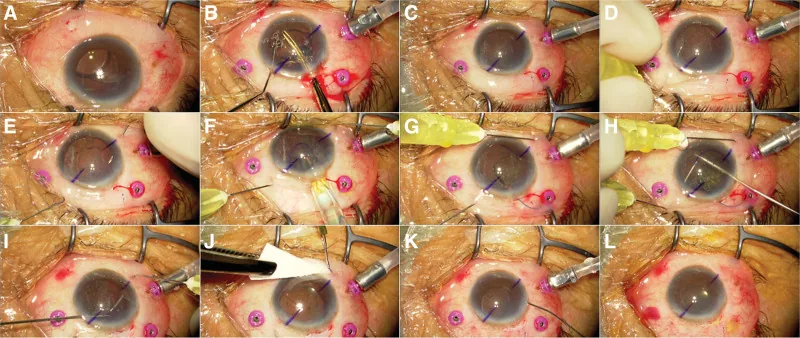
Nakagawa S, Ishii K. Secondary intrascleral intraocular lens (IOL) fixation with capsule preservation for IOL dislocation following mature cataract surgery with incomplete capsulorhexis: A case report. Medicine (Baltimore). 2025;104(25):e43030. doi:10.1097/MD.0000000000043030. PMID:40550021. PMCID:PMC12187320. Figure 1. License: CC BY 4.0. https://creativecommons.org/licenses/by/4.0/
Intraoperative course shown in 12 panels from preoperative IOL inferonasal decentration (A) to 30-gauge needle insertion (D/E), 3-piece IOL injector insertion (F/G), and flange formation and scleral fixation using the double-needle technique (H–J). Corresponds to the sequential steps of the Yamane double-needle technique described in section “5-4. Intrascleral fixation (Yamane technique).”
Principle: A scleral tunnel is created with a 30-gauge thin-wall needle, the haptic of a 3-piece IOL is inserted into the needle lumen and pulled out through the sclera, then the haptic tip is cauterized to form a flange (bulbous enlargement). The flange is locked within the scleral tunnel, fixing the IOL. No sutures or adhesives are used. 1)
Specific technique using the Yamane double-needle method:
- A 30-gauge thin-wall needle is inserted at 2 mm from the corneal limbus at two sites 180 degrees apart
- Each IOL haptic is inserted into the lumen of each needle
- The haptic is pulled out through the sclera together with the needle
- The tip of the haptic is cauterized with low-temperature electrocautery to form a flange (bulbous enlargement)
- The flange is pulled back into the scleral tunnel and embedded for fixation
IOL selection: In the Yamane method, a 3-piece IOL is used that allows the haptic to be externalized through the needle lumen and a stable flange to be created at the tip. Since the haptic material, diameter, and behavior differ by product, the choice should be made by confirming compatibility with the technique and manufacturer information1)5).
Advantages:
- No need for scleral flap creation, making it minimally invasive
- No risk of late dislocation due to suture breakage
- Early visual recovery can be expected
- When combined with glaucoma surgery, the surgical technique should be individually considered to avoid interference with conjunctival and scleral manipulation6)
Main complications:
- Elevated intraocular pressure
- IOL tilt and decentration1)5)
- Optic capture
- Vitreous hemorrhage
- Cystoid macular edema (CME)
- Haptic conjunctival penetration/erosion
- Endophthalmitis2)
Important note: The surgical technique should be selected individually because the condition of the sclera and conjunctiva, the IOL material, and the position of haptic fixation affect postoperative stability1)5).
5-5. Surgical technique comparison table
Section titled “5-5. Surgical technique comparison table”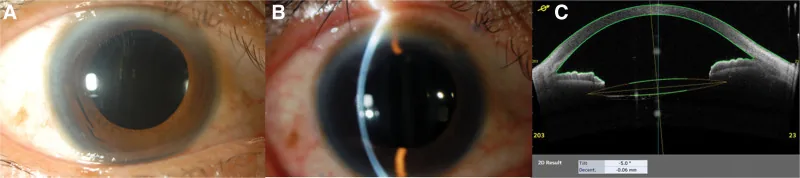
Nakagawa S, Ishii K. Secondary intrascleral intraocular lens (IOL) fixation with capsule preservation for IOL dislocation following mature cataract surgery with incomplete capsulorhexis: A case report. Medicine (Baltimore). 2025;104(25):e43030. doi:10.1097/MD.0000000000043030. PMID:40550021. PMCID:PMC12187320. Figure 2. License: CC BY 4.0. https://creativecommons.org/licenses/by/4.0/
Anterior segment photographs (A: normal illumination, B: slit-lamp optical section) and anterior segment OCT (C) 3 months after intrascleral fixation. IOL tilt 5.0 degrees and decentration 0.06 mm indicate good centration. This corresponds to the refractive predictability and tilt evaluation after intrascleral fixation discussed in section “5-5. Surgical technique comparison table”.
| Item | Sutured technique (transscleral suture fixation) | Intrascleral fixation (Yamane technique) |
|---|---|---|
| Fixation principle | Fixation of haptic to sclera with suture | Implantation of haptic flange into scleral tunnel |
| Suture | Required (e.g., 9-0/8-0 polypropylene) | Not required |
| Scleral flap | Varies by technique | Not required |
| Suitable IOL | IOL suitable for suture fixation | 3-piece IOL suitable for flange formation |
| Late breakage risk | Yes (reported with 10-0 polypropylene, etc.12)) | No suture breakage |
| Haptic erosion risk | Low | Yes |
| Procedure complexity | Moderately high | High (requires proficiency) |
| Combined glaucoma surgery | Case-by-case | Case-by-case6) |
| Visual outcomes | Generally comparable across studies | Generally comparable across studies3) |
In a network meta-analysis of three methods (iris fixation, transscleral suturing, and intrascleral fixation), best-corrected visual acuity was generally comparable, while complication profiles such as cystoid macular edema, hemorrhage, and corneal endothelial effects differed between techniques3). The AAO PPP lists anterior chamber IOL, iris fixation, and scleral fixation as options when capsular support is insufficient, and selection should be based on ocular condition and surgeon experience2).
5-6. Key points for suturing in zonular rupture
Section titled “5-6. Key points for suturing in zonular rupture”If zonular rupture is detected intraoperatively, assess the extent of rupture, anterior and posterior capsule status, and residual support, and combine capsular support devices, anterior vitrectomy, and secondary IOL fixation as needed. The indication for capsular support devices including the fixation-type CTR and whether to preserve or remove the capsule should be determined on a case-by-case basis2).
Suturing technique (transscleral suture fixation)
Indications: Loss of capsular support, zonular rupture, etc. Select based on IOL shape and ocular tissue condition.
Suture: 9-0 or 8-0 polypropylene. Tie to the haptic using a cow-hitch technique and suture under a scleral flap via the ciliary sulcus.
Advantages: Compatible with multiple fixation methods and IOL shapes. Long-term outcomes have been accumulated.
Disadvantages: Risk of suture breakage (late dislocation). The need for a scleral flap varies by technique. When performed concurrently with glaucoma surgery, the surgical method is selected individually considering interference with conjunctival and scleral manipulation.
Intrascleral fixation (Yamane technique)
Indications: Cases with loss of capsular support where a 3-piece IOL suitable for flange formation can be used.
Fixation method: Scleral tunnel with a 30G thin-wall needle + haptic flange capture. No sutures, glue, or scleral flap required.
Advantages: No risk of suture breakage. A single case of concurrent intrascleral fixation and trabeculectomy has been reported, but general superiority has not been established6).
Disadvantages: Requires a learning curve. Risks include haptic erosion, tilt, and decentration1)5).
Q
Which is better: suture fixation or intrascleral fixation?
A
In a network meta-analysis, best-corrected visual acuity was generally comparable among the three methods, but complication profiles differed3). The surgical technique is selected individually based on capsular support, iris, scleral, and corneal endothelial status, the IOL used, comorbidities, and surgeon experience2)3). Since scleral fixation can cause refractive errors due to IOL position, preoperative explanation and postoperative refractive evaluation are necessary.
Q
What should I be careful about in daily life after surgery?
A
Postoperatively, IOL decentration, pupillary capture, inflammation, elevated intraocular pressure, and cystoid macular edema may occur1)3)5). If sudden vision changes, eye pain, or redness occur, seek medical attention promptly. For suture fixation, late redislocation due to suture degradation or breakage should be monitored; for the Yamane technique, haptic exposure/erosion and IOL decentration require long-term follow-up.
6. Prognosis and Long-term Outcomes
Section titled “6. Prognosis and Long-term Outcomes”Visual Prognosis
Section titled “Visual Prognosis”In network meta-analysis, postoperative best-corrected visual acuity was generally comparable among iris fixation, transscleral suturing, and intrascleral fixation across studies3). However, individual visual prognosis varies depending on the underlying disease, corneal, retinal, and optic nerve status, IOL position, and postoperative complications.
Frequency of Major Complications
Section titled “Frequency of Major Complications”| Complication | Suture technique | Yamane technique | Notes |
|---|---|---|---|
| Suture breakage/exposure | Present | Absent | Related to late redislocation and infection risk of suture technique |
| Haptic exposure/erosion | Absent | Present | Confirm fixation position and flange burial |
| IOL tilt/decentration | Present | Present | Cause of refractive error |
| Cystoid macular edema/intraocular hemorrhage | Present | Present | Differences in frequency between surgical techniques have been reported3) |
| Pupillary capture | Present | Present | Check position when vision changes |
Complication rates vary widely depending on the target population, fixation method, and follow-up period; therefore, a single rate cannot be applied to all cases3).
Key points for long-term follow-up
Section titled “Key points for long-term follow-up”- In scleral fixation, long-term regular follow-up is necessary to prepare for late IOL dislocation due to suture degradation
- In the Yamane method, check for conjunctival penetration/erosion of the haptic and changes over time in IOL tilt/decentration.
- Cystoid macular edema (CME) may develop several months after surgery; perform OCT evaluation when visual acuity decreases.
7. Pathophysiology and Detailed Mechanisms
Section titled “7. Pathophysiology and Detailed Mechanisms”Function of the Zonules of Zinn and Mechanism of IOL Displacement
Section titled “Function of the Zonules of Zinn and Mechanism of IOL Displacement”The zonules of Zinn pull the lens capsule equator in 360 degrees, serving a dual role: fixing the lens in the visual axis center and maintaining capsular shape through uniform traction. Depending on the extent and degree of rupture, either fixation, shape maintenance, or both may be lost.
The mechanisms of IOL displacement by cause are as follows:
- Decentration/tilt: Due to surgical technique issues such as extracapsular insertion, asymmetric insertion, or improper placement during suturing or scleral fixation.
- Intracapsular dislocation: A condition where the IOL sinks posteriorly due to progression of zonular rupture. Associated with exfoliation syndrome, trauma, high myopia, prior surgery, connective tissue diseases, etc. 2)
- Extracapsular dislocation: Often occurs after intraoperative capsular complications.
- IOL drop: When intracapsular dislocation progresses to complete zonular rupture, or when the IOL completely separates from the capsule in extracapsular dislocation.
Zonular Weakness in Exfoliation Syndrome
Section titled “Zonular Weakness in Exfoliation Syndrome”In exfoliation syndrome, exfoliative material deposits intraocularly, which may be accompanied by zonular weakening and poor pupillary dilation, affecting cataract surgery and IOL fixation planning 2).
Late Dislocation Due to Anterior Capsular Contraction
Section titled “Late Dislocation Due to Anterior Capsular Contraction”After continuous curvilinear capsulorhexis (CCC), lens epithelial cells at the capsulotomy edge proliferate and transdifferentiate into myofibroblasts. When the centripetal contractile force generated by these cells exceeds the centrifugal traction of the zonules, anterior capsular contraction (capsular phimosis) progresses. Increased weight of the IOL and capsule due to posterior capsule opacification further increases stress on the zonules.
Refractive Characteristics of Sutured and Intrascleral Fixated IOLs
Section titled “Refractive Characteristics of Sutured and Intrascleral Fixated IOLs”Refractive outcomes after scleral fixation are affected by the effective lens position, tilt, and decentration of the IOL. A 5-year follow-up study of glued IOL evaluated IOL tilt, but it is not a study demonstrating the refractive prediction accuracy of the Yamane technique 10). The refractive predictability of each surgical technique should be explained based on studies where the target eyes and fixation method match.
Indications for Suture Fixation in Posterior Capsule Rupture
Section titled “Indications for Suture Fixation in Posterior Capsule Rupture”When intraoperative posterior capsule rupture prevents stable fixation in the capsular bag or ciliary sulcus, options such as anterior chamber IOL, iris fixation, scleral suture fixation, and intrascleral fixation should be considered based on residual capsular support 2).
8. Recent Research and Future Perspectives
Section titled “8. Recent Research and Future Perspectives”Application of Light Adjustable Lens (LAL) for Scleral Fixation
Section titled “Application of Light Adjustable Lens (LAL) for Scleral Fixation”After scleral fixation, refractive errors may occur due to the effective IOL position. The Light Adjustable Lens (LAL) is an IOL whose power can be adjusted postoperatively with UV irradiation.
Ma et al. (2023) reported a case of a 53-year-old woman with spontaneous bilateral lens subluxation who underwent off-label use of LAL with trocar-based ISHF (intrascleral haptic fixation) 7). Postoperative power adjustment was performed targeting micro-monovision, achieving uncorrected visual acuity of 20/20 in both eyes. This single case suggests the potential to reduce refractive error after scleral fixation, but additional studies are needed to establish efficacy and safety.
Simplification of Technique with Trocar-Based Modification
Section titled “Simplification of Technique with Trocar-Based Modification”Bever et al. (2021) reported a modification in which the IOL is intentionally dropped onto the retina, and then the haptic tip is directly grasped with a 27-gauge forceps and pulled out through the sclera 8). This technique eliminates the need for manipulation at the iris plane and is a safe and efficient procedure for surgeons experienced in vitreoretinal surgery. All 4 cases achieved stable IOL fixation and good centration.
Refixation of Multifocal IOL Using the Cable Tie Technique
Section titled “Refixation of Multifocal IOL Using the Cable Tie Technique”Eom et al. (2022) reported four-point flanged intrascleral fixation for subluxated multifocal IOLs with C-loop and double C-loop haptics using the cable tie method with 6-0 polypropylene. 9)By forming the suture into a cable-tie-like loop, secure fixation to the optic-haptic junction was achieved, and both cases showed good IOL centration and distance and near visual acuity.
4-flange intrascleral fixation
Section titled “4-flange intrascleral fixation”Canabrava (2020) reported a four-point intrascleral fixation method without scleral flaps, knots, or glue, using flanging of the four ends of 5-0 polypropylene monofilament by cauterization 11).
9. References
Section titled “9. References”- Yamane S, Sato S, Maruyama-Inoue M, Kadonosono K. Flanged intrascleral intraocular lens fixation with double-needle technique. Ophthalmology. 2017;124:1136-1142. doi:10.1016/j.ophtha.2017.03.036.
- Miller KM, Oetting TA, Tweeten JP, Carter K, Lee BS, Lin S, et al. Cataract in the Adult Eye Preferred Practice Pattern. Ophthalmology. 2022;129(1):P1-P126. doi:10.1016/j.ophtha.2021.10.006. PMID:34780842.
- Li X, Ni S, Li S, Zheng Q, Wu J, Liang G, et al. Comparison of Three Intraocular Lens Implantation Procedures for Aphakic Eyes With Insufficient Capsular Support: A Network Meta-analysis. American journal of ophthalmology. 2018;192:10-19. doi:10.1016/j.ajo.2018.04.023. PMID:29750951.
- John T, Tighe S, Hashem O, Sheha H. New use of 8-0 polypropylene suture for four-point scleral fixation of secondary intraocular lenses. Journal of cataract and refractive surgery. 2018;44(12):1421-1425. doi:10.1016/j.jcrs.2018.08.008. PMID:30314754.
- Yamane S, Ito A. Flanged fixation: Yamane technique and its application. Current opinion in ophthalmology. 2021;32(1):19-24. doi:10.1097/ICU.0000000000000720. PMID:33196545.
- Mano Y, Mizobuchi K, Watanabe T, Watanabe A, Nakano T. Minimally invasive surgery for intraocular lens removal and intrascleral intraocular lens fixation with trabeculectomy in a patient with dislocated intraocular lens and elevated intraocular pressure. Case Rep Ophthalmol. 2021;12:538-542. PMID: 34248588. PMCID: PMC8255743. doi:10.1159/000511593.
- Chu Jian Ma, Craig C. Schallhorn, Jay M. Stewart, Julie M. Schallhorn. Modified intrascleral haptic fixation of the light adjustable lens in a case of spontaneous adult-onset bilateral lens subluxation. American Journal of Ophthalmology Case Reports. 2023;31:101864. doi:10.1016/j.ajoc.2023.101864.
- Bever GJ, Liu Y, Stewart JM. Modified technique for trocar-based sutureless scleral fixation of intraocular lenses: A new approach to haptic externalization. American journal of ophthalmology case reports. 2021;23:101145. doi:10.1016/j.ajoc.2021.101145. PMID:34195478; PMCID:PMC8233194.
- Eom Y, Lee YJ, Park SY, Choi Y, Kim JW, Kim SJ, et al. Cable tie technique for securing scleral fixation suture to intraocular lens. American journal of ophthalmology case reports. 2022;27:101646. doi:10.1016/j.ajoc.2022.101646. PMID:35813586; PMCID:PMC9263869.
- Kumar DA, Agarwal A, Agarwal A, Chandrasekar R, Priyanka V. Long-term assessment of tilt of glued intraocular lenses: an optical coherence tomography analysis 5 years after surgery. Ophthalmology. 2015;122(1):48-55. doi:10.1016/j.ophtha.2014.07.032. PMID:25200402.
- Canabrava S, Canêdo Domingos Lima AC, Ribeiro G. Four-Flanged Intrascleral Intraocular Lens Fixation Technique: No Flaps, No Knots, No Glue. Cornea. 2020;39(4):527-528. doi:10.1097/ICO.0000000000002185. PMID:31658168.
- Buckley EG. Hanging by a thread: the long-term efficacy and safety of transscleral sutured intraocular lenses in children (an American Ophthalmological Society thesis). Trans Am Ophthalmol Soc. 2007;105:294-311. PMID:18427618; PMCID:PMC2258120.