Spectacle prescription is the selection and prescription of appropriate lens power, type, and frame to correct refractive errors (myopia, hyperopia, astigmatism, presbyopia). It is not merely determining the lens power, but a comprehensive medical act that includes consideration of wearing comfort, binocular vision function, and aniseikonia.
Refractive error is a disease, and refractive correction is a medical act1). Unlike prescriptions at optical shops, prescriptions at an ophthalmology clinic are directly linked to the detection and exclusion of ocular diseases.
Visual acuity of 0.7 is considered the threshold for considering (re)prescription of glasses. According to the Ministry of Education, Culture, Sports, Science and Technology’s visual acuity classification, if visual acuity is 0.7 or higher, characters on the blackboard can be read from seats at the back of the classroom. The passing standard for an ordinary driver’s license is also 0.7 with both eyes.
Classification
Visual acuity
Meaning of classification
A
1.0 or higher
Characters on the blackboard are clearly visible from the back seats
B
0.9 to 0.7
Characters on the blackboard are mostly visible from the back seats
C
0.7 to 0.3
Characters on the blackboard are difficult to see from the back seats
D
Less than 0.3
Characters on the blackboard are not sufficiently visible even from the front seats
The rate of spectacle use among adults is 74.2% (including constant wear, occasional wear, and combined use with contact lenses), with constant wear reported in 40.4% of men and 21.8% of women1). The most common age to start wearing glasses is junior high to high school, followed by the 40s to 50s (due to demand for near-vision glasses for presbyopia)1). More than half of Japanese people have myopia, and glasses are the most widespread method of refractive correction.
Kempen et al. reported estimated prevalence rates of myopia (spherical equivalent ≤ −1 D) in individuals aged 40 years and older as 25.4% in the United States, 26.6% in Western Europe, and 16.4% in Australia, and hyperopia (+3 D or more) as 9.9% in the United States, 11.6% in Western Europe, and 5.8% in Australia, estimating that about one-third of individuals aged 40 and older in the US and Western Europe, and about one-fifth in Australia, have refractive errors10). Prevalence varies by age range, definition of refractive error, and region. In Japan, myopia progression has become an important public health issue, and guidelines for myopia management glasses were established in 20252).
QWhy should spectacle prescriptions be obtained from an ophthalmologist?
A
Ophthalmologic spectacle prescriptions not only determine the appropriate refractive correction but also enable early detection of eye diseases such as cataracts, glaucoma, amblyopia, and strabismus. Refractive error is a disease, and its correction is a medical act1). Since vision measurements at optical shops cannot diagnose or rule out diseases, an ophthalmology visit is recommended for initial prescriptions or changes in prescription.
Undercorrection: Poor vision, asthenopia, headache, difficulty with near vision
Overcorrection (myopia): Asthenopia due to excessive accommodative effort, especially during near work
Overcorrection of hyperopia: Discomfort, poor vision
Axis misalignment of astigmatism: Sensation of tilt, distortion, discomfort with stereopsis
In adult spectacle prescriptions, while using best-corrected visual acuity as a reference, it is important to prescribe a power that is comfortable for daily wear. Strong myopia or oblique astigmatism, if fully corrected, may cause distortion and make wearing difficult1).
Aniseikonia is a condition in which there is a difference in image size between the two eyes. Convex lenses produce magnification and concave lenses produce minification, so it is prone to occur when correcting anisometropia with spectacles.
Latent hyperopia is often overlooked in childhood because uncorrected visual acuity is good. With age-related decline in accommodative ability, decompensation occurs, starting with visual impairment at near and extending to intermediate and far distances. Symptoms typically worsen from evening to night.
QWhat is aniseikonia?
A
Aniseikonia is a condition in which the image size differs between the two eyes due to a difference in the power of the spectacle lenses. Generally, a difference of 2% or less is considered acceptable, and a spectacle lens power difference of approximately 1.5–2.0 D serves as a guideline, but since tolerance varies among individuals, the visual experience should be confirmed with trial lenses for each case 1). It is accompanied by characteristic subjective symptoms such as the “revolving door” sensation and the “slant” sensation, and the disappearance of these symptoms when one eye is covered is a clue for differential diagnosis.
Myopia: Parallel light rays focus in front of the retina. Elongation of the axial length (axial myopia) is the main cause. Corrected with concave lenses.
Hyperopia: Parallel light rays focus behind the retina. When accommodative ability is insufficient, both distance and near vision are blurred. Corrected with convex lenses.
Astigmatism: The curvature of the cornea or lens differs along meridians, so light does not focus to a single point. Corrected with cylindrical lenses.
Presbyopia: Age-related loss of lens elasticity reduces accommodative ability, making it impossible to focus on near objects. Managed with an addition (plus lens) power.
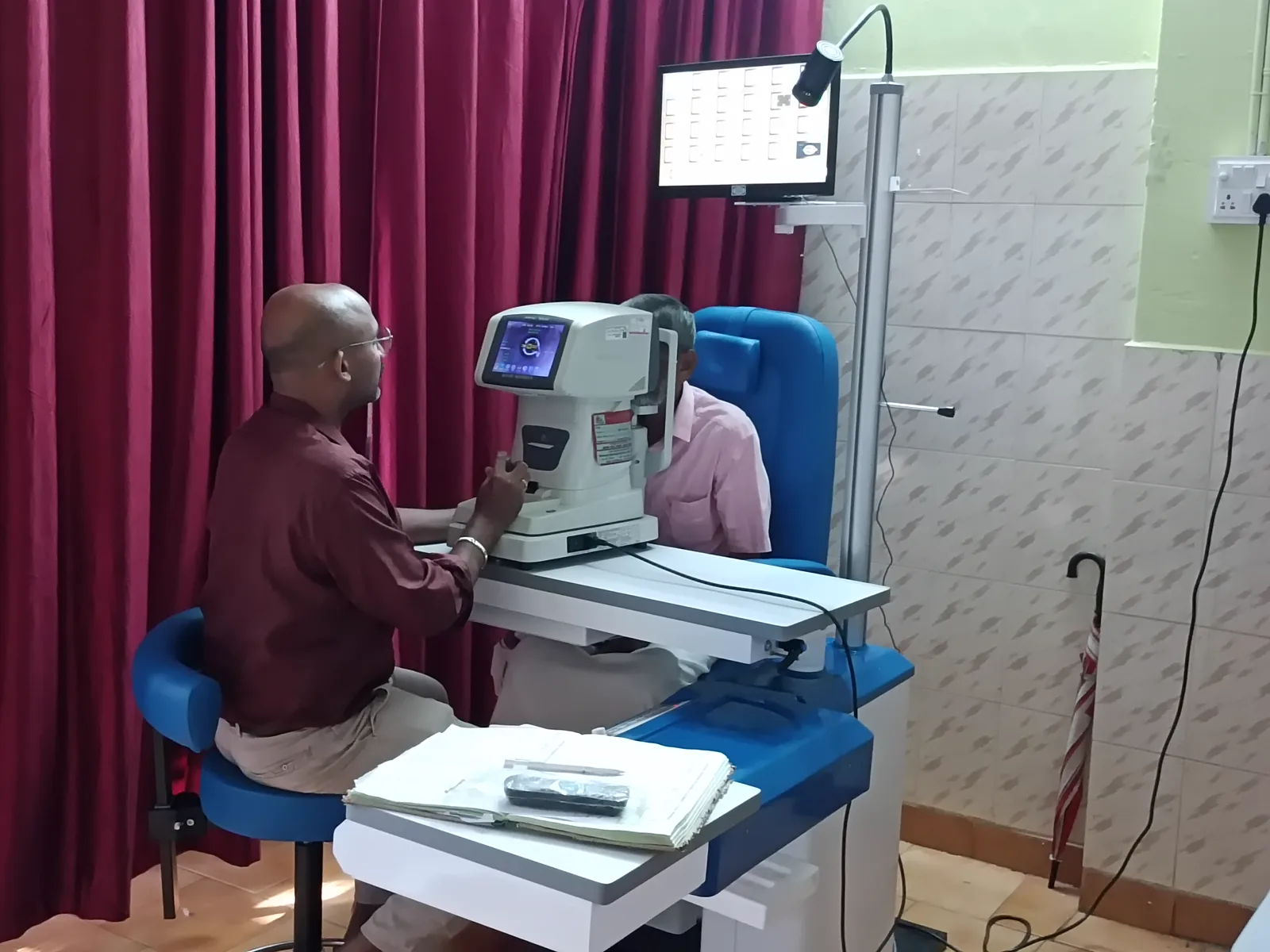
This image shows an examiner operating an auto refractometer (automatic refractometer) to objectively measure the patient’s refractive status. It corresponds to the objective refraction measurement using an auto refractometer discussed in the section “4. Diagnosis and Examination Methods.”
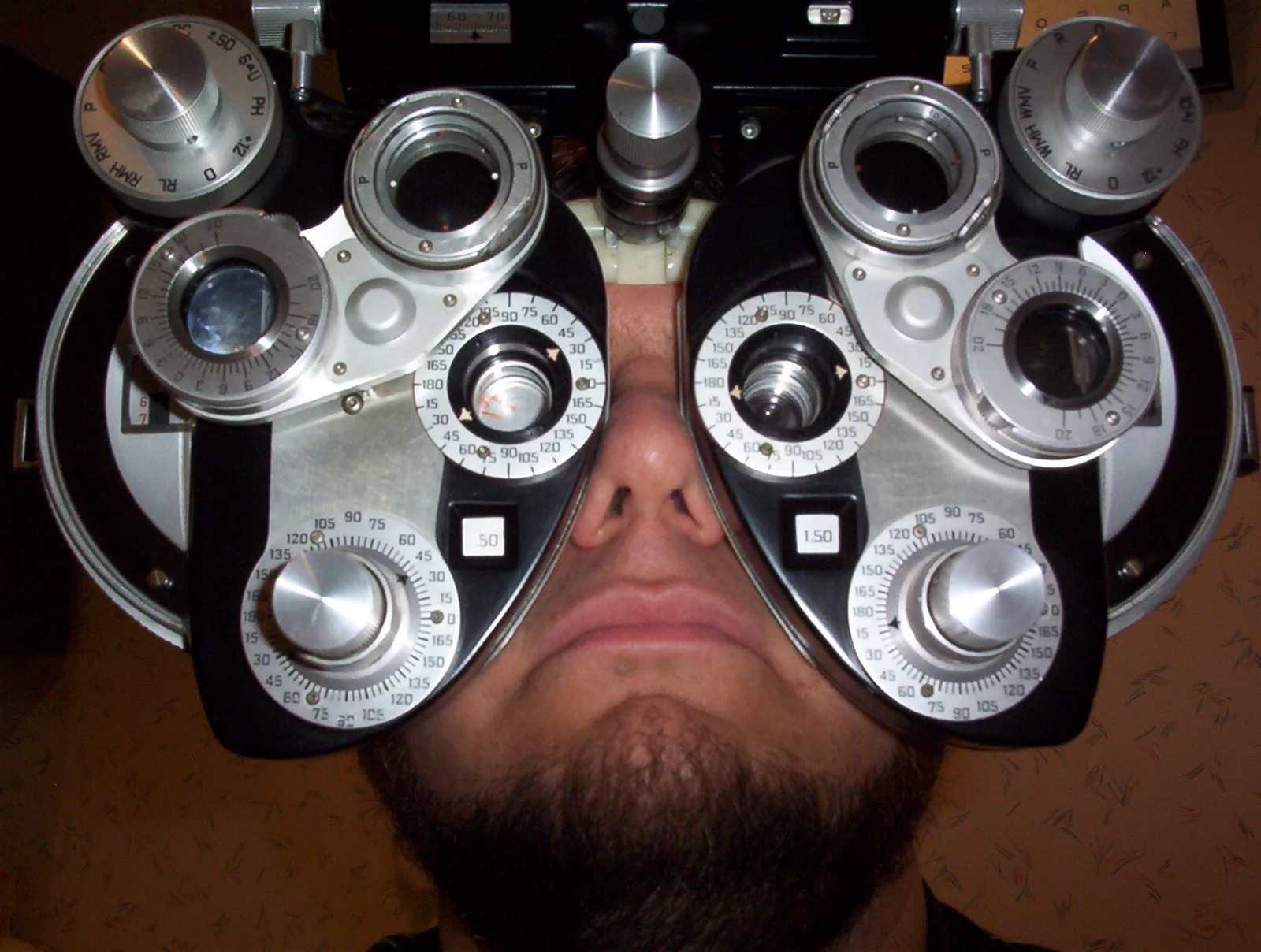
This image shows a patient placing their face against the eyepiece of a phoropter (comprehensive refraction examination device) and undergoing subjective refraction examination while checking visual targets. It corresponds to the subjective refraction examination (subjective determination of power after objective measurement with an auto refractometer) discussed in the section “4. Diagnosis and Examination Methods.”
Examination Flow for Adults
Inquiry about usage: Understand the usage scenarios and visual distances, such as driving, PC work, playing musical instruments, sports, etc.
Check current glasses: Measure the power of the current glasses using a lensmeter.
Refraction examination: After measuring objective values with an auto refractometer, determine the final power through subjective examination.
Accommodation test: Evaluate the amount of accommodation and use it to calculate the near addition power.
PD measurement: Measure the interpupillary distance and record it on the eyeglass prescription.
Examination Flow for Children
Refraction examination under cycloplegia: The cycloplegic drug used is selected based on ocular alignment and age3). If esotropia is present, use atropine sulfate drops from the beginning, and if hyperopia is present, prescribe full correction glasses3). Because the astigmatism axis can be accurately detected, it is also recommended to use atropine sulfate drops in cases of severe astigmatism3). For children without esotropia, generally instill one drop of cyclopentolate hydrochloride into each eye, then another drop after 5 minutes, and perform refraction examination 45 minutes later3). If refractive error is found during that examination and glasses are deemed necessary for amblyopia due to acquired esotropia or hyperopia, re-examine after instilling atropine sulfate, which has a stronger cycloplegic effect, into both eyes 1 to 3 times daily for 5 days3). Atropine sulfate is a powerful drug and mydriasis and cycloplegia persist for 2 to 3 weeks, so it should not be used thoughtlessly3). The drug, concentration, and frequency are determined by the ophthalmologist based on age, eye position, and other factors.
Axial length measurement: Measurement using laser interferometry is recommended 2). Used for monitoring myopia progression.
Binocular vision assessment: Evaluate cover test, near stereopsis, and accommodative lag.
Fundus examination: Essential to rule out amblyopia and organic diseases.
Pre-prescription examination for myopia control glasses
Before prescribing myopia control glasses (multisegment lenses), the following evaluations are necessary 2).
Combining myopia control glasses with other myopia management methods cannot be uniformly considered standard treatment. According to the myopia control glasses guidelines, evidence for combination with low-concentration atropine eye drops is currently limited, and treatment should be considered individually 2).
QWhy are cycloplegic agents necessary for prescribing glasses in children?
A
Because children have strong accommodative ability, it is important to evaluate the true refractive error under cycloplegia when prescribing glasses3). Without cycloplegia, accommodation can lead to overestimation of myopia or underestimation of hyperopia. If esotropia is present, atropine sulfate is used, and if esotropia is absent, cyclopentolate hydrochloride is generally used3). Atropine sulfate is also used in severe astigmatism because the astigmatism axis can be accurately detected3).
5. Standard treatment (types of glasses and actual prescription)
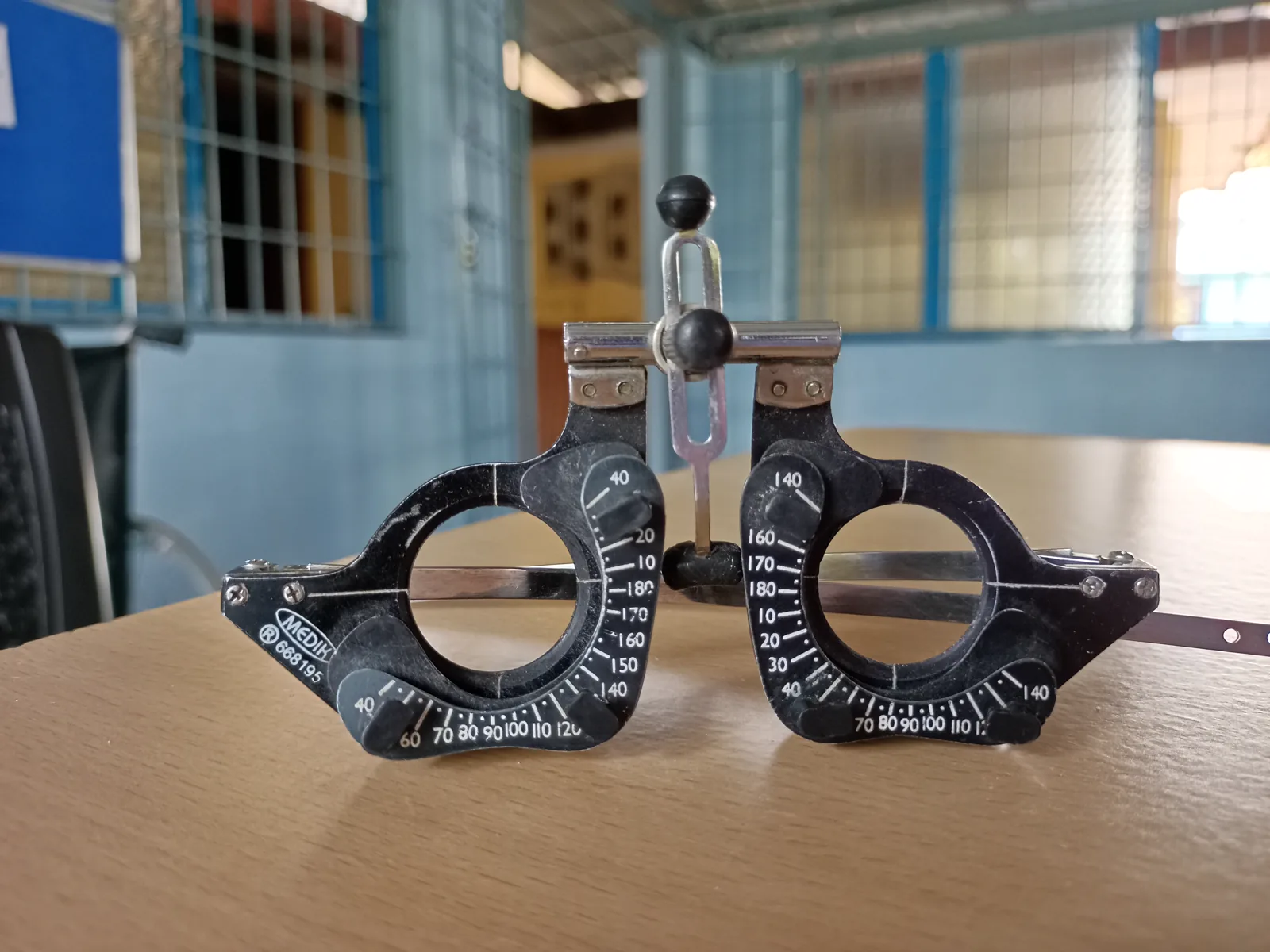
Appearance of a trial frame used to check visual acuity by wearing corrective lenses for refractive errors. Corresponds to subjective refraction and power determination discussed in section “5. Standard treatment (types of glasses and actual prescription).”
In childhood, accommodative amplitude exceeds 10D and sensory adaptation is strong. Refractive errors can generally be fully corrected. However, with aging, accommodative amplitude decreases, and optical considerations become necessary.
Exceptional cases where undercorrection of myopia is appropriate (adults)1):
When high myopia results in large spectacle magnification effects and satisfactory vault cannot be achieved
When myopia compensates for near vision at presbyopic age (myopia within -3D provides benefit at presbyopic age)
Young individuals with strong accommodation who are prone to overcorrection
The following shows age-specific guidelines for near addition power in emmetropic eyes.
Age
Guideline for Addition Power
52 years
+0.50D
56 years
+1.00D
60 years
+1.50D
64 years
+2.00D
68 years
+2.50D
If there is an existing myopia prescription, subtract the myopic power to calculate the addition (e.g., for a 56-year-old with −0.5D myopia, the near prescription is +0.50D, not +1.00D).
Indications: Basic correction for myopia, hyperopia, and astigmatism. Prescribed separately for distance and near.
Features: Simple prescription and easy to adapt. Often made separately for distance and near.
Materials: Ultra-high index (1.74–1.76) double-sided aspheric lenses can be prescribed up to −20D.
Progressive Addition Lenses
Indications: Standard multifocal glasses for presbyopia.
Features: No visible line and no image jump. However, astigmatic areas occur on both sides of the progressive corridor.
Cautions: The stronger the addition and the shorter the progressive corridor length, the more pronounced the astigmatic issues.
Intermediate-Near and Near-Near Lenses
Indications: For PC work, manual tasks, musical instrument playing, and other intermediate-to-near specific uses.
Features: Provide a wide near zone with less astigmatism.
Myopia Control Glasses (Multisegment Lenses)
Age: Clinical trial target ages are 5–18 years for MiYOSMART® and 7–18 years for Essilor® Stellest®. Not recommended for children under 5; the final target age is determined by the ophthalmologist2).
Indications: Basic criterion is bilateral myopia of −0.5 D or more under cycloplegic spherical equivalent; adaptation is considered based on myopia progression and family history 2).
Efficacy: Mean myopia progression suppression rate of 55–59% over 2 years 2).
Aniseikonia is generally considered tolerable up to 2%, corresponding to a spectacle lens power difference of approximately 1.5–2.0 D. However, tolerance varies individually, so test lenses should be used for each case 1).
The following three management methods are representative:
Reduce cylinder power: Add half the cylinder power to the sphere while keeping the circle of least confusion constant (e.g., change −1.00 D = −cyl 2.50 D A135° to −1.50 D = −cyl 1.50 D A135°)
Shift the axis: Shifting toward 90° or 180° reduces shear disparity. Limit axis shift to 15° or less to avoid increasing residual astigmatism
Shorten vertex distance: Bringing the frame closer to the face reduces magnification effects
Used to correct strabismus and diplopia. The range correctable with built-in prisms depends on lens power but is generally about 5–10 Δ; beyond that, Fresnel membrane prisms should be considered. For Fresnel membrane prisms exceeding 10 Δ, be aware of visual acuity reduction due to aberrations 1). The prescription should include the prism type, power, and base direction.
Spectacle correction for high myopia causes image minification. Compared to contact lenses (CLs), soft CLs increase higher-order aberrations, and hard CLs cause unstable vision due to lens movement. Spectacles have apparent accommodation and prism effects, which are particularly beneficial in middle age and beyond.
Points to note when prescribing spectacles for high myopia (−6 D or more) 1):
Vertex distance effect: Moving the spectacles forward or backward changes the effective power. In high myopia, even small changes in vertex distance have a large impact
Image minification: Strong concave lenses minify the image, making objects appear smaller and farther away. Caution is needed for walking and step recognition, especially when starting to wear new spectacles
Prism effect: When viewed off-axis, concave lenses produce a prism effect. Proper fitting of the glasses is important.
Selection of thin lenses: Ultra-high refractive index lenses (1.74–1.76) can reduce thickness and improve appearance and weight.
Considerations for Prescribing Glasses for Various Diseased Eyes
The Adult Eyeglass Prescription Guide (2025) details prescriptions for diseased eyes1).
Corneal diseases (e.g., keratoconus): In mild cases not manageable with RGP lenses, spherical glasses can be useful. Irregular astigmatism cannot be corrected with glasses.
Pseudophakic eyes: After cataract surgery, residual refractive error may occur depending on the IOL power setting. Residual axial hyperopia or myopia can be managed with single-vision glasses or progressive lenses.
Retinal diseases (AMD, RP, etc.): Prescription for low vision aims to maximize visual function, and combination with tinted glasses or magnifiers should be considered as needed.
Medical Expenses for Therapeutic Glasses for Pediatric Amblyopia, etc.
For children under 9 years of age, if an insurance physician determines that glasses or contact lenses are necessary for treatment of amblyopia, strabismus, or after congenital cataract surgery, medical expenses may be covered11). The full amount is initially paid out of pocket and reimbursed later upon application. The upper limit of coverage is 40,492 yen (as of April 2024; the upper limit may be revised), and within this limit, an amount corresponding to the copayment ratio of the enrolled health insurance is paid. For contact lenses, the upper limit per lens is set separately and is lower than for glasses. Occlusion devices such as eye patches and Fresnel membrane prisms are excluded. For re-issuance, at least 1 year must have passed since the previous payment for children under 5 years old, and 2 years or more for children aged 5 and older. The application requires a medical expense claim form, a copy of the prescription instructions for therapeutic glasses issued by an insurance physician (ophthalmologist), and a receipt for the purchased therapeutic glasses. Part of the copayment may be reimbursed by municipal children’s medical expense subsidy programs, but program details vary by municipality. Check with your health insurance provider for the latest handling.
For children or when monocular visual function is particularly important, consult an ophthalmologist about lens materials and the need for protective eyewear based on lifestyle and injury risk. The impact resistance and suitability of each material should be selected by checking product standards and intended use.
Examination Flow for Eyeglass Prescription (Adults, Detailed Version)
Outpatient examination flow based on the Adult Visual Acuity Testing and Eyeglass Prescription Guide (2025)1).
Gathering information on usage: Obtain detailed information on usage scenarios and viewing distances, such as driving, desk PC (monitor distance 40–80 cm), smartphone (30–40 cm), musical instrument playing (sheet music distance 50–70 cm), and near work (around 30 cm).
Check of current glasses: Measure the power and prism of the current glasses with a lensmeter. Ask about wearing status, satisfaction, and complaints.
Objective refraction: Measure spherical and cylindrical power and axis with an auto refractometer. Perform measurements at least 3 times to confirm reproducibility.
Subjective refraction: Refine spherical power, then cylindrical power, then axis using a phoropter or trial frame. Aim for MPMVA (maximum plus to maximum visual acuity).
Accommodation test: Evaluate accommodative amplitude. Used to determine near addition. If accommodative lag is present, consider near addition.
Visual acuity measurement: Record corrected visual acuity for distance and near (33 cm).
PD (pupillary distance) measurement: Accurately measure distance PD and near PD. Errors in PD can lead to prismatic errors.
Prescription writing: Record sphere, cylinder, axis, add, prism, PD, and vertex distance.
1–3 times/day in both eyes × 5 days → examination at follow-up visit
Used when esotropia is present. Recommended for use in severe astigmatism as well because the astigmatism axis can be accurately detected. Also used when glasses are deemed necessary for amblyopia due to conditions such as acquired esotropia or hyperopia
Tropicamide
Determined by ophthalmologist
1 drop in each eye → examination after 20–30 minutes
Cycloplegic effect is relatively weak; may be used in junior high school students and older
Cycloplegic agents have side effects and varying durations of action. Atropine sulfate may cause fever and facial flushing, while cyclopentolate hydrochloride may cause drowsiness. Follow the ophthalmologist’s instructions 3).
QCan myopia management glasses cure myopia?
A
Myopia management glasses do not “cure” myopia but “slow” its progression. MiYOSMART® and Essilor® Stellest® have been reported to slow myopia progression by an average of 55–59% in 2-year clinical trials 2). No rebound effect has been reported after discontinuation, and they can be stopped at any time for any reason. The typical discontinuation age is 18±2 years, continuing until myopia progression stabilizes. Consider discontinuation if there is no change in refractive error or axial length on two consecutive visits every 6 months 2).
Because spectacle lenses are placed at a distance from the corneal apex, the image appears magnified (convex lens) or minified (concave lens) depending on the power. A convex lens brings near objects within the focal length, moving the focus from behind the retina to onto the retina in hyperopia. A concave lens diverges parallel rays, moving the focus from in front of the retina to onto the retina in myopia.
When there is a difference in refractive power between the eyes, prescribing fully corrective glasses creates a difference in image size between the two eyes (aniseikonia). Convex lenses produce magnification, while concave lenses produce minification, and the greater the vertex distance, the greater the magnification effect. Cylindrical lenses for astigmatism correction cause meridional aniseikonia, where magnification differs depending on the meridian direction.
In presbyopia, decreased elasticity of the crystalline lens leads to insufficient accommodative ability, making it impossible to focus on near objects. The addition power (add) compensates for the accommodative insufficiency by adding convex power to the near portion, and it is not determined uniformly by age alone but adjusted based on working distance and residual accommodative ability1).
Accommodation is achieved by contraction of the ciliary muscle, relaxation of the zonules, and bulging of the crystalline lens. Accommodative ability decreases with age, and addition power in reading glasses or progressive addition lenses is used to compensate for the accommodation needed for near vision1).
Accommodative lag is a condition where the actual focus is behind the fixation distance (near lag), and it is particularly problematic in young myopes. Peripheral hyperopic defocus on the retina is thought to act as a signal for axial elongation, promoting myopia progression. Myopia control glasses (multisegment lenses) suppress axial elongation by converting this peripheral defocus to myopic defocus8).
The main mechanism of myopia progression is axial elongation (axial myopia). An increase of 1 mm in axial length changes the refractive error by approximately −2.5 to −3.0 D. Axial elongation is primarily due to scleral stretching, and retinal defocus signals are thought to regulate eye growth9). Bullimore et al. showed that 1 D of myopia progression suppression significantly reduces the future risk of visual impairment and pathological myopia7), indicating that even a small amount of myopia control has long-term significance.
Myopia control glasses (multisegment lenses) have an optical design that controls peripheral defocus. DIMS technology (MiYOSMART®) and HALT technology (Stellest®) are thought to send signals to suppress axial elongation by providing myopic defocus to the peripheral retina. The design maintains good central vision with full correction while simultaneously controlling defocus in the peripheral visual field2).
MiYOSMART® (HOYA, DIMS technology): 2-year RCT showed 52% reduction in spherical equivalent progression and 62% reduction in axial elongation 5)
Essilor Stellest® (Nikon-Essilor, HALT technology): 2-year RCT showed 67% reduction in spherical equivalent progression (wear time ≥12 hours/day) 6)
No rebound effect has been reported after discontinuation; can be stopped at any time. Discontinuation is typically considered at age 18±2 years, or when no change in refractive error and axial length is observed for two consecutive visits every 6 months 2)
Unlike contact lenses, spectacle lenses do not form a tear lens. Therefore, irregular astigmatism cannot be corrected with spectacles and requires RGP lenses or scleral lenses.
The Guidelines for Adult Visual Acuity Testing and Spectacle Prescription (2025) emphasize spectacle fitting as part of the prescription 1). The following are outpatient fitting checkpoints.
Back vertex distance (BVD): Usually 12–14 mm. Shortening the distance changes the effect: convex lenses become smaller, concave lenses become larger
Pantoscopic tilt: Vertical angle of the frame. A larger tilt increases the cylindrical power
Pupillary distance (PD) and lens optical center misalignment: Prism error can cause diplopia and asthenopia
Nose pad height and frame width: Slippage during wear alters the power effect
Collaboration with a certified spectacle technician (national qualification) is recommended. For myopia control spectacles, a certified spectacle technician is considered desirable as the manufacturer 2).
The global myopia population is projected to reach 4.9 billion (including 940 million with high myopia) by 2050, up from 1.3 billion in 20004). Currently, two products are recommended in guidelines: MiYOSMART® and Essilor® Stellest®; MYOGEN®, MyoCare®, and DOT lenses are scheduled for reevaluation in future revisions2). Bullimore et al. showed that 1 D of myopia progression suppression significantly reduces the risk of future visual impairment7).
Development of the spectacle optician certification system
To standardize frame fitting, a spectacle optician (national certification) system has been established. The myopia management spectacle guidelines recommend that spectacle opticians be the makers of myopia management spectacles2).
The prevalence of high myopia among junior high school students is 11.3%, exceeding the 8.2% in adults2), making the progression of myopia in younger age groups a public health issue. The natural history of myopia is comprehensively summarized in the 2023 digest of the International Myopia Institute (IMI)8). Active myopia management from school age is required.
The prevalence of refractive errors varies greatly by age, region, and definition. Kempen et al. estimated the prevalence of myopia (spherical equivalent ≤ −1 D) in individuals aged 40 years and older to be 25.4% in the United States, 26.6% in Western Europe, and 16.4% in Australia, hyperopia (+3 D or more) to be 9.9% in the United States, 11.6% in Western Europe, and 5.8% in Australia, and overall refractive errors were estimated to be about one-third in the US and Western Europe, and about one-fifth in Australia10).
Evolution of individualized lenses and progressive addition lenses
Lens manufacturers are developing progressive addition designs specialized for short to intermediate distances for HMDs (head-mounted displays) and smartphones. For “individualized” lenses that consider wavefront aberrations, the frame shape, vertex distance, pantoscopic tilt, and pupil height are measured, and the design is customized to the wearing conditions. Considerations for aniseikonia in anisometropic spectacle prescriptions and principles for determining addition power in presbyopia are summarized in the adult spectacle prescription guide1).
Holden BA, Fricke TR, Wilson DA, et al. Global prevalence of myopia and high myopia and temporal trends from 2000 through 2050. Ophthalmology. 2016;123(5):1036-1042. doi:10.1016/j.ophtha.2016.01.006. PMID:26875007.
Lam CSY, Tang WC, Tse DY, Lee RPK, Chun RKM, Hasegawa K, et al. Defocus Incorporated Multiple Segments (DIMS) spectacle lenses slow myopia progression: a 2-year randomised clinical trial. The British journal of ophthalmology. 2020;104(3):363-368. doi:10.1136/bjophthalmol-2018-313739. PMID:31142465; PMCID:PMC7041503.
Bao J, Huang Y, Li X, Yang A, Zhou F, Wu J, et al. Spectacle Lenses With Aspherical Lenslets for Myopia Control vs Single-Vision Spectacle Lenses: A Randomized Clinical Trial. JAMA ophthalmology. 2022;140(5):472-478. doi:10.1001/jamaophthalmol.2022.0401. PMID:35357402; PMCID:PMC8972151.
Bullimore MA, Brennan NA. Myopia Control: Why Each Diopter Matters. Optometry and vision science : official publication of the American Academy of Optometry. 2019;96(6):463-465. doi:10.1097/OPX.0000000000001367. PMID:31116165.
Sankaridurg P, Berntsen DA, Bullimore MA, et al. IMI 2023 digest. Invest Ophthalmol Vis Sci. 2023;64(6):7.
Troilo D, Smith EL 3rd, Nickla DL, Ashby R, Tkatchenko AV, Ostrin LA, et al. IMI - Report on Experimental Models of Emmetropization and Myopia. Investigative ophthalmology & visual science. 2019;60(3):M31-M88. doi:10.1167/iovs.18-25967. PMID:30817827; PMCID:PMC6738517.
Kempen JH, Mitchell P, Lee KE, Tielsch JM, Broman AT, Taylor HR, et al. The prevalence of refractive errors among adults in the United States, Western Europe, and Australia. Archives of ophthalmology (Chicago, Ill. : 1960). 2004;122(4):495-505. doi:10.1001/archopht.122.4.495. PMID:15078666.