Amblyopia is a condition in which corrected visual acuity in one or both eyes does not develop sufficiently due to visual deprivation or abnormal binocular interaction during the sensitive period of visual development. It is characterized by visual impairment that cannot be explained by organic disease and can be improved with appropriate treatment1).
Low vision is a social and functional concept referring to visual impairment that cannot be adequately corrected with spectacles, and is distinct from medical amblyopia caused by abnormal visual development. Medical amblyopia is evaluated as visual impairment that cannot be explained by organic disease alone, and is diagnosed after excluding causative ocular diseases1).
Population-based studies have shown a prevalence of amblyopia ranging from 0.7% to 2.6% in children aged 30–71 months1). By classification, anisometropic amblyopia is the most common, followed by refractive amblyopia, strabismic amblyopia, and form deprivation amblyopia. Unilateral amblyopia is associated with strabismus in 19–50% of cases and with refractive error in 46–79% of cases1).
Risk factors for amblyopia include prematurity, low birth weight, developmental delay (including Down syndrome), and a first-degree family history of amblyopia or strabismus. Some reports also suggest an association with maternal smoking and alcohol consumption during pregnancy1).
QCan amblyopia develop in adulthood?
A
Amblyopia is a developmental disorder that occurs during the sensitive period of visual development. It does not newly develop in adults, but childhood amblyopia may persist untreated. Some improvement has been observed in studies targeting children aged 7 to 17 years, and treatment potential should not be judged solely by age 1).
Unilateral amblyopia is often asymptomatic. Because the healthy eye compensates for daily vision, the affected child rarely notices the visual impairment.
Decreased visual acuity: Often noticed only when the healthy eye is occluded. Most cases are discovered incidentally during vision screening.
Impaired stereopsis (depth perception): Stereopsis may be reduced due to anisometropia or strabismus, making it difficult to judge distances 1).
Crowding phenomenon: In the amblyopic eye, identifying letters in a row is more difficult than identifying a single letter.
The diagnostic criteria for amblyopia are shown below 1).
Age
Unilateral Amblyopia
Bilateral Amblyopia
3–4 years
Interocular difference ≥2 lines
Both eyes <20/50
4–5 years
Interocular difference ≥2 lines
Both eyes <20/40
≥5 years
Interocular difference ≥2 lines
Both eyes <20/30
Interocular difference in corrected visual acuity: A difference of ≥2 lines on the logMAR chart is a diagnostic criterion.
Fixation abnormality: Strabismic amblyopia may be accompanied by eccentric fixation (parafoveal, paramacular, or peripheral fixation).
Reduced contrast sensitivity: In anisometropic amblyopia, reduced contrast sensitivity in the medium-to-high spatial frequency range is characteristic, affecting both central and peripheral visual fields. In strabismic amblyopia, the reduction is limited to the central visual field.
Loss or reduction of stereopsis: Assessed using the Worth 4-Dot Test, Titmus stereo test, Lang stereo test, etc.1)
QWhat is crowding phenomenon?
A
This is a phenomenon in which the amblyopic eye has difficulty identifying letters when they are densely arranged. Because single letters are seen better than a line of letters on a visual acuity chart, testing with a single optotype may underestimate the severity of amblyopia. It is recommended to use optotypes with crowding bars for visual acuity testing.
Amblyopia is broadly classified into four types based on cause.
Refractive Amblyopia
Ametropic amblyopia: A condition in which both eyes have a similar high degree of refractive error, preventing clear image formation on the foveal retina and impairing visual development. The higher the refractive error, the greater the risk 1).
Meridional amblyopia: A special type occurring in eyes with high astigmatism. Sensitivity to stripe patterns in a specific orientation is reduced.
Anisometropic Amblyopia
Anisometropic amblyopia: A condition in which the refractive difference between the two eyes is large, and the eye with the greater refractive error fails to develop normal vision. Hyperopic anisometropia can cause amblyopia even with relatively small differences 1).
This is the most common type of amblyopia. Approximately one-third of children with 2 diopters of anisometropia have amblyopia, and even a 1–2 D difference increases the odds of amblyopia by 4.5 times 1).
Strabismic Amblyopia
Strabismic amblyopia: A unilateral amblyopia caused by strabismus, where a clear retinal image is not projected onto the fovea of the deviated eye, leading to suppression of the non-dominant eye. It is more common in esotropia. If alternating fixation is present, amblyopia is less likely. It rarely occurs in intermittent exotropia.
Form Deprivation Amblyopia
Form deprivation amblyopia: Caused by obstruction of visual stimulation due to congenital cataract, corneal opacity, or severe ptosis. It is often resistant to treatment, and unilateral cases tend to be more severe than bilateral ones 1).
Microstrabismic amblyopia is sometimes considered a fifth type. In primary microstrabismus, amblyopia due to eccentric fixation may occur 1).
Guidelines for Refractive Correction Prescription in Infants and Young Children
The table from the AAO Pediatric Eye Evaluations PPP provides expert consensus-based guidelines for prescribing refractive correction in infants and young children, not thresholds for amblyopia development. Due to the lack of rigorous scientific data, decisions should be individualized based on age, visual acuity, eye alignment, and refractive progression 13).
By type of anisometropia, hyperopic anisometropia tends to cause amblyopia, while myopic anisometropia is less likely to cause amblyopia than hyperopic anisometropia with the same degree of difference because the myopic eye can be used for near vision. Treatment decisions are made based on a comprehensive assessment of age, refractive difference, visual acuity, and eye alignment1,13).
Hyperopic Anisometropia
Amblyopia risk: The greater the difference in hyperopia between the eyes, the higher the risk of amblyopia1).
Characteristics: The most common type of anisometropic amblyopia. The eye with stronger hyperopia does not form a clear image on the fovea, making it prone to amblyopia.
Myopic Anisometropia
Amblyopia risk: Amblyopia can occur when the difference in myopia between the eyes is large, but it is less likely to occur than with a similar degree of hyperopic anisometropia1).
Characteristics: For near vision, the more myopic eye obtains a clearer image, making amblyopia less likely.
Astigmatic Anisometropia
Amblyopia risk: The greater the difference in astigmatism between the eyes, the higher the risk of amblyopia1).
Characteristics: The axis direction affects visual development. The greater the difference in astigmatism, the higher the risk of onset.
Main risk factors:
Family history: Increased risk with a first-degree family history of amblyopia or strabismus
Prematurity / low birth weight
Developmental delay: Developmental disorders including Down syndrome
Environmental factors: Reports suggest an association with smoking and alcohol consumption during pregnancy
Amblyopia is a diagnosis of exclusion, and the prerequisite for diagnosis is the absence of any organic disease that would explain the reduced visual acuity.
In Japan, the 3-year-old visual health checkup consists of a primary screening at home, a secondary screening at public health centers, and a detailed examination by an ophthalmologist. Vision tests use optotypes appropriate for the child’s age and comprehension level. For young children or those with developmental delays who cannot undergo reliable subjective vision testing, instrument-based screening is useful 13).
Select a method appropriate for the child’s age. Options include the Landolt C ring, picture optotypes, Lea chart, and HOTV. The use of optotypes with crowding bars is recommended.
In children suspected of having amblyopia, refraction under cycloplegia should be performed to eliminate the influence of accommodation. Cyclopentolate hydrochloride 1% is widely used because it achieves cycloplegia close to atropine 1% with a shorter duration of action1). In infants under 6 months of age, a combination eye drop of cyclopentolate 0.2% + phenylephrine 1% is often used, and atropine sulfate 1% is used in cases requiring stronger cycloplegia1). Concomitant use of tropicamide 0.5% and phenylephrine 2.5% is also an option1). The choice of cycloplegic agent, its concentration, and the number of instillations are determined by the ophthalmologist based on the child’s age, ocular alignment, and general condition 1,13).
Ocular Alignment, Fixation, and Stereopsis Testing
It is important to differentiate from organic visual impairment, ruling out optic nerve diseases, retinal dystrophies, trauma, refractive errors, accommodative spasm, and visual pathway lesions. Evaluation of the pupillary light reflex (RAPD) is also important1).
QHow is amblyopia detected during the 3-year-old health checkup?
A
In Japan, the 3-year-old visual health checkup consists of a primary checkup at home, a secondary checkup at a health center, and a detailed checkup at an ophthalmology clinic. If visual acuity is low in one eye, if testing is unstable, or if refractive error is suspected, the child is referred for detailed examination. For children who have difficulty with subjective visual acuity testing, screening using instruments is also utilized13).
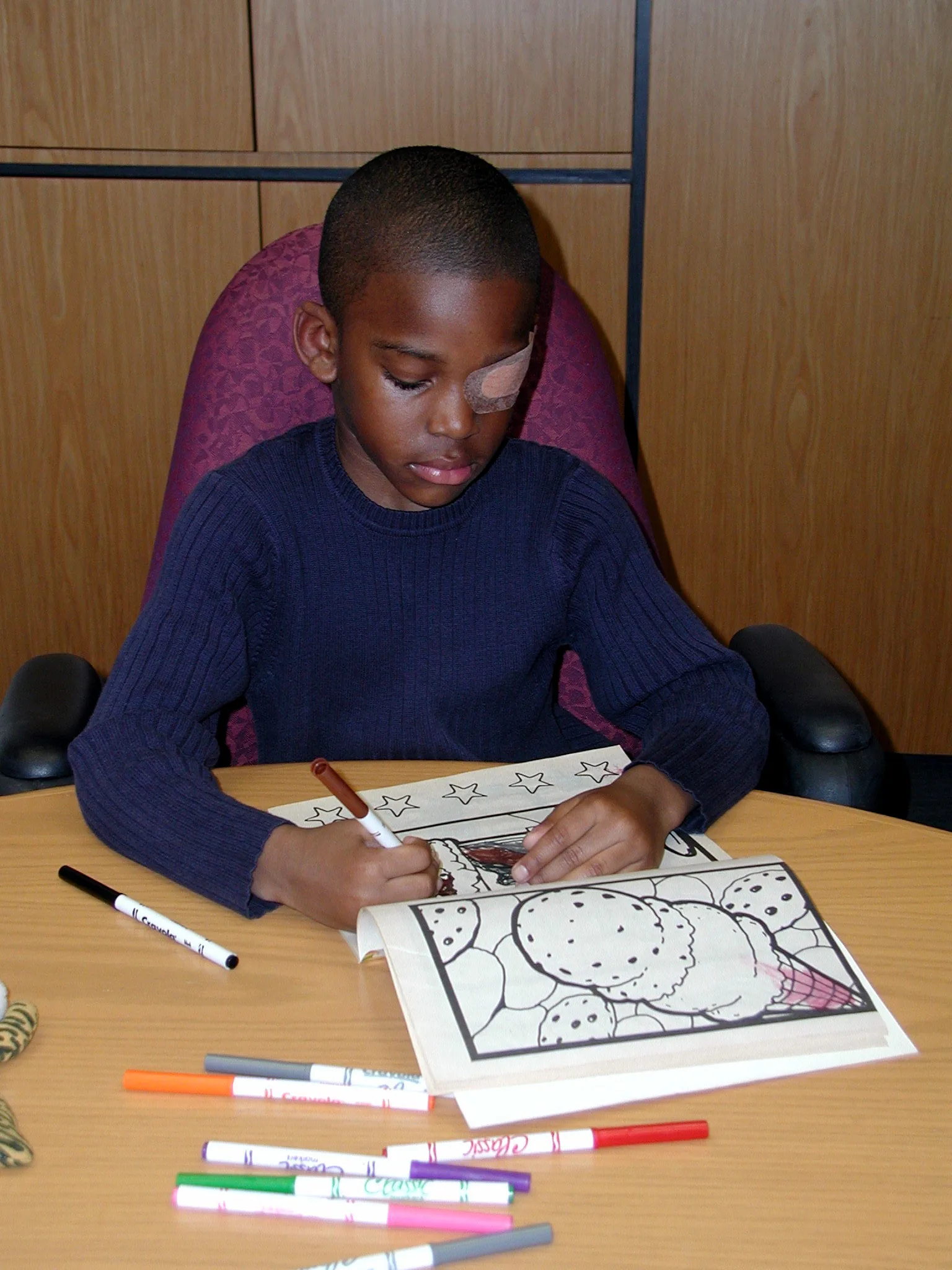
National Eye Institute, National Institutes of Health. Wikimedia Commons File:Child_eyepatch.jpg. Public domain (United States federal government work).
A child undergoing occlusion therapy with an eye patch on the healthy eye, actively using the amblyopic eye. Near vision tasks such as coloring are used to stimulate visual input to the amblyopic eye.
Since the large-scale RCT results from the Pediatric Eye Disease Investigator Group (PEDIG) in the United States were published in 2002, evidence from multicenter studies has accumulated for amblyopia treatment 9). The basis of treatment is to eliminate the underlying cause and promote visual stimulation to the amblyopic eye.
When the visual axis is obstructed by congenital cataract or severe ptosis, the causative disease should be evaluated early, and the timing of occlusion removal, including surgery, is determined individually by a pediatric ophthalmologist 1). In unilateral congenital cataract causing visual deprivation, the visual prognosis is reported to be good if cataract extraction and optical correction can be completed by 2 months of age1).
The first step in treatment is spectacle prescription based on cycloplegic refraction. In anisometropic amblyopia, visual improvement can be achieved in many cases with spectacle wear alone 10).
In a PEDIG prospective study, 27% of children aged 3–6 years with anisometropic amblyopia were cured with spectacle correction alone, with an average improvement of 0.29 logMAR, and 77% showed improvement of 0.2 logMAR or more 10). Since improvement with refractive correction can also be expected in strabismic and mixed amblyopia, it is recommended to first observe with spectacles alone until visual acuity stabilizes 1).
In Japan, therapeutic spectacles and contact lenses for pediatric amblyopia in children under 9 years of age are covered by medical expense benefits. Renewal is eligible if at least 1 year has passed since the previous fitting for children under 5 years, and at least 2 years for children aged 5 to under 9 years 21). As the system may change, confirm the latest information from the insurer at the time of application.
If a visual acuity difference remains after refractive correction alone, consider adding occlusion of the sound eye or atropine treatment while monitoring visual acuity changes 1).
When visual acuity does not improve sufficiently with spectacle wear alone, the non-amblyopic eye (sound eye) is occluded. The basic method is complete occlusion using an adhesive patch.
Key results from the PEDIG ATS study group 1):
Study
Content
Result
ATS1
Patching vs atropine (6 months)
3.16 lines vs 2.84 lines improvement, equivalent
ATS2A
All-day vs 6 hours (severe amblyopia)
No significant difference
ATS2B
6 hours vs 2 hours (moderate amblyopia)
No significant difference
ATS3
Treatment for ages 7–17
Effective for ages 7–12; also effective for ages 13–17 if untreated
ATS15
Stagnation at 2 hours → increase to 6 hours
Improvement seen
Guidelines for occlusion time:
Severe amblyopia (0.05–0.2): No significant difference in improvement between 6-hour and all-day occlusion
Moderate amblyopia (0.25–0.5): No significant difference between 2-hour and 6-hour occlusion
Microstrabismic amblyopia: Confirm fixation status, visual acuity difference, and binocular function, and individually adjust occlusion time 1)
Electronic occlusion time monitoring studies have reported that the occlusion time required for a one-line improvement changed from 58 hours/line in the first month to an average of 169 hours/line over 4 months 11). Starting occlusion of the sound eye after the child has become accustomed to wearing glasses can reduce the child’s stress.
This method involves instilling atropine into the sound eye to blur near vision and encourage use of the amblyopic eye. Atropine 1% eye drops in the sound eye are effective for mild to moderate amblyopia aged 3 to 15 years, and instillation on two consecutive days per week showed efficacy equivalent to daily instillation1). The concentration and frequency of instillation are determined by the ophthalmologist based on age, refractive status, and treatment response 1).
In a 17-week RCT for children aged 7–12 years, weekend atropine and 2 hours of daily occlusion showed similar visual acuity improvement 16)
In a 4-month RCT for children aged 3 to under 7 years, daily instillation and weekend instillation showed similar improvement 17)
Follow-up at age 15 compared the original RCT’s daily 1% atropine with 6 or more hours daily or full-time occlusion, and found no difference between groups in long-term visual acuity18)
Atropine + patching combination: In severe amblyopia, an additional 0.14 logMAR improvement compared to monotherapy 3)
In moderate amblyopia, it shows equivalent efficacy to patching 1)
This method involves attaching a Bangerter (translucent) filter to the spectacle lens of the sound eye. In moderate amblyopia, the difference in visual acuity improvement compared to patching is within 0.5 lines, and it has been reported to reduce caregiver burden and stress 1). Amblyz liquid crystal shutter glasses (intermittent occlusion of 30 seconds per minute) have shown equivalent efficacy to patching 3).
Refractive surgery (PRK) has been reported to be effective in cases of anisometropic amblyopia where patients are noncompliant with spectacle correction, but sufficient evidence for its use in children has not been established 1).
QHow many hours of occlusion therapy are appropriate?
A
The PEDIG ATS study showed that for severe amblyopia, full-time occlusion and 6-hour occlusion had no significant difference in improvement, and for moderate amblyopia, 6-hour and 2-hour occlusion had no significant difference 1). Depending on the severity of amblyopia, 2 to 6 hours of occlusion is recommended; excessive occlusion increases the risk of occlusion amblyopia. If improvement plateaus, consider increasing to 6 hours.
Up to age 12, there is potential for improvement of 2 or more lines of visual acuity. Even at age 13 or older, untreated cases may show improvement, but the response diminishes with age. PEDIG ATS3 showed improvement of 0.2 logMAR or more in 53% of children aged 7–12 years and 25% of those aged 13–17 years; among untreated 13–17-year-olds, 47% improved by 0.2 or more with glasses plus occlusion (vs. 20% with glasses alone) 3).
At the end of treatment, gradually reduce occlusion time rather than stopping abruptly. In a PEDIG prospective study, approximately 24% of children aged 3–8 years who discontinued occlusion or atropine treatment experienced recurrence within 52 weeks 12). Recurrence can occur early after treatment cessation, so visual acuity should be monitored after discontinuation.
Human visual function develops rapidly after birth, with different sensitive periods for each function. The period during which abnormal visual input has the greatest impact and the period during which treatment can restore function do not completely overlap 2).
Visual development involves multiple sensitive periods 2).
Sensitive period for normal development: the period during which visual input is necessary for normal development
Sensitive period for deprivation: the period during which abnormal visual input causes permanent adverse effects (including after normal development is complete)
Sensitive period for recovery: the period during which recovery from the adverse effects of deprivation is possible
Different visual functions have different sensitive periods, with distinct timelines for visual acuity, peripheral vision, global motion, and OKN asymmetry 2).
Abnormal visual stimulation during the sensitive period of visual development leads to structural and functional changes in the lateral geniculate nucleus (LGN) and the striate cortex (primary visual cortex, V1).
Lateral geniculate nucleus (LGN): Shrinkage of cell bodies of neurons corresponding to the amblyopic eye. fMRI studies have confirmed reduced LGN response.
Functions primarily involving the striate cortex, such as visual acuity and contrast sensitivity, are impaired by competitive interactions between the deprived and non-deprived eyes 2). Functions involving extrastriate cortex, such as global motion, involve interocular cooperative interactions 2). In the amblyopic eye, decreased contrast sensitivity and accommodative function are observed 1). Subtle functional deficits may also exist in the fellow eye 1).
Anisometropic amblyopia: Two mechanisms are involved: blurring of the retinal image in one eye (direct effect) and interocular competition/suppression (indirect effect). Contrast sensitivity loss occurs at medium to high spatial frequencies and involves both central and peripheral visual fields, distinguishing it from strabismic amblyopia.
Strabismic amblyopia: Competitive and suppressive interactions between neurons processing non-fusible binocular input lead to dominance of the fixating eye and chronic reduction of cortical response in the deviating eye. Contrast sensitivity loss is limited to the central visual field.
Form deprivation amblyopia: Deterioration of the retinal image due to complete or partial occlusion of the visual axis. Onset timing and duration of deprivation strongly affect prognosis, so early evaluation and treatment of the causative condition are necessary 1,2).
While conventional occlusion therapy passively stimulates the amblyopic eye, dichoptic treatment presents different images with adjusted contrast to each eye, actively balancing binocular vision.
The digital therapeutic “Luminopia” showed in an RCT of 105 children aged 4–7 years with anisometropic or strabismic amblyopia that visual acuity in the amblyopic eye improved by 1.8 lines in the treatment group compared to 0.8 lines in the spectacle-only group 14). Another study reported visual acuity improvement with dichoptic movie viewing 3).
The “CureSight” system using eye-tracking technology demonstrated non-inferiority to patching in a multicenter RCT involving 103 patients aged 4 to under 9 years 15).
Arnold et al. (2024) administered CureSight to a 6-year-old girl with severe anisometropic amblyopia who had poor compliance with conventional patching and atropine treatment 4). After one month of treatment, logMAR improved from 0.9 to 0.7, and stereopsis improved from 400 seconds of arc to 140 seconds of arc. At 5 months, visual acuity reached 0.6.
In the PEDIG RCT (dichoptic therapy using a falling block game, 385 patients aged 5–12 years), the mean improvement was 1.35 lines in the patching group and 1.05 lines in the game group, with the patching group showing numerically greater improvement, and non-inferiority of game therapy was not established 19).
Molina-Martin et al. (2023) conducted 18 sessions (30 minutes each) of immersive VR Gabor patch stimulation in 4 children with anisometropic amblyopia5). In younger patients aged 8 years or younger, distance visual acuity improved by 3–4 lines, stereopsis improved by at least one step in all cases, with 3 cases reaching 60 seconds of arc. Contrast sensitivity at 3 cpd also improved by approximately 0.5 CS units 5).
Conventionally, amblyopia in adults beyond the sensitive period has been considered difficult to treat. However, a study of 16 patients aged 21–67 years who wore glasses and underwent occlusion for 1 hour daily showed a mean improvement of 2.4 lines, with 31% improving by 3 or more lines 20). This is a small study and cannot be generalized to all adults. Perceptual learning is also being investigated for its potential to improve visual acuity and contrast sensitivity in adult amblyopic eyes 3).
Halicka et al. (2021) reported that a 22-year-old adult with anisometropic amblyopia underwent 44 hours of dichoptic training in a VR environment, and corrected visual acuity in the amblyopic eye improved from 0.05 to 0.5 6). Visual acuity of 0.4 was maintained one year after training completion. fMRI showed changes in visual cortex activity patterns.
In a prospective study of 100 cases by Jost et al. (2023), the risk of amblyopia recurrence after dichoptic treatment was 24% (95% CI: 16–35%) at 36 months by Kaplan-Meier analysis 7). The mean time to recurrence was 11.8 months, similar to reported values after cessation of patching or atropine treatment. There was no significant difference between the group that received additional treatment (19%) and the group that did not (32%).
Drews-Botsch et al. (2025) followed 105 children with unilateral congenital cataract (UCC) and showed that visual acuity at age 4 predicts prognosis at age 10.5 (Spearman r=0.83) 8). There was no correlation between the amount of patching after age 4 and visual acuity change; children with 20/200 or worse did not reach 20/100 or better with additional patching.
Regarding attempts to enhance treatment efficacy by combining levodopa (a dopamine precursor) with patching, PEDIG is conducting a multicenter RCT, but its effectiveness for residual amblyopia is currently considered limited 1). There are also some reports on the application of citicoline for amblyopia 3).
QCan dichoptic treatment replace patching?
A
At present, it does not replace conventional treatment for all types of amblyopia. Luminopia has shown efficacy compared to glasses alone, and CureSight compared to patching, but the target age and disease types are limited, so indications should be discussed with a pediatric ophthalmologist 14,15).
Cruz OA, Repka MX, Hercinovic A, Cotter SA, Lambert SR, Hutchinson AK, et al. Amblyopia Preferred Practice Pattern. Ophthalmology. 2023;130(3):P136-P178. doi:10.1016/j.ophtha.2022.11.003. PMID:36526450; PMCID:PMC10701408.
Terri L. Lewis, Daphne Maurer. Multiple sensitive periods in human visual development: Evidence from visually deprived children. Developmental Psychobiology. 2005;46(3):163-183. doi:10.1002/dev.20055.
Meier K, Tarczy-Hornoch K. Recent Treatment Advances in Amblyopia. Annu Rev Vis Sci. 2022;8:323-343. doi:10.1146/annurev-vision-100720-022550.
Arnold RW. Dichoptic Rescue for Spectacle-Flip Sabotage of Anisometropic Amblyopia Therapy. Clinical optometry. 2024;16:83-87. doi:10.2147/OPTO.S454342. PMID:38476961; PMCID:PMC10929207.
Molina-Martín A, Leal-Vega L, de Fez D, Martínez-Plaza E, Coco-Martín MB, Piñero DP.. Amblyopia Treatment through Immersive Virtual Reality: A Preliminary Experience in Anisometropic Children. Vision (Basel). 2023;7(2):42. doi:10.3390/vision7020042. PMID:37218960; PMCID:PMC10204412.
Juraj Halicka, Michal Bittsansky, Stefan Sivak, David P. Piñero, Peter Ziak. Virtual Reality Visual Training in an Adult Patient with Anisometropic Amblyopia: Visual and Functional Magnetic Resonance Outcomes. Vision. 2021;5(2):22. doi:10.3390/vision5020022.
Jost RM, Kelly KR, Birch EE. Risk of recurrence after cessation of dichoptic, binocular treatment of amblyopia. Journal of AAPOS : the official publication of the American Association for Pediatric Ophthalmology and Strabismus. 2023;27(5):298-300. doi:10.1016/j.jaapos.2023.06.009. PMID:37619861; PMCID:PMC10592044.
Drews-Botsch CD, Cotsonis G, Celano M, et al. Is patching after age 4 beneficial for children born with a unilateral congenital cataract? Ophthalmology. 2025;132:389-396. doi:10.1016/j.ophtha.2024.11.005. PMID:39522734; PMCID:PMC11930621.
Pediatric Eye Disease Investigator Group. A randomized trial of atropine vs. patching for treatment of moderate amblyopia in children. Archives of ophthalmology (Chicago, Ill. : 1960). 2002;120(3):268-78. doi:10.1001/archopht.120.3.268. PMID:11879129.
Cotter SA, Pediatric Eye Disease Investigator Group, Edwards AR, Wallace DK, Beck RW, Arnold RW, et al. Treatment of anisometropic amblyopia in children with refractive correction. Ophthalmology. 2006;113(6):895-903. doi:10.1016/j.ophtha.2006.01.068. PMID:16751032; PMCID:PMC1790727.
Fronius M, Cirina L, Ackermann H, Kohnen T, Diehl CM. Efficiency of electronically monitored amblyopia treatment between 5 and 16 years of age: new insight into declining susceptibility of the visual system. Vision research. 2014;103:11-9. doi:10.1016/j.visres.2014.07.018. PMID:25130409.
Holmes JM, Beck RW, Kraker RT, Astle WF, Birch EE, Cole SR, et al. Risk of amblyopia recurrence after cessation of treatment. Journal of AAPOS : the official publication of the American Association for Pediatric Ophthalmology and Strabismus. 2004;8(5):420-8. PMID:15492733.
Hutchinson AK, Morse CL, Hercinovic A, Cruz OA, et al. Pediatric Eye Evaluations Preferred Practice Pattern. Ophthalmology. 2023;130(3):P222-P270. doi:10.1016/j.ophtha.2022.10.030. PMID:36543602; PMCID:PMC10680450.
Xiao S, Angjeli E, Wu HC, et al. Randomized Controlled Trial of a Dichoptic Digital Therapeutic for Amblyopia. Ophthalmology. 2022;129(1):77-85. doi:10.1016/j.ophtha.2021.09.001. PMID:34534556.
Wygnanski-Jaffe T, Kushner BJ, Moshkovitz A, et al. An Eye-Tracking-Based Dichoptic Home Treatment for Amblyopia: A Multicenter Randomized Clinical Trial. Ophthalmology. 2023;130(3):274-285. doi:10.1016/j.ophtha.2022.10.020. PMID:36306974.
Scheiman MM, Hertle RW, Kraker RT, Beck RW, Birch EE, Felius J, et al. Patching vs atropine to treat amblyopia in children aged 7 to 12 years: a randomized trial. Arch Ophthalmol. 2008;126(12):1634-1642. doi:10.1001/archophthalmol.2008.107. PMID:19064841; PMCID:PMC2846774.
Repka MX, Cotter SA, Beck RW, Kraker RT, Birch EE, Everett DF, et al. A randomized trial of atropine regimens for treatment of moderate amblyopia in children. Ophthalmology. 2004;111(11):2076-2085. doi:10.1016/j.ophtha.2004.04.032. PMID:15522375.
Repka MX, Kraker RT, Holmes JM, Summers AI, Glaser SR, Barnhardt CN, et al. Atropine vs patching for treatment of moderate amblyopia: follow-up at 15 years of age of a randomized clinical trial. JAMA Ophthalmol. 2014;132(7):799-805. doi:10.1001/jamaophthalmol.2014.392. PMID:24789375; PMCID:PMC4206086.
Holmes JM, Manh VM, Lazar EL, Beck RW, Birch EE, Kraker RT, et al. Effect of a Binocular iPad Game vs Part-time Patching in Children Aged 5 to 12 Years With Amblyopia: A Randomized Clinical Trial. JAMA Ophthalmol. 2016;134(12):1391-1400. doi:10.1001/jamaophthalmol.2016.4262. PMID:27812703; PMCID:PMC5145771.
Kishimoto F, Fujii C, Shira Y, Hasebe K, Hamasaki I, Ohtsuki H. Outcome of conventional treatment for adult amblyopia. Jpn J Ophthalmol. 2014;58(1):26-32. doi:10.1007/s10384-013-0279-z. PMID:24158452.