

Synoptophore (Major Amblyoscope)
1. What is a synoptophore (major amblyoscope)?
Section titled “1. What is a synoptophore (major amblyoscope)?”A large amblyoscope is an instrument used for examining binocular function and performing vision training in cases of strabismus, amblyopia, and ocular motility disorders. It is also called a synoptophore, with “large amblyoscope” being the official name.
Device Structure
Section titled “Device Structure”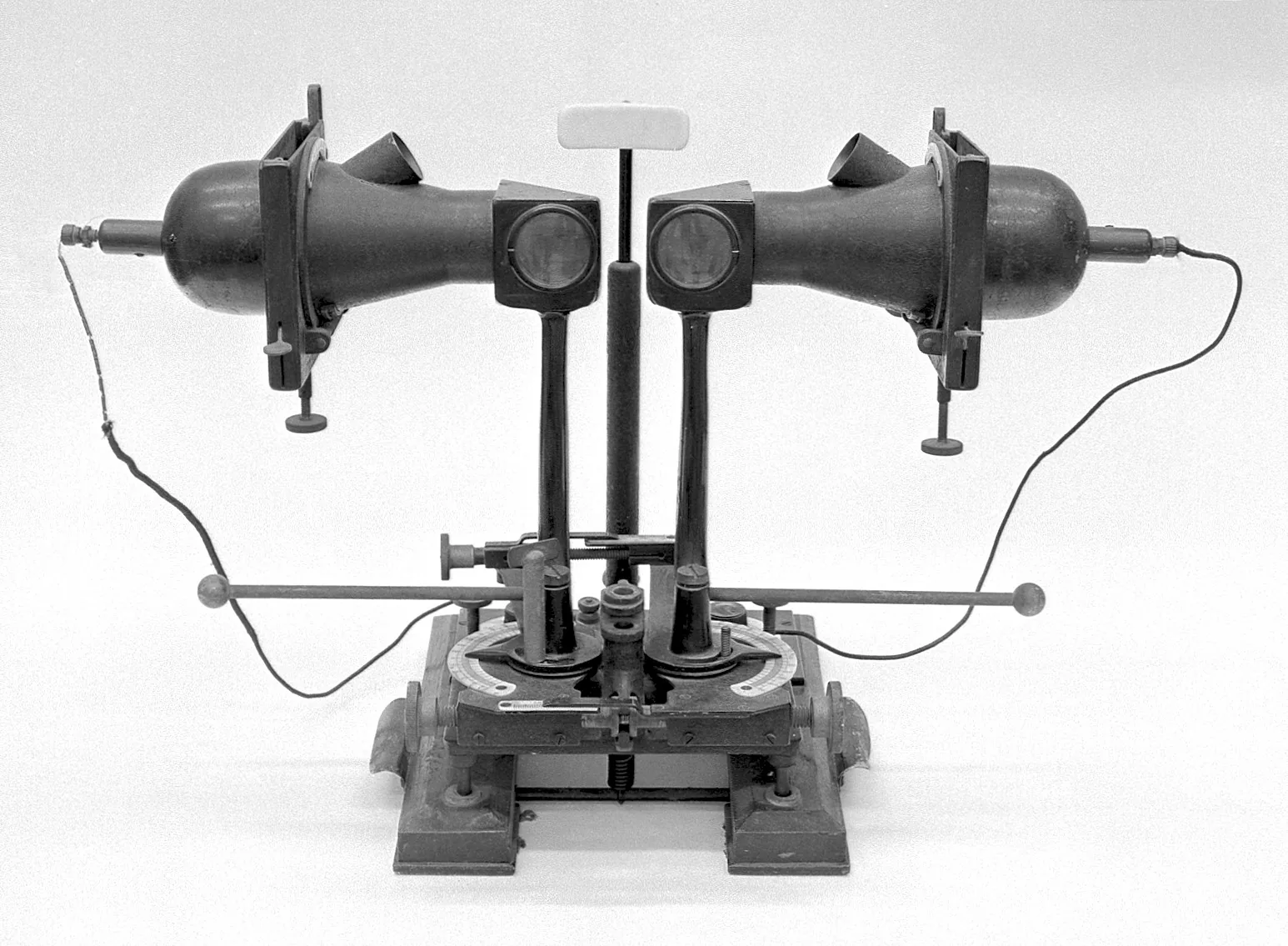

The large amblyoscope consists of the following components.
- Illumination chamber/slide chamber: The part where the test slide is loaded and the target is illuminated.
- Reflecting mirrors and eyepieces: An optical system that refracts the target light and guides it to each eye.
- Telescope tube: A structure that integrates the illumination chamber, slide chamber, reflector, and eyepiece. It exists independently on the left and right sides.
- Angle display: A scale that shows the direction of the tube in angles (prism diopters or degrees).
The left and right tubes each have independent optical systems, presenting separate targets to the left and right eyes. The examinee undergoes testing in a state of binocular dissociation, where different targets are presented to each eye while using both eyes simultaneously. Since the targets are presented as optically distant to each eye, evaluation can be performed under conditions where the influence of accommodation is reduced compared to ordinary near vision.
Five classifications for examination and training purposes
Section titled “Five classifications for examination and training purposes”The functions of the major amblyoscope can be broadly classified into five categories.
- Quantitative eye position measurement: Quantifies eye position in 9 directions (horizontal, vertical, and torsional).
- Binocular vision function test: Evaluates the presence and degree of simultaneous perception, fusion, and stereopsis.
- Fusional range measurement: Quantifies fusional amplitude.
- Measurement of cyclodeviation: Quantify objective and subjective cyclodeviation.
- Vision training: Gradually train sensory fusion and stereopsis.
The ability to comprehensively perform these functions with a single device is the greatest feature of the large amblyoscope.
Types of Target Slides
Section titled “Types of Target Slides”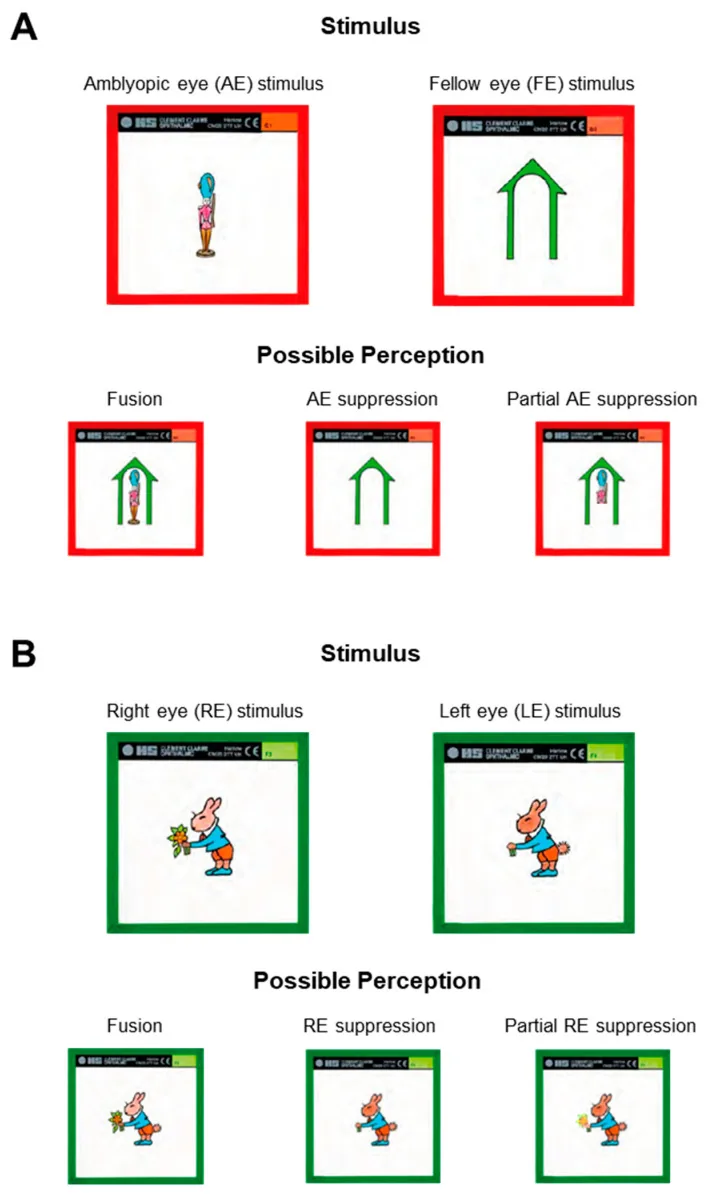
Multiple sets of two test slides are available, and the appropriate slides are selected according to the examination purpose and the patient’s age.
| Slide type | Example of target | Main examination purpose |
|---|---|---|
| Simultaneous perception slide | Lion and cage | Check for simultaneous perception and suppression |
| Fusion slide | Rabbit (body and tail) | Measurement of fusion range and fusion width |
| Stereoscopic slide | Small-angle disparity target | Assessment of stereoscopic function |
Simultaneous perception slides use two non-overlapping targets (e.g., a lion and a cage). If suppression is present, the patient reports that the target in one eye disappears. Fusion slides use targets that are identical in shape but differ in part (e.g., a rabbit body and its tail). When fusion is achieved, the targets merge into a single complete image. Since appropriate slide selection directly affects test accuracy, it is important to choose slides based on the patient’s age and level of cooperation.
2. Indications and Clinical Findings
Section titled “2. Indications and Clinical Findings”Indications
Section titled “Indications”The major amblyoscope is indicated for the following diseases and conditions.
- Comitant strabismus (esotropia/exotropia): A strabismus in which the eye deviation is approximately equal in all directions.
- Incomitant strabismus (ocular muscle palsy/eye movement disorder): Strabismus where the angle of deviation varies depending on the direction of gaze.
- Intermittent strabismus: A case in which strabismus appears intermittently.
- Amblyopia: Cases requiring evaluation and training of binocular vision.
The main subjects of examination are children with strabismus aged 3 years and older. It is standard equipment in strabismus and amblyopia specialty clinics and is one of the basic examination instruments in outpatient care. Since young children need to cooperate by looking into the tube and responding to targets, it is assumed that they have reached a developmental stage where subjective responses can be reliably obtained.
Facilities of Use
Section titled “Facilities of Use”It is standard equipment in ophthalmology clinics with specialized strabismus and amblyopia outpatient services. Orthoptists are often in charge of examination and training, playing a central role in binocular vision assessment and vision training using the instrument.
Clinical findings obtained through examination
Section titled “Clinical findings obtained through examination”The major amblyoscope examination allows quantitative evaluation of the following clinical findings.
- Subjective angle of strabismus: The subjective deviation of the visual axis in horizontal, vertical, and torsional directions is measured in degrees.
- Fusional amplitude: Quantifies the range of angles over which fusion can be maintained.
- Presence of simultaneous perception, fusion, and stereopsis: Determine each stage of binocular visual function individually.
- Retinal correspondence status: Determine whether normal or abnormal retinal correspondence is present.
- Gamma angle: Evaluates the angular deviation between the visual axis and the fovea centralis. An abnormal gamma angle may cause apparent strabismus in appearance.
- Objective angle of strabismus: The ocular deviation measured objectively. Comparison with the subjective angle of strabismus allows diagnosis of anomalous retinal correspondence.
The main target is children aged 3 years and older. Since the child must look into the tube and respond to targets, it may be difficult for younger children with immature language and comprehension skills. For children under 3 years, other examination methods (such as alternate cover test, Hirschberg test, Krimsky test, etc.) are prioritized.
3. Principles and Methods of Examination
Section titled “3. Principles and Methods of Examination”Principle of binocular dissociation
Section titled “Principle of binocular dissociation”The major amblyoscope inserts different target slides into the left and right tubes, presenting separate targets to each eye as optical distance vision. Unlike ordinary near vision, the optical system of the tubes artificially creates a distance vision state, allowing the examination to be performed in an environment where accommodation is less likely to be induced.
However, note that proximity convergence (convergence due to physical closeness) and accommodative convergence (convergence linked to accommodation) are slightly induced by the act of looking into the instrument. It is necessary to interpret the obtained strabismic angle on the assumption that these interventions are present.
Subjective and Objective Examinations
Section titled “Subjective and Objective Examinations”The major amblyoscope allows two types of examinations.
- Objective examination: The examiner observes the patient’s eyes and calculates the objective strabismus angle from the fixation position. Since the patient’s conscious cooperation is not required, this can be performed even in infants or patients with communication difficulties.
- Subjective test: The subject reports the position where the visual target is aligned (subjective ocular position), and the subjective strabismus angle is calculated from the angle of the mirror tube.
Quantitative measurement of eye position in 9 directions
Section titled “Quantitative measurement of eye position in 9 directions”Ocular alignment is measured along three axes: horizontal deviation (esotropia/exotropia), vertical deviation (hypertropia/hypotropia), and torsional deviation (intorsion/extorsion). This allows the creation of a nine-direction gaze map, which is useful for identifying the paralyzed muscle in incomitant strabismus (ocular muscle palsy) and evaluating postoperative progress.
Examination procedure
Section titled “Examination procedure”- The examinee sits facing the instrument and places both eyes against the eyepieces of each tube.
- Adjust the height and width (interpupillary distance) of the binocular tube to fit the patient’s face.
- Insert the target test slide into the slide chamber.
- Instruct the examinee to look at the target, and in subjective testing, give instructions such as “Move it to the position where the two figures overlap.”
- Read the angle scale on the tube and record the squint angle and fusion range.
Each examination item (simultaneous perception, fusion range, cyclodeviation, retinal correspondence) is performed sequentially within the same session. The examination is generally conducted in the order of simultaneous perception, fusion, and stereopsis.
4. Details of Examination Techniques and Evaluation Items
Section titled “4. Details of Examination Techniques and Evaluation Items”Procedure for Each Examination Item
Section titled “Procedure for Each Examination Item”Simultaneous perception test: Using simultaneous perception slides, check whether the patient can recognize the targets of both eyes simultaneously. If suppression is present, the patient reports that the target in one eye is invisible (disappears).
Ocular alignment measurement (subjective): Using fusion slides, record the angle of the prism bars at the position where the patient perceives the two targets as “superimposed into one.” Measure horizontal, vertical, and torsional alignment. If the difference from the objective strabismus angle is large, suspect abnormal retinal correspondence.
Fusional amplitude measurement: Using a fusion slide, gradually move the tubes inward and outward to determine the angle at which fusion breaks. Calculate the fusional amplitude from the limits of convergence (positive direction) and divergence (negative direction). Narrowing of the fusional amplitude is an indicator of binocular vision dysfunction. It has been reported that children with intermittent exotropia have reduced convergence fusional amplitude compared to normal children1. Note that the fusional amplitude measured with a synoptophore and a prism bar may not match (especially on the convergence side, where the synoptophore tends to show larger values), and it is not recommended to use them interchangeably2.
Stereopsis test: Using stereoscopic slides, check whether the patient can perceive depth. Stereopsis evaluation with a major amblyoscope has the advantage of allowing adjustment of the angular disparity of targets presented to the left and right eyes.
Measurement of cyclodeviation: Subjectively, the patient adjusts the cyclofusion target to the position where it appears straight; objectively, it is evaluated using fundus photographs or ophthalmoscopic findings. This provides important information for diagnosing ocular muscle palsy.
Retinal correspondence test: Compare the subjective angle of strabismus with the objective angle. If they match, it is normal retinal correspondence; if there is a difference, it is judged as abnormal retinal correspondence (ARC).
Organization of information evaluable with the large amblyoscope
Section titled “Organization of information evaluable with the large amblyoscope”| Evaluation item | Slide used | Clinical significance |
|---|---|---|
| Presence of simultaneous perception | Simultaneous perception slide | Presence and degree of suppression |
| Subjective angle of strabismus | Fusion slides | Reference for surgical amount |
| Fusion range | Fusion slide | Strength of binocular vision |
| Stereopsis | Stereopsis slide | Assessment of highest-level binocular vision |
| Cyclodeviation | Cyclorotation | Diagnosis of superior oblique palsy, etc. |
| Retinal correspondence | Fusion/simultaneous perception slides | Presence or absence of ARC |
5. Vision training using a major amblyoscope
Section titled “5. Vision training using a major amblyoscope”Concept of Vision Training
Section titled “Concept of Vision Training”Vision training is a treatment method that coordinates sensory and motor training to achieve good eye alignment and binocular vision. The major amblyoscope is used for both stepwise evaluation and training of binocular visual function. Since young children have difficulty using the instrument and providing subjective responses, training is realistically implemented after school age.
Indications for training
Section titled “Indications for training”The main indications for visual training using a major amblyoscope are as follows.
- Intermittent exotropia after school age: Performed as suppression removal, convergence training, and fusion training before and after surgical treatment.
- Strabismus with amblyopia: When binocular vision is evaluated and trained in parallel with amblyopia treatment.
In young children (generally preschool age), cooperation with examination is difficult to obtain, making training implementation challenging. The appropriate time to start training is after school age, when stable subjective responses can be obtained.
Three stages of training
Section titled “Three stages of training”Vision training using a large amblyoscope proceeds in the following three stages. Each stage is carried out sequentially, and the next stage is initiated only after mastery of the previous stage is confirmed.
Stage 1: Simultaneous Perception Training
Section titled “Stage 1: Simultaneous Perception Training”For cases with suppression (a condition where the brain unconsciously erases the image from the squinting eye), training is first conducted to enable simultaneous recognition of targets in both eyes. Using simultaneous perception slides, techniques such as flashing and brightness adjustment are employed to break suppression and promote simultaneous binocular recognition. Acquiring simultaneous perception is a prerequisite for fusion and stereopsis training. It has been reported that the technique of gradually changing the illumination of the synoptophore on the left and right sides can be applied to quantify the depth of suppression with higher sensitivity than the Worth 4-dot test3.
Stage 2: Fusion Training
Section titled “Stage 2: Fusion Training”After achieving simultaneous perception, the goal is to expand the fusion range. Using fusion slides, repeatedly practice superimposing the targets into one. Gradually widen the range of convergence (positive fusion) and divergence (negative fusion) to strengthen stable binocular single vision.
Stage 3: Stereopsis Training
Section titled “Stage 3: Stereopsis Training”After fusion is stable, aim to acquire fine stereopsis. Using stereoscopic slides, practice eliciting depth perception from the disparity between left and right targets. Acquiring stereopsis is an indicator that binocular visual function has reached a practical level.
Combination of hospital visits and home training
Section titled “Combination of hospital visits and home training”Training using a large amblyoscope is generally performed on an outpatient basis. Since the large amblyoscope cannot be used at home, it is recommended to combine it with convergence training at home (such as reading exercises and pencil push-ups) to maintain continuous training effects.
Limitations and positioning of vision training
Section titled “Limitations and positioning of vision training”Only a limited number of cases achieve complete cure of strabismus through vision training alone. For intermittent exotropia in school-age children and older, it is effective as an adjunctive therapy before and after surgical treatment, and is used in combination with preoperative binocular vision assessment and postoperative fusion enhancement. It is important to periodically reassess training effects with a major amblyoscope and adjust the training program. It has been reported that combining binocular vision training with refractive correction and prism therapy improves ocular alignment rates and binocular vision in children with esotropia and amblyopia compared to monotherapy4. In amblyopia treatment, improvement in fusion function has also been shown to correlate with visual acuity improvement5.
- Preoperative role: Preparation for postoperative binocular vision acquisition by releasing suppression and expanding fusion range
- Postoperative role: Stabilization of eye position through fusion training, promotion of stereopsis recovery
- Cases not requiring surgery: Training assistance for follow-up observation while maintaining binocular vision in intermittent exotropia with a small deviation angle
Only a limited number of cases of strabismus are cured by vision training alone. In intermittent exotropia after school age, it is positioned as an adjunctive therapy before and after surgery. It is important to confirm the results of training through reassessment with a major amblyoscope and consider the indication for surgery as necessary.
6. Development of binocular vision and significance of examination
Section titled “6. Development of binocular vision and significance of examination”Developmental stages of binocular vision
Section titled “Developmental stages of binocular vision”Binocular vision develops in stages through visual experience after birth. The developmental sequence is as follows.
- Simultaneous perception: The first binocular vision function to be acquired. The stage at which images from both eyes are simultaneously recognized by the brain.
- Fusion: The ability to integrate the images from both eyes into a single image. It includes sensory fusion and motor fusion.
- Stereopsis: The highest level of binocular vision that perceives depth from binocular disparity (slight differences between the images in the left and right eyes).
This developmental sequence corresponds to the three stages of binocular vision evaluated with the major amblyoscope: simultaneous perception, fusion, and stereopsis. In patients with strabismus or amblyopia, any of these stages may be disrupted during development, and identifying which stage is affected directly determines the treatment strategy.
Positioning of the major amblyoscope: comparison with other examination methods
Section titled “Positioning of the major amblyoscope: comparison with other examination methods”The major amblyoscope is characterized by its ability to quantitatively assess each binocular visual function in stages under conditions of binocular separation. In contrast, near stereopsis tests (such as the Titmus stereo test and Randot stereo test) measure stereopsis under natural binocular viewing conditions (using polarized glasses), and the two are complementary.
| Comparison item | Major amblyoscope | Near stereopsis test (Titmus, etc.) |
|---|---|---|
| Measurement conditions | Binocular dissociation, simulated distance conditions | Natural near binocular vision conditions |
| Measurable functions | Simultaneous perception, fusion, stereopsis, eye position | Primarily stereopsis |
| Quantitative | High (quantified by angle and degree) | Medium (displayed in seconds of arc) |
| Application in training | Possible | Not possible |
By combining the results of binocular visual function evaluation obtained with the major amblyoscope and the results of near stereopsis testing, a more accurate overall picture of the patient’s binocular visual function can be obtained. The involvement of proximity and accommodative convergence is a limitation of the major amblyoscope, and caution is needed in interpreting the results. Stepwise evaluation of binocular visual function provides important information for determining the indication for strabismus surgery, selecting the surgical technique, and managing postoperative care.
Simultaneous perception is the ability to recognize images from both eyes at the same time, fusion is the ability to combine them into a single image, and stereopsis is the ability to perceive depth from slight differences between the left and right images. Development proceeds in this order (simultaneous perception → fusion → stereopsis). The major amblyoscope can individually evaluate and train these functions.
This examination can be performed at an ophthalmology facility with a specialized strabismus and amblyopia outpatient clinic. At facilities with orthoptists, not only testing but also orthoptic training (simultaneous perception, fusion, and stereopsis training) can be provided.
References
Section titled “References”Footnotes
Section titled “Footnotes”-
Fu T, Wang J, Levin M, Su Q, Li D, Li J. Fusional vergence detected by prism bar and synoptophore in chinese childhood intermittent exotropia. J Ophthalmol. 2015;2015:987048. PMID: 25954512. doi:10.1155/2015/987048 ↩
-
Haque S, Toor S, Buckley D. Are Horizontal Fusional Vergences Comparable When Measured Using a Prism Bar and Synoptophore? Br Ir Orthopt J. 2024;20(1):85-93. PMID: 38525409. PMCID: PMC10959145. doi:10.22599/bioj.326 ↩
-
Plaumann MD, Roberts KL, Wei W, Han C, Ooi TL. Refining Clinical Quantification of Depth of Suppression in Amblyopia through Synoptophore Measurement. Life (Basel). 2023;13(9):1900. PMID: 37763304. PMCID: PMC10532546. doi:10.3390/life13091900 ↩
-
Liang J, Pang S, Yan L, Zhu J. Efficacy of binocular vision training and Fresnel press-on prism on children with esotropia and amblyopia. Int Ophthalmol. 2023;43(2):583-588. PMID: 35945412. doi:10.1007/s10792-022-02461-9 ↩
-
Lv Z, Tao Z, Hu G, Deng H. Significance of binocular fusion in enhancing visual acuity during amblyopia treatment. Transl Pediatr. 2024;13(10):1767-1776. PMID: 39524389. PMCID: PMC11543132. doi:10.21037/tp-24-125 ↩