Superficial punctate keratitis (superficial punctate keratopathy: SPK) is a condition in which the outermost cells of the corneal epithelium are shed in a punctate pattern due to various causes. When fluorescein vital staining is performed, the epithelial defects are observed as punctate or clustered staining. The basal cell layer is preserved; if the damage extends deeper, it is called corneal erosion, and if it reaches the stroma, it is called corneal ulcer.
An important premise is that SPK is merely a “finding” and not an independent disease name. It is commonly seen in patients presenting with a foreign body sensation in ophthalmology outpatient clinics, and various underlying diseases may be hidden. Therefore, in the management of SPK, searching for the cause is the first step in determining the treatment strategy.
On the other hand, an exceptional case treated as an independent disease entity is Thygeson superficial punctate keratitis (TSPK). TSPK was reported by Phillips Thygeson in 1950; it is a mostly bilateral, recurrent corneal epithelitis, and is described in a separate section as an idiopathic superficial keratitis for which no clear causative disease can be identified.
Chemical factors: Toxicity of eye drop medications (including the preservative benzalkonium chloride), transfer of systemic antineoplastic drugs into tears
SPK is not a disease name but a “finding” observed as a result of corneal epithelial damage from some cause. Since definitive treatment is not possible without identifying the cause, a search for the cause must always be performed when SPK is found. Only Thygeson superficial punctate keratitis is exceptionally treated as an independent disease entity.
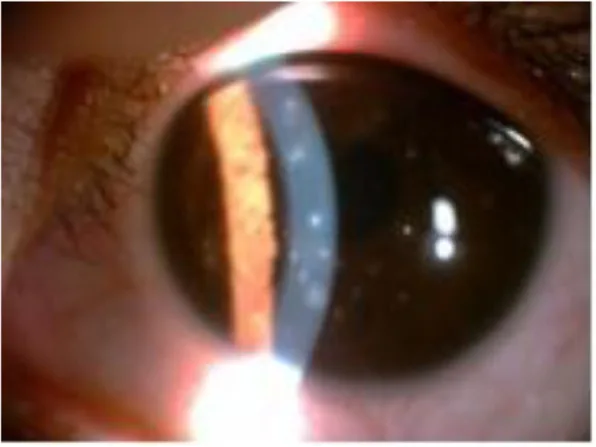
Tang XJ, et al. Thygeson’s superficial punctate keratitis (TSPK): a paediatric case report and review of the literature. BMC Ophthalmology. 2021;21:64. Figure 1. PMCID: PMC7845125. License: CC BY 4.0 (https://creativecommons.org/licenses/by/4.0/).
Slit-lamp microscope photograph showing multiple isolated epithelial lesions (left eye). These correspond to the punctate epithelial lesions discussed in the section “2. Main symptoms and clinical findings.”
In many cases, slit-lamp microscopy does not reveal visible lesions, and evaluation using fluorescein vital staining is central to diagnosis. Staining patterns vary, including punctate, vortex, and crack-line forms, and the degree of staining differs depending on the severity of the damage.
Observation points: Observe the palpebral fissure width, meibomian gland openings, and tear meniscus.
Diffuse / Focal Type
Diffuse: Drug toxicity (eyedrop toxicity, antineoplastic drug side effects), severe dry eye, SCL disorders, corneal epithelial-related dystrophies (e.g., Meesmann).
Focal type: Conjunctival foreign body, herpes infection, 3 o’clock and 9 o’clock staining in CL wearers.
Mild SPK: Scattered punctate staining. Subjective symptoms mild to moderate.
Late staining (Bathwater cornea): Fluorescein seeps in some time after instillation. Indicates epithelial barrier dysfunction. Frequent in drug toxicity.
Hurricane keratopathy: Whorl-like staining pattern in the central cornea. Moderate finding of drug toxicity.
Epithelial crack line: Crack-like linear defect. Severe form of drug toxicity.
Persistent epithelial defect: SPK progresses to extensive epithelial defect.
Findings of Thygeson Superficial Punctate Keratitis
TSPK is a distinct disease different from common cause-specific SPK and shows characteristic clinical features.
Bilateral and recurrent: Usually bilateral, with a course of exacerbations and remissions.
Elevated lesions in the central cornea: Multiple gray-white, roundish, slightly elevated punctate opacities scattered.
Conjunctival quietness: The absence of conjunctival injection or inflammatory reaction is an important clue for differential diagnosis.
Fluorescein staining: The center of the lesion stains punctately. The corneal epithelium around the lesion is normal.
Corneal sensation: Normal or only slightly reduced.
Subjective symptoms: Photophobia, blurred vision, foreign body sensation, and irritation. Review-level literature notes an average of about 20 punctate lesions per exacerbation, with exacerbations lasting 1–2 months and remission taking about 6 weeks. A retrospective case series of 40 patients showed that the disease can last for years to decades12).
QHow much can the cause be narrowed down based on the staining pattern?
A
The distribution of fluorescein staining is a strong clue for estimating the cause. Superior staining suggests superior limbic keratoconjunctivitis or allergy; central staining suggests neurotrophic keratopathy, Thygeson SPK, or hard contact lens (HCL) damage; inferior or interpalpebral staining suggests dry eye or MGD; diffuse staining suggests drug toxicity or severe dry eye. However, the cause cannot be determined solely by the staining site; comprehensive evaluation of tear function, eyelids, corneal sensation, medications, and systemic diseases is necessary.
Aqueous tear-deficient dry eye: A subtype with reduced basal tear secretion. The 2016 Japanese diagnostic criteria require both “subjective symptoms such as ocular discomfort and visual disturbance” and “tear breakup time (BUT) ≤5 seconds.” Schirmer I test is an auxiliary test for evaluating tear secretion and is not part of the current diagnostic criteria8). Risk factors include aging, Sjögren syndrome, rheumatoid arthritis, and anticholinergic medication use.
Short BUTdry eye: Tear volume is preserved but tear film stability is reduced, with tear film breakup immediately after blinking. Associated with VDT work, air conditioning, and contact lens wear3).
Meibomian gland dysfunction (MGD): Obstruction of meibomian gland openings or abnormal lipid secretion impairs the tear lipid layer, leading to evaporative dry eye and refractory SPK1,4). Inferior to interpalpebral SPK is typical.
Hard contact lens damage: Causes SPK localized to the central cornea. Prolonged wear time and poor lens fitting are risk factors.
Soft contact lens-related disorder: Presents with diffuse or inferior SPK. A prospective study of silicone hydrogel lens wearers reported that the incidence of corneal staining from care products varied by lens and care product combination, and suggested that lens material/design, care products, and their interaction contribute to adverse events9).
Trichiasis and entropion: Eyelashes abrade the corneal surface, causing mechanical damage.
Conjunctivochalasis: Loose conjunctiva encroaches into the inferior palpebral fissure, increasing friction during blinking.
Toxic keratopathy from medications: Primarily caused by preservatives in eye drops (benzalkonium chloride: BAC), but may also result from the toxicity of the active ingredient. Commonly reported with antiglaucoma drugs, antibiotics, antifungals, antivirals, NSAID eye drops, beta-blockers, and topical anesthetics. Mild cases present with dry eye-like palpebral fissure to inferior SPK; severe cases progress to hurricane keratopathy, epithelial crack lines, and persistent epithelial defects. Long-term toxic load from eye drops can induce limbal stem cell deficiency and pseudopemphigoid. Systemic administration of anticancer drugs such as TS-1 causes epithelial damage from the superior limbus.
Herpes simplex virus keratitis (epithelial type): Typically unilateral, with decreased corneal sensation and dendritic ulcer. Early stages may show punctate or stellate epithelial lesions, requiring differentiation from SPK7).
Adenoviral keratitis: Observed as multiple subepithelial infiltrates associated with epidemic keratoconjunctivitis. A history of preceding conjunctivitis is a distinguishing feature.
Neurotrophic keratopathy: Caused by trigeminal nerve damage leading to decreased corneal sensation and impaired epithelial healing, resulting in central SPK. Etiologies include post-herpetic corneal disease, herpes zoster ophthalmicus, trigeminal nerve surgery, and brainstem lesions.
Exposure keratopathy: Incomplete eyelid closure leads to drying of the inferior cornea. Underlying conditions include facial nerve palsy, thyroid eye disease, orbital tumors, nocturnal lagophthalmos, and coma.
Diabetic keratopathy: Caused by diabetic neuropathy and reduced epithelial adhesion.
This is a recurrent corneal epitheliopathy of unknown cause; an immunological mechanism has been hypothesized. Coexistence with celiac disease has been reported in one case of a 20-year-old female, but a causal relationship or general frequency of coexistence cannot be concluded from a single case2). In a retrospective case series examining the efficacy of tacrolimus, improvement in symptoms and signs during treatment was reported, but recurrence occurred upon discontinuation, and it was not shown to be a curative treatment15).
Collagen diseases such as rheumatoid arthritis, diabetes mellitus, and atopic dermatitis can be underlying conditions for SPK. When formulating a treatment plan, it is important to obtain a history of systemic diseases.
The management of SPK involves not only confirming the findings but also systematically investigating “what is causing the epithelial damage,” which is key to determining the treatment strategy.
History taking: Obtain information on acute/chronic onset, unilateral/bilateral involvement, CL wear history, current eye drops and oral medications, trauma or foreign body exposure, and history of systemic diseases (rheumatoid arthritis, diabetes, atopy, Sjögren syndrome, etc.). Acute, unilateral cases are more likely to be exogenous (foreign body, chemical substance), while chronic, bilateral cases are more likely to be endogenous (dry eye, MGD, drug toxicity).
Slit-lamp examination: Check for inflammatory findings such as subepithelial infiltrates, conjunctival injection, and anterior chamber inflammation.
Fluorescein vital staining: Estimate the cause from the staining pattern and location (see CardGrid in Section 2).
Schirmer test I: Measures basal and reflex tear secretion. A 5-minute value of ≤5 mm suggests decreased tear secretion, but the 2016 Japanese diagnostic criteria for dry eye require a combination of subjective symptoms and BUT ≤5 seconds; the Schirmer value is interpreted as an auxiliary assessment of the subtype and tear secretion volume8).
Tear film breakup time (BUT): After fluorescein instillation, the patient maintains an open eyelid, and the time until dry spots appear on the tear film is measured. A value of ≤5 seconds is considered abnormal and serves as the diagnostic basis for BUT-shortened dry eye3,8).
Tear meniscus observation: The height of the tear meniscus at the lower eyelid margin is evaluated. It shows low values in decreased-secretion dry eye.
Cochet-Bonnet corneal esthesiometer: Sensitivity is reduced in conditions such as corneal herpes, diabetic keratopathy, post-LASIK, long-term contact lens wear, and facial nerve palsy. Decreased sensitivity reduces reflex tear secretion and worsens SPK.
Confocal microscopy: In a study of 5 TSPK cases, stellate hyperreflective deposits in the superficial and basal epithelial layers, subepithelial opacities, and Langerhans cells in the basal epithelial layer were reported, corresponding to lesions seen on slit-lamp examination. Bowman’s layer abnormalities observed in 3 cases were all associated with a disease history exceeding 1 year, but these are findings from a small-scale study13).
Tear tests: Lactoferrin quantification, MMP-9 testing, etc., are used as adjuncts.
Systemic disease screening: Anti-SS-A/SS-B antibodies, HbA1c, serum IgE, etc., are evaluated as needed.
Record the extent of fluorescein staining and the density of punctate lesions. Since the scale used may vary by facility or clinical setting, the same evaluation method should be used consistently for the same patient to compare changes before and after treatment.
QWhat methods are available for assessing the severity of SPK?
A
Record the area of fluorescein staining and the density of punctate lesions, and compare before and after treatment. Since evaluation scales may vary by facility or clinical setting, it is important to consistently use the same method during follow-up.
The basic principle of SPK treatment is the combination of “removal of the cause” and “protection and repair of the corneal epithelium”. Treatment strategies differ greatly depending on the underlying disease, so cause-specific approaches are described below.
Tear Supplementation and Protection
Sodium hyaluronate eye drops: Used to retain water on the ocular surface and improve keratoconjunctival epithelial disorders. In the Japanese guideline CQ for dry eye associated with Sjögren’s syndrome, it is weakly recommended as a treatment option3).
Artificial tears: Preservative-free formulations are preferable. They are the first choice for mild cases or cases of drug toxicity.
Ophthalmic ointment: Consider ophthalmic ointment for corneal protection in cases where dryness or exposure during sleep is a problem.
Improvement of Tear Dynamics
Diquafosol sodium eye drops: Promote water and mucin secretion. In the Japanese guideline CQ for dry eye associated with Sjögren’s syndrome, it is strongly recommended as a treatment option that improves tear stability, keratoconjunctival epithelial disorders, and subjective symptoms3).
Rebamipide eye drops: Have a mucin secretion-promoting effect. In the same CQ for dry eye associated with Sjögren’s syndrome, it is weakly recommended as a treatment option that improves keratoconjunctival epithelial disorders and subjective symptoms3).
Evaluate the deficient components of the tear film and severity, and select individually from artificial tears, hyaluronic acid, diquafosol, rebamipide, etc.
For dry eye associated with Sjögren’s syndrome, the Japanese guideline strongly recommends diquafosol and punctal plugs, and weakly recommends hyaluronic acid, rebamipide, and corticosteroids3).
In a randomized study comparing punctal plugs and artificial tears in 42 eyes with primary Sjögren’s syndrome, symptoms, corneal fluorescein staining, Schirmer values, and BUT improved from baseline in both groups after 3 months. Between-group comparison showed greater improvement in Schirmer values and BUT in the punctal plug group, but it was not superior in all outcomes including symptoms and corneal staining11).
When using corticosteroid eye drops, monitor for elevated intraocular pressure and infections 3).
Warm compress: Current MGD clinical practice guidelines strongly recommend it as a treatment to improve symptoms and meibum quality1). Although devices and heating conditions in included studies vary, patient instructions in Japan widely use around 40°C, 5 minutes per session, 1–2 times daily. Specific temperature, duration, and frequency should follow product instructions and ophthalmologist’s guidance.
Eyelid hygiene: Use in combination depending on the condition of the eyelid margin 1).
If dry eye is also present, provide eye drop treatment according to the tear film condition. Antibiotics, corticosteroids, oral antibiotics, etc., should be individually assessed based on inflammatory findings, disease type, and indications, and not used as a uniform regimen 1).
Anti-allergic eye drops are the mainstay; if corneal involvement is present, consider corticosteroid eye drops depending on severity. Monitor for elevated intraocular pressure and do not continue indiscriminately. Immunosuppressive eye drops such as tacrolimus are not added for general allergic conjunctivitis but are considered by a specialist for severe or refractory atopic keratoconjunctivitis or vernal keratoconjunctivitis5).
Adjunctive therapy: If hyperemia or follicular conjunctivitis is prominent, consider low-concentration steroid eye drops, but be aware of delayed wound healing.
Neurotrophic Keratopathy, Diabetic Keratopathy, and Lagophthalmos-Related Keratopathy
Perform forced eyelid closure (e.g., with mepatch clear) and use protective soft contact lenses.
Adjust lubricating and protective eye drops or ointments individually according to the degree of ocular surface dryness, exposure, and epithelial damage.
Antibacterial agents are not routinely administered; they are used only when infection is suspected or diagnosed, in the minimum necessary amount according to the susceptibility of the presumed or identified pathogen and the package insert.
Mild cases: TSPK is a benign, self-limiting disease with recurring exacerbations and remissions that heals without scarring. If symptoms are mild, treatment may be limited to symptom relief with artificial tears, or observation without treatment12). Because long-term steroid eye drops carry risks of increased intraocular pressure and cataracts, choosing observation in mild cases is reasonable.
Symptomatic cases: Corticosteroid eye drops are the mainstay of treatment; the drug, concentration, frequency, and tapering schedule are determined individually based on the lesion and risk of side effects12).
Recurrent or steroid-dependent cases: Immunomodulatory therapy with cyclosporine or tacrolimus may be an option. However, evidence is limited to case reports and retrospective case series. In a series of 14 cases treated with tacrolimus, improvement was seen during treatment, but recurrence occurred upon discontinuation, and a curative effect was not demonstrated2,15).
Therapeutic contact lenses: In a case series of 40 patients, therapeutic contact lenses were used as second-line therapy in only one case; they are not considered standard treatment and are considered individually by specialists for refractory cases12).
QHow should diquafosol and rebamipide be differentiated for SPK due to dry eye?
A
Since the two drugs have different mechanisms of action, selection is based on evaluation of the tear film status, epithelial damage, and subjective symptoms. The recommendation strength in domestic guidelines is based on a CQ targeting dry eye associated with Sjögren syndrome: diquafosol is strongly recommended, and rebamipide is weakly suggested. This should not be uniformly applied to all dry eye subtypes; the attending physician makes an individual judgment3).
The corneal epithelium is constantly renewed through turnover from the basal cell layer. SPK is understood as an early state where the balance of turnover is disrupted due to increased shedding of the most superficial cells or decreased cell supply from basal cells. In many cases, the former, i.e., increased shedding, is the main cause.
Dry eye: Instability of the tear film leads to ocular surface drying and stress on epithelial cells. Inflammatory cytokines (IL-1, TNF-α) and activation of MMP-9 disrupt the epithelial barrier6).
Meibomian gland dysfunction: Qualitative and quantitative abnormalities of meibomian gland lipids reduce the function of the tear lipid layer, leading to increased evaporation and tear film instability1). Chronic inflammation creates a vicious cycle of progressive obstruction of the meibomian glands within the tarsal plate.
Drug toxicity: The preservative benzalkonium chloride (BAC) disrupts the phospholipid layer of corneal epithelial cell membranes, impairing barrier function. Even mild epithelial damage is visualized as a late-staining pattern where fluorescein readily penetrates. Long-term exposure leads to reduced limbal stem cell function.
Neurotrophic keratopathy: Loss of trigeminal nerve innervation deprives the epithelium of neurotrophic factors (substance P, CGRP, NGF), reducing epithelial adhesion and wound healing capacity.
Immunological Mechanisms of Thygeson Superficial Punctate Keratitis
The immunological mechanism of TSPK has not been established. Findings from small studies and case reports include the following.
Langerhans cells: In a confocal microscopy study of 3 cases (4 eyes), Langerhans cells were increased in the basal epithelial layer and Bowman’s membrane of the lesions. This small study suggests inflammatory involvement but does not establish a cause14).
Coexistence with autoimmune diseases: The original article confirmed in this review is a single case with coexisting celiac disease, and should not be generalized to Addison’s disease, Sjögren’s syndrome, or systemic lupus erythematosus2).
Response to immunomodulators: There are case reports of cyclosporine and a retrospective case series of tacrolimus, but drug response alone cannot prove a T-cell-mediated pathology2,15).
Confocal microscopy studies of TSPK have reported microstructural changes in the epithelium, subepithelium, Bowman’s layer, and stroma, but the subjects were only 5 cases, limiting generalization of the relationship with duration 13). In a case series of 40 patients, many had visual acuity of 20/30 or better in both eyes at initial presentation, and the disease was reported to span years to decades 12).
Tagmouti et al. reported a case of a 20-year-old woman with a history of celiac disease who developed TSPK. In this case, cyclosporine A 2% eye drops were tapered from three times daily over 6 months, and no recurrence was observed during 3 years of follow-up 2). However, this is a single case report and does not support a causal relationship between the two diseases, routine celiac disease screening in TSPK patients, or generalization of treatment efficacy.
The TFOS DEWS II (2017) presents a framework for the definition, classification, management, and treatment of dry eye based on factors causing tear film instability and severity 6,10). Since SPK is a finding, dry eye is not treated uniformly; instead, the background such as tear deficiency, tear film instability, MGD, and inflammation is evaluated to select treatment.
Tagmouti A, Lazaar H, Benchekroun M, Boutaj T, Benchekroun S, Amazouzi A, et al. Association Between Thygeson Superficial Punctate Keratitis and Celiac Disease. Cureus. 2025;17(3):e80252. doi:10.7759/cureus.80252. PMID:40196095; PMCID:PMC11975144.
Jones L, Downie LE, Korb D, Benitez-Del-Castillo JM, Dana R, Deng SX, et al. TFOS DEWS II Management and Therapy Report. The ocular surface. 2017;15(3):575-628. doi:10.1016/j.jtos.2017.05.006. PMID:28736343.
Carnt NA, Evans VE, Naduvilath TJ, Willcox MDP, Papas EB, Frick KD, Holden BA. Contact lens-related adverse events and the silicone hydrogel lenses and daily wear care system used. Arch Ophthalmol. 2009;127(12):1616-1623. doi:10.1001/archophthalmol.2009.313. PMID:20008717.
Craig JP, Nichols KK, Akpek EK, Caffery B, Dua HS, Joo CK, et al. TFOS DEWS II Definition and Classification Report. The ocular surface. 2017;15(3):276-283. doi:10.1016/j.jtos.2017.05.008. PMID:28736335.
Qiu W, Liu Z, Ao M, Li X, Wang W. Punctal plugs versus artificial tears for treating primary Sjögren’s syndrome with keratoconjunctivitis SICCA: a comparative observation of their effects on visual function. Rheumatol Int. 2013;33(10):2543-2548. doi:10.1007/s00296-013-2769-1. PMID:23649850.
Nagra PK, Rapuano CJ, Cohen EJ, Laibson PR. Thygeson’s superficial punctate keratitis: ten years’ experience. Ophthalmology. 2004;111(1):34-37. doi:10.1016/j.ophtha.2003.05.002. PMID:14711711.
Kobayashi A, Yokogawa H, Sugiyama K. In vivo laser confocal microscopy findings of Thygeson superficial punctate keratitis. Cornea. 2011;30(6):675-680. doi:10.1097/ICO.0b013e318200099d. PMID:21562457.
Kawamoto K, Chikama T, Takahashi N, Nishida T. In vivo observation of Langerhans cells by laser confocal microscopy in Thygeson’s superficial punctate keratitis. Mol Vis. 2009;15:1456-1462. PMID:19649162; PMCID:PMC2718741.
Marquezan MC, Nascimento H, Vieira LA, Serapiao M, Ghanem RC, Belfort R Jr, Freitas D. Effect of Topical Tacrolimus in the Treatment of Thygeson’s Superficial Punctate Keratitis. Am J Ophthalmol. 2015;160(4):663-668. doi:10.1016/j.ajo.2015.06.019. PMID:26133248.
Copy the article text and paste it into your preferred AI assistant.
Article copied to clipboard
Open an AI assistant below and paste the copied text into the chat box.