Retinal capillary hemangioma is an orange benign tumor that occurs in the retina or optic disc of young individuals. Because it is pathologically identical to cerebellar hemangioblastoma, it is also called retinal hemangioblastoma in recent years. It can be solitary/multiple, unilateral/bilateral, and sporadic/syndromic.
When only retinal hemangioblastoma occurs sporadically, it is called Von Hippel disease. When accompanied by a systemic tumor syndrome, it is diagnosed as VHL disease (von Hippel-Lindau disease). In the Japanese Ophthalmological Society glossary, it is described as “retinal hemangioma” in accordance with the VHL Clinical Practice Guidelines (2024 edition), but this article uses the common term “retinal capillary hemangioma.”
VHL disease is an autosomal dominant hereditary tumor syndrome caused by mutations in the VHL gene (3p25-26), a tumor suppressor gene. Its frequency is 1 in 36,000 people. In VHL disease, in addition to retinal hemangioma, lesions occur in multiple organs including hemangioblastomas of the cerebellum, medulla oblongata, pons, and spinal cord; renal cell carcinoma; pheochromocytoma; and cysts in abdominal organs (pancreas, kidney, adrenal glands). Because life prognosis also depends on the management of systemic lesions, multidisciplinary collaboration is essential.
QIn what cases is VHL disease suspected?
A
According to the diagnostic criteria in the VHL Clinical Practice Guidelines (2024 edition), if there is a family history, a diagnosis is made with one or more lesions including hemangioblastoma or retinal hemangioma1). If there is no family history, a diagnosis is made with two or more lesions (including hemangioblastoma or retinal hemangioma), or confirmation of a VHL gene mutation plus one lesion. In young patients with sporadic retinal hemangioma, consider the possibility of VHL disease and evaluate with systemic workup and genetic testing. In solitary cases under 10 years of age, the probability of VHL disease is reported to be approximately 45%. 13)
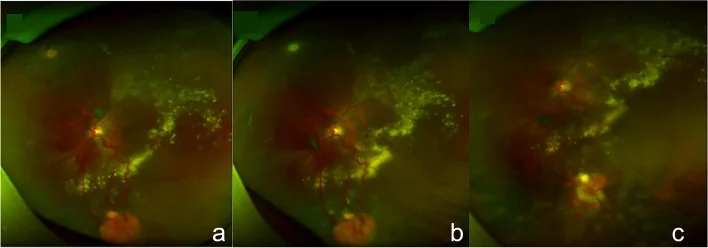
Guo J, Du L, Zhou P, et al. Combined therapy guided by multimodal imaging of fifteen retinal capillary hemangioblastomas in a monocular Von Hippel- Lindau syndrome case report. BMC Ophthalmol. 2022;22(1):205. Figure 4. PMID: 35524216; PMCID: PMC9074324; DOI: 10.1186/s12886-022-02409-8. License: CC BY 4.0. License URL: https://creativecommons.org/licenses/by/4.0/.
Fundus photographs showing a typical orange-red retinal capillary hemangioma in the peripheral retina with markedly dilated and tortuous feeding vessels (feeding artery and draining vein), and tumor regression after cryocoagulation. These correspond to the fundus findings discussed in the section “2. Main Symptoms and Clinical Findings.”
Retinal hemangioblastomas are classified by growth pattern and location as follows.
Peripheral Type
Frequency: The most common typical form.
Fundus findings: Forms an orange-red round mass in the peripheral fundus, accompanied by markedly dilated and tortuous feeding artery and draining vein.
Fundus findings: Occurs near the optic disc. It is often difficult to identify the feeding and draining vessels.
Prognosis: Located close to the optic nerve and macula, requiring caution regarding tissue damage from treatment. Treatment methods are not yet established. 13) In a report examining 72 eyes (68 cases) with juxtapapillary capillary hemangioma, 60 out of 70 eyes (86%) had corrected visual acuity of 20/200 or better at initial examination, whereas after an average follow-up of 5.4 years, only 33 out of 60 eyes (55%) maintained 20/200 or better.
Fundus findings are characterized by solitary or multiple round retinal tumors. Peripheral lesions are associated with dilated and tortuous feeding and draining vessels, and the lesions usually appear by age 30. Approximately half of cases are bilateral, and multiple lesions may occur in various parts of the fundus.
The tumor itself is a hemangioblastoma composed of capillaries and foamy stromal cells, and produces large amounts of VEGF (vascular endothelial growth factor). VEGF causes exudative retinal detachment, leading to decreased visual acuity.
Marked conjunctival and episcleral vascular dilation: In extremely advanced cases, reports include right eye NLP and intraocular pressure reaching 45 mmHg2).
Wide-field fundus photography and OCT angiography (OCTA) are useful for evaluating lesions and follow-up1). OCT can assess tumor morphology, presence of subretinal fluid, and macular edema.
The frequency of VHL disease is 1 in 36,000 people. A national database analysis by the Ministry of Health, Labour and Welfare research group reported 1,448 patients with VHL disease in Japan16). The incidence of retinal hemangioblastoma in VHL patients is 40–70%, with a mean age of onset of 25 years1).
Age distribution: Most common in the 10s to 40s. Onset before age 10 occurs in approximately 5%.
Bilaterality: Approximately half of cases are bilateral.
Multifocality: Multiple tumors may occur in the same eye.
VHL-related risk in sporadic cases: In solitary retinal hemangioblastoma occurring before age 10, the probability of VHL disease is reported to be approximately 45%13).
The VHL gene follows an autosomal dominant inheritance pattern. A germline mutation (first hit) in one allele of the VHL gene, combined with a somatic second hit, leads to loss of tumor suppressor function (two-hit hypothesis).
As a genetic risk factor, all members of families with pathogenic VHL gene mutations require surveillance, and genetic testing for VHL should be considered in cases of retinal hemangioblastoma under 40 years of age1).
Fundus examination characteristically shows a combination of orange-red tumors in the periphery and dilated, tortuous feeding and draining vessels. The following tests are used in combination for evaluation.
Wide-field fundus photography: Useful for obtaining an overall view of peripheral lesions.
Fluorescein angiography (FA): Identifies tumors and assesses activity. Early intense fluorescein leakage is a diagnostic basis.
OCT/OCTA: Evaluates tumor morphology and quantifies macular edema and subretinal fluid.
Ultrasonography (B-mode): Confirms solid tumors and assesses retinal detachment.
For children with a parent diagnosed with VHL, ophthalmic surveillance should begin from age 0, with dilated slit-lamp examination and indirect ophthalmoscopy of both eyes at least once a year. Wide-field fundus photography is used as an adjunct1).
In VHL disease, multiple lesions can occur in organs other than the retina, so regular systemic evaluation by a multidisciplinary team is necessary. 1)8)
Head/brain MRI: Screening for central nervous system lesions such as the cerebellum and brainstem.
Spinal MRI: Screening for spinal hemangioblastomas.
Abdominal ultrasound/CT/MRI: Search for renal cell carcinoma, pancreatic, renal, and adrenal cysts.
Pheochromocytoma screening: Measurement of urinary catecholamine metabolites.
The age to start screening and the interval vary depending on organ and lesion risk, so individual planning should follow the VHL clinical practice guidelines. As a guideline indicated in the manual (2024 edition), contrast-enhanced head/entire spinal MRI is considered for the central nervous system from age 11 onwards, and every 1 to 2 years if hemangioblastoma is not observed, while renal cell carcinoma screening is annual from age 15 (alternating ultrasound and unenhanced MRI). Starting ages and intervals for other organs including pheochromocytoma should also be planned individually by each department according to the table in the manual. 1)
Organ-specific surveillance differs in starting age, examination method, and interval for each target lesion. In Japan, planning is based on the VHL clinical practice guidelines (2024 edition) by each department, and ophthalmic surveillance begins immediately after birth (0 years of age). 1) Since starting ages may differ from international protocols, do not apply the table values based on self-judgment.
VHL genetic testing is indicated for sporadic retinal hemangioma cases under 40 years of age and for patients or their families suspected of having VHL disease 1). It is desirable to perform it in conjunction with genetic counseling.
Differentiation from the following diseases is necessary.
Coats disease: More common in boys. It does not show dilation and tortuosity of feeding and draining vessels but is accompanied by hard exudates and exudative retinal detachment.
Choroidal hemangioma: An orange-red lesion, but not associated with systemic complications of VHL disease.
Retinal vasoproliferative tumor: Predilection for the inferior periphery. Differentiate from secondary changes.
QWhere are the fundus findings of retinal hemangioma found?
A
Peripheral type often occurs in the peripheral fundus, so detailed fundus examination under mydriasis is necessary. Early small tumors may appear as capillary hemangioma-like lesions, and wide-angle fundus photography can help prevent oversight. Optic disc type appears as a peripapillary mass, and identification of feeder and draining vessels is often difficult.
Treatment is selected based on the location, size, and degree of exudative changes of the hemangioma. Lesions that can be ablated without impairing visual function are candidates for laser photocoagulation or cryocoagulation, while lesions with high treatment risk are managed by observation or non-ablative therapy. 12)13)
Indications: Considered for small lesions in the periphery that can be directly ablated without impairing visual function. 13)
Method: Direct coagulation of the hemangioma, with additional treatment as needed based on response. Indications are determined by lesion size, location, and degree of exudation. 1)13)
Irradiation parameters: Set by the ocular oncologist according to the device, lesion diameter, color, and response. Multiple sessions may be required. 3)
Limitations: Large lesions or those with exudation may require multiple treatments or alternative therapies.
Cryocoagulation
Indications: Large lesions or cases where laser photocoagulation is difficult to apply.
Method: Cryocoagulation is selected based on the size and degree of protrusion of the hemangioma.
When exudative changes are present: Subretinal fluid drainage, diathermy, etc. are performed concurrently, but the condition is refractory.
Bhende et al. (2022) reported a case of bilateral retinal hemangioblastoma in a 40-year-old man who had undergone transpupillary thermotherapy (TTT) in both eyes two years earlier. This time, for the left eye with tractional and exudative retinal detachment, vitrectomy, tumor resection, and silicone oil tamponade were performed, and postoperative corrected visual acuity was 6/36. The right eye received an additional single session of TTT, and fluorescein angiography showed decreased leakage11).
PDT and anti-VEGF therapy: Photodynamic therapy (PDT) and anti-VEGF agents may be considered for lesions that are difficult to ablate or for exudative changes, but responses are inconsistent and case-by-case judgment is required. 4)13)
Treatment for the optic disc type is not established1). Laser photocoagulation carries a high risk of optic nerve and macular damage, and the indication must be carefully considered. The following treatments have been reported at the case report level, but none are established as standard therapy.
Intravitreal anti-VEGF injection: Expected to suppress exudative changes, but tumor shrinkage effect is limited.
After treatment, recurrence or new lesions may appear, so lifelong follow-up is necessary. After local treatment, the response is assessed to determine the need for additional treatment, and the entire fundus is evaluated thereafter. 13)
For the prognosis of VHL disease, management of renal cell carcinoma and central nervous system hemangioblastoma is important. Under multidisciplinary collaboration with neurosurgery, urology, endocrinology, etc., appropriate surveillance and intervention for each organ lesion should be performed.
The VHL gene is a tumor suppressor gene located on chromosome 3p25-26, encoding the pVHL protein, a component of the E3 ubiquitin ligase complex. The main function of the pVHL protein is the ubiquitination and proteasomal degradation of the hypoxia-inducible factor (HIF) alpha subunit.
Under normal conditions, HIFα is recognized by pVHL, ubiquitinated, and rapidly degraded. When the VHL gene is inactivated, pVHL function is lost, leading to accumulation of HIFα.
In VHL disease, in addition to a germline mutation (first hit), a somatic second hit (such as loss of heterozygosity, LOH) causes complete loss of VHL gene function, leading to tumor formation.
When HIFα accumulates in the nucleus, transcription of numerous angiogenesis- and cell proliferation-related genes, including VEGF, PDGF, and EPO, is constitutively activated. In VHL disease, HIF-2α (EPAS1) functions as the major driver1).
Retinal hemangioblastomas are composed of two types of cells.
Foamy stromal cells: lipid-rich and produce large amounts of cytokines, including VEGF.
Capillaries: secondarily induced by VEGF produced by stromal cells.
These stromal cells are the tumor parenchyma, and constitutive VEGF production directly causes tumor vascular proliferation and exudative retinal detachment. The molecular basis of tumor formation is a “pseudohypoxic state” in which HIF is constitutively activated independent of oxygen tension due to VHL gene mutations.
VHL-associated hemangioblastomas have been reported to highly express somatostatin receptors (SSTR). In an analysis of 9 specimens, SSTR4 was expressed in 100% and SSTR1/2/5 in 89% of specimens10). This characteristic is being investigated for diagnostic imaging using 68Ga-DOTATOC PET-CT, as described later, and as a molecular target for somatostatin analog therapy.
The association between VHL gene mutation types and clinical phenotypes (e.g., Type 1: non-pheochromocytoma type, Type 2: pheochromocytoma-associated type) is partially known, but further analysis is awaited regarding detailed classification and differences in the frequency of ocular involvement.
Belzutifan is a small molecule that selectively inhibits HIF-2α. In the Japanese package insert, the indication includes “von Hippel-Lindau disease-associated tumors,” and the usual adult dose is 120 mg orally once daily. Important adverse effects such as anemia and hypoxia, as well as precautions regarding pregnancy, require careful assessment of indication and safety before administration.14)
In the phase 2 trial (LITESPARK-004), improvement was reported in all 16 evaluable eyes with retinal hemangioblastoma. However, “improvement” refers to investigator-assessed fundus imaging findings and does not imply tumor disappearance in all cases or replacement of local treatment for retinal lesions.7) The Japanese Ophthalmological Society also mentions that belzutifan may become a new option for retinal lesions, but currently local treatments such as laser photocoagulation and cryocoagulation remain the first choice.15)
Ercanbrack et al. (2024) reported three cases of retinal hemangioblastoma treated with belzutifan. In the first case, tumor area decreased from 2.1 mm² to 1.4 mm² after 4 months of treatment, but treatment was discontinued due to anemia and dyspnea. Subsequently, multiple laser treatments were performed, and nearly complete fibrosis was confirmed at 21 months after initial presentation. In another case, tumor area decreased from 10.3 mm² to 5.5 mm² over approximately 7 months. These are reports of a small number of cases, and the efficacy or treatment duration cannot be generalized9).
Photodynamic therapy (PDT) has been reported to be indicated for both peripheral and optic disc types of the disease.
di Nicola et al. (2022) reported the efficacy of PDT therapy for retinal hemangioblastoma, particularly showing its applicability to juxtapapillary type 4).
Schmidt-Erfurth et al. evaluated the applicability of PDT to optic disc type and the risk of complications 6).
In the case series by Hussain et al., tumor progression stabilized in many eyes after proton beam therapy, but visual outcomes were poor. It is a limited option for difficult-to-treat cases and is not considered standard treatment. 5)
Anti-VEGF agents are sometimes considered for the purpose of adjunctive suppression of exudative changes, but the response of the tumor itself is inconsistent, and no protocol has been established. 13)
Based on the background that hemangioblastomas highly express somatostatin receptors (SSTR), the possibility of treatment with somatostatin analogs is being investigated. There is a treatment report of subcutaneous injection of lanreotide 120 mg at 28-day intervals.
Brabo et al. (2024) reported that in one VHL disease patient receiving lanreotide, the SUVmax on 68Ga-DOTATOC PET-CT decreased from 15.6 to 4.8, while the tumor diameter on imaging remained stable. This is a single-case finding and not a comparative trial demonstrating efficacy. 10)
Treatment with somatostatin analogs has been reported only in a small number of cases, such as single case reports, and its efficacy has not been established10).
68Ga-DOTATOC PET-CT is a functional imaging modality that utilizes tumor SSTR expression. Although there is a report of its use in evaluating the treatment course of one patient with VHL disease, its utility as a standard systemic surveillance test for VHL disease has not been established. 10)
QIs belzutifan available in Japan?
A
Belzutifan (brand name Welireg) is approved in Japan, and its package insert includes “von Hippel-Lindau disease-associated tumors” as an indication. Whether to initiate systemic therapy solely for retinal hemangioma should be determined by a physician experienced in VHL care, considering the feasibility of local treatment, systemic lesions, and safety concerns such as anemia and hypoxia. 14)15)
QWhat happens if retinal hemangioma is not treated?
A
If the hemangioma enlarges, it becomes refractory and visual prognosis worsens significantly. When exudative retinal detachment extends to the macula, vision loss is likely irreversible, and progression to tractional retinal detachment or neovascular glaucoma ultimately leads to blindness. In VHL disease, new lesions appear throughout life, so continuous fundus examination is essential alongside treatment.
Lin H, Lin X. Pronounced Conjunctival Vascular Engorgement in Von Hippel-Lindau Syndrome. Ophthalmology. 2025;132(4):e70. doi:10.1016/j.ophtha.2024.06.008. PMID:38970570.
Krivosic V, Kamami-Levy C, Jacob J, Richard S, Tadayoni R, Gaudric A.. Laser Photocoagulation for Peripheral Retinal Capillary Hemangioblastoma in von Hippel-Lindau Disease. Ophthalmol Retina. 2017;1(1):59-67. doi:10.1016/j.oret.2016.08.004. PMID:31047395.
Di Nicola M, Williams BK Jr, Hua J, Bekerman VP, Mashayekhi A, Shields JA, Shields CL. Photodynamic Therapy for Retinal Hemangioblastoma: Treatment Outcomes of 17 Consecutive Patients. Ophthalmology. Retina. 2022;6(1):80-88. doi:10.1016/j.oret.2021.04.007. PMID:33892136.
Hussain RN, Hassan S, Ho V. Proton beam radiotherapy (PBR) for the treatment of retinal capillary haemangioblastoma stabilises tumour progression but with poor visual outcomes. Eye (Lond). 2019;33(7):1188-1190. doi:10.1038/s41433-019-0377-3. PMID:30792524; PMCID:PMC6707222.
Schmidt-Erfurth UM, Kusserow C, Barbazetto IA, Laqua H.. Benefits and complications of photodynamic therapy of papillary capillary hemangiomas. Ophthalmology. 2002;109(7):1256-1266. doi:10.1016/s0161-6420(02)01059-x. PMID:12093647.
Jonasch E, Donskov F, Iliopoulos O, Rathmell WK, Narayan VK, Maughan BL, Oudard S, Else T, Maranchie JK, Welsh SJ, Thamake S, Park EK, Perini RF, Linehan WM, Srinivasan R, MK-6482-004 Investigators.. Belzutifan for Renal Cell Carcinoma in von Hippel-Lindau Disease. N Engl J Med. 2021;385(22):2036-2046. doi:10.1056/nejmoa2103425. PMID:34818478; PMCID:PMC9275515.
Bajaj S, Gandhi D, Nayar D, Serhal A. Von Hippel-Lindau Disease (VHL): Characteristic Lesions with Classic Imaging Findings. J Kidney Cancer VHL. 2023;10(3):23-31. doi:10.15586/jkcvhl.v10i3.293. PMID:37555195; PMCID:PMC10404985.
Ercanbrack CW, Elhusseiny AM, Sanders RN, Santos Horta E, Uwaydat SH. Belzutifan-induced regression of retinal capillary hemangioblastoma: A case-series. Am J Ophthalmol Case Rep. 2024;33:102011. doi:10.1016/j.ajoc.2024.102011. PMID:38374949; PMCID:PMC10875190.
Brabo EP, Altino de Almeida S, Rafful PP, Rosado-de-Castro PH, Vieira L. Expression of somatostatin receptors in hemangioblastomas associated with von Hippel-Lindau disease as a novel diagnostic, therapeutic, and follow-up opportunity: A case report and literature review. Arch Endocrinol Metab. 2024;68:e230181. doi:10.20945/2359-4292-2023-0181. PMID:38788146; PMCID:PMC11156175.
Bhende P, Kashyap H, Nadig RR. Surgical management of complicated retinal detachment in a case of retinal hemangioblastoma. Indian J Ophthalmol. 2022;70(8):3167. doi:10.4103/ijo.IJO_1161_22. PMID:35919014; PMCID:PMC9672797.
Naseripour M, Fadakar K, Azimi F, Taherian MM, Naseripour M, Mirshahi R. Retinal Capillary Hemangioblastoma: A Comprehensive Review on Treatments. Ocul Oncol Pathol. 2026;12(1):53-62. doi:10.1159/000550011. PMID:41608742; PMCID:PMC12846321.
Wiley HE, Krivosic V, Gaudric A, et al. Management of Retinal Hemangioblastoma in von Hippel-Lindau Disease. Retina. 2019;39(12):2254-2263. doi:10.1097/IAE.0000000000002572. PMID:31259811; PMCID:PMC6878154.