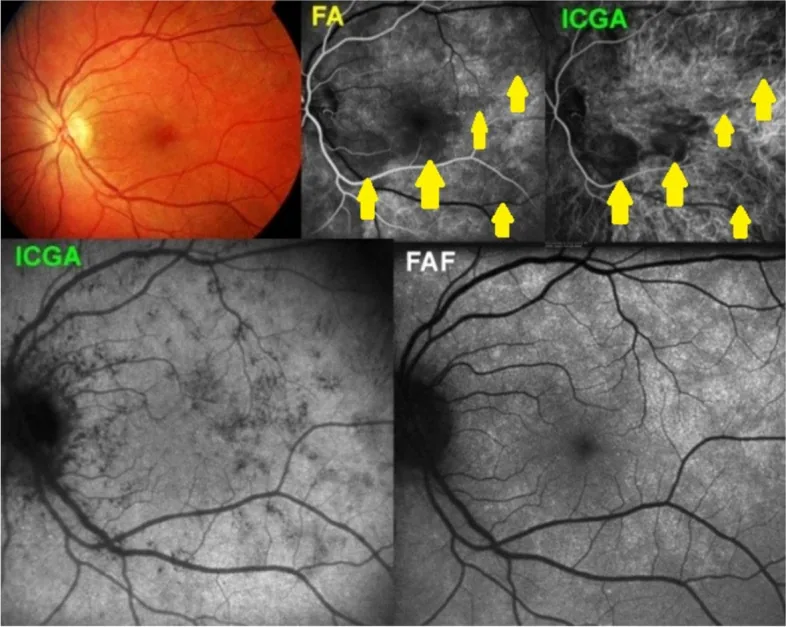
Multiple evanescent white dot syndrome (MEWDS) is an acute inflammatory disease first reported by Jampol et al. in 1984 17). It typically occurs unilaterally in young myopic women, presenting with numerous pale gray-white spots at the level of the deep retina to the retinal pigment epithelium (RPE) in the posterior pole to the equator. The white spots almost disappear over several weeks, and visual acuity improves; it is a self-limiting disease.
According to the Uveitis Clinical Practice Guidelines (Journal of Japanese Ophthalmological Society 2019;123(6):635-696), it is classified as non-infectious posterior uveitis predominantly involving fundus lesions, characterized by unilaterality, acute onset, and transient course 1).
MEWDS is considered part of the AZOOR complex (MEWDS, AZOOR, AMN, PIC, MFC, AIBSE, AAOR), and these diseases are regarded as a continuum (spectrum) of inflammatory disorders primarily affecting the outer retina, photoreceptors, and RPE2). Among the white dot syndromes, MEWDS is one of the diseases whose pathophysiology has been most elucidated through multimodal imaging 2).
Sex ratio: 1:4, overwhelmingly more common in women1)
Annual incidence: approximately 0.22 cases per 100,000 people10)
Predilection for myopic eyes, often unilateral
About half of cases have flu-like prodromal symptoms 1–2 weeks before onset1)
Precipitating factors include flu-like symptoms, oral contraceptive use, vaccination, and upper respiratory tract infection1)
Bilateral involvement is rare, often asymmetric, and the milder side may be asymptomatic18)
Atypical ages have been reported; the youngest is a 9-year-old girl13) and the oldest is a 75-year-old man10)
QDoes MEWDS recur?
A
Most cases resolve after a single episode, but recurrences are observed in about 10% (14% in a large retrospective cohort)11). Although some case reports show a temporal association with vaccination or infection, a causal trigger for recurrence has not been established.
Papasavvas I, et al. Choroidal vasculitis as a biomarker of inflammation of the choroid. Indocyanine Green Angiography (ICGA) spearheading for diagnosis and follow-up, an imaging tutorial. J Ophthalmic Inflamm Infect. 2024. Figure 5. PMCID: PMC11618284. License: CC BY 4.0.
Fundus photographs show faint white dot lesions in the posterior pole. FA and ICGA reveal scattered dot lesions, and FAF also shows abnormal signals, providing a visual understanding of the clinical findings of MEWDS.
Multiple pale patchy lesions scattered in the deep retinal layer to RPE from the posterior pole to the equator of the fundus1). The white spots range in size from 100 to 200 μm, vary in size, and may coalesce. Mild optic dischyperemia and mild vitreous cells may be observed1). Foveal granularity (orange to yellow granular appearance) is a diagnostic finding detectable on near-infrared FAF, seen in 74–96% of cases, and may be the only finding after the white spots resolve2)5).
Optic disc edema: may be accompanied by peripapillary serous subretinal fluid
Retinal venous sheathing and retinal hemorrhages: rare findings
Acute Phase Findings
Fundus white spots: Numerous pale gray-white spots scattered from the posterior pole to the equator. They are smaller and more widespread than the spots in APMPPE1).
Foveal granularity: A diagnostic finding confirmed by near-infrared FAF and slit-lamp biomicroscopy as foveal granularity. It appears in the active phase and resolves with recovery2)5).
FAF (fundus autofluorescence): Shows hyperautofluorescence in the acute phase, with a mixture of hypofluorescence and hyperfluorescence1)2).
OCT: Marked disruption or loss of the ellipsoid zone and focal thickening of the RPE. Disruption of the IS/OS line in the active phase is useful for diagnosis2)3).
Remission Phase Findings
Resolution of white spots: White spots disappear within a few weeks, and visual acuity improves1).
Recovery of the ellipsoid zone: The ellipsoid zone on OCT often recovers over time2)3). This correlates with visual acuity improvement.
Preservation of choriocapillaris: On OCT-A, choriocapillaris blood flow is generally preserved, although transient flow voids have also been reported in some cases4,8).
QWhat is the "scintillation" (photopsia) felt in MEWDS?
A
Photopsia is thought to be related to changes in the outer retina and ellipsoid zone that are transiently impaired in MEWDS. It usually resolves with recovery from the disease2).
The primary site of MEWDS is the outer retina and ellipsoid zone (IS/OS), while the choriocapillaris is generally preserved2). Late-phase hypofluorescence on ICGA is observed, but it has been suggested that this may result from abnormal pigment uptake due to RPE dysfunction rather than ischemia of the choriocapillaris2). Choriocapillaris impairment (ICGA findings) is also observed around the optic disc where no white spots are seen, and may be more extensive than the clinically visible lesions1).
Temporal associations with flu-like symptoms, infection, vaccination, etc., have been reported, and immune mechanisms are being considered as hypotheses, but the established cause is unknown2,7)
Vaccination: Onset after hepatitis B, influenza, HPV, meningococcal, and COVID-19 vaccines has been reported11,14,15). A review of 27 cases after COVID-19 vaccination found a mean time from vaccination to onset of 14.7 days (range 1–90 days)14)
COVID-19 infection: Multiple cases of MEWDS onset after SARS-CoV-2 infection have been reported. A review of 7 reported cases found a mean time from infection to onset of 29.6 days (range 0–70 days)14)
Proposed mechanisms for post-vaccination onset include molecular mimicry, immune response to vaccine components, and complement activation, but these are not established causal mechanisms15). A preliminary report also suggests that the frequency of the HLA-B51 haplotype is 3.5 times higher in MEWDS patients than in normal controls12).
Late-phase hypofluorescence of the white spots. Extensive hypofluorescent areas beyond clinical findings. Peripapillary hypofluorescent spots also appear1)2)
A key feature of MEWDS is that FA shows hyperfluorescence from the early phase, which is an important distinction from APMPPE. APMPPE shows a reversal phenomenon (early hypofluorescence → late hyperfluorescence), whereas MEWDS shows persistent hyperfluorescence from the early phase 2)6). In OCT, the ellipsoid zone (IS/OS line) becomes irregular during the active phase, and improvement of this irregularity correlates with visual recovery, which is an important finding for understanding the pathology 3).
Differential diagnosis (from Uveitis Clinical Practice Guidelines “Table 3”) 1)
MEWDS tends to be unilateral, transient, and fully recover, whereas PIC is often bilateral, leaving atrophic scars or complicated by choroidal neovascularization (CNV). On FA, MEWDS shows hyperfluorescence from the early phase, while PIC shows leakage in the late phase. On OCT-A, the choriocapillaris is generally preserved in MEWDS, but PIC may show more pronounced changes1).
Since spontaneous healing can be expected without special treatment, observation is the basic approach for mild cases1). White spots disappear spontaneously within weeks, and visual prognosis is good. Over time, the ERG becomes quiescent and normalizes1).
Because of the strong tendency for spontaneous improvement, most cases do not require treatment1). In cases with significant visual loss or papilledema, anti-inflammatory treatment may be considered on an individual basis, but standard drugs and dosages have not been established.
In a review of 7 cases of COVID-19-associated MEWDS, 5 cases (71%) received some form of treatment, suggesting that COVID-19-associated cases may be slightly more severe than viral MEWDS in general14). Cases of incomplete visual recovery have also been reported, and careful follow-up is required for COVID-19-associated cases.
Recurrent or persistent cases are rare. One recurrent case treated with cyclosporine has been reported, but this does not demonstrate efficacy as a standard treatment19).
When choroidal neovascularization is present, intravitreal anti-VEGF agents (bevacizumab, ranibizumab, aflibercept) should be considered1). Although CNV is rare, it can cause poor visual prognosis and requires attention. OCT-A is useful for assessing CNV activity and aids in treatment decisions and efficacy evaluation of anti-VEGF therapy8).
QDoes steroid treatment lead to faster recovery?
A
Since this disease generally has a strong tendency for spontaneous improvement, treatment is unnecessary in most cases. The uveitis clinical guidelines also state that “spontaneous recovery without special treatment” is the basic policy1). Although steroids may be used in severe cases, there is no established evidence that they accelerate recovery compared to the natural course.
The main site of damage in MEWDS is the outer retina and ellipsoid zone (IS/OS junction), while the choriocapillaris is generally preserved2). This is an important pathophysiological difference from APMPPE.
On OCT, the ellipsoid zone (the junction between the inner and outer segments of photoreceptors) becomes irregular or absent during the active phase. It has been reported that visual acuity recovers as this disruption improves, indicating that transient and reversible outer retinal damage is the essence of MEWDS 3). Recent en face swept-source OCT has also visualized the extent of lesions that were difficult to recognize on conventional tomographic images 3).
Although late-phase hypofluorescence is observed on ICGA, it has been suggested that this may result from abnormal pigment uptake due to RPE dysfunction rather than ischemia of the choriocapillaris2). On OCT-A, blood flow in the choriocapillaris is generally preserved, with transient flow voids reported only in some cases 4)8). Studies using swept-source OCT-A have confirmed sparing of the choriocapillaris in MEWDS 4).
Foveal granularity observed on near-infrared FAF is a characteristic finding reflecting damage to the foveal photoreceptor layer 2)5). It can also be detected on multicolor imaging (near-infrared reflectance and blue reflectance) and is considered useful for diagnosis in the active phase.
A concept has been proposed that integrates MEWDS, AZOOR, PIC, and MFC as part of the AZOOR complex 2,7). Jampol and Becker (2003) hypothesized that these diseases share a common genetic autoimmune and inflammatory mechanism, but specific genetic factors unique to MEWDS have not been established 7).
OCT-A assessment of choriocapillaris function: Transient detection of flow voids in the choriocapillaris using swept-source OCT-A has been reported, and reevaluation of the involvement of the choriocapillaris is ongoing4)8). In some cases, decreased choriocapillaris blood flow is also observed, suggesting diversity in the pathophysiology8).
En face swept-source OCT: Reports are increasing on this new diagnostic method that three-dimensionally visualizes the shape, distribution, and inner layer boundaries of white dot lesions3).
Evolution of the AZOOR complex concept: Research is advancing toward an integrated understanding of MEWDS, AZOOR, PIC, AMN, AIBSE, and AASR as a single spectrum2)9). Zicarelli et al. (2020) proposed a new interpretation of the pathophysiology of MEWDS9).
Multicolor imaging: Development of clinical diagnostic aids using near-infrared reflectance and blue reflectance. Noninvasive assessment of foveal granularity is now possible5).
MEWDS after COVID-19 infection and vaccination: Case reports after infection and after mRNA vaccination have accumulated, and the association with immune triggers is being investigated14,15).
Recurrence rate and long-term prognosis data: Accumulation of large-scale long-term follow-up studies is awaited.
Chen et al. (2024) reviewed 7 cases of MEWDS occurring after COVID-19 infection in the literature and reported a mean age of 38.4 years, 5 female patients, and a mean interval from infection to onset of 29.6 days14). Two cases (29%) were bilateral, and 5 cases (71%) received treatment, suggesting that COVID-19-related cases may have a higher likelihood of incomplete visual recovery and need for therapeutic intervention than typical cases.
Regarding COVID-19 vaccine-associated MEWDS, a review summarizing 27 previously reported cases showed a mean age of 34.1 years, female predominance, and a mean interval from vaccination to onset of 14.7 days14). The mRNA vaccine (Pfizer-BioNTech) was the most common.
Ramirez Marquez et al. (2022) reported a 17-year-old female who developed MEWDS after simultaneous HPV and meningococcal vaccination, and subsequently experienced two recurrences in the contralateral eye following COVID-19 infection and BNT162b2 vaccination11).
Yasuda et al. (2022) reported a 67-year-old Japanese woman who developed MEWDS the day after receiving the second dose of the BNT162b2 mRNA vaccine15). She had moderate vitreitis, and visual acuity decreased to 0.2 but recovered to 0.8 without treatment.
Wiley et al. (2022) reported a case of a 17-year-old female who developed bilateral optic disc edema and MEWDS-like white dot lesions two days after SARS-CoV-2 vaccination, with cerebrospinal fluid examination revealing an opening pressure of 55 cmH2O and a white blood cell count of 48 cells/μL, consistent with uveomeningeal syndrome16). This was the first report of uveomeningeal syndrome associated with MEWDS.
Testi I, Modugno RL, Pavesio C. Multimodal imaging supporting the pathophysiology of white dot syndromes. Journal of ophthalmic inflammation and infection. 2021;11(1):32. doi:10.1186/s12348-021-00261-3. PMID:34529201; PMCID:PMC8446150.
Pichi F, Srvivastava SK, Chexal S, Lembo A, Lima LH, Neri P, et al. EN FACE OPTICAL COHERENCE TOMOGRAPHY AND OPTICAL COHERENCE TOMOGRAPHY ANGIOGRAPHY OF MULTIPLE EVANESCENT WHITE DOT SYNDROME: New Insights Into Pathogenesis. Retina. 2016;36(Supplement 1):S178-S188. doi:10.1097/IAE.0000000000001255. PMID:28005676.
Yannuzzi NA, Swaminathan SS, Zheng F, Miller A, Gregori G, Davis JL, Rosenfeld PJ.. Swept-Source OCT Angiography Shows Sparing of the Choriocapillaris in Multiple Evanescent White Dot Syndrome. Ophthalmic Surg Lasers Imaging Retina. 2017;48(1):69-74. doi:10.3928/23258160-20161219-10. PMID:28060397.
Mantovani A, Invernizzi A, Staurenghi G, Herbort CP Jr. Multiple Evanescent White Dot Syndrome: A Multimodal Imaging Study of Foveal Granularity. Ocular immunology and inflammation. 2019;27(1):141-147. doi:10.1080/09273948.2017.1353104. PMID:28981397.
Dell’Omo R, Wong R, Marino M, Konstantopoulou K, Pavesio C. Relationship between different fluorescein and indocyanine green angiography features in multiple evanescent white dot syndrome. British Journal of Ophthalmology. 2010;94(1):59-63. doi:10.1136/bjo.2009.163550. PMID:19692364.
Jampol LM, Becker KG. White spot syndromes of the retina: a hypothesis based on the common genetic hypothesis of autoimmune/inflammatory disease. American journal of ophthalmology. 2003;135(3):376-9. doi:10.1016/s0002-9394(02)02088-3. PMID:12614757.
Khochtali S, Dridi T, Abroug N, Ksiaa I, Lupidi M, Khairallah M. Swept-Source Optical Coherence Tomography Angiography Shows Choriocapillaris Flow Reduction in Multiple Evanescent White Dot Syndrome. Journal of current ophthalmology. 2020;32(2):211-215. doi:10.4103/JOCO.JOCO_107_20. PMID:32671309; PMCID:PMC7337020.
Zicarelli F, Mantovani A, Preziosa C, Staurenghi G. Multimodal Imaging of Multiple Evanescent White Dot Syndrome: A New Interpretation. Ocul Immunol Inflamm. 2020;28(5):814-820. doi:10.1080/09273948.2019.1635169. PMID:31414928.
Wang L, Lankry P, Rabinovitch D, Gallo R, Laiginhas R, Iyer P, Shulman S, Trivizki O.. An Elderly Man with Atypical Multiple Evanescent White Dot Syndrome. Case Rep Ophthalmol. 2022;13(3):892-896. doi:10.1159/000526583. PMID:36466057; PMCID:PMC9710463.
Ramirez Marquez E, Ayala Rodríguez SC, Rivera L, Pappaterra-Rodriguez MC, Requejo-Figueroa GA, Rios R, Rivera-Grana E, Rodríguez-García EJ, Oliver AL.. Contralateral Recurrences of Post-vaccination Multiple Evanescent White Dot Syndrome. Cureus. 2022;14(12):e32300. doi:10.7759/cureus.32300. PMID:36628035; PMCID:PMC9822784.
Smeller L, Toth-Molnar E, Sohar N.. White Dot Syndrome Report in a SARS-CoV-2 Patient. Case Rep Ophthalmol. 2022;13(3):744-750. doi:10.1159/000526090. PMID:36845457; PMCID:PMC9944209.
Shepherd EA, Herst BS, Parlitsis GJ, Shapiro MJ, Goldstein DA, Merrill PT.. Multiple Evanescent White-Dot Syndrome in a 9-Year-Old Girl. J Vitreoretin Dis. 2022;6(6):470-473. doi:10.1177/24741264211044222. PMID:37009534; PMCID:PMC9954785.
Chen N, Mandell M, Arjmand P. Multimodal imaging findings of multiple evanescent white dot syndrome in COVID-19 patients. IDCases. 2024;38:e02110. doi:10.1016/j.idcr.2024.e02110. PMID:39582747; PMCID:PMC11585666.
Yasuda E, Matsumiya W, Maeda Y, Kusuhara S, Nguyen QD, Nakamura M, Hara R.. Multiple evanescent white dot syndrome following BNT162b2 mRNA COVID-19 vaccination. Am J Ophthalmol Case Rep. 2022;26:101532. doi:10.1016/j.ajoc.2022.101532. PMID:35434421; PMCID:PMC8994682.
Wiley ZC, Pakravan M, Charoenkijkajorn C, et al. Uveomeningeal syndrome presenting with bilateral optic disc edema and multiple evanescent white dots syndrome (MEWDS). Am J Ophthalmol Case Rep. 2022;26:101538. doi:10.1016/j.ajoc.2022.101538. PMID:35514800; PMCID:PMC9062123.
Jampol LM, Sieving PA, Pugh D, Fishman GA, Gilbert H. Multiple evanescent white dot syndrome. I. Clinical findings. Arch Ophthalmol. 1984;102(5):671-674. doi:10.1001/archopht.1984.01040030527008. PMID:6721749.
Finn AP, Khurana RN. Multiple evanescent white dot syndrome: Bilateral disease may be silent and asymmetric. Am J Ophthalmol Case Rep. 2021;21:101004. doi:10.1016/j.ajoc.2020.101004. PMID:33376834; PMCID:PMC7758516.
Figueroa MS, Ciancas E, Mompean B, Quereda C. Treatment of multiple evanescent white dot syndrome with cyclosporine. Eur J Ophthalmol. 2001;11(1):86-88. doi:10.1177/112067210101100118. PMID:11284494.
Ramakrishnan MS, Patel AP, Melles R, Vora RA. Multiple Evanescent White Dot Syndrome: Findings from a Large Northern California Cohort. Ophthalmol Retina. 2021;5(9):850-854. doi:10.1016/j.oret.2020.11.016. PMID:33271345.
Copy the article text and paste it into your preferred AI assistant.
Article copied to clipboard
Open an AI assistant below and paste the copied text into the chat box.