Acquired retinal arterial macroaneurysm (RAM) is a localized saccular or fusiform dilation of a retinal artery within the third-order branches. It is often observed protruding from arterial bifurcations or arteriovenous crossings. This disease concept was first reported by Robertson in 1973.
Exudation or hemorrhage from RAM leads to morphological changes and functional impairment. The typical size is 100–250 μm 1, 3). About 50% occur in the superotemporal artery and about 45% in the inferotemporal artery, while nasal involvement is rare 3). Most cases are unilateral and solitary, but bilateral and multiple cases also exist. RAM on the optic disc is rare, accounting for 3.7–8% of all cases 7, 10).
It is common in elderly individuals with a history of hypertension and arteriosclerosis. RAM is known to have a tendency for spontaneous regression, which influences treatment decisions.
QHow rare is acquired retinal arterial macroaneurysm?
A
It is a relatively rare disease, but the chance of encountering it is increasing with the aging population. RAM on the optic disc is even rarer, reported in 3.7–8% of all cases 7, 10). In the hemorrhagic type, when bleeding or exudation extends to the macula, it can cause severe visual impairment, so early diagnosis and management are important.
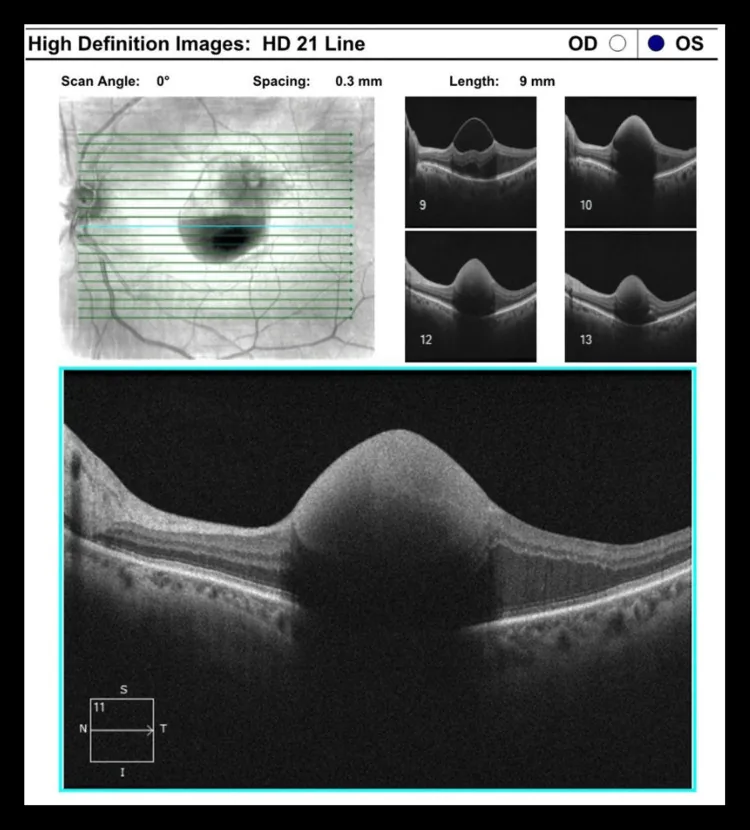
Jemelian A, et al. Outcomes of Combined Therapy With Focal Laser and Intravitreal Bevacizumab for Retinal Arterial Macroaneurysm: A Case Series. Cureus. 2025. Figure 2. PMCID: PMC12034429. License: CC BY 4.0 (https://creativecommons.org/licenses/by/4.0/).
OCT cross-sectional image. It corresponds to the dome-shaped hyperreflective lesion described in section 2, Main Symptoms and Clinical Findings.
When exudation or hemorrhage involves the macula, it causes decreased vision and metamorphopsia. If there is no hemorrhage or exudation, there are no subjective symptoms and it is difficult to detect.
When hemorrhage or exudation involves the macula, the following symptoms occur:
Decreased vision: Decreased vision due to hemorrhage or exudation in the macula. It may be gradual or sudden.
Metamorphopsia (distorted vision): Caused by macular edema or exudation.
Central scotoma: Visual field defect due to damage to the fovea.
RAM is clinically classified into the following three types3, 9).
Type
Main Symptoms
Typical Findings
Asymptomatic type
None
Incidental finding
Hemorrhagic type
Acute vision loss
Multilayered hemorrhage
Exudative type
Slow vision loss
Hard exudates and edema
The characteristic hemorrhage in RAM is multilayered, involving multiple layers including subretinal, intraretinal, sub-internal limiting membrane (ILM), preretinal, and vitreous 9). This multilayered hemorrhage pattern is one of the characteristic findings of RAM.
On fundus examination, it appears red along the retinal arterioles, white if accompanied by fibrin, and gray-white if fibrotic. The aneurysm may not be identifiable due to hemorrhage or exudation. In the exudative type, circinate retinopathy, retinal edema, and serous retinal detachment are observed.
Multilayered hemorrhage (hemorrhage across multiple layers: subretinal, intraretinal, and vitreous) is a characteristic finding of RAM and an important clue for diagnosis 9). However, when hemorrhage is extensive, the aneurysm itself may be difficult to visualize, making adjunctive evaluation with IA, OCT, or OCTA essential for diagnosis 3).
The development of RAM involves multiple risk factors that promote vascular wall weakening. It is more common in elderly individuals with a history of hypertension and arteriosclerosis. It is thought that the muscular layer of the vascular wall is lost, and the media undergoes collagen fibrosis, reducing elasticity and leading to dilation due to intraluminal pressure 1, 9).
Major Risk Factors
Hypertension: The greatest risk factor, present in 51–75% of patients. Sustained hypertension promotes hyaline degeneration and arteriosclerosis of the vascular wall 9).
Arteriosclerosis: Weakening of the blood vessel wall due to hyaline degeneration and collagenization. Long-term vascular wall damage forms the basis for dilation 1, 9).
Aging: Commonly occurs in people aged 60 and older. Age-related weakening of the blood vessel wall is a contributing factor.
Female sex: Women account for 70–78% of patients. The detailed mechanism of this sex difference is unknown 9).
Other Risk Factors
Dyslipidemia: Promotes the progression of arteriosclerosis and worsens vascular wall damage 1, 3).
Cardiovascular disease: An association with coronary artery disease and aortic aneurysm has been reported. RAM may occur as part of systemic vascular disease 9).
Lynch syndrome: It has been suggested that DNA repair gene mutations may lead to increased complexity of the vascular network. This is the first reported case of an association with RAM1).
Valsalva maneuver: Sudden blood pressure fluctuations can trigger RAM rupture. Strenuous labor, coughing, and straining during defecation have been reported as triggers 9).
Multimodal imaging is essential for accurate diagnosis of RAM3). Especially when there is extensive hemorrhage, FA alone may make it difficult to identify the aneurysm itself, and a combination of multiple tests is necessary.
Fluorescein angiography (FA): In the arterial phase, aneurysmal hyperfluorescence of RAM is observed, and in the late phase, leakage and tissue staining appear. If hyperfluorescence due to leakage and tissue staining is strong, it is considered active. It is useful for assessing activity and is the standard diagnostic method.
Indocyanine green angiography (IA): In cases with significant hemorrhage, IA is superior to FA for detecting RAM3). Since IA shows weaker fluorescence leakage than FA, hyperfluorescence on IA indicates higher activity.
Optical coherence tomography (OCT): RAM is visualized as hyperreflective spherical structures in the inner retina. It allows confirmation and quantification of retinal edema and serous retinal detachment, and is also useful for stratifying hemorrhage.
Optical coherence tomography angiography (OCTA): Noninvasively visualizes blood flow signals. It can depict intrawall passages due to dissecting-like changes in the vessel wall 8).
Laser speckle flowgraphy (LSFG): A method for noninvasive quantitative assessment of blood flow. The MBR (Mean Blur Rate) value correlates with RAM regression and can be used to monitor treatment progress 5).
Near-infrared reflectance imaging (NIR-R): A case report detected cuff-type vessel wall thickening 3 years before onset, suggesting its potential as an early detection tool 6).
B-mode ultrasound: Used when fundus examination is not possible due to vitreous hemorrhage7, 10). It allows a rough evaluation of intraocular lesions.
The treatment strategy for RAM is determined based on the disease type, impact on the macula, and tendency for spontaneous regression. Although spontaneous remission is common, the degree of visual impairment and recovery varies depending on the extent and duration of exudation or hemorrhage affecting the macula.
Observation: Since there is a tendency for spontaneous regression, this applies to cases without macular involvement or symptoms. Regular fundus examinations are performed to monitor progress.
Pharmacotherapy: Carbazochrome (Adona tablets) 30 mg, 3 tablets divided into 3 doses. This is an adjunctive treatment aimed at suppressing increased vascular permeability and achieving hemostasis.
Risk factor management: Strict control of blood pressure and lipids is essential for preventing recurrence and managing disease activity.
Invasive Treatment
Laser photocoagulation: Aimed at promoting wound healing of the permeable or ruptured wall of the aneurysm. The procedure is performed by lightly ablating the surface of the aneurysm without occluding the artery; it is not necessary to apply overlapping burns until the entire aneurysm turns gray-white. A complication is the risk of arterial occlusion.
Intravitreal anti-VEGF injection: Used for exudative RAM. Not covered by insurance in Japan 2, 3, 4).
Vitrectomy: When blood accumulates between the ILM and nerve fiber layer, vitrectomy with ILM peeling is performed. Persistent vitreous hemorrhage is also an indication for vitrectomy.
Indirect coagulation: A technique to coagulate the retina around the aneurysm, diverting leakage away from the macula. Often combined with direct coagulation.
Laser + anti-VEGF combination therapy: In a study of 3 cases, mean central foveal thickness (CRT) decreased by 275.7 μm and visual acuity improved by 0.55 logMAR 4).
Nd:YAG laser: Used for drainage of sub-ILM hemorrhage. Early treatment is recommended 9).
Intravitreal gas injection (pneumatic displacement): Indicated within 2 weeks of subretinal hemorrhage involving the macula. Not indicated if the hemorrhage is organized. Inject 0.2–0.8 mL of SF6 or C3F8, with prone positioning for 1–2 weeks postoperatively. May be combined with tPA (tissue plasminogen activator) to enhance displacement of submacular hemorrhage.
Subthreshold laser: Reported to have similar efficacy to conventional laser with fewer complications 9).
QCan it heal on its own?
A
RAM has a tendency to regress spontaneously, and many asymptomatic cases improve with observation alone. However, if hemorrhage or exudation involves the macula, it affects visual prognosis, so active treatment intervention should be considered. The choice between natural course and treatment intervention should be made based on a comprehensive assessment of disease type, disease activity, and patient background.
6. Pathophysiology and Detailed Mechanism of Onset
The core pathophysiology of RAM is degeneration of the vascular wall structure and increased intraluminal pressure. Weakening of the vascular wall due to hypertension and arteriosclerosis forms the basis, and leakage due to increased permeability of the arterial wall and hemorrhage due to rupture cause visual impairment.
Vascular wall degeneration process: Hyaline degeneration due to hypertension and arteriosclerosis damage the muscular layer of the vascular wall, and collagen fibrosis of the media progresses 9). As a result, the elasticity of the vascular wall decreases, resistance to intraluminal pressure is lost, and local dilation occurs 1, 9).
Gass hypothesis: Atheromatous emboli damage the vascular wall, causing local ischemia and increasing VEGF expression. This promotes increased permeability and vasodilation 2). VEGF causes arterial dilation and increased permeability via endothelial NO production, contributing to the pathology of exudative RAM3).
Dissection-like changes: Detailed observations using adaptive optics scanning laser ophthalmoscopy (AOSLO), OCT, and OCTA have reported a pathology in which cracks occur in the vascular wall and intramural passages are formed 8). New RAM may form in adjacent areas from these intramural passages.
Rupture mechanism: Rupture occurs when the intraluminal pressure exceeds the threshold of the weakened vascular wall 9). A sudden rise in blood pressure due to the Valsalva maneuver (e.g., coughing, heavy labor, straining during defecation) can trigger rupture 9).
Meng Y et al. reviewed the literature on RAM rupture cases triggered by the Valsalva maneuver and discussed the mechanism by which a sudden increase in venous and arterial pressure due to a rapid rise in intra-abdominal pressure disrupts the fragile vascular wall 9).
Breakdown of the blood-retinal barrier: In exudative RAM, disruption of the blood-retinal barrier underlies macular edema and hard exudates 15).
Characteristics of RAM on the optic disc: Arteries near the disc have a large diameter and high blood flow velocity. Therefore, wall stress is high, and vitreous hemorrhage tends to occur early 10).
Microstructural analysis using adaptive optics scanning laser ophthalmoscopy (AOSLO): Detailed observations using AOSLO have visualized the disappearance of pulsation, thrombus formation process, and crack structures in the vascular wall within RAM8). This has revealed a new pathology of dissection-like changes in the vascular wall, deepening the understanding of the pathogenesis.
Longitudinal evaluation using laser speckle flowgraphy (LSFG): It has been reported that with regression of RAM, the mean blur rate (MBR) significantly decreased from 6.8 AU to 1.1 AU5). Non-invasive blood flow monitoring with LSFG is a promising objective tool for evaluating treatment efficacy.
Hanazaki H et al. longitudinally evaluated ocular blood flow in treated RAM using LSFG and showed that the decrease in MBR correlated with RAM regression5).
Early detection using near-infrared reflectance imaging (NIR-R): A case has been reported in which cuff-like vascular wall thickening was detected on NIR-R images three years before RAM became clinically apparent6). This may serve as a predictive factor in hypertensive patients and is expected to be applied as an early screening tool.
Efficacy of combined laser and anti-VEGF therapy: In a series of three cases, treatment combining focal laser photocoagulation and intravitreal bevacizumab resulted in a mean decrease in central retinal thickness (CRT) of 275.7 μm and an improvement in visual acuity of 0.55 logMAR4). A synergistic effect of vascular stabilization by anti-VEGF and wall repair by laser is suggested, and larger trials are expected.
Subthreshold laser: Compared with conventional threshold laser, sublethal retinal hyperthermia mediated by heat shock proteins is reported to achieve comparable efficacy while reducing complications9).
Association between Lynch syndrome and RAM: The first report of RAM development in a patient with Lynch syndrome, which involves DNA repair gene mutations, has been published1). It is suggested that DNA repair gene mutations may lead to a more complex vascular network and increased VEGF-A expression, contributing to RAM pathogenesis.
Need for treatment guidelines: With the diversification of treatment options, evidence-based clinical practice guidelines are needed9).
Accumulation of cases with multilayered hemorrhage and noninvasive imaging assessment: In ruptured RAM, cases showing multilayered hemorrhage including subretinal, intraretinal, and vitreous hemorrhage have been reported11). In cases with subvitreal hemorrhage, the indication for Nd:YAG laser or vitrectomy is important12). Near-infrared reflectance videography is used to evaluate RAM pulsatility, and OCTA is used for noninvasive assessment of intralesional blood flow13, 14).
QIs anti-VEGF treatment effective for RAM?
A
Case reports and small series have reported the efficacy of intravitreal anti-VEGF injections for exudative RAM2, 3, 4). Particularly promising results have been obtained with combination therapy using laser 4). However, it is not covered by insurance in Japan 2), and large-scale randomized trials have not yet been conducted. It is necessary to have sufficient consultation with the attending physician before use.
Sood S, Friedman S. Retinal Arterial Macroaneurysm in a Patient With Lynch Syndrome. J VitreoRetinal Diseases. 2023;7(3):239-241.
Takamiya M. The Management of Two Cases with Retinal Arterial Macroaneurysm by Anti-Vascular Endothelial Growth Factor. Case reports in ophthalmology. 2024;15(1):490-496. doi:10.1159/000538998. PMID:39015226; PMCID:PMC11249609.
Balas M, Mandell MA, Arjmand P. Juxtafoveal Retinal Arterial Macroaneurysm Diagnosed on Ancillary Imaging. Journal of vitreoretinal diseases. 2024;8(5):609-613. doi:10.1177/24741264241262102. PMID:39318990; PMCID:PMC11418749.
Jemelian A, Enghelberg M. Outcomes of Combined Therapy With Focal Laser and Intravitreal Bevacizumab for Retinal Arterial Macroaneurysm: A Case Series. Cureus. 2025;17(3):e81382. doi:10.7759/cureus.81382. PMID:40291271; PMCID:PMC12034429.
Hanazaki H, Yokota H, Aso H, et al. Evaluation of ocular blood flow over time in a treated retinal arterial macroaneurysm using laser speckle flowgraphy. Am J Ophthalmol Case Rep. 2021;21:101022.
Zienkiewicz A, Francone A, Cirillo MP, Zompa T, Charles M. Near-Infrared Reflectance Imaging to Detect an Incipient Retinal Arterial Macroaneurysm. Case reports in ophthalmology. 2021;12(1):150-153. doi:10.1159/000513344. PMID:33976673; PMCID:PMC8077541.
Takahashi S, Nishida K, Sakaguchi H, Nishida K. A Case of Idiopathic Dense Vitreous Hemorrhage: Suspected Rupture of a Large Retinal Arterial Macroaneurysm on the Optic Disc. Case reports in ophthalmology. 2021;12(2):634-639. doi:10.1159/000511110. PMID:34413754; PMCID:PMC8339441.
Ishikura M, Muraoka Y, Kadomoto S, Nishigori N, Murakami T, Ooto S, et al. Retinal arterial macroaneurysm rupture caused by dissection-like change in the vessel wall. American journal of ophthalmology case reports. 2022;25:101346. doi:10.1016/j.ajoc.2022.101346. PMID:35128170; PMCID:PMC8807975.
Meng Y, Xu Y, Li L, He L, Yi Z, Chen C. Retinal arterial macroaneurysm rupture by Valsalva maneuver: a case report and literature review. BMC ophthalmology. 2022;22(1):461. doi:10.1186/s12886-022-02662-x. PMID:36451117; PMCID:PMC9710132.
Sasajima H, Zako M, Aoyagi A, Ueta Y, Suzuki T. Acute Onset of Dense Vitreous Hemorrhage Associated with Retinal Arterial Macroaneurysm on the Optic Disc. Case reports in ophthalmology. 2022;13(3):763-769. doi:10.1159/000526928. PMID:36845452; PMCID:PMC9944217.
Temkar S, Stephen M, Agarwal D, Deb AK. Multilayered retinal bleed in ruptured retinal artery macroaneurysm. BMJ case reports. 2023;16(4). doi:10.1136/bcr-2023-254669. PMID:37015766; PMCID:PMC10083764.
Mahjoub A, Zaafrane N, Ben Youssef C, Sellem I, Guiga A, Jabri A, et al. Retinal artery macroaneurysm complicated with subhyaloid hemorrhage: two case reports. Annals of medicine and surgery (2012). 2023;85(4):1130-1136. doi:10.1097/MS9.0000000000000361. PMID:37113883; PMCID:PMC10129110.
Abdul-Rahman A, Morgan W, Yu DY. Near infra-red reflectance videography in the evaluation of retinal artery macroaneurysm pulsatility. American journal of ophthalmology case reports. 2022;27:101664. doi:10.1016/j.ajoc.2022.101664. PMID:35938146; PMCID:PMC9352520.
Mohd Lokman M, Catherine Bastion ML, Che Hamzah J. Objective Assessment of Retinal Artery Macroaneurysm With Optical Coherence Tomography Angiography. Cureus. 2022;14(12):e32328. doi:10.7759/cureus.32328. PMID:36628049; PMCID:PMC9825258.
O’Leary F, Campbell M. The blood-retina barrier in health and disease. The FEBS journal. 2023;290(4):878-891. doi:10.1111/febs.16330. PMID:34923749. doi:10.1111/febs.16330. PMID:34923749.
Copy the article text and paste it into your preferred AI assistant.
Article copied to clipboard
Open an AI assistant below and paste the copied text into the chat box.