

Intrapapillary Hemorrhage with Adjacent Peripapillary Subretinal Hemorrhage
1. What is Intrapapillary Hemorrhage (IHAPSH)?
Section titled “1. What is Intrapapillary Hemorrhage (IHAPSH)?”Definition
Section titled “Definition”Intrapapillary Hemorrhage with Adjacent Peripapillary Subretinal Hemorrhage (IHAPSH) refers to a clinical picture in which hemorrhage within the optic disc (intrapapillary) and contiguous peripapillary subretinal hemorrhage are observed simultaneously. It may be accompanied by optic disc edema-like findings and is positioned as a benign syndrome that commonly occurs in young, myopic eyes1).
History
Section titled “History”The condition of optic disc hemorrhage and peripapillary subretinal hemorrhage in the same eye dates back to a 1975 report by Cibis et al. on retinal hemorrhage associated with posterior vitreous detachment2). In 1995, Katz and Hoyt reported intrapapillary and peripapillary hemorrhage occurring in young individuals with incomplete posterior vitreous detachment as a finding of vitreopapillary traction3). In 2004, Kokame et al. reported this syndrome in 9 cases (10 eyes; 7 women, 2 men; ages 14–79). Of the 10 eyes, 8 had myopia of −2.50 to −9.50 D, and 8 had tilted optic discs1).
Epidemiology
Section titled “Epidemiology”The exact incidence is unknown, but case reports in Japan tend to be biased toward young, myopic women. In the initial 9 cases by Kokame et al., the majority were women, and refractive errors ranged from mild to high myopia1). Bilateral cases are relatively rare, but there are reports of sequential onset in both eyes over a 2-year course in a 25-year-old woman5) and similar findings in both eyes at a 2-month interval in a 36-year-old woman6). Cases in teenagers are also increasing, with typical cases accumulating in an 11-year-old girl7), a 12-year-old9,10), a 17-year-old11), and a 19-year-old1).
The nationwide incidence is not known. Current literature consists mainly of small case series and case reports, and the exact prevalence is unclear1).
2. Main Symptoms and Clinical Findings
Section titled “2. Main Symptoms and Clinical Findings”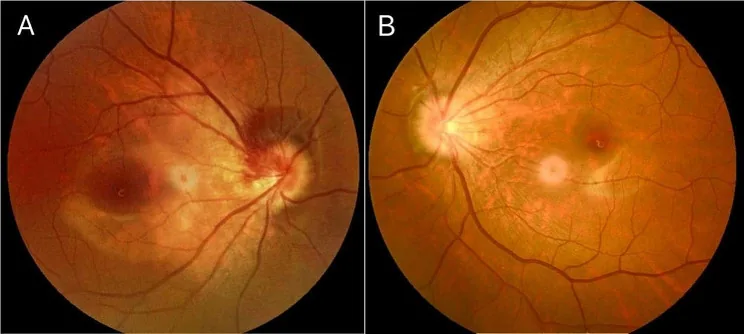
Subjective Symptoms
Section titled “Subjective Symptoms”Typical subjective symptoms are floaters and mild blurred vision, and it may be discovered asymptomatically. Visual acuity is often well preserved; in 8 of 10 eyes reported by Kokame et al., it was 20/25 or better1). In Japanese cases, a 12-year-old girl with corrected visual acuity of 0.9/1.2 at initial visit10), a 17-year-old maintaining 1.2 in both eyes11), and an 11-year-old girl with 1.2/1.27) have been reported.
However, when hemorrhage extends into the vitreous cavity or subretinal hemorrhage occurs near the macula, blurred vision, visual field defects, and central scotoma may occur. A case of a 62-year-old woman with vitreous hemorrhage and peripapillary subretinal hemorrhage whose corrected visual acuity in the right eye decreased to 0.01 has also been reported4).
Fundus Findings
Section titled “Fundus Findings”Three characteristic hemorrhagic components are observed simultaneously or sequentially1,4).
- Intrapapillary hemorrhage: Red to dark red hemorrhage spreading radially on the optic disc surface.
- Peripapillary subretinal hemorrhage: Pale red to dark red hemorrhage extending from the disc margin to the nasal to inferonasal side, with less distinct borders than intraretinal hemorrhage.
- Vitreous hemorrhage: In mild cases, it appears as thin hemorrhagic floaters in front of the disc; in severe cases, it may obscure fundus examination.
Peripapillary subretinal hemorrhage is often biased toward the nasal side4,7,8,10). At onset, mild papilledema-like swelling may be present, requiring differentiation from congestive optic disc9). Hwang and Lin reported multilayered hemorrhages on the disc surface, subretinal, and vitreous in adolescent patients with myopia and crowded or tilted discs, and considered vitreopapillary traction as one mechanism21).
Visual Field Findings
Section titled “Visual Field Findings”Visual field changes are mild, such as enlargement of the Mariotte blind spot or Bjerrum-type scotoma, and are often not noticed by the patient. Goldmann or Humphrey perimetry may show arcuate sensitivity loss or nasal step corresponding to the hemorrhage site. After hemorrhage resolution, visual field defects often improve1,5).
Course and Prognosis
Section titled “Course and Prognosis”Hemorrhage generally resolves spontaneously over 6 weeks to several months without treatment. In Kokame et al.’s observation, 8 out of 10 eyes achieved 20/25 or better, and no recurrence was noted in the same eye1). In typical cases in Japan, there is a report of a 12-year-old girl whose vitreous hemorrhage disappeared 6 weeks after the initial visit, with corrected visual acuity improving to 1.010), and a report of a 36-year-old woman with bilateral involvement who recovered to 1.2 in the right eye and 1.0 in the left eye within 2 months6). Since some cases develop in both eyes at different times, the contralateral eye should also be examined5,6).
3. Causes and Risk Factors
Section titled “3. Causes and Risk Factors”Related Anatomical Factors
Section titled “Related Anatomical Factors”- Small optic disc and small scleral canal: Teng et al. reported that a crowded optic nerve head and small scleral canal are associated with IHAPSH13). Dense nerve fibers within the disc and a small scleral canal opening may predispose to hemorrhage under minor mechanical stress.
- Disc tilt: Takahashi et al. used swept-source OCT to show that the disc tilt angle in IHAPSH eyes is larger than in control eyes14). A case in Japan with combined tilted disc syndrome, PHOMS, and IHAPSH also supports the association between tilt and this condition15).
- Myopia and axial elongation: Most reported cases have mild to high myopia, and there is a case of a 12-year-old girl who developed IHAPSH during the progressive phase of myopia9). Axial elongation and weakening of peripapillary tissue are thought to underlie this condition.
- Coexistence of PHOMS (peripapillary hyperreflective ovoid mass-like structures): PHOMS are ovoid hyperreflective structures observed on Bruch’s membrane around the optic disc and are thought to reflect axoplasmic stasis16,17). Multiple reports in Japan have described PHOMS in IHAPSH patients15,18), suggesting common anatomical and mechanical predispositions. In children, PHOMS have been reported as a frequent cause of pseudopapilledema22), and the prevalence of PHOMS is significantly higher in children with myopia23).
Related Mechanical Factors
Section titled “Related Mechanical Factors”- Posterior vitreous detachment (PVD) and vitreopapillary traction: Cibis et al. reported that PVD can cause optic disc hemorrhage and retinal hemorrhage2), and Katz and Hoyt showed that vitreopapillary traction due to incomplete PVD causes optic disc hemorrhage in young individuals3). In a 62-year-old case in Japan, PVD and rupture of superficial optic disc vessels were presumed to be the bleeding mechanism4).
- Valsalva-like venous pressure elevation: This has been proposed as a candidate bleeding mechanism but is not established as a trigger for IHAPSH12).
Patient background as risk
Section titled “Patient background as risk”- Young (10s–30s) female
- Myopia (mild to high)
- Tilted disc, small scleral canal, PHOMS
- Incomplete PVD, vitreopapillary adhesion
- Valsalva-like venous pressure elevation (hypothetical candidate, not an established trigger)
Among these, a small scleral canal/crowded disc and papilla tilt are associated factors that showed differences from the control group in case-control studies and fellow-eye comparisons13,14), while a Valsalva-like venous pressure elevation is a candidate at the hypothesis stage12). None of these are established risk scores for predicting individual onset1,3,12,13,14).
4. Diagnosis and examination methods
Section titled “4. Diagnosis and examination methods”Basic diagnosis
Section titled “Basic diagnosis”The starting point for diagnosis is ophthalmoscopic confirmation of “intrapapillary hemorrhage” and “adjacent peripapillary subretinal hemorrhage” in the same eye. When findings such as nasal deviation of subretinal hemorrhage, mild vitreous hemorrhage, and background factors like young age, myopia, and female sex are present, IHAPSH should be strongly suspected1,4).
Imaging Tests
Section titled “Imaging Tests”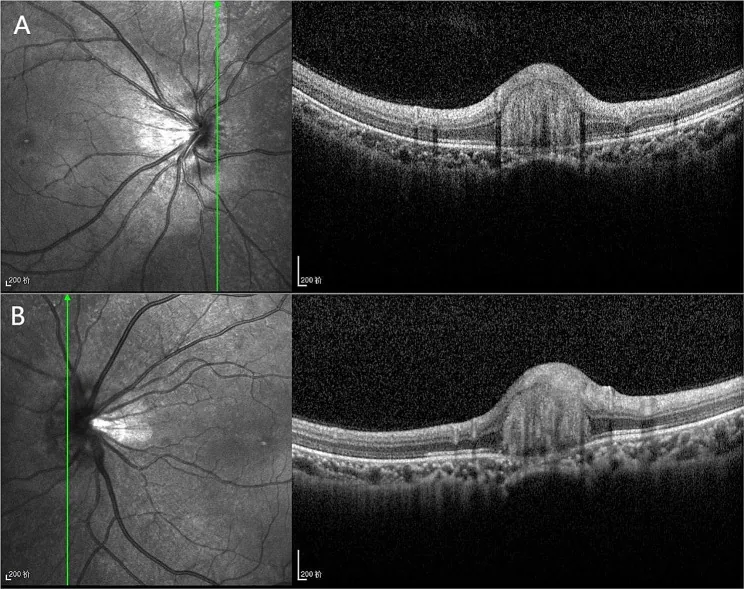
- Optical coherence tomography (OCT): Evaluates the layered structure of intra- and peripapillary hemorrhage. Hemorrhage appears as a hyperreflective lesion extending into the subretinal space, and the presence of PHOMS (peripapillary hyperreflective ovoid mass-like structures) is also assessed10,15,16). Swept-source OCT is useful for observing optic disc tilt angle, small scleral canal, and PHOMS14,15).
- OCT angiography (OCTA): An ancillary test to check for abnormal vascular signals around the optic disc. Blood flow signals within PHOMS have also been reported17).
- Fluorescein angiography (FA) / Indocyanine green angiography (IA): In addition to fluorescence blockage due to hemorrhage, some cases show mild optic disc staining1). In atypical cases, angiography is used to rule out neovascular lesions12).
- Head MRI/MRV: Considered when bilateral optic disc edema, headache, pulsatile tinnitus, etc., suggest papilledema or idiopathic intracranial hypertension (IIH). In a Japanese case of IIH in a patient in their 30s, findings included enlargement of the perioptic subarachnoid space, flattening of the posterior globe, and PHOMS, with a cerebrospinal fluid opening pressure of 300 mmH₂O confirmed19).
Visual Field and Electrophysiological Tests
Section titled “Visual Field and Electrophysiological Tests”Goldmann perimetry and Humphrey perimetry are used to evaluate enlargement of the Mariotte blind spot and the presence of Bjerrum scotoma. In isolated IHAPSH, central visual field is often preserved1,5). If another optic nerve disease such as optic neuritis is suspected, additional tests are performed based on symptoms and findings.
Differential Diagnosis
Section titled “Differential Diagnosis”Check for decreased visual acuity, RAPD, optic disc edema, and systemic symptoms, and rule out the following diseases based on clinical findings and necessary additional tests1,19,20,22).
| Differential Diagnosis | Key Points for Differentiation |
|---|---|
| Nonarteritic anterior ischemic optic neuropathy (NAION) | Older age, acute severe vision loss with profound visual field defect, predominantly optic disc edema |
| Optic neuritis | Pain with eye movement, central scotoma, relative afferent pupillary defect (RAPD) |
| Glaucomatous optic neuropathy | Chronic course, characteristic optic disc cupping and RNFL defect |
| Papilledema / IIH | Bilateral optic disc edema, headache, pulsatile tinnitus, elevated CSF pressure |
| Optic disc drusen | Autofluorescence, OCT, ultrasound for calcification assessment |
| Tilted disc syndrome alone | Congenital optic disc dysplasia without hemorrhage |
| Terson syndrome | Preceding CNS event such as subarachnoid hemorrhage |
| Traumatic optic disc hemorrhage | Clear history of trauma |
| Optic disc hemorrhage related to hematologic disease | Systemic findings such as severe anemia or thrombocytopenia 20) |
5. Standard Treatment
Section titled “5. Standard Treatment”Observation as a Principle
Section titled “Observation as a Principle”IHAPSH is a benign condition that resolves spontaneously, and no definitive medical or surgical treatment has been established. Many reports indicate that hemorrhage resolves within 6 weeks to a few months with observation alone 1,6,10,11).
Key Points for Observation
Section titled “Key Points for Observation”- Initial evaluation: Basic assessments include visual acuity, refractive error, intraocular pressure, visual field, and OCT. Additional tests such as FA/OCTA or neuroimaging may be performed based on findings to rule out other diseases 1,12,14).
- Observation interval: Set individually according to the extent of hemorrhage, visual acuity, visual field, and certainty of differential diagnosis.
- Lifestyle guidance: No established activity restrictions prevent recurrence of IHAPSH. Discuss lifestyle precautions individually with the attending physician based on symptoms and fundus findings.
- Evaluation of the fellow eye: Since metachronous involvement of the fellow eye can occur, examine the fellow eye at the initial visit and follow up individually based on symptoms and findings 5,6).
Exceptional Interventions
Section titled “Exceptional Interventions”There is no established medical or surgical treatment for IHAPSH itself 1). If the hemorrhage extends to the macula, visual impairment persists, or abnormal vascular signals are observed, deviating from the typical course, reassess for CNV or other retinal/optic nerve diseases and treat according to the diagnosis.
6. Pathophysiology and Detailed Mechanism
Section titled “6. Pathophysiology and Detailed Mechanism”Mechanical Traction Hypothesis
Section titled “Mechanical Traction Hypothesis”One proposed mechanism is that nerve fibers and blood vessels densely packed in the small scleral canal of the optic disc undergo mechanical stress due to vitreopapillary traction associated with incomplete posterior vitreous detachment (PVD), leading to hemorrhage1,3,13). Cases with hemorrhage extending to multiple layers, including the disc surface, peripapillary subretinal space, and vitreous cavity, have also been reported21).
Vascular and Tissue Fragility
Section titled “Vascular and Tissue Fragility”In a case-control study using swept-source OCT, the optic disc tilt angle in eyes with IHAPSH was greater than that in the contralateral eyes14). Cases of tilted disc syndrome accompanied by PHOMS and IHAPSH have been reported, but whether tilt or PHOMS is the cause of onset has not been established15).
Association with PHOMS
Section titled “Association with PHOMS”PHOMS are ovoid hyperreflective structures observed above the Bruch’s membrane opening on OCT. Initially, differentiation from optic disc drusen was a concern, but they are now understood to reflect axoplasmic flow stasis in retinal nerve fibers16,17). Borrelli et al. demonstrated blood flow signals within PHOMS on OCTA17). Tokuhisa et al. reported a 12-year-old girl with IHAPSH who had bilateral PHOMS, suggesting that the coexistence of PHOMS and IHAPSH may not be coincidental18). Yamamoto et al. also presented an 11-year-old case with tilted disc syndrome accompanied by PHOMS and IHAPSH, discussing the possibility that PHOMS may predispose to the development of IHAPSH15).
Hemodynamic Factors
Section titled “Hemodynamic Factors”Valsalva-like venous pressure elevation has been proposed as a candidate mechanism, but it has not been established as a common trigger or actual cause of IHAPSH12).
Integrated Model
Section titled “Integrated Model”In IHAPSH, anatomical features of the optic disc, vitreopapillary traction, and transient hemodynamic changes have been considered as candidate mechanisms. However, the combination varies among cases, and a single onset model has not been established1,3,12,13,14).
7. Recent Research and Future Perspectives
Section titled “7. Recent Research and Future Perspectives”Advances in Imaging Diagnosis
Section titled “Advances in Imaging Diagnosis”With the widespread use of swept-source OCT and OCTA, it has become possible to noninvasively evaluate PHOMS, optic disc tilt angle, and peripapillary blood flow signals 14,17). Takahashi et al. quantified a larger optic disc tilt angle in IHAPSH eyes 14). The coexistence of tilted optic disc and PHOMS has been reported in individual cases, and further case accumulation is needed to determine the frequency 15,18).
Refinement of Disease Characteristics Through Case Accumulation
Section titled “Refinement of Disease Characteristics Through Case Accumulation”Multiple case reports suggest a tendency for onset to cluster in young women (teens) and middle-aged women (30s–40s), but the limited number of cases has not led to a definitive onset pattern 7,9,10,11). Cases of onset in the contralateral eye at a different time have also been reported 5,6).
Development of a Differential Diagnosis Algorithm
Section titled “Development of a Differential Diagnosis Algorithm”Since PHOMS is also observed in IIH and demyelinating diseases, it is necessary to carefully rule out coexisting IIH or optic neuritis in IHAPSH with PHOMS. A Japanese report of IIH with PHOMS in a patient in their 30s highlights the importance of systematic evaluation when PHOMS findings are detected 19). In the future, an algorithm that parameterizes the presence, size, and distribution of PHOMS to quantify the risk of developing IHAPSH is expected.
Prevention and Patient Education
Section titled “Prevention and Patient Education”No established method exists to prevent the onset or recurrence of IHAPSH. Myopia is managed according to standard ophthalmic practice, but there is no clinical evidence that myopia progression control or refractive correction prevents IHAPSH.
8. References
Section titled “8. References”- Kokame GT, Yamamoto I, Kishi S, et al. Intrapapillary hemorrhage with adjacent peripapillary subretinal hemorrhage. Ophthalmology. 2004;111(5):926-930. doi:10.1016/j.ophtha.2003.08.040.
- Cibis GW, Watzke RC, Chua J. Retinal hemorrhages in posterior vitreous detachment. Am J Ophthalmol. 1975;80(6):1043-1046. doi:10.1016/0002-9394(75)90334-7.
- Katz B, Hoyt WF. Intrapapillary and peripapillary hemorrhage in young patients with incomplete posterior vitreous detachment. Signs of vitreopapillary traction. Ophthalmology. 1995;102(2):349-354. doi:10.1016/s0161-6420(95)31018-4.
- 牧野伸二, 竹澤美貴子, 久保田みゆき, ほか. 硝子体出血と乳頭周囲網膜下出血を伴った傾斜乳頭症候群の1例. 臨床眼科. 2005;59(3):277-281.
- 西智, 湯川英一, 松浦豊明, ほか. 両眼に発症したIntrapapillary Hemorrhage with Adjacent Peripapillary Subretinal Hemorrhage(IHAPSH)の1例. あたらしい眼科. 2009;26(6):845-847.
- 坂井貴三彦, 春田雅俊, 石橋有美, ほか. 両眼に発症したintrapapillary hemorrhage with adjacent peripapillary subretinal hemorrhageの1例. 臨床眼科. 2020;74(3):335-339.
- 長岡広祐, 月井里香, 渡辺芽里, 牧野伸二. 11歳女児にみられたintrapapillary hemorrhage with adjacent peripapillary subretinal hemorrhageの1例. 眼科. 2021;63(4):381-385.
- 田邉智子, 森文彦, 江口秀一郎. 17歳に発症した典型的なintrapapillary hemorrhage with adjacent peripapillary subretinal hemorrhage(IHAPSH)の1例. 眼科. 2020;62(12):1363-1366.
- 高橋京一. 近視進行期に発症したintrapapillary hemorrhage with adjacent peripapillary subretinal hemorrhage(IHAPSH)の1例. 臨床眼科. 2022;76(2):241-244.
- 町田碧, 寺崎寛人, 三原直久, ほか. 若年で発症したintrapapillary hemorrhage with adjacent peripapillary subretinal hemorrhage(IHAPSH)の1例. 臨床眼科. 2024;78(4):431-436.
- Caryssa L. Yan, Marten E. Brelen, Haoyu Chen, Weiqi Chen. Spontaneous intrapapillary hemorrhage with adjacent peripapillary subretinal hemorrhage in adolescents. cleverjournal. 2019;2(1):6-10. doi:10.15713/ins.clever.21.
- Moon IH, Lee SC, Kim M. Intrapapillary hemorrhage with concurrent peripapillary and vitreous hemorrhage in two healthy young patients. BMC ophthalmology. 2018;18(1):172. doi:10.1186/s12886-018-0833-z. PMID:30005697; PMCID:PMC6045832.
- Teng Y, Yu X, Teng Y, Xu B, Sun Q, Dong L, et al. Evaluation of crowded optic nerve head and small scleral canal in intrapapillary hemorrhage with adjacent peripapillary subretinal hemorrhage. Graefe’s archive for clinical and experimental ophthalmology = Albrecht von Graefes Archiv fur klinische und experimentelle Ophthalmologie. 2014;252(2):241-8. doi:10.1007/s00417-013-2459-4. PMID:24057175.
- Takahashi S, Kawashima R, Morimoto T, Sakimoto S, Shiozaki D, Nishida K, et al. Analysis of optic disc tilt angle in intrapapillary hemorrhage adjacent to peripapillary subretinal hemorrhage using swept-source optical coherence tomography. American journal of ophthalmology case reports. 2022;27:101598. doi:10.1016/j.ajoc.2022.101598. PMID:35651596; PMCID:PMC9149012.
- 山本大介, 長岡広祐, 牧野伸二, 反保宏信. PHOMSとIHAPSHがみられた傾斜乳頭症候群の1例. 眼科. 2024;66(12):1513-1519.
- Fraser JA, Sibony PA, Petzold A, Thaung C, Hamann S, ODDS Consortium. Peripapillary Hyper-reflective Ovoid Mass-like Structure (PHOMS): An Optical Coherence Tomography Marker of Axoplasmic Stasis in the Optic Nerve Head. Journal of neuro-ophthalmology : the official journal of the North American Neuro-Ophthalmology Society. 2021;41(4):431-441. doi:10.1097/WNO.0000000000001203. PMID:33630781; PMCID:PMC9258618.
- Borrelli E, Barboni P, Battista M, Sacconi R, Querques L, Cascavilla ML, et al. Peripapillary hyperreflective ovoid mass-like structures (PHOMS): OCTA may reveal new findings. Eye (London, England). 2021;35(2):528-531. doi:10.1038/s41433-020-0890-4. PMID:32346103; PMCID:PMC7997888.
- 徳久照朗, 林孝彰, 西島麗美, 中野匡. 視神経乳頭出血を合併したperipapillary hyperreflective ovoid mass-like structures(PHOMS)の1例. 日本眼科学会雑誌. 2022;126(7):642-650.
- 岩井星磨, 粕谷友香, 牧野伸二, 蕪城俊克. 特発性頭蓋内圧亢進症に伴ったperipapillary hyperreflective ovoid mass-like structuresの1例. 眼科. 2025;67(9):827-835.
- Janetos TM, Bhasin A. Optic Disc Hemorrhages in Severe Anemia and Thrombocytopenia. Journal of general internal medicine. 2023;38(1):234-235. doi:10.1007/s11606-022-07853-2. PMID:36326990; PMCID:PMC9849492.
- Hwang JF, Lin CJ. Multilayered optic disk hemorrhages in adolescents. J Pediatr Ophthalmol Strabismus. 2014;51(5):313-318. doi:10.3928/01913913-20140715-01. PMID:25036104.
- Mezad-Koursh D, Klein A, Rosenblatt A, Teper Roth S, Neudorfer M, Loewenstein A, et al. Peripapillary hyperreflective ovoid mass-like structures-a novel entity as frequent cause of pseudopapilloedema in children. Eye (London, England). 2021;35(4):1228-1234. doi:10.1038/s41433-020-1067-x. PMID:32616868; PMCID:PMC8115042.
- Lyu IJ, Park KA, Oh SY. Association between myopia and peripapillary hyperreflective ovoid mass-like structures in children. Scientific reports. 2020;10(1):2238. doi:10.1038/s41598-020-58829-3. PMID:32041993; PMCID:PMC7010819.