
主要リスク因子

網膜静脈分枝閉塞症(BRVO)
1分でわかる網膜静脈分枝閉塞症(BRVO)
本編へどんな病気?
網膜静脈分枝閉塞症は、網膜の動脈と静脈が交差する場所で、静脈が詰まる病気です。その血管が関わる範囲に出血やむくみが起きたり、細い血管に血液が流れなくなったりします。1)半数以上に、網膜の中心にある黄斑のむくみ(黄斑浮腫)が起こります。これが視力低下の最も重要な原因です。
- どんな症状に気づきますか?
- 黄斑が障害されると、痛みのない急な視力低下が最も多い症状です。詰まった範囲に応じて視野の欠損や、物が歪んで見える変視症が生じることがあります。
- 治療では何を目指しますか?
- 黄斑のむくみには、抗VEGF薬を目の中に注射する治療をまず選びます。12)治療を中断すると黄斑のむくみが再発することがあるため、自己判断で中止しないでください。
- 早く受診したほうがよいのはどんなときですか?
- 注射のあと視力の変化や目の痛みを感じたときは、すぐに受診してください。高血圧などの全身の管理も治療の一環で、内科と連携した継続的な管理が大切です。
本編
もっと詳しく知りたい方へ
ここからは、このテーマについて、さらに詳しく解説します。
1. 網膜静脈分枝閉塞症とは
Section titled “1. 網膜静脈分枝閉塞症とは”網膜静脈分枝閉塞症(Branch Retinal Vein Occlusion; BRVO)は、網膜の動静脈交叉部で静脈が閉塞し、その支配領域に網膜出血・黄斑浮腫・毛細血管無灌流を生じる血管疾患である。網膜静脈閉塞症のなかで最も頻度が高い病型であり、網膜中心静脈閉塞症(CRVO)の約5倍多い1)。
2015年の世界有病率は約0.77%で、30〜89歳の推定2800万人が罹患している1)。40歳以上に限ると有病率は約2.0%とされる。日本における大規模疫学データとして、久山町研究では9年間の累積発症率とリスク因子が報告されている2)。Beaver Dam Eye Studyによる15年間の累積発症率はRVO全体で2.3%と報告されている1)。有病率は年齢とともに有意に上昇し、60歳以降で高い4)。東アジアでの発症率は米国と同等との報告があり、韓国ではやや高い可能性も示唆されている12)。
閉塞部位と分類
Section titled “閉塞部位と分類”閉塞部位は上耳側が58〜66%と最多で、下耳側22〜43%、鼻側12.9%の順である3)。病型はその閉塞部位と範囲により以下に分類される。
- 主幹部網膜静脈分枝閉塞症:第1〜3分枝の閉塞。広い網膜領域が障害される。
- 黄斑部網膜静脈分枝閉塞症:黄斑を支配する細小血管の閉塞。視力への直接的影響が大きい。
- hemiRVO(半側RVO):乳頭部で閉塞し、網膜の半分のドレナージが障害される。臨床的にはBRVOよりCRVOに近い経過をたどる12)。
また虚血の程度により2型に分類される。
- 非虚血型:蛍光眼底造影(FA)で無灌流域が5乳頭径(DD)未満。全体の約80%を占める。
- 虚血型:無灌流域が5DD以上(CVOS基準では10DD以上)。新生血管形成・硝子体出血のリスクが高い。15〜20%の非虚血型が経過中に虚血型へ移行する3)。
Q
片眼に発症したら対側眼も発症しやすいか?
2. 主な症状と臨床所見
Section titled “2. 主な症状と臨床所見”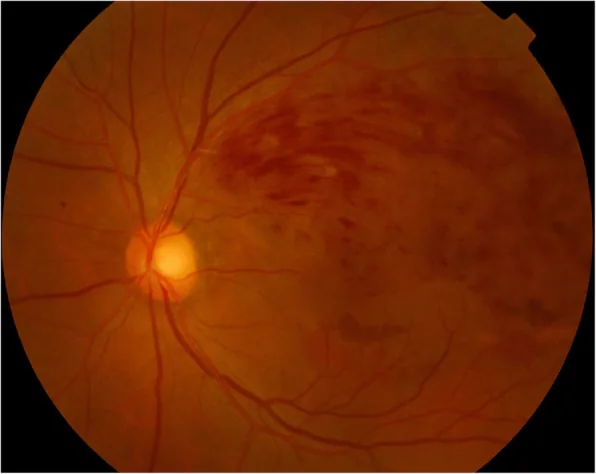
Lee JH, et al. Rapid progression of cataract to mature stage after intravitreal dexamethasone implant injection: a case report. BMC Ophthalmol. 2019. Figure 1. PMCID: PMC6318997. License: CC BY 4.0 (https://creativecommons.org/licenses/by/4.0/).
眼底写真では、上耳側を中心に扇状の網膜出血と黄白色病変がみられる。分枝静脈の還流障害を示す所見が確認でき、網膜静脈分枝閉塞症の臨床像が示されている。
閉塞部位によって症状は異なる。
- 急性の無痛性視力低下:黄斑が障害される場合に最も多い主訴。
- 視野欠損:閉塞領域に対応した扇形の暗点。
- 変視症:黄斑浮腫により物が歪んで見える。
- 飛蚊症:硝子体出血を合併した場合に生じる。
- 無症状:末梢部位の閉塞では自覚症状が乏しく、偶然発見されることがある。
急性期は閉塞領域に一致した特徴的な眼底所見を呈する。
- 扇形(楔形)の網膜出血:閉塞静脈の支配領域に一致した分布を示す。火炎状出血(flame-shaped hemorrhage)が特徴的である。
- Bonnet徴候:動静脈交叉部に集中する出血。閉塞部位の同定に有用である。
- 綿花状白斑(CWS):毛細血管前細動脈の閉塞による神経線維層の梗塞。網膜内の微小循環障害を示す指標であり、増加時はFA検査で虚血の程度を評価し光凝固の必要性を検討する。
- 硬性白斑:慢性期の脂質沈着。
- 静脈の拡張・蛇行:閉塞静脈の末梢側に著明。
- 慢性期所見:出血の吸収、側副血行路(上下静脈間の交通血管)の形成、毛細血管瘤。
黄斑浮腫の定量評価に必須である。
- 嚢胞様黄斑浮腫(CME):網膜内の嚢胞様腔形成。最も多い浮腫パターン。
- 垂直断における非対称な黄斑浮腫:BRVOに特徴的な所見で、閉塞側に偏在する浮腫を呈する。
- 網膜下液(SRF):中心窩下に認められることがある。
- 外境界膜(ELM)の破綻:視細胞障害の指標であり、視力予後不良因子。
- 楕円体帯(EZ)の途絶:ELMとともに視機能予後を予測する重要な所見。
- 網膜内高反射点:硬性白斑に対応するリポタンパク沈着。
BRVOの重要な合併症は黄斑浮腫と血管新生である。
- 黄斑浮腫:半数以上で認められ、BRVOによる視力低下の最も重要な原因である。全BRVO患者の約30%に発症する12)。
- 血管新生:視神経乳頭および網膜に生じる。CRVOと異なり前眼部に生じることはまれである。血管新生が生じた場合、約60%に硝子体出血が発生すると報告されている。
- 黄斑前膜(epiretinal membrane):BRVO罹患眼でしばしば発生し、黄斑浮腫と併存することがある12)。
視力低下の主な原因を以下に示す。
| 原因 | 時期 | 頻度 |
|---|---|---|
| 黄斑浮腫 | 急性〜慢性 | 最多 |
| 黄斑虚血 | 急性期 | 重症例 |
| 新生血管出血 | 慢性期 | 虚血型の約30% |
3. 原因とリスク要因
Section titled “3. 原因とリスク要因”動静脈交叉部での圧迫機序
Section titled “動静脈交叉部での圧迫機序”BRVOは動静脈交叉部において、硬化した動脈が静脈を圧迫することで発症する。この部位では動脈と静脈が共通の外膜(共有外膜)に包まれており、動脈壁の肥厚・硬化が静脈を直接圧迫する。動脈が静脈の前方(表層側)を走行している比率は97.6〜100%に達する。圧迫により静脈内腔が狭小化し、Virchowの3徴(血液凝固亢進・血流異常・血管内皮障害)が成立して血栓が形成される。
全身的リスク因子
Section titled “全身的リスク因子”メタ解析によれば、RVOの48%が高血圧に帰因し、20%が脂質異常症、5%が糖尿病に関連する5)。
その他のリスク因子
COVID-19ワクチン関連BRVO
Section titled “COVID-19ワクチン関連BRVO”mRNAワクチン接種後のBRVO発症例が報告されている。
Sugiharaら(2022)は、BNT162b2(ファイザー社)接種2日後に発症した38歳男性のBRVOを報告した9)。アフリベルセプト2mg硝子体内注射2回で最高矯正視力が0.9から1.2に改善した。
Tanakaら(2022)は、mRNAワクチン接種3日後に発症した50歳・56歳の女性2例を報告した10)。いずれもタモキシフェン服用歴を有しており、ワクチン後の凝固亢進にタモキシフェンによる静脈血栓リスクが重なった可能性が指摘された。ラニビズマブ3回投与で視力は20/25から20/20に改善した。
Girioniら(2023)は、mRNA-SARS-CoV-2ブースター投与24時間後に両眼性BRVOを発症した50歳男性を報告し、ワクチン接種後の両眼性BRVO初報告として記録した11)。ワクチン関連RVOの50%超がmRNAワクチンによるもので、発症までの中央値は2日であった。
スパイクタンパクによる血栓形成促進・炎症性反応が発症機序として仮説されているが10, 11)、発症頻度は極めて稀であり、ワクチン接種の利益がリスクを大幅に上回ると考えられている。
Q
COVID-19ワクチン後に網膜静脈分枝閉塞症が起きることはあるか?
A
mRNAワクチン(ファイザー・モデルナ)接種後のBRVO報告が蓄積されており、発症までの中央値は約2日である11)。発症頻度は極めて低く、ワクチン接種の便益がリスクを大幅に上回る。接種後に急激な視力低下や視野欠損を自覚した場合はすぐに眼科を受診することが勧められる。
4. 診断と検査方法
Section titled “4. 診断と検査方法”BRVOの診断は眼底所見が基本となる。閉塞静脈の支配領域に一致した特徴的な扇形の網膜出血を示すことから、診断自体は難しくない。ただし治療適応の判定や予後予測のためには、眼底検査以外の検査も重要である。
- 蛍光眼底造影(FA):循環動態評価の必須検査である。罹患部の充盈遅延、静脈拡張、血管透過性亢進を示す。発症直後は網膜出血により毛細血管床閉塞部位の評価が困難なことが多く、出血吸収後に再検査を行う。側副血行路と新生血管の鑑別にも非常に有用である。虚血型の定義はCVOS基準で10乳頭径以上の毛細血管無灌流による12)。広角FA(wide-field FA)では末梢無灌流域の一括評価が可能であるが、臨床的有益性データはまだ限られている12)。抗VEGF時代にFAの使用頻度は減少しているが、依然として重要な検査である。
- OCT:黄斑浮腫の定量評価に最も優れた検査である。診断のみならず治療効果のモニタリングにも有用で、臨床試験においてもOCT計測値に基づく治療判断が主流となっている12)。中心窩網膜厚(CST)の減少量が治療効果の指標となる。網膜厚が減少しても視力が改善しないこともあるため、厚みと視力は常に相関するとは限らない点に留意する12)。
- OCTA(OCT血管造影):造影剤を用いない非侵襲的な血管描出法である。毛細血管無灌流域の評価やFAZ面積の定量に有用であるが、画像アーチファクトや視野の制限が課題として残る12)。
- 超音波検査:硝子体出血など中間透光体混濁時に網膜・硝子体関係を評価する12)。
50歳未満・両眼性・再発例では血栓素因のスクリーニングが推奨される6)。CRVO 50歳未満発症の58%に非伝統的リスク因子が検出されたとの報告がある。検査対象は以下のとおりである。
- プロテインC・プロテインS欠乏
- 抗リン脂質抗体症候群
- ホモシステイン値
- 第V因子ライデン変異
全例で高血圧・脂質異常症・糖尿病の評価を実施する。RVO患者は心血管疾患・脳卒中のリスクが高いため、内科医・プライマリケア医との連携が推奨される12)。
鑑別診断には以下の疾患が挙げられる。眼底検査およびFA検査にて鑑別を行う。若年発症では内科と連携し基礎疾患の精査が重要である。
| 疾患 | 鑑別ポイント |
|---|---|
| 糖尿病網膜症 | 両眼性・点状出血・毛細血管瘤が散在 |
| 高血圧性網膜症 | 出血が静脈分布に限局しない |
| 腎性網膜症 | 全身状態・両側性変化 |
| 傍中心窩毛細血管拡張症 | 黄斑部に限局した所見 |
| 放射線網膜症 | 放射線照射歴 |
5. 標準的な治療法
Section titled “5. 標準的な治療法”BRVOの治療は黄斑浮腫に対する治療と血管新生に対する治療に大別される。
抗VEGF硝子体内注射(第一選択)
Section titled “抗VEGF硝子体内注射(第一選択)”抗VEGF薬の硝子体内注射が、BRVOに伴う黄斑浮腫の第一選択治療である12)。複数の大規模RCTで有効性が確立されており、良好なリスク・ベネフィットプロファイルにより初期治療として推奨される。
抗VEGF療法
ラニビズマブ(BRAVO試験):0.5mg月1回×6か月で平均+18.3文字の視力改善を達成し、61.1%が15文字以上の改善を示した13)。12か月後も視力は維持され(HORIZON trial: -0.7文字)、48か月後も改善が持続した(RETAIN study: 平均53か月・14.8回投与。50%の症例で再投与6か月以上経過後もME消失)。
アフリベルセプト(VIBRANT試験):2mg月1回投与で、24週時点で52.7%が15文字以上の視力改善を達成し、グリッドレーザー群の26.7%に対する優越性を示した14)。
ファリシマブ(BALATON試験):6mg月1回投与。24週時点で+16.9文字の改善を示し、アフリベルセプト群の+17.5文字に対する非劣性が確認された。56.1% vs 60.4%が15文字以上改善。IOI発生率はBALATON試験でファリシマブ0.4% vs アフリベルセプト0%15)。
ベバシズマブ:保険適用外であるが、臨床での使用実績がある。SCORE2試験ではCRVO/HRVOにおいてアフリベルセプトと6か月時点で視力が同等であった21)。LEAVO試験100週ではRBZ +12.5文字、AFL +15.1文字、BEV +9.8文字と報告されている12)。
ステロイド療法
デキサメタゾンインプラント(GENEVA試験):0.7mgの単回投与で41%が15文字以上の改善を達成(6か月時点)18)。効果は90日でピークに達し、6か月で消失する。白内障・眼圧上昇(25mmHg以上16%)のリスクを伴う。COBALT試験では4か月ごとの再投与で12か月後15.3文字改善、初回投与後1週間で最大効果の約70%に到達した19)。
トリアムシノロン(SCORE試験):1mg・4mgをグリッドレーザーと比較。12か月後の視力改善はいずれの群も同等(約1/3が15文字以上改善)であり、TA投与の優位性は認められなかった。4mg群では白内障発生頻度が有意に高く、BRVOへのTA投与は限られた症例のみが適応となる。
適応:抗VEGF薬に抵抗する症例、または投与間隔延長を目的として使用する。
投与レジメン
Section titled “投与レジメン”抗VEGF薬の投与方法には、月1回固定投与(loading phase)のほか、以下のレジメンがある。
- PRN(pro re nata; 必要時投与):OCT所見や視力に基づき再投与を判断する。
- Treat-and-extend(T&E):投与間隔を個別に延長する方式。PRN投与と短期成績は同等との報告がある。SCORE2試験のT&E vs monthly比較では、T&Eで1〜2回少ない注射で同等の視力転帰が示されたが、CI幅が広く慎重な解釈が必要である16)。BRIGHTER試験24か月の結果では、ラニビズマブ単独とラニビズマブ+レーザー併用で視力転帰に差がなく、レーザー追加のメリットは示されなかった17)。RETAIN 4年データでも同様にレーザー追加の効果はなかった12)。
BRVO患者の約半数が5年以上にわたり抗VEGF療法の継続を必要とすると報告されている12)。
レーザー光凝固
Section titled “レーザー光凝固”- 格子状凝固(BVOS 1984年):発症3〜18か月後で矯正視力0.5以下の症例に対し黄斑部に格子状凝固を実施。治療群の63%で2段階以上の視力改善が得られ、無治療群の37%を上回った20)。3年フォローアップでは最終視力20/40以上が34%、20/200以下が23%であった。ただし凝固斑による絶対暗点が生じることがあり、抗VEGF薬が使用可能な現代では第一選択とはならない。
- 散乱(scatter)光凝固:虚血型に対して施行する。FA上の毛細血管閉塞領域に光凝固を行うことで、血管新生の発生率を約40%から約20%に抑制できる。虚血型BRVOで乳頭新生血管(NVD)・網膜新生血管(NVE)が出現した場合、sectoral PRPが推奨される12)。
以下の場合に適応が検討される。
- 硝子体出血:新生血管からの反復出血で自然吸収が期待できない場合。
- 線維血管増殖による牽引性網膜剥離:緊急性の高い手術適応。
- 難治性黄斑浮腫:人工的後部硝子体剥離を作製し、硝子体牽引の解除と炎症性サイトカインの除去を行う。内境界膜剥離やA/Vシースオトミーの併用も報告されている。ただし無硝子体眼ではVEGF阻害薬の効果が減弱するため、手術適応は慎重に判断する。
BVOS研究によれば、未治療でも37%が自然に2段階以上の視力改善を示す一方、23%は最終視力が20/200以下となり、34%が20/40以上を達成する20)。3年フォローアップでは平均2.3行の視力改善が観察されている。側副血行路の形成が静脈ドレナージを改善し、浮腫・虚血を軽減するメカニズムが関与する12)。自然経過の幅が広いため、治療介入の判断にはOCTによる黄斑浮腫の定量評価が重要である。
Q
抗VEGF注射はいつまで続けるのか?
A
RETAIN研究では平均53か月間・14.8回の注射が必要と報告されており、BRVO患者の約半数が5年以上治療を継続する12)。治療反応を見ながらPRN(必要に応じて)またはT&E(treat-and-extend)で調整するのが一般的である。詳細は「標準的な治療法」の項を参照。
Q
自然に治ることはあるか?
A
BVOS研究によれば未治療でも37%が自然に2段階以上の視力改善を示すが、23%は最終視力が20/200以下にとどまる20)。側副血行路の形成により浮腫が軽減する場合があるが、自然経過は予測が困難であり、黄斑浮腫が持続する場合は治療介入が推奨される。
6. 病態生理学・詳細な発症機序
Section titled “6. 病態生理学・詳細な発症機序”BRVOの発症機序は多因子性であり、動静脈交叉部の解剖学的特性と全身的血管危険因子が複合的に作用する。
動静脈交叉部の解剖と閉塞機序
Section titled “動静脈交叉部の解剖と閉塞機序”動静脈交叉部では動脈と静脈が共通の外膜(共有外膜)に包まれている。動脈硬化による動脈壁の肥厚・硬化が静脈の外側から圧迫を加え、静脈内腔を狭小化させる。OCT研究では交叉部での静脈内腔の変形(扁平化ではなく狭小化)が確認されている。この狭小化により乱流が生じ、慢性的な血管内皮障害、内膜のリモデリング、血栓形成へと進展する。
静脈閉塞後の病態
Section titled “静脈閉塞後の病態”静脈閉塞により還流圧が上昇し、血流うっ滞と網膜虚血が生じる。同時に、還流圧上昇による中心窩毛細血管網からの漏出および血管透過性亢進により黄斑浮腫が形成される。
分子レベルの機序
Section titled “分子レベルの機序”BRVO患者の硝子体液では以下のサイトカインの上昇が報告されている。
- VEGF:血管透過性亢進・黄斑浮腫形成の主要メディエーターである。虚血網膜から放出される低酸素関連因子として中心的な役割を担う。
- Angiopoietin-2(Ang-2):RVO患者では全網膜疾患のなかで最高レベルに達する15)。Ang-2はAngiopoietin-1とTie2受容体への結合を競合的に阻害し、血管安定化を妨げる。VEGFとAng-2の二重作用により、血管不安定性が増幅され、血管漏出・炎症・新生血管化が促進される。ファリシマブによるAng-2/VEGF二重阻害では、VEGF単独阻害より持続的な網膜血管安定化が期待される。
- IL-6、IL-8:炎症の増幅に関与する。
- MCP-1(単球走化性タンパク質-1):単球・マクロファージの集積を誘導する。
ワクチン関連BRVOの機序については、スパイクタンパクによる血栓形成促進・炎症性反応が仮説として提唱されている10, 11)。スパイクタンパクが血管内皮細胞を直接障害し、von Willebrand因子の放出を促進するとの説もある。
7. 最新の研究と今後の展望(研究段階の報告)
Section titled “7. 最新の研究と今後の展望(研究段階の報告)”ファリシマブの長期データ
Section titled “ファリシマブの長期データ”ファリシマブはAng-2とVEGF-Aを同時に阻害する二重特異性抗体であり、2024年にRVO適応のプレフィルドシリンジがFDA承認された12)。BALATON/COMINO試験のPart 1(24週間固定月1回投与)では視力改善・CST減少においてアフリベルセプトと同等の有効性が示された15)。
BALATON試験では、ファリシマブ6mgとアフリベルセプト2mgの24週間比較において、CST減少はそれぞれ-311.4μmと-304.4μmで同等であった。注目すべきは、FA上の黄斑漏出消失率がファリシマブ群で有意に高かった点(33.6% vs 21.0%、P=0.0023)である15)。COMINO試験でも同様に44.4% vs 30.0%とファリシマブ群で高く、Ang-2阻害による血管安定化効果が示唆されている。
Part 2(24〜72週)ではmodified T&Eレジメンにより最大16週間隔への延長が検討されている15)。長期の耐久性および投与間隔に関するデータが待たれる。
バイオシミラーの動向
Section titled “バイオシミラーの動向”抗VEGF薬のバイオシミラーが相次いでFDAに承認されており、治療アクセス改善への寄与が期待されている12)。
- ラニビズマブバイオシミラー:ranibizumab-nuna(Byooviz、2021年FDA承認)、ranibizumab-eqrn(Cimerli、2022年FDA承認)がRVO黄斑浮腫適応で承認済み。
- アフリベルセプトバイオシミラー:2024年に4製品がFDA承認(aflibercept-jbvf [Yesafili]、aflibercept-yszy [Opuviz]、aflibercept-mrbb [Ahzantive]、aflibercept-ayyh [Pavblu])。参照品との同等性は確認済みだが、長期臨床データはまだ限られている。
COVID-19ワクチン関連RVOの知見の蓄積
Section titled “COVID-19ワクチン関連RVOの知見の蓄積”ワクチン接種後のRVO症例報告が世界的に蓄積されている。
Girioniら(2023)は、mRNA-SARS-CoV-2ブースター投与後の両眼性BRVOを初めて報告した11)。ワクチン関連RVOの50%超がmRNAワクチンによるもので、発症までの中央値は2日であった。スパイクタンパクの直接的な血管内皮障害・プロコアギュラント反応が病態に関与する可能性が示唆されている。
8. 参考文献
Section titled “8. 参考文献”- Song P, Xu Y, Zha M, Zhang Y, Rudan I. Global epidemiology of retinal vein occlusion: a systematic review and meta-analysis of prevalence, incidence, and risk factors. Journal of global health. 2019;9(1):010427. doi:10.7189/jogh.09.010427. PMID:31131101; PMCID:PMC6513508.
- Arakawa S, Yasuda M, Nagata M, et al. Nine-year incidence and risk factors for retinal vein occlusion in a general Japanese population: the Hisayama Study. Invest Ophthalmol Vis Sci. 2011;52:5905-9. doi:10.1167/iovs.11-7775. PMID:21693603.
- Jaulim A, Ahmed B, Khanam T, Chatziralli IP. Branch retinal vein occlusion: epidemiology, pathogenesis, risk factors, clinical features, diagnosis, and complications. An update of the literature. Retina (Philadelphia, Pa.). 2013;33(5):901-10. doi:10.1097/IAE.0b013e3182870c15. PMID:23609064.
- Rogers S, McIntosh RL, Cheung N, et al. The prevalence of retinal vein occlusion: pooled data from population studies from the United States, Europe, Asia, and Australia. Ophthalmology. 2010;117:313-9. doi:10.1016/j.ophtha.2009.07.017. PMID:20022117; PMCID:PMC2945292.
- O’Mahoney PR, Wong DT, Ray JG. Retinal vein occlusion and traditional risk factors for atherosclerosis. Archives of ophthalmology (Chicago, Ill. : 1960). 2008;126(5):692-9. doi:10.1001/archopht.126.5.692. PMID:18474782.
- Rothman AL, Thomas AS, Khan K, Fekrat S. Central retinal vein occlusion in young individuals: a comparison of risk factors and clinical outcomes. Retina. 2019;39:2205-16.
- Chou KT, Huang CC, Tsai DC, et al. Sleep apnea and risk of retinal vein occlusion: a nationwide population-based study of Taiwanese. Am J Ophthalmol. 2012;154:200-5. doi:10.1016/j.ajo.2012.01.011. PMID:22464364.
- Wu CY, Riangwiwat T, Limpruttidham N, et al. Association of retinal vein occlusion with cardiovascular events and mortality: a systematic review and meta-analysis. Retina. 2019;39:1635-45. doi:10.1097/IAE.0000000000002472. PMID:30829987.
- Sugihara K, et al. Branch Retinal Vein Occlusion after Messenger RNA-Based COVID-19 Vaccine. Case Rep Ophthalmol. 2022;13:28-32. doi:10.1159/000521838. PMID:35221977; PMCID:PMC8832183.
- Tanaka H, et al. Branch retinal vein occlusion post severe acute respiratory syndrome coronavirus 2 vaccination. Taiwan J Ophthalmol. 2022;12:202-5. doi:10.4103/tjo.tjo_24_22. PMID:35813793; PMCID:PMC9262010.
- Girioni M, et al. Bilateral BRVO after mRNA-SARS-CoV-2 booster dose vaccination. J Clin Med. 2023;12:1325.
- Flaxel CJ, Adelman RA, Bailey ST, et al. Retinal Vein Occlusions Preferred Practice Pattern. Ophthalmology. 2024;131:P1-P48.
- Campochiaro PA, Heier JS, Feiner L, et al. Ranibizumab for macular edema following branch retinal vein occlusion: six-month primary end point results of a phase III study (BRAVO). Ophthalmology. 2010;117:1102-12. doi:10.1016/j.ophtha.2010.02.021. PMID:20398941.
- Clark WL, Boyer DS, Heier JS, Brown DM, Haller JA, Vitti R, et al. Intravitreal Aflibercept for Macular Edema Following Branch Retinal Vein Occlusion: 52-Week Results of the VIBRANT Study. Ophthalmology. 2016;123(2):330-336. doi:10.1016/j.ophtha.2015.09.035. PMID:26522708.
- Tadayoni R, Paris LP, Danzig CJ, et al. Efficacy and safety of faricimab for macular edema due to retinal vein occlusion: 24-week results from the BALATON and COMINO trials. Ophthalmology. 2024;131:950-60. doi:10.1016/j.ophtha.2024.01.029. PMID:38280653.
- Scott IU, VanVeldhuisen PC, Ip MS, Blodi BA, Oden NL, Altaweel M, Berinstein DM, SCORE2 Investigator Group. Comparison of Monthly vs Treat-and-Extend Regimens for Individuals With Macular Edema Who Respond Well to Anti-Vascular Endothelial Growth Factor Medications: Secondary Outcomes From the SCORE2 Randomized Clinical Trial. JAMA ophthalmology. 2018;136(4):337-345. doi:10.1001/jamaophthalmol.2017.6843. PMID:29476687; PMCID:PMC5876862.
- Tadayoni R, Waldstein SM, Boscia F, et al. Sustained benefits of ranibizumab with or without laser in branch retinal vein occlusion: 24-month results of the BRIGHTER study. Ophthalmology. 2017;124:1778-87. doi:10.1016/j.ophtha.2017.06.027. PMID:28807635.
- Haller JA, Bandello F, Belfort R Jr, et al. Randomized, sham-controlled trial of dexamethasone intravitreal implant in patients with macular edema due to retinal vein occlusion (GENEVA). Ophthalmology. 2010;117:1134-46. doi:10.1016/j.ophtha.2010.03.032. PMID:20417567.
- Augustin AJ, Offermann I, Grisanti S, et al. Dexamethasone intravitreal implant for early treatment and retreatment of macular edema related to branch retinal vein occlusion: the COBALT study. Ophthalmology. 2020;127:1420-31.
- Branch Vein Occlusion Study Group. Argon laser photocoagulation for macular edema in branch vein occlusion. The Branch Vein Occlusion Study Group. Am J Ophthalmol. 1984;98:271-82. doi:10.1016/0002-9394(84)90316-7. PMID:6383055.
- Scott IU, VanVeldhuisen PC, Ip MS, et al. Effect of bevacizumab vs aflibercept on visual acuity among patients with macular edema due to central retinal vein occlusion: the SCORE2 randomized clinical trial. JAMA. 2017;317(20):2072-2087. doi:10.1001/jama.2017.4568. PMID:28492910; PMCID:PMC5710547.