

Endoscopic Cyclophotocoagulation (ECP)
Jump to: Indications and preoperative evaluation / Devices and technique / Combination with cataract surgery / ECP Plus / Pediatric outcomes / Postoperative management and complications / Long-term outcomes
Mechanism of ECP and differences from the transscleral method
Section titled “Mechanism of ECP and differences from the transscleral method”Endoscopic cyclophotocoagulation (ECP) is a type of cyclodestructive surgery developed by Martin Uram in 1992. While directly observing the ciliary processes with an endoscopic probe inserted into the eye, an 810 nm semiconductor diode laser is applied. The ciliary epithelium is cauterized, suppressing aqueous humor production and lowering intraocular pressure.
In conventional transscleral cyclophotocoagulation (TSCPC), the laser is applied from outside the sclera, so the target tissue cannot be directly observed. In ECP, the amount of laser applied can be adjusted while observing the tissue response. On the other hand, dedicated equipment and intraocular manipulation are required, and attention must also be paid to risks associated with intraocular surgery, such as retinal detachment and endophthalmitis.
Conventional cyclodestructive surgery (cyclocryotherapy and transscleral cyclophotocoagulation) is associated with problems such as prolonged hypotony, pain, uveitis, choroidal effusion, and phthisis bulbi. The transscleral method is used for eyes with poor visual prognosis or eyes that are not candidates for incisional surgery1)2). According to US Medicare data, the proportion of ECP among cyclophotocoagulation procedures reportedly increased from 47% in 2005 to 77% in 20122).
Mechanism of action and histological findings
Section titled “Mechanism of action and histological findings”The main effect of ECP is suppression of aqueous humor production through coagulation of the ciliary epithelium. In reports targeting angle closure, widening of the angle associated with contraction of the ciliary body has been described, including cases with peripheral anterior synechiae4). The main site of action differs from that of iStent or ab interno trabeculotomy (AIT), which target the aqueous humor outflow pathway.
In experiments using rabbits by Lin et al., poor perfusion persisted at the treated site one month after the transscleral method, whereas with ECP reperfusion was observed from one week and recovered further at one month. In tissue morphology, the transscleral method caused extensive damage to the ciliary processes and iris root, whereas ECP produced localized contraction of the ciliary processes. Stronger vascular occlusion was also confirmed with the transscleral method. This difference may explain differences in effects and complications, but it is not the result of directly comparing clinical safety in humans13).
Indications and preoperative evaluation
Section titled “Indications and preoperative evaluation”Targets and patient selection
Section titled “Targets and patient selection”ECP is used for primary open-angle glaucoma, angle-closure glaucoma, pigmentary glaucoma, neovascular glaucoma, traumatic glaucoma, pediatric glaucoma, and others. Cases in which intraocular pressure is not sufficiently lowered by medication, cases complicated by cataract, and cases in which intraocular pressure remains high after filtration surgery or tube shunt surgery are considered candidates. It is also indicated when success with filtration surgery or drainage devices is not expected, or when these cannot be performed1).
For mild to moderate glaucoma complicated by cataract, phaco-ECP is considered with the aim of reducing medication burden and for other purposes. This includes moderate cases in which intraocular pressure is controlled by medication, and there is a view that patients using two or more glaucoma medications in particular are candidates. However, the indication should not be decided based on the number of medications alone; it should be judged together with cataract affecting visual function, target intraocular pressure, medication burden, prior surgery, and risk of postoperative inflammation. See also Complications and risk factors.
In glaucoma with elevated episcleral venous pressure, unlike surgery targeting Schlemm’s canal, methods that suppress aqueous humor production are considered. Paik et al. discuss the potential of ECP in uveitic glaucoma, neovascular glaucoma, and others, but the subjects of the quantitative meta-analysis in that paper are primary angle closure and primary angle-closure glaucoma4). When there is a history of inflammatory eye disease, attention must also be paid to postoperative inflammation, cystoid macular edema, and hypotony14).
Subjective symptoms, findings, and preoperative tests
Section titled “Subjective symptoms, findings, and preoperative tests”ECP is not a disease name but a treatment for glaucoma. Affected patients may have visual field defects, decreased visual acuity associated with progression, and eye pain or headache during acute rises in intraocular pressure. Visual field defects begin in the peripheral visual field and extend to the central visual field as the disease progresses. Evaluate enlargement of the optic disc cupping, intraocular pressure, and visual field and structural changes.
| Evaluation | What to confirm |
|---|---|
| Intraocular pressure measurement | Measure baseline intraocular pressure with a Goldmann applanation tonometer or similar, and set the target intraocular pressure |
| Gonioscopy | Confirm whether the angle is open or closed and whether peripheral anterior synechiae are present. This is also relevant to choosing surgery targeting Schlemm’s canal |
| Visual field testing, OCT, and fundus examination | Evaluate the degree and progression of glaucomatous optic neuropathy |
| Status of the lens and vitreous | Distinguish phakic, pseudophakic, and aphakic eyes, and consider the limbal versus pars plana approach |
Devices and Techniques
Section titled “Devices and Techniques”Device Configuration
Section titled “Device Configuration”The endoscope incorporates an 810 nm semiconductor diode laser, an image guide for a video camera, and a light guide for illumination, and the target is confirmed using an aiming beam2). The xenon light source is 175 W, and the depth of focus is 1–30 mm. Probes of 18–23 gauge are used, but the field of view differs by model, with reports of 110 degrees for 18 gauge and 70 degrees for 20 gauge14)15). The maximum laser output is 2.0 W, and there are straight and curved probes.
Approach
Section titled “Approach”| Approach | Target/Features |
|---|---|
| Corneal limbus | In phakic eyes, pseudophakic eyes, etc., advance from the anterior chamber side toward the ciliary sulcus. Used for combined surgery with cataract surgery, and either clear corneal incision or scleral tunnel incision can be used. The incision width is said to be 1.5–2.2 mm or more |
| Pars plana | Considered for pseudophakic and aphakic eyes. The ciliary processes can be observed widely, but anterior vitrectomy is required. Also used when extending the treatment range to the pars plana with ECP Plus |
Viscoelastic material, probe position, and irradiation
Section titled “Viscoelastic material, probe position, and irradiation”- Stabilize the anterior chamber with an ophthalmic viscosurgical device (OVD) and deepen the ciliary sulcus. Cohesive OVDs (Healon, Healon GV) are considered a suitable choice. Healon 5 is excellent for maintaining space, but caution is needed for postoperative intraocular pressure spikes. Dispersive OVDs have a lower ability to maintain space and tend to absorb laser energy.
- Place the probe about 2 mm from the ciliary processes. At this position, about 6 ciliary processes can be observed. In experiments by Yu et al., transmitted energy decreased as the distance increased, and 2 mm was considered a suitable distance16).
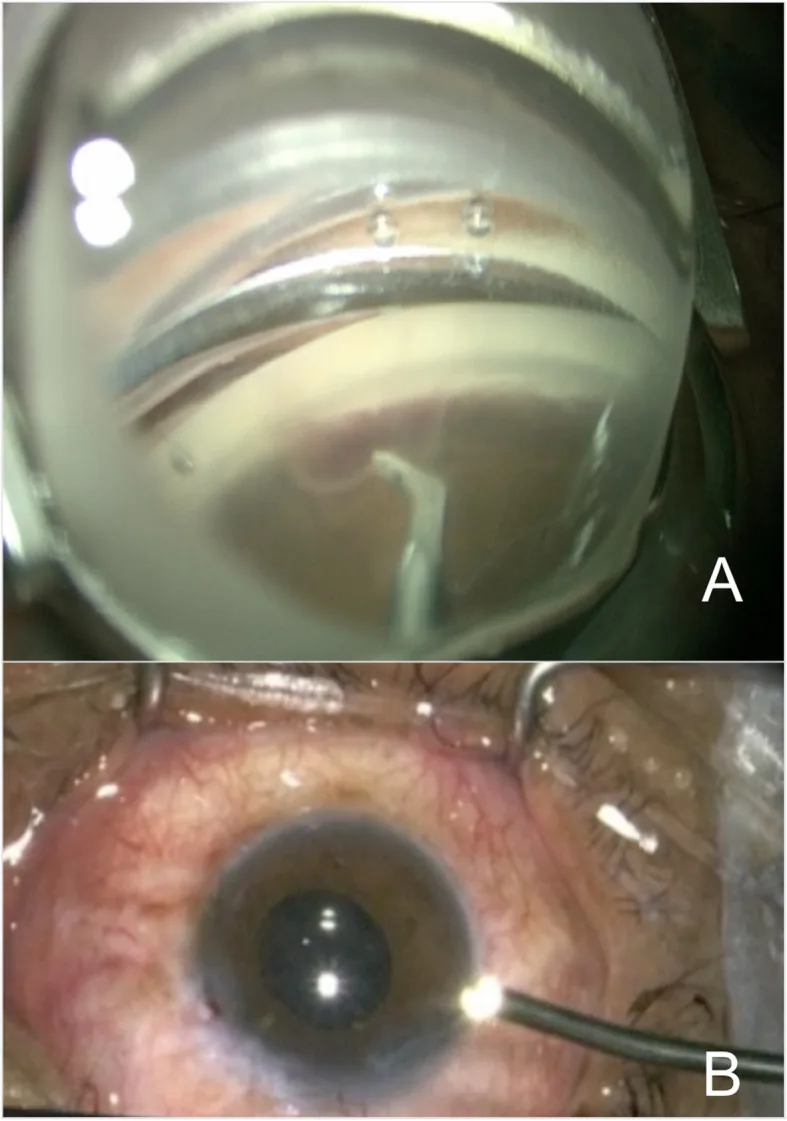
- Apply an 810 nm laser in continuous wave at 100–300 mW, adjusting while confirming whitening and contraction of the ciliary processes. In the technique description by Seibold et al., the initial power is 0.25 W, and rupture of the processes or popping sounds indicate overtreatment and should be avoided14).
- Treat each process systematically. With a curved probe, approximately 270 degrees can be treated from one incision, and adding an incision on the opposite side allows 360-degree treatment14). In a nonrandomized, retrospective comparison by Kahook et al., the 2-incision group had lower intraocular pressure and fewer medications at 6 months than the 1-incision group. This is a comparison of methods for extending the treatment range, and it is not a uniform criterion that 270 degrees or more is mandatory in all cases17).
Combination with cataract surgery (phaco-ECP)
Section titled “Combination with cataract surgery (phaco-ECP)”In patients with coexisting cataract and glaucoma, there is a method of performing lens reconstruction surgery and ECP at the same time. Because ECP can be performed through the limbal incision made for cataract surgery, it is also used as an initial glaucoma surgery2).
Comparison with cataract surgery alone
Section titled “Comparison with cataract surgery alone”A 2024 meta-analysis by Amaral et al. compared phaco-ECP and cataract surgery alone in 9 studies and 5,389 eyes. At each time point evaluated in that analysis, the phaco-ECP group consistently had lower intraocular pressure and fewer medications, while the odds of complications were higher. For the change in best-corrected visual acuity from before surgery to the final follow-up, the cataract surgery alone group was better3).
| Outcome | Comparison of phaco-ECP and phaco alone | P value |
|---|---|---|
| Intraocular pressure at 6 months | Mean difference −1.84 mmHg | 0.002 |
| IOP at 12 months | Mean difference −1.68 mmHg | 0.0002 |
| IOP at final visit | Mean difference −1.49 mmHg | — |
| Number of medications at final visit | Mean difference −0.75 medications | <0.00001 |
| Change in best-corrected visual acuity through final follow-up | Mean difference 0.09 logMAR (favoring phaco alone) | 0.005 |
| General complications | Odds ratio 3.96 | — |
| Serious complications | Odds ratio 8.82 | 0.03 |
These are between-group comparisons from the same meta-analysis, and are not values representing the amount of intraocular pressure reduction from before surgery in individual patients or the absolute incidence of complications. Because there was also a between-group difference in preoperative best-corrected visual acuity, the visual acuity results must be read with that difference in mind3). Long-term outcomes are presented as a separate follow-up study.
ECP Plus
Section titled “ECP Plus”This is a method for refractory cases in which intraocular pressure remains high even after multiple glaucoma surgeries, extending the treatment area from the pars plana approach to include the ciliary processes and the anterior 1–2 mm of the pars plana. It is indicated for pseudophakic or aphakic eyes and is performed together with pars plana vitrectomy14).
There is a report that at 2 years intraocular pressure decreased from 27.9±7.5 mmHg to 11.1±6.5 mmHg, and the number of medications decreased from 3.4±1.2 to 0.6±1.3. The intraocular pressure reduction rate is reported to be about 60%, and hypotony about 7.5%. Because the treatment area is expanded, the outcomes and safety should not be treated as identical to standard ECP.
Outcomes in pediatric glaucoma
Section titled “Outcomes in pediatric glaucoma”Meta-analyses and individual case series involving children need to be read with the number of eyes studied and the follow-up period considered separately.
Pediatric meta-analysis (Elhusseiny et al., 2024)
Section titled “Pediatric meta-analysis (Elhusseiny et al., 2024)”Subjects: 17 studies and 658 eyes combining pediatric TS-CPC and ECP. This includes 197 eyes from 5 studies dealing with ECP alone and 52 eyes in the ECP group of comparative studies of both procedures.
Outcomes and follow-up: Mean intraocular pressure in the ECP group decreased from 32.9±8 to 22.6±9.8 mmHg (P < 0.0001). The median follow-up period in the ECP group was 34.4 months7).
Case series of aphakic and pseudophakic eyes (Carter et al., 2007)
Section titled “Case series of aphakic and pseudophakic eyes (Carter et al., 2007)”Subjects: A retrospective case series of 25 children (34 eyes) with aphakic or pseudophakic glaucoma.
Outcomes and follow-up: At a mean follow-up of 44.4 months, success according to the study definition was 18/34 eyes (53%). This includes multiple ECP treatments, and eyes that succeeded with only one treatment were 13/34 eyes8).
Do not treat all 658 eyes as the number of eyes in the ECP group, or interpret 53% as the success rate of the entire meta-analysis. The populations and evaluation methods of the two studies differ7)8).
Postoperative Management and Complications
Section titled “Postoperative Management and Complications”Postoperative Management
Section titled “Postoperative Management”Transient blurred vision, eye pain, and hyperemia may occur after surgery. Perioperatively, broad-spectrum antibiotic eye drops, steroid eye drops (1% prednisolone acetate or difluprednate), and NSAID eye drops are used. To prevent early postoperative intraocular pressure spikes, glaucoma medications may be used together as eye drops or oral agents. Glaucoma medications are tapered over 1–2 months after surgery depending on intraocular pressure and target.
Assess pain and inflammation, and use steroid eye drops and atropine eye drops as needed. Check intraocular pressure early after surgery and adjust glaucoma medications1)6). Manage postoperative inflammation early and aggressively to reduce the development of posterior synechiae and cystoid macular edema.
Complications and Risk Factors
Section titled “Complications and Risk Factors”The criteria for patients considered for surgery are summarized in Target and Patient Selection.
The main complications are inflammation, intraocular pressure spikes, anterior chamber hemorrhage, and cystoid macular edema. Also watch for iris damage from overtreatment, ciliary block glaucoma, hypotony, and phthisis bulbi. Especially in angle-closure or refractory cases, evaluate the balance between efficacy and complications4).
The figures reported by the ECP Collaborative Study Group (5,824 eyes, mean follow-up 5.2 years) are as follows.
| Complication | Reported frequency |
|---|---|
| Intraocular pressure spike associated with retained viscoelastic material | 14.5% |
| Anterior chamber hemorrhage | 3.8% |
| Cystoid macular edema | 0.7% |
| Visual acuity loss of 2 or more lines | 1.03% |
| Choroidal detachment | 0.36% |
| Retinal detachment | 0.2% |
| Hypotony | 0.12% |
| Loss of light perception | 0.12% |
In the review by Falkenberry et al. citing the same tabulation, choroidal hemorrhage 0.09%, hypotony/phthisis bulbi 0.12%, and loss of light perception 0.12% are described, and an association with neovascular glaucoma or intraoperative hypotony in a single-chamber eye is stated. On the other hand, serous choroidal detachment 0.36% and others are said to have occurred regardless of the mechanism of glaucoma15). Therefore, do not generalize all the serious complications in the table above as occurring “only with neovascular glaucoma.”
In ECP, the risk of hypotony and phthisis bulbi is said to be lower than with the transscleral approach, but it does not mean they never occur. With ECP Plus, pay even greater attention to the risk of hypotony. Statements that no serious complications have been reported in eyes without neovascular glaucoma should also not be used to guarantee safety beyond the scope of a specific tabulation.
Long-term outcomes and comparative studies
Section titled “Long-term outcomes and comparative studies”Long-term outcomes of ECP combined with cataract surgery
Section titled “Long-term outcomes of ECP combined with cataract surgery”3-year outcomes (Yap et al., 2022): A retrospective case series of 83 eyes with primary open-angle glaucoma and no history of glaucoma surgery. Success rates according to the study criteria were 70% at 1 year, 54% at 2 years, and 45% at 3 years. Failure criteria were two consecutive IOP readings above 21 mmHg or a decrease of less than 20%, IOP below 5 mmHg, or additional IOP-lowering surgery. Over 3 years, filtration surgery was performed in 1 eye10).
6-year outcomes (Feinberg et al., 2023): A retrospective case series of 84 eyes with poorly controlled IOP and no history of glaucoma surgery. By 6 years, 57 eyes (68%) met the study’s surgical failure criteria. Inadequate IOP control accounted for 36%, and 32% required additional laser or surgery; not all of the 68% received additional intervention9).
Feinberg et al.’s failure criteria included IOP above 21 mmHg, below 6 mmHg, a decrease of less than 20% from preoperative levels, and additional laser or surgery9). Success rates vary depending on the evaluation criteria, and figures from different studies cannot be directly compared.
Comparison with other procedures and MIGS
Section titled “Comparison with other procedures and MIGS”The IOP-lowering rate of ECP alone has been reported as 34-57%2). In studies comparing ECP with the Ahmed glaucoma valve, IOP reduction was reported to be similar, with fewer complications with ECP2). However, a 2019 Cochrane review concluded that the evidence was insufficient to determine the superiority or inferiority of effectiveness and complications for comparisons including ECP versus Ahmed in refractory glaucoma12).
In comparisons of ECP combined with cataract surgery versus trabeculectomy combined with cataract surgery, equivalent success rates have been reported2). For both procedures, there is a randomized prospective comparison of 58 eyes by Gayton et al. (mean follow-up 2 years)18). It cannot be uniformly stated that “no direct-comparison RCTs exist.” On the other hand, studies with matched subjects and evaluation criteria are needed to clarify the long-term positioning of the procedures.
In a meta-analysis by Paik et al. of primary angle closure and primary angle-closure glaucoma, it was stated that AIT may produce greater IOP reduction than endoCPG. However, it was also discussed that many studies of endoCPG treated a range of 180 degrees or less4).
In the same paper, in a comparison of phaco-MIGS including endoCPG versus cataract surgery alone, the WMD for IOP reduction was 1.22 mmHg, and the difference in medication reduction was 0.59 agents. The 95% confidence intervals for both crossed the value of no difference, so this result alone does not establish the superiority of phaco-MIGS4).
There were 27 adverse events among 156 eyes treated with endoCPG (17.3%), including 4 cases of cystoid macular edema, 11 cases of fibrinous uveitis, 1 case of hemorrhagic choroidal detachment, 2 cases of secondary pupillary block, and 1 case of malignant glaucoma. When comparing these with the 23.0% for iStent and 53.7% for AIT aggregated within the same review, do not interpret different study populations, procedures, and reporting methods as a single direct comparison4).
Scope of the Review and Future Issues
Section titled “Scope of the Review and Future Issues”The 2019 Cochrane review by Tóth et al. found no results from published RCTs meeting the selection criteria for open-angle glaucoma and primary angle closure among studies searched up to July 12, 2018, and listed one ongoing trial11). This does not mean that no research on ECP exists at all.
The same-year review by Chen et al. examined 5 trials and 330 eyes on cyclodestructive procedures for refractory glaucoma but could not determine superiority among procedures12). Clearly state the scope and search date of each review, and interpret them separately from subsequent research.
With cyclodestructive procedures, insufficient coagulation yields no effect, while excessive coagulation carries risks such as phthisis bulbi. Retreatment may also be necessary, and reported retreatment rates for the transscleral method range from 0 to 59%. This is not the retreatment rate of ECP itself.
As another research application, there is a case report in which collector channels were coagulated with an ECP probe for recurrent anterior chamber hemorrhage after trabeculotomy5). The purpose and target differ from the suppression of aqueous production by usual ECP, and case reports should not be treated as general standard treatment.
References
Section titled “References”- European Glaucoma Society. European Glaucoma Society Terminology and Guidelines for Glaucoma, 6th Edition. Br J Ophthalmol. 2025;109(Suppl 1):1-212. PMID:41026937. doi:10.1136/bjophthalmol-2025-egsguidelines.
- Gedde SJ, Vinod K, Wright MM, et al. Primary Open-Angle Glaucoma Preferred Practice Pattern. Ophthalmology. 2021 Jan;128(1):P71-P150. doi:10.1016/j.ophtha.2020.10.022. PMID:34933745.
- Amaral DC, Louzada RN, Moreira PHS, de Oliveira LN, Yuati TT, Guedes J, et al. Combined Endoscopic Cyclophotocoagulation and Phacoemulsification Versus Phacoemulsification Alone in the Glaucoma Treatment: A Systematic Review and Meta-Analysis. Cureus. 2024;16(3):e55853. doi:10.7759/cureus.55853. PMID:38590498; PMCID:PMC11001325.
- Paik B, Chua CH, Yip LW, Yip VCH. Outcomes and Complications of Minimally Invasive Glaucoma Surgeries (MIGS) in Primary Angle Closure and Primary Angle Closure Glaucoma: A Systematic Review and Meta-Analysis. Clin Ophthalmol. 2025;19:483-506. doi:10.2147/OPTH.S505856. PMID:39963523; PMCID:PMC11830760.
- Gallardo MJ, Reyes T. A novel use of the endoscopic cyclophotocoagulative probe for the management of excisional goniotomy induced chronic recurrent hyphema. American journal of ophthalmology case reports. 2022;26:101492. doi:10.1016/j.ajoc.2022.101492. PMID:35340745; PMCID:PMC8943413.
- European Glaucoma Society. European Glaucoma Society Terminology and Guidelines for Glaucoma, 5th Edition. Br J Ophthalmol. 2021 Jun;105(Suppl 1):1-169. doi:10.1136/bjophthalmol-2021-egsguidelines. PMID:34675001.
- Elhusseiny AM, Hassan AK, Elsaman AS, et al. Continuous Wave Transscleral Cyclophotocoagulation and Endoscopic Cyclophotocoagulation in Childhood Glaucoma: A Meta-Analysis. J Glaucoma. 2024;33(6):456-463. doi:10.1097/IJG.0000000000002365. PMID:38506746; PMCID:PMC11142875.
- Carter BC, Plager DA, Neely DE, Sprunger DT, Sondhi N, Roberts GJ. Endoscopic diode laser cyclophotocoagulation in the management of aphakic and pseudophakic glaucoma in children. J AAPOS. 2007;11(1):34-40. doi:10.1016/j.jaapos.2006.08.015. PMID:17307681.
- Feinberg L, Swampillai AJ, Byles D, Smith M. Six year outcomes of combined phacoemulsification surgery and endoscopic cyclophotocoagulation in refractory glaucoma. Graefes Arch Clin Exp Ophthalmol. 2023;261(5):1339-1347. doi:10.1007/s00417-022-05906-0. PMID:36482212.
- Yap TE, Zollet P, Husein S, et al. Endocyclophotocoagulation combined with phacoemulsification in surgically naive primary open-angle glaucoma: three-year results. Eye (Lond). 2022;36(10):1890-1895. doi:10.1038/s41433-021-01734-4. PMID:34526677; PMCID:PMC9499941.
- Tóth M, Shah A, Hu K, Bunce C, Gazzard G. Endoscopic cyclophotocoagulation (ECP) for open angle glaucoma and primary angle closure. Cochrane Database Syst Rev. 2019;2:CD012741. doi:10.1002/14651858.CD012741.pub2. PMID:30801132; PMCID:PMC6388466.
- Chen MF, Kim CH, Coleman AL. Cyclodestructive procedures for refractory glaucoma. Cochrane Database Syst Rev. 2019;3:CD012223. doi:10.1002/14651858.CD012223.pub2. PMID:30852841; PMCID:PMC6409080.
- Lin SC, Chen MJ, Lin MS, Howes E, Stamper RL. Vascular effects on ciliary tissue from endoscopic versus trans-scleral cyclophotocoagulation. Br J Ophthalmol. 2006;90(4):496-500. doi:10.1136/bjo.2005.072777. PMID:16547335; PMCID:PMC1856979.
- Seibold LK, SooHoo JR, Kahook MY. Endoscopic Cyclophotocoagulation. Middle East Afr J Ophthalmol. 2015;22(1):18-24. doi:10.4103/0974-9233.148344. PMID:25624669; PMCID:PMC4302471.
- Falkenberry SM, Siegfried CJ. Endocyclophotocoagulation. Middle East Afr J Ophthalmol. 2009;16(3):130-133. doi:10.4103/0974-9233.56225. PMID:20142978; PMCID:PMC2813596.
- Yu JY, Kahook MY, Lathrop KL, Noecker RJ. The effect of probe placement and type of viscoelastic material on endoscopic cyclophotocoagulation laser energy transmission. Ophthalmic Surg Lasers Imaging. 2008;39(2):133-136. doi:10.3928/15428877-20080301-18. PMID:18435337.
- Kahook MY, Lathrop KL, Noecker RJ. One-site versus two-site endoscopic cyclophotocoagulation. J Glaucoma. 2007;16(6):527-530. doi:10.1097/IJG.0b013e3180575215. PMID:17873713.
- Gayton JL, Van Der Karr M, Sanders V. Combined cataract and glaucoma surgery: trabeculectomy versus endoscopic laser cycloablation. J Cataract Refract Surg. 1999;25(9):1214-1219. doi:10.1016/S0886-3350(99)00141-8. PMID:10476504.