
ARS type 1
Causative gene: PITX2 (4q25)
Main features: Anterior segment anomalies, dental anomalies, redundant periumbilical skin/omphalocele, craniofacial anomalies, cardiovascular anomalies

Axenfeld-Rieger syndrome (ARS) is a group of congenital disorders combining anterior segment dysgenesis and systemic abnormalities. The fundamental etiology is thought to be abnormal migration and differentiation of neural crest cells. During late embryonic development, the normal regression of undifferentiated endothelial cells covering the anterior chamber from the iris and angle is impaired, and their remnants cause strand formation and high iris insertion.
Historical background: In 1920, Axenfeld described posterior embryotoxon (anterior displacement and thickening of Schwalbe’s line) and iris strands. In 1934–1935, Rieger additionally reported iris hypoplasia, corectopia, and polycoria. Currently, it is classified into the following three stages.
These are collectively referred to as Axenfeld-Rieger syndrome. Glaucoma complicates 50–60% of cases, and it is usually bilateral with autosomal dominant inheritance. Cataract and lens dislocation are also frequently associated.
Epidemiology: The prevalence has been reported as approximately 1/200,000, but recent estimates suggest 1/50,000 to 1/100,000 2)4). There is no sex predilection, and it is often diagnosed in infancy.
Genetic classification is as follows:
ARS type 1
Causative gene: PITX2 (4q25)
Main features: Anterior segment anomalies, dental anomalies, redundant periumbilical skin/omphalocele, craniofacial anomalies, cardiovascular anomalies
ARS type 2
Causative gene: 13q14 (not yet identified)
Main features: Anterior segment anomalies, glaucoma. Systemic anomalies are less frequent than in types 1 and 3
ARS type 3
Causative gene: FOXC1 (6p25)
Main features: Anterior segment anomalies, glaucoma, sensorineural hearing loss, atrial septal defect, renal anomalies, white matter lesions
FOXC1 and PITX2 mutations account for 40–70% of ARS cases 5). However, the causative gene remains unidentified in 60% of ARS cases 4), indicating substantial genetic heterogeneity.
In a large registry analysis of 506 cases of childhood- and young adult-onset glaucoma, the overall molecular diagnostic rate was 24.7% (125/506 cases) 11). A diagnostic rate of 56.5% was limited to the subgroup of glaucoma associated with non-acquired ocular anomalies 11). Among cases with a genetic diagnosis, CYP1B1 (23.2%), MYOC (19.2%), and FOXC1 (16.8%) were most common, with the genetic composition varying by study population 11).
They are distinguished by the causative gene. Type 1 is caused by PITX2 (4q25) mutations and is associated with dental, umbilical, and facial bone anomalies. Type 3 is caused by FOXC1 (6p25) mutations and is associated with hearing loss, cardiac defects, renal anomalies, and neurological abnormalities. Type 2 maps to 13q14 but the causative gene has not been identified; it primarily involves anterior segment anomalies and glaucoma. Identification of a pathogenic variant aids in genetic confirmation and classification, but a negative result does not exclude ARS 10).
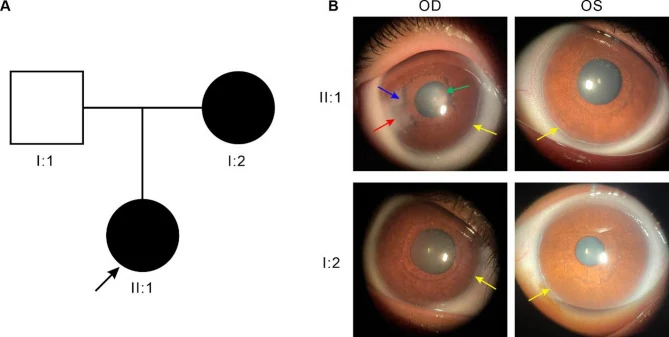
Major ocular findings are listed below.
| Ocular Finding | Characteristics |
|---|---|
| Posterior embryotoxon | Anterior displacement and thickening of Schwalbe’s line |
| Iris processes | Fine thread-like to broad band-like |
| Pupil deviation | Deviation away from posterior embryotoxon |
| Pseudopolycoria | Perforation-like appearance of iris stroma |
| Uveal ectropion | Eversion of iris pigment epithelium |
Posterior embryotoxon is a remnant of undifferentiated cells at the Schwalbe line, appearing as a linear opacity along the limbus, 0.5–2.0 mm central to the limbus. It is often partial rather than circumferential. Adhesion between the prominent Schwalbe line and the iris is called Axenfeld anomaly, and when accompanied by iris stromal atrophy, it is called Rieger anomaly.
The cornea is usually clear with normal endothelial structure, but secondary corneal opacity may occur due to physical contact with residual tissue. Corneal opacity is often limited to the periphery and generally does not directly affect vision. However, in FOXC1 mutations, corneal opacity and corneal neovascularization are more pronounced, and the degree of corneal abnormality is greater and glaucoma is more frequent compared to PITX2 mutations1).
Angle findings include high iris insertion, persistent uveal strands, and thickened Schwalbe line (posterior embryotoxon). Cases with spherophakia and lens subluxation have also been reported7).
Glaucoma occurs in 50–60% of cases. Intraocular pressure elevation may occur in infancy, but most cases develop in childhood to young adulthood. Some cases are diagnosed after progressive vision loss, so it is important not to overlook anterior segment findings and glaucomatous changes6).
In a 7-year-old boy reported by Li et al. (2021) (ARS type 3, de novo FOXC1 mutation), corneal diameter was 14 mm, axial length 27.16/26.56 mm, cup-to-disc ratio 0.9, and IOP 33/20 mmHg. Bilateral glaucoma surgery was required from 36 days after birth5).
Systemic findings are as follows:
Approximately 50–60% of ARS cases are complicated by glaucoma. It often develops from childhood to young adulthood, but some cases present with elevated intraocular pressure in infancy. Regular intraocular pressure measurement and optic nerve evaluation are necessary; for details, see the “Standard Treatment” section.
ARS mainly shows autosomal dominant inheritance, but penetrance and clinical presentation vary10). Even within the same family carrying the same gene mutation, significant individual differences (variable expressivity) in clinical features can occur1).
In large cohort studies, FOXC1 and PITX2 mutations were associated with a broad spectrum of glaucoma from childhood to adulthood9). Cases initially diagnosed clinically as PCG (primary congenital glaucoma) may be reclassified by genetic testing, and genetic testing contributes to accurate disease classification when anterior segment findings in infants are subtle.
In cases with microdeletions around the PITX2 gene, overlapping deletions of NEUROG2, UGT8, and NDST4 can lead to developmental delay and intellectual disability8)3).
Kawanami et al. (2023) reported a 3-year-old Japanese boy with a 2.5 Mb microdeletion at 4q25 (including PITX2, NEUROG2, and ANK2). He presented with umbilical hernia, iris coloboma, and developmental delay, but his electrocardiogram was normal despite the ANK2 deletion. Haploinsufficiency of NEUROG2 was considered a candidate cause of developmental delay8).
Due to autosomal dominant inheritance, the probability of transmission from an affected parent is 50%. Penetrance and phenotype are variable; even with the same mutation, the presence and severity of symptoms can differ1)10). Genetic testing and genetic counseling are recommended.
The diagnosis of ARS is based on a combination of bilateral anterior segment anomalies centered on the angle and iris. Posterior embryotoxon is seen in many cases but is not essential for diagnosis10). In cases where posterior embryotoxon is not visible on slit-lamp microscopy, angle abnormalities are assessed by gonioscopy. If systemic abnormalities are present, referral to relevant departments such as dentistry, cardiology, and neurology is indicated as ARS syndrome, and in pediatric cases, a full systemic workup is performed in collaboration with pediatrics10,13).
Posterior embryotoxon alone is not specific to ARS; therefore, it should be evaluated together with iris and angle findings, glaucoma, systemic findings, and family history13).
In the classification system for childhood glaucoma in the Glaucoma Clinical Practice Guidelines (5th edition), ARS is positioned as a representative example of glaucoma associated with congenital ocular anomalies13). It is diagnosed when ocular anomalies present at birth meet the diagnostic criteria for childhood glaucoma.
The main diseases to be differentiated from ARS are shown below.
| Disease | Differences from ARS |
|---|---|
| ICE syndrome | Unilateral, acquired, female predominance |
| Peters anomaly | Central corneal opacity, Descemet membrane defect |
| Aniridia | Corneal pannus, foveal hypoplasia |
| Posterior polymorphous corneal dystrophy | Bilateral, familial, no sex difference |
ICE syndrome (progressive iris atrophy, Chandler syndrome, etc.) is important to differentiate from ARS, but the key distinguishing point is that ICE is unilateral and acquired, whereas ARS is bilateral and congenital.
There is currently no curative treatment for ARS itself; management focuses on glaucoma control and surveillance for systemic complications. The treatment strategy follows that for early-onset developmental glaucoma (primary congenital glaucoma: PCG) 13).
Glaucoma complicates approximately 50–60% of ARS cases. Pharmacological treatment follows that for general glaucoma, but it is often ineffective.
Aqueous humor suppressants
Beta-blockers: One of the drugs used in pediatric glaucoma. Selection should consider age, systemic condition, and contraindications 13).
Carbonic anhydrase inhibitor (CAI) eye drops: e.g., brinzolamide. Can be used in combination with beta-blockers.
Alpha-2 agonists (brimonidine): Contraindicated in children under 2 years of age due to neuropsychiatric symptoms (apnea, bradycardia, hypotension, hypotonia, central nervous system depression) 13).
Aqueous humor outflow enhancers
Prostaglandin-related drugs: e.g., latanoprost, travoprost. Their efficacy in children is considered weaker than in adults 13).
Example: A 7-year-old boy was managed long-term with travoprost + brinzolamide 5). In a 77-year-old man, IOP remained 35 mmHg despite latanoprost/timolol + brinzolamide, indicating poor control 2).
There is a report that there is no difference in efficacy between prostanoid FP receptor agonists and beta-blockers 13).
In infants and young children, the dose of eye drops is relatively large compared to body weight and body surface area, so the lowest concentration possible should be used 13).
If intraocular pressure cannot be controlled with medication, surgery is performed 10)13).
Reported complications after GDD surgery include shallow anterior chamber 13.6%, hypotony 11.7%, choroidal effusion 8.3%, and endophthalmitis 1.7% 14).
Chakraborty et al. (2022) reported a case of ARS-associated retinal detachment (15-year-old boy). The patient had microspherophakia and lens subluxation; after vitrectomy, IOP rose to 41 mmHg and a staphyloma formed. Diode cyclophotocoagulation was performed, and final IOP was 18 mmHg 7).
A reliable success rate specific to ARS has not been established, and outcomes vary depending on age, angle dysgenesis, and prior surgery. The success rate of angle surgery is considered lower than that of primary congenital glaucoma13). In a meta-analysis of pediatric glaucoma overall (not limited to ARS), the estimated success rate of GDD was 87% at 12 months and 77% at 24 months, but there was heterogeneity among disease groups and study conditions14). Refractory cases may require multiple surgeries.
The fundamental etiology of ARS is a defect in neural crest cell migration and differentiation. Impaired development of neural crest cells in the anterior chamber, anterior chamber angle, facial bones, teeth, cardiovascular system, and periumbilical skin leads to multisystem malformations.
In late embryonic stages, the undifferentiated endothelial cells covering the anterior chamber normally disappear from the iris and angle. In ARS, this disappearance process is impaired, and undifferentiated endothelial cells persist on the iris, causing strand formation. In the angle, high iris insertion occurs, mechanically covering the trabecular meshwork.
Histologically, a monolayer of endothelial-like cells with a Descemet-like membrane abnormally extends from the posterior cornea to the anterior chamber, angle, and iris surface. The membrane is present in quadrants with ectropion uveae and corectopia, while iris atrophy is observed in the opposite quadrants.
FOXC1 and PITX2 are both transcription factors that bind to specific DNA sequences to regulate the expression of downstream genes. They act synergistically in anterior segment development and regulate common downstream target genes3). The forkhead domain (a 110-amino acid DNA-binding domain) of FOXC1 is functionally most important2), and mutations in this domain have been suggested to be more strongly associated with neuropsychiatric symptoms.
The following two mechanisms have been identified for intraocular pressure elevation:
The degree of iris coloboma and the amount of angle iris processes do not necessarily correlate with glaucoma severity. However, a high degree of iris synechia in the angle predisposes to glaucoma.
FOXC1 mutations promote congenital glaucoma more than other mutations1), and morphological abnormalities of the ciliary body and drainage angle may contribute to IOP elevation1).
In FOXC1 mutant mice, decreased collagen fibers and structural abnormalities in the corneal stroma, as well as impairment of keratocytes, are observed1). Furthermore, FOXC1 functions as a suppressor of corneal angiogenesis (via regulation of VEGF bioavailability)1), and loss of this suppression due to FOXC1 mutation leads to corneal neovascularization.
FOXC1, as a FOX family transcription factor, also plays an important role in brain development4).
In a systematic review, white matter abnormalities were reported in 26 of 63 reports (41.3%). However, 60 reports were case reports or case series, and the patient-level prevalence cannot be estimated from this proportion15). FOXC1 mutations may be associated with cerebral small vessel disease (CSVD), white matter hyperintensities, enlarged perivascular spaces, microbleeds, and lacunar infarcts.
Ohkubo et al. (2025) confirmed periventricular white matter lesions, enlarged perivascular spaces, and tortuous dilation of the vertebrobasilar artery on brain MRI in a 2-year-old Japanese boy (FOXC1 mutation: c.240del, p.Y81Ifs21). His father had a history of cerebral infarction at age 184).
In a review of 95 FOXC1 mutation cases, 6.3% had neuropsychiatric symptoms (learning difficulties, epilepsy, intellectual disability, delusional jealousy, etc.), and 83.3% of cases with forkhead domain mutations exhibited neuropsychiatric symptoms2).
Yes. ARS with FOXC1 mutations has been reported with white matter abnormalities. In a systematic review, 26 of 63 reports described such findings, but patient-level prevalence could not be estimated15). FOXC1 mutations have been suggested to be associated with cerebral small vessel disease and stroke risk, and neurological evaluation based on symptoms and family history is considered.
In recent years, many novel mutations have been reported through next-generation sequencing and whole-genome sequencing.
Wowra et al. (2024) identified a large deletion (novel mutation) involving part of FOXC1 exon 1 and the entire 3’UTR in three Polish sisters with ARS. The phenotype varied greatly within the same family, and they were initially misdiagnosed with Chandler syndrome1).
Jiang et al. (2024) identified a complex genomic rearrangement in a Chinese family with ARS type 1, including a 6.15 Mb deletion of chromosome 4q25 involving PITX2, a 45.71 Mb inversion, and a 14 bp deletion. An 11-year-old girl presented with IOP of 43.5/44.0 mmHg3).
Other novel mutation reports include FOXC1 p.Phe136Leu (forkhead domain)2), FOXC1 p.S82R (de novo mutation)5), and FOXC1 c.240del, p.Y81Ifs214).
Yoshino et al. (2024) reported a case of ARS type 3 in a 77-year-old Japanese man. Delusional jealousy appeared at age 72, and leukoencephalopathy was confirmed. A literature review of 95 cases with FOXC1 mutations found neuropsychiatric symptoms in 6.3% (6/95 cases), of which 83.3% (5/6 cases) had forkhead domain mutations2).
This finding suggests that the functional domain of FOXC1 mutations may be involved in the development of neuropsychiatric symptoms, indicating the importance of long-term follow-up from a mental health perspective.
It has been suggested that FOXC1 mutations may induce CSVD and increase the risk of stroke4). The importance of prevention and early intervention for neurovascular diseases in ARS patients is considered a future research topic.
The pathogenesis of corneal “sclerocornea” due to FOXC1 mutations is being elucidated1). Understanding the molecular mechanisms of corneal opacity is expected to lead to the development of novel treatments using gene therapy, anti-fibrotic drugs, and biomaterials1).