The dexamethasone intravitreal implant (brand name: Ozurdex, Allergan/AbbVie) is a biodegradable intravitreal implant containing 0.7 mg of dexamethasone.
It uses a PLGA (poly(D,L-lactide-co-glycolide)) matrix called the Novadur drug delivery system. PLGA is biodegraded in the body into lactic acid and glycolic acid, releasing dexamethasone slowly over up to 6 months. The peak effect occurs 60 to 90 days after administration, and the implant itself is biodegraded in 3 to 4 months. 4)
Position: Approved in 2009 based on the GENEVA study (1,131 cases). Onset of effect from day 30, peak at 90 days.
Features: Effect disappears after 6 months, so re-administration is necessary.
Non-infectious uveitis
Indications: Intermediate and posterior uveitis of the posterior segment
Position: Used in combination with systemic immunosuppressive therapy. Approved in 2010.
Features: Local administration avoids systemic side effects.
QHow long does the effect last?
A
The peak effect occurs 60 to 90 days after administration and lasts up to 6 months. The implant itself is biodegradable within 3 to 4 months. 4) In the GENEVA study, for RVO, the effect appeared from day 30, peaked at 90 days, and disappeared at 6 months. If recurrence occurs after the effect wears off, re-administration may be considered.
Anterior chamber migration: 4.8% in vitrectomized eyes, 1.6% overall5).
Intralenticular injection (lens implantation): Caused by incorrect needle direction, surgeon inexperience, or patient movement1)
QCan it be administered to eyes that have undergone cataract surgery?
A
Administration is possible, but if there is a posterior capsule defect, the risk of implant migration into the anterior chamber increases to 4.8%. 5) Confirm the presence or absence of posterior capsule defect in advance, and administer after explaining the risk of anterior chamber migration and the need for early consultation to the patient. In pseudophakic eyes with an intact posterior capsule, there is no concern for cataract, making it a good indication for DME.
OCT (Optical Coherence Tomography): Quantitative evaluation of macular edema (CRT measurement). Also useful for confirming implant position after administration3), 4)
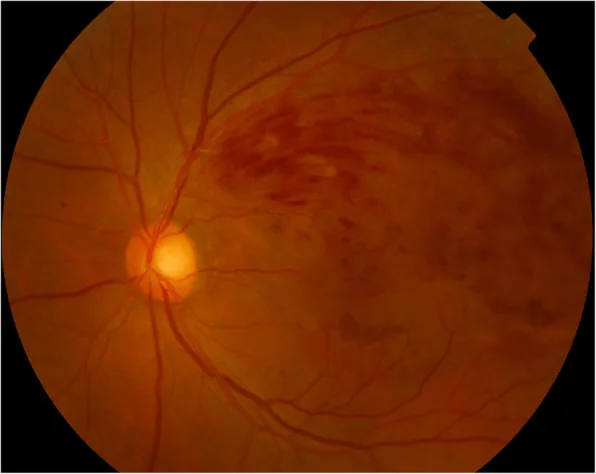
Jae Hyung Lee; Jae Yong Park; Jae Suk Kim; Je Hyung Hwang. Rapid progression of cataract to mature stage after intravitreal dexamethasone implant injection: a case report. BMC Ophthalmol. 2019 Jan 3; 19:1. Figure 1. PMCID: PMC6318997. License: CC BY 4.0 (https://creativecommons.org/licenses/by/4.0/).
A 22-gauge needle applicator is used. Insert at 4 mm from the limbus, parallel to the limbus with the bevel facing upward. After inserting the needle tip 1 mm, direct it toward the center of the eye. Concurrent cataract surgery can be performed safely.3)
Anti-VEGF agents are first-line therapy; this implant is positioned as a second-line treatment. In phakic eyes, careful consideration is required due to the risk of cataract and elevated intraocular pressure.6) The DRCR.net Phase 2 trial showed a reduction in CRT when combined with anti-VEGF therapy, but no additional visual acuity benefit was demonstrated.6)
In the GENEVA trial (1,131 patients), the effect appeared from day 30, peaked at 90 days, and disappeared by 6 months. At 1 year, IOP ≥25 mmHg occurred in 16% of patients.6)
The COBALT trial showed a mean improvement of +18.6 letters at 6 months and +15.3 letters at 12 months for branch retinal vein occlusion.6)
Meta-analysis indicates that anti-VEGF agents are superior to steroids for visual acuity improvement in RVO.6)
In a meta-analysis, the implant group showed a reduction in CMT of −127.60 μm at 1 month. However, some reports indicate that the anti-VEGF group had superior visual acuity improvement. 7)
Incidence: 4.8% in vitrectomized eyes, 1.6% overall5)
Risk: Corneal endothelial damage. In a report of 15 cases, 14 had corneal edema, 10 did not recover, and 6 required corneal transplantation.5)
Management: Early removal is important. Delayed removal (5.5 days) vs. early removal (0.5 days) showed a significant difference in prognosis (P=0.04).5)
Intraocular Pressure Elevation
Incidence: Approximately 1/3 require treatment intervention6)
Characteristics: In the GENEVA study, at 1 year, IOP ≥25 mmHg occurred in 16%.6)
Management: Screen for glaucoma history and risk in advance. Manage with topical antihypertensive eye drops.
Cataract
Incidence: 67.9% in phakic eyes (MEAD study)6)
Comparison with sham group: Significantly higher frequency compared to 20.4% in the placebo group.6)
Management: No problem in pseudophakic eyes. In phakic eyes, explain the need for cataract surgery in advance.
QCan it be used when anti-VEGF drugs are ineffective?
A
It can be used. In DME, it is positioned as second-line therapy for cases unresponsive to anti-VEGF agents. 6) It is considered more effective in cases with chronic macular edema or strong inflammatory components. However, in phakic eyes, the side effects of cataract and elevated intraocular pressure are frequent, so pseudophakic eyes or patients who have difficulty with frequent visits are particularly good indications.
QWhat should be done if it migrates into the anterior chamber?
A
Prompt removal is recommended. Early removal (approximately 0.5 days) significantly reduces the risk of corneal edema compared to delayed removal (approximately 5.5 days) (P=0.04). 5) A removal technique using a 19-gauge bent needle has been reported and can be completed within one minute. It is important to see an ophthalmologist immediately upon detecting anterior chamber migration.
6. Pathophysiology and Detailed Mechanism of Onset
PLGA (poly(D,L-lactide-co-glycolide)) is hydrolyzed into lactic acid and glycolic acid. This degradation rate determines the drug release rate. The implant releases the drug for up to 6 months and is almost completely biodegraded in 3–4 months. 4)
Mudri et al. (2021) reported a case using a dexamethasone intravitreal implant as initial treatment for CAR. A patient presenting with acute bilateral blurred vision and central scotoma, with abnormalities on FA and electroretinography, showed improvement in visual acuity and electroretinographic findings after administration. 2)
The efficacy as initial treatment for CAR is at the single case report stage, and further verification is needed to establish it as standard treatment.
Potential Application to Retinitis Pigmentosa (RP)
In a review by Napoli et al. (2025), preclinical findings were summarized indicating that intraocular dexamethasone may protect cone photoreceptors and RPE in the rd10 mouse model. The involvement of inflammatory responses in cone degeneration progression is presented as a rationale for repurposing to RP. 8)
Currently, these are findings from animal models, and clinical trials are necessary for human application.
A new complication of intracapsular migration was reported in 2026. Verma et al. presented a case managed conservatively without complications, highlighting the risk in eyes with posterior capsule defects. 4)
A simple removal technique for anterior chamber migration using a 19-gauge bent needle has been reported by Depla et al., described as a safe procedure that can be completed within one minute. 5)
Additionally, a case has been reported in which prolonged contact with the macula for 16 weeks did not cause retinal toxicity, drawing attention as evidence supporting the long-term safety of the implant. 3)
Maria Ludovica Ruggeri, Alberto Quarta, Rossella D’Aloisio, Lisa Toto, Rodolfo Mastropasqua. A case of accidental into-the-lens dexamethasone implant: watching or removing?. BMC Ophthalmol. 2024;24(1). doi:10.1186/s12886-024-03538-y.
Mudri J, Phagura RS, Lam WS, Wu XN. Intravitreal dexamethasone implant use as first-line therapy for cancer-associated retinopathy. BMJ case reports. 2021;14(11). doi:10.1136/bcr-2021-245527. PMID:34764094; PMCID:PMC8587697.
Kelkar AS, Kelkar JA, Agarwal AA, Mehta HM, Kelkar SB. PROLONGED OZURDEX-MACULAR CONTACT FOLLOWING VITRECTOMY FOR MACULAR HOLE. Retinal cases & brief reports. 2022;16(2):168-169. doi:10.1097/ICB.0000000000000951. PMID:31842045; PMCID:PMC8860207.
Verma L, Priya B, Lakhlan P, Thoumungkan BR, Gupta A. Ozurdex® Implant Inside the Capsular Bag: A Report of a Rare Case. Cureus. 2026;18(1):e101142. doi:10.7759/cureus.101142. PMID:41664769; PMCID:PMC12883051.
Depla JAM, van der Linden CMC, Braaf B, Wijnans J, Bijlsma WR, Missotten TOAR. Active removal of anterior segment-migrated dexamethasone implant (Ozurdex). GMS Ophthalmol Cases. 2022;12:Doc08.
Lim JI, Kim SJ, Bailey ST, et al. Diabetic Retinopathy Preferred Practice Pattern. Ophthalmology. 2025 Apr;132(4):P75-P162. doi:10.1016/j.ophtha.2024.12.020. PMID:39918521.
Napoli D, Di Marco B, Salamone G, Orsini N, Mazziotti R, Strettoi E. Keeping the lights on: a new role for an old drug to support cone survival in Retinitis Pigmentosa. Prog Retin Eye Res. 2025;109:101403. doi:10.1016/j.preteyeres.2025.101403.
Copy the article text and paste it into your preferred AI assistant.
Article copied to clipboard
Open an AI assistant below and paste the copied text into the chat box.