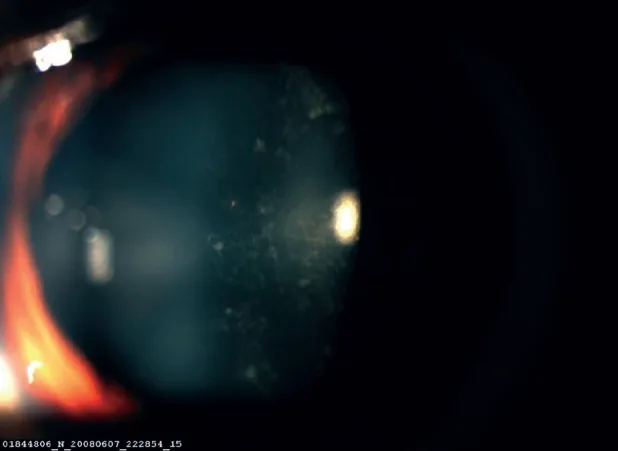
The reverse RAPD test is a technique that evaluates dilation of the normal (unaffected) pupil while performing the swinging flashlight test.
Standard RAPD (Marcus Gunn pupil) is a clinical sign that defines a pathological defect on the afferent side of the pupillary pathway. It appears as a difference in the pupillary light reflex between the two eyes, and patients with RAPD do not have anisocoria.
The standard swinging flashlight test assumes observation of the reacting pupil (the pupil of the affected eye). However, when one eye has an efferent pupillary defect, the pupil of the affected eye does not respond to light, so RAPD cannot be assessed using the standard technique.
In the reverse RAPD test, the pupil of the healthy eye is observed continuously. If the healthy eye dilates when the light is swung to the abnormal eye, it suggests RAPD in the abnormal eye.
Causes of efferent pupillary defects that require the reverse RAPD test:
Absolute pupillary rigidity (e.g., iris atrophy due to iritis, acute primary angle-closure glaucoma, sphincter paralysis due to atropine)
QHow does the reverse RAPD test differ from a regular RAPD test?
A
In the standard swinging flashlight test, the pupil of the affected eye is observed, whereas in the reverse RAPD test, the pupil of the healthy eye is observed continuously. If the healthy eye dilates when light is swung to the abnormal eye, it suggests the presence of an afferent pupillary defect (RAPD) in the abnormal eye.
Cases where RAPD is not positive (or may occur in the reverse direction):RAPD is not positive in ordinary media opacities or macular holes. However, note that in severe unilateral nuclear cataract, a small RAPD may occur on the contralateral (clear lens) side due to scattering of the test light (Lam & Thompson, 1990). Evaluation becomes complex in cases where cataract coexists with optic pathway lesions.
QIn what situations is a reverse RAPD test necessary?
A
It is indicated when one pupil does not react to light due to posterior synechiae, traumatic mydriasis, oculomotor nerve palsy, pharmacologic mydriasis, etc. Even with these efferent pupillary defects, the presence or absence of RAPD can be evaluated by observing the pupil of the healthy eye.
In a dimly lit room, have the patient fixate on a distant target.
Using a bright penlight (or handheld slit lamp), shine light alternately into the right and left eyes from below for 1–2 seconds each.
A dimmer light (like a penlight) is better for detection than an overly bright light.
If the pupil of the illuminated eye cannot maintain constriction and dilates, it is judged as RAPD positive.
It is important to shine the light from the same angle (preferably from the front) for both eyes. Shining from an oblique angle may lead to a false judgment of asymmetry.
It is important to distinguish between afferent defects (RAPD positive) and efferent defects (anisocoria present). Input pathway disorders (optic nerve diseases) cause abnormal light reflex but do not cause anisocoria.
If both eyes are present and at least one functional pupil exists, RAPD can be assessed using the reverse RAPD test. Observe the healthy eye continuously, and when light is swung to the abnormal eye, the dilation response of the healthy eye is used as an indicator of RAPD.
The reverse RAPD test is an examination technique and finding; there is no specific treatment for reverse RAPD itself. Treatment is directed at the underlying cause.
Treatment for Afferent Pathway Disorders (Causes of RAPD)
Oculomotor nerve palsy with pupillary dilation may indicate a posterior communicating artery aneurysm, requiring urgent vascular imaging (CT/CTA).
However, if RAPD is present in the same patient, the lesion location shifts from the posterior communicating artery to the orbital apex, changing the diagnostic approach.
QWhat treatment is given if reverse RAPD is confirmed?
A
There is no specific treatment for reverse RAPD itself; treatment is directed at the underlying cause. For optic neuritis, steroid pulse therapy (methylprednisolone 1,000 mg IV for 3 days) is first-line. For oculomotor nerve palsy, investigation of the cause (e.g., excluding posterior communicating artery aneurysm) is prioritized.
Unilateral afferent pathway damage reduces input to the EW nucleus when light stimulates the affected eye. As a result, the pupillary light reflex is diminished, and when light is swung to the affected eye, both pupils dilate.
In humans, the direct and consensual light reflexes are nearly equal in magnitude. Even if one optic nerve is damaged, anisocoria does not occur when both eyes are open. This is why RAPD does not cause anisocoria.
The supranuclear fibers to the EW nucleus for the near response run ventral to the midbrain pretectum and posterior commissure, through which the afferent fibers of the light reflex pass. Therefore, damage to the pretectum can impair the light reflex while sparing the near response.
The ratio of neurons involved in the light reflex to those involved in accommodation in the ciliary ganglion is said to be 3:97. The fact that fibers for the light reflex are originally few is another reason why this dissociation easily occurs.
Beck RW, Cleary PA, Anderson MM Jr, et al. A randomized, controlled trial of corticosteroids in the treatment of acute optic neuritis. The Optic Neuritis Study Group. N Engl J Med. 1992;326(9):581-588. PMID: 1734247. https://pubmed.ncbi.nlm.nih.gov/1734247/