COVID conjunctivitis is an ocular symptom associated with severe acute respiratory syndrome coronavirus 2 (SARS-CoV-2) infection. The COVID-19 pandemic began in Wuhan, China in December 2019. Previous coronavirus-related diseases such as SARS and MERS did not report conjunctivitis, but conjunctivitis has been confirmed with SARS-CoV-2.
SARS-CoV-2 is a beta coronavirus belonging to the Coronaviridae family. It is an enveloped single-stranded RNA virus that uses the angiotensin-converting enzyme 2 (ACE2) receptor for cell entry. ACE2 receptors are expressed in the conjunctiva and cornea, but their density in ocular tissues is relatively low. Detection of the virus in tears and conjunctival secretions has been reported, suggesting the possibility of transmission through the eyes 1). However, some reports indicate that the risk of infection via ocular secretions is low 1).
QCan COVID conjunctivitis be the initial symptom of COVID-19?
A
Cases have been reported where conjunctivitis was the only sign of COVID-19. Conjunctivitis may appear before respiratory symptoms or fever, and during the pandemic, it was necessary to consider the possibility of COVID-19 in patients with conjunctivitis. However, recent studies suggest that SARS-CoV-2-related conjunctivitis may not be common in patients presenting only with conjunctivitis.
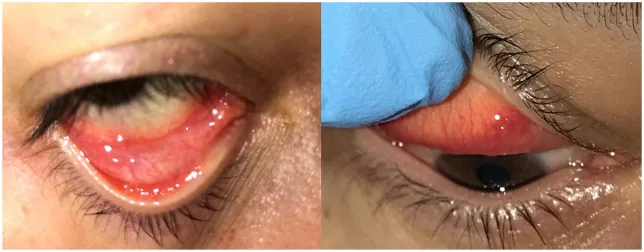
Z, B. Conjunctivitis as sole symptom of COVID-19: A case report and review of literature. Eur J Ophthalmol. 2020 Jul 24:1120672120946287. Figure 1. PMCID: PMC7383095. License: CC BY 4.0 (https://creativecommons.org/licenses/by/4.0/).
Follicular changes in the upper and lower fornix conjunctiva, with mild conjunctival edema and serous discharge. This shows non-specific but clinically encountered conjunctival findings in COVID conjunctivitis.
Tearing, foreign body sensation, and ocular redness are the main subjective symptoms. Some cases may be asymptomatic. Cases have been reported where conjunctivitis was the only symptom of COVID-19. Conjunctivitis may also develop during the course of hospitalization.
Lymph nodes: May be accompanied by tender preauricular lymphadenopathy.
Systemic Findings
Respiratory symptoms: Fever, cough, and shortness of breath are common findings.
Gastrointestinal symptoms: Diarrhea, nausea, and vomiting have also been reported.
Neurological symptoms: New loss of taste or smell is characteristic.
Others: Accompanied by muscle pain, headache, chest pain, and sore throat.
Animal studies have also shown anterior uveitis, retinitis, vasculitis, and optic neuritis. In humans, subtle microvascular abnormalities in the retinal ganglion cell layer and inner plexiform layer have been described.
The main routes of SARS-CoV-2 infection are droplet transmission and direct contact with mucous membranes. Possible routes of conjunctival infection include direct inoculation of ocular tissue from droplets of infected individuals, spread from the nasopharynx via the nasolacrimal duct, and infection through the lacrimal gland. Ocular surface cells have been reported to be susceptible to SARS-CoV-2 infection 1).
Risk factors for severe COVID-19 include advanced age, chronic lung disease, immunocompromised status, diabetes, obesity, chronic kidney disease, and liver disease. Healthcare workers are at high risk of infection due to occupational exposure. Since ophthalmic examinations are performed at close range, ophthalmologists need to be particularly cautious 1).
The incubation period of COVID-19 averages 5 to 7 days. Approximately 97% of patients develop symptoms within 11.5 days after exposure, which is the basis for the recommended 14-day quarantine. The median duration of viral shedding is 20 days, with reports of up to 37 days.
Definitive diagnosis is made by RT-PCR testing of conjunctival swabs. However, RT-PCR has high specificity but low sensitivity. False negatives are common depending on the timing of collection, and the use of topical anesthetics may also affect results. Two consecutive negative RT-PCR results are required to confirm patient safety.
Serological testing for SARS-CoV-2 antibodies is also useful for diagnosis. IgM positive and IgG negative indicates active infection. Both IgM and IgG positive indicates recent infection. IgM negative and IgG positive indicates past infection. However, IgG positivity alone does not imply immunity.
Itching is the main symptom. Predominant papillary reaction
Other differential diagnoses include herpes simplex keratitis, anterior uveitis, dry eye syndrome, and exposure keratopathy. Since some cases of COVID conjunctivitis occur without systemic symptoms, it was necessary to consider the possibility of COVID-19 in all patients presenting with conjunctival injection during the pandemic.
COVID conjunctivitis usually resolves spontaneously, but the following complications may occur: punctate superficial keratitis with subepithelial infiltrates, secondary bacterial infection, conjunctival scarring, symblepharon, severe dry eye, corneal ulcer, and corneal scarring have been reported.
QWhat is the prognosis of COVID conjunctivitis?
A
COVID conjunctivitis resolves spontaneously without sequelae. No specific long-term ocular complications have been reported to date. However, if it progresses to pseudomembranous conjunctivitis or keratitis, there is a risk of conjunctival scarring and corneal opacity, requiring follow-up.
The pathophysiology of COVID-19-associated conjunctivitis is not fully understood. Based on the SARS-CoV model, the disease is thought to progress through three stages: viral replication, immune hyperactivity, and tissue destruction.
SARS-CoV-2 enters conjunctival epithelial cells via the ACE2 receptor. Similar to lung tissue, conjunctival cells die due to virus-mediated lysis or immune reactions. As a result of cell death, the virus is released into the tear fluid.
The low density of receptors in the eye is speculated to be one reason for the lower incidence of conjunctivitis compared to the overall prevalence of COVID-19. Phylogenetic analysis has identified two distinct types of SARS-CoV-2, L and S, with over 100 strains confirmed. The receptor-binding domain is similar to that of SARS-CoV.
Through the experience of the COVID-19 pandemic, the importance of infection prevention measures for viral conjunctivitis has been reaffirmed. Understanding of the transmission route of respiratory viruses via the ocular surface is expected to deepen further.