

Examination Under Anesthesia (EUA) in Children
Key Points at a Glance
Section titled “Key Points at a Glance”1. What is Pediatric Examination Under Anesthesia (EUA)
Section titled “1. What is Pediatric Examination Under Anesthesia (EUA)”Examination Under Anesthesia (EUA) refers to performing an eye examination under general anesthesia or sedation for young children or uncooperative patients. Infants and young children have difficulty cooperating during examinations, and accurate intraocular pressure measurement, fundus examination, and electrophysiological testing require complete stillness. Therefore, in many cases, precise evaluation is difficult with routine outpatient examinations alone for young children.
In ophthalmic surgery, candidates for general anesthesia include children, elderly patients, those undergoing long procedures, and patients who cannot remain still.
EUA involves two levels: procedural sedation using sedatives and analgesics for the purpose of examination, and general anesthesia with complete loss of consciousness.
Depth classification of anesthesia/sedation:
- Sedation: Consciousness is preserved, and airway reflexes are maintained. Oral or rectal sedatives are used, applicable for short outpatient examinations.
- General anesthesia: Complete loss of consciousness requiring airway protection. Applied for prolonged, detailed examinations in the operating room.
The ophthalmologist should summarize anesthesia-related issues when requesting general anesthesia and consult anesthesiologists or other specialists as needed.
2. Indications and Clinical Findings
Section titled “2. Indications and Clinical Findings”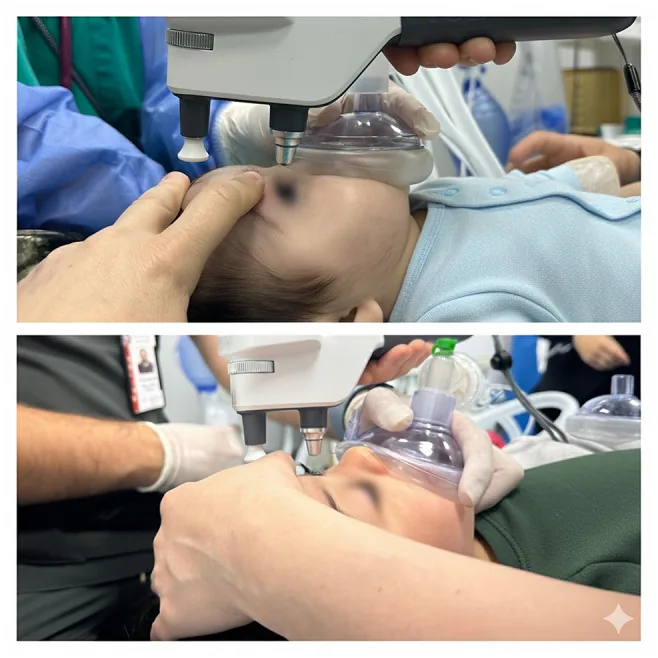
EUA is primarily indicated for the following examinations and conditions:
Indications for EUA
Section titled “Indications for EUA”| Test | Reason/Target |
|---|---|
| Fundus examination | Detailed fundus examination in infants and uncooperative children, e.g., retinoblastoma screening |
| Intraocular pressure measurement | Diagnosis and follow-up of developmental glaucoma. Using Goldmann tonometer or Tonopen |
| Refraction test (under cycloplegia) | Assessment of refractive error in infantile esotropia and developmental glaucoma |
| Ultrasound biometry (axial length measurement) | Evaluation of progression in developmental glaucoma |
| ERG (electroretinogram) | Evaluation of retinal function in achromatopsia, congenital stationary night blindness, etc. |
| VEP (visual evoked potential) | Objective assessment of amblyopia and optic nerve diseases |
| Corneal diameter measurement and gonioscopy | Diagnosis and follow-up of developmental glaucoma |
Major disease groups targeted
Section titled “Major disease groups targeted”- Retinoblastoma: EUA is essential for regular fundus screening. High-risk children require repeated EUA from early infancy 1).
- Developmental glaucoma: Comprehensive measurement of intraocular pressure, corneal diameter, gonioscopy, and axial length is performed for diagnosis and follow-up evaluation.
- Congenital cataract: Used for preoperative evaluation and postoperative follow-up.
- Diseases requiring ERG/VEP: Objective evaluation is possible in the electrophysiological diagnosis of achromatopsia, congenital stationary night blindness, and amblyopia.
Target Patients
Section titled “Target Patients”The main targets are uncooperative infants and patients with developmental disabilities. EUA is chosen when sufficient accuracy cannot be ensured during routine outpatient examination.
Items to Confirm During Examination
Section titled “Items to Confirm During Examination”Systematically evaluate intraocular pressure (note the decrease due to anesthetics), corneal diameter, anterior chamber depth, gonioscopic findings, fundus findings, and axial length. In developmental glaucoma, comparison with normal neonatal corneal diameter (approximately 10 mm) and at 1 year of age (approximately 11.5 mm) serves as a diagnostic indicator.
3. Preoperative Evaluation and Safety Management
Section titled “3. Preoperative Evaluation and Safety Management”Three pediatric emergencies that can occur in the ophthalmology examination room or operating room are: ① respiratory and circulatory depression due to sedatives and analgesics, ② anaphylaxis to any medication, and ③ symptomatic bradycardia or cardiac arrest due to the oculocardiac reflex (OCR). Preoperatively, assess each risk and prepare appropriately.
Preoperative Evaluation of the Respiratory System
Section titled “Preoperative Evaluation of the Respiratory System”Cold symptoms immediately before surgery increase airway hyperreactivity. It is desirable to postpone general anesthesia for 2 to 4 weeks after resolution of the cold. In children, airway hyperreactivity may cause laryngospasm during intubation or worsening of respiratory status due to excessive secretions. If not urgent, consider postponement after consultation with anesthesiology.
Assessment of Difficult Airway Risk
Section titled “Assessment of Difficult Airway Risk”For patients in whom difficult airway management is anticipated, organize the following points preoperatively and consult the anesthesiology department.
- Down syndrome: Prone to complications such as micrognathia, macroglossia, and laryngotracheomalacia
- Other chromosomal abnormalities: Risk assessment according to individual complications
- Adenoid hypertrophy and tonsillar hypertrophy: Risk of ventilation difficulty due to airway narrowing
Preoperative Fasting Guidelines
Section titled “Preoperative Fasting Guidelines”| Ingested Substance | Fasting Time |
|---|---|
| Clear Liquids | 2 hours |
| Breast Milk | 4 hours |
| Formula milk | 6 hours |
| Light meal | 6 hours |
Cold symptoms increase airway reactivity, raising the risk of laryngospasm and excessive secretions during intubation. If not urgent, postponing for 2–4 weeks after cold improvement is desirable. Decide in consultation with the anesthesiology department.
4. Tests performed under EUA
Section titled “4. Tests performed under EUA”Intraocular pressure measurement
Section titled “Intraocular pressure measurement”Use a Goldmann applanation tonometer or Tono-Pen. General anesthetics (e.g., inhalation anesthetics, propofol) lower intraocular pressure, so caution is needed when interpreting measurements. For developmental glaucoma, measurement immediately after awakening or under light anesthesia is recommended.
Corneal diameter measurement
Section titled “Corneal diameter measurement”In developmental glaucoma, enlargement of corneal diameter is an important indicator for diagnosis and follow-up. The normal corneal diameter in newborns is approximately 10 mm, and at 1 year of age, approximately 11.5 mm is used as a reference.
Gonioscopy
Section titled “Gonioscopy”Use a direct gonioscope (e.g., Koeppe lens). Evaluate angle structure abnormalities in developmental glaucoma (e.g., Barkan membrane).
Fundus examination
Section titled “Fundus examination”Perform wide-angle fundus examination using an indirect ophthalmoscope under mydriasis. For retinoblastoma, combine with scleral depression to examine the peripheral retina thoroughly.
Ultrasound biometry
Section titled “Ultrasound biometry”Perform axial length measurement using A-mode ultrasound. This is important for evaluating progression of developmental glaucoma; compare serial measurements to determine disease progression.
ERG (electroretinography)
Section titled “ERG (electroretinography)”Full-field ERG objectively evaluates retinal function. It is essential for diagnosing complete color blindness and congenital stationary night blindness, and EUA is necessary for infants who cannot remain still.
VEP (Visual Evoked Potential)
Section titled “VEP (Visual Evoked Potential)”VEP is used to evaluate the function of the visual pathway. It is useful as an objective screening for amblyopia and optic nerve diseases.
Refraction Test
Section titled “Refraction Test”Refractive errors are evaluated by retinoscopy under cycloplegia. It is used for assessing refractive errors in infantile esotropia and monitoring developmental glaucoma.
5. Methods of Sedation and Anesthesia
Section titled “5. Methods of Sedation and Anesthesia”5-a. Approach without sedatives (first choice)
Section titled “5-a. Approach without sedatives (first choice)”The most effective preventive method is to avoid using sedatives. Depending on the child’s age, developmental stage, and personality, it is important to alleviate anxiety through family cooperation and techniques such as informed assent and preparation.
Preparation by age group:
- Newborns and early infants: Wrapping in a towel or swaddle, using a pacifier
- Late infants: Parental presence, distracting with toys that make sounds or lights
- School-age children: Explanation of the necessity and content of the examination, offering choices
5-b. Procedural Sedation for Outpatient Procedures
Section titled “5-b. Procedural Sedation for Outpatient Procedures”When procedural sedation is chosen for short outpatient examinations, the following medications are used.
| Medication | Brand Name | Dosage Form | Dosage |
|---|---|---|---|
| Triclofos sodium | Tricloryl® | Syrup | 20–80 mg/kg (max 2 g) |
| Chloral hydrate | Escre® | Suppository / enema | 30–50 mg/kg (max 1.5 g) |
| Phenobarbital | Wakobital® | Suppository | 4–7 mg/kg |
| Hydroxyzine | Atarax®-P | Injection | 1 mg/kg |
| Diazepam | Cercine® | Injection | 0.3–0.5 mg/kg (max 1 mg/kg) |
| Midazolam | Dormicum® | Injection | 0.1–0.3 mg/kg |
5-c. General anesthesia
Section titled “5-c. General anesthesia”General anesthesia is selected for detailed examinations or long procedures in the operating room, or when sedation is insufficient.
Inhalation anesthetics:
- Sevoflurane, desflurane, etc. are used. The main mechanism is neural inhibition through enhanced signaling at GABA receptors and potassium channels.
- The contraindications and precautions for inhalation anesthetics are as follows.
| Drug | Contraindications/Precautions |
|---|---|
| Halothane | History of unexplained liver disorder |
| Isoflurane | Severe asthma/bronchospasm |
| Sevoflurane | Renal dysfunction |
Induction agents:
- Propofol, thiopental, etomidate, etc. are used. These have intraocular pressure-lowering effects.
Nitrous oxide (laughing gas):
- Contraindicated for 4 to 6 weeks after intravitreal gas injection.
5-d. Discharge criteria after sedation
Section titled “5-d. Discharge criteria after sedation”Ensure an in-hospital observation period of at least 30 minutes to 1 hour.
EUA is indicated for infants and young children who cannot cooperate with a routine examination, when fundus screening for retinoblastoma is needed, when intraocular pressure and gonioscopy for developmental glaucoma are needed, or when electrophysiological tests such as ERG or VEP are required.
All sedatives carry a risk of respiratory depression. Injectable drugs also have circulatory depressant effects. Excitement or unsteadiness may persist for about 24 hours after sedation, and caregivers should be instructed to watch the child closely to prevent accidents after returning home.
Malignant hyperthermia was previously considered a contraindication for general anesthesia, but it can now be performed with appropriate advance planning, such as avoiding trigger drugs (succinylcholine, inhalational anesthetics). The approach should be determined in consultation with the anesthesiology department.
6. Pediatric Anatomical Characteristics and Anesthesia Physiology
Section titled “6. Pediatric Anatomical Characteristics and Anesthesia Physiology”Pediatric Airway Anatomical Characteristics
Section titled “Pediatric Airway Anatomical Characteristics”The airways of infants and young children have the following characteristics, posing higher management risks compared to adults.
- Narrow airways: High risk of obstruction by secretions
- Tongue base collapse: Prone to tongue base collapse due to a large head and short neck
- High laryngeal position: The larynx is located at the C3-4 level, posing an aspiration risk
Due to these characteristics, special attention to airway management is required during general anesthesia in children.
Mechanism of the Oculocardiac Reflex (OCR)
Section titled “Mechanism of the Oculocardiac Reflex (OCR)”Compression or traction on the eyeball or orbit stimulates the trigeminal nerve (ophthalmic branch V1) as the afferent pathway, forming a reflex arc that causes cardiac suppression (bradycardia, arrhythmia, cardiac arrest) via the vagal center. This occurs more frequently and intensely in children than in adults.
As a countermeasure, atropine 0.02 mg/kg is administered preoperatively or at the time of occurrence. Stopping the manipulation of the eyeball or orbit usually leads to rapid recovery, but in severe cases, atropine administration is necessary. There are also reports that sub-Tenon’s injection of bupivacaine contributes to a reduced incidence of OCR.
Effects of General Anesthetics on Intraocular Pressure
Section titled “Effects of General Anesthetics on Intraocular Pressure”Induction agents (propofol, thiopental, etomidate) and inhalation anesthetics (sevoflurane, etc.) lower intraocular pressure. The reason why measurement immediately after awakening or under light anesthesia is desirable for intraocular pressure measurement in developmental glaucoma is due to this pharmacological effect. Selection of measurement timing is important for accurate intraocular pressure evaluation.
Considerations for Diseases Requiring Repeated General Anesthesia
Section titled “Considerations for Diseases Requiring Repeated General Anesthesia”For diseases requiring repeated EUA, such as retinoblastoma, in-hospital observation after sedation (at least 30 minutes to 1 hour) should be performed each time. It is important to regularly consult with the anesthesiology department regarding cumulative anesthesia risks.
7. Latest Research and Future Prospects
Section titled “7. Latest Research and Future Prospects”Effects of Anesthetics on Pediatric Neurodevelopment
Section titled “Effects of Anesthetics on Pediatric Neurodevelopment”There is ongoing debate about whether repeated general anesthesia in infancy may affect neurodevelopment. This is a particularly important consideration for diseases requiring repeated EUA, such as retinoblastoma, and further evidence accumulation is needed.
Advances in Non-Sedation Approaches
Section titled “Advances in Non-Sedation Approaches”Research is underway on ophthalmic examination techniques for patients with special needs such as developmental disorders and autism spectrum disorder. Efforts to avoid EUA, including behavioral therapy approaches and consideration of sensory hypersensitivity, are progressing.
Development of Portable Examination Devices
Section titled “Development of Portable Examination Devices”The spread of handheld fundus cameras and portable ERG devices may reduce the frequency of EUA. More precise outpatient examinations are expected to lower the risk of general anesthesia.
8. References
Section titled “8. References”- Dagi LR, Velez FG, Archer SM, Atalay HT, Campolattaro BN, Holmes JM, et al. Adult Strabismus Preferred Practice Pattern®. Ophthalmology. 2020;127(1):P182-P298. doi:10.1016/j.ophtha.2019.09.023. PMID:31757496.
- American Academy of Ophthalmology. Cataract in the Adult Eye Preferred Practice Pattern. Ophthalmology. 2022;129(4):S1-S126.
- Gupta Y, Shanmugam C, K P, Mandal S, Tandon R, Sharma N. Pediatric keratoconus. Surv Ophthalmol. 2025;70(2):296-330. PMID: 39396644.