Congenital nasolacrimal duct obstruction (CNLDO) is a condition in which the caudal opening of the nasolacrimal duct fails to open into the inferior meatus congenitally. It occurs in 6–20% of newborns and is the most common lacrimal disorder in children. 1)
At the lower end of the nasolacrimal duct, a membranous structure formed by the fusion of the nasolacrimal duct epithelium and the nasal mucosa is observed around the 13th week of gestation. This membrane begins to disappear around the 32nd week, opening the nasolacrimal duct into the nasal cavity, but it persists in about 20% of cases even at the 38th week, just before birth. The persistence of this membrane is called congenital nasolacrimal duct obstruction. This membrane often disappears spontaneously after birth, and the nasolacrimal duct usually opens naturally; the lacrimal drainage system in newborns is considered to be still developing.
Approximately 80% of cases are unilateral, and no sex difference or clear genetic predisposition has been identified. 1)
The spontaneous resolution rate is high: about 60% resolve by 3 months of age, and about 90% by 12 months of age. Prospective studies have reported a spontaneous resolution rate of 96% by 12 months of age 4). The spontaneous resolution rate within the first year of life is reported to be 89–96% 1).
QDoes congenital nasolacrimal duct obstruction resolve on its own?
A
About 90% of cases resolve spontaneously by 12 months of age. Properly performed lacrimal sac massage (Crigler method) may promote resolution 4). If symptoms persist beyond 1 year of age, interventions such as probing are considered.
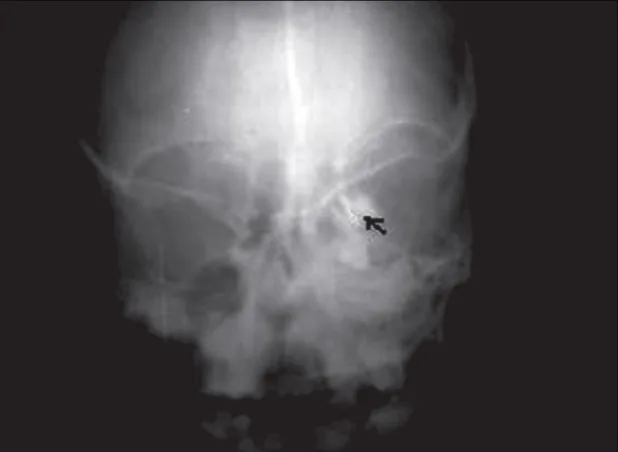
Preoperative dacryocystography of the left eye: contrast medium cannot pass beyond the lacrimal sac (black arrow). This corresponds to the pooling of contrast in the lacrimal sac described in section 2, Main Symptoms and Clinical Findings.
The main symptoms are tearing and discharge, which appear early after birth.
Tearing: Persistent from shortly after birth. Tears flow down the cheek.
Discharge: Mucoid to mucopurulent secretions adhere around the eye. Typically, the discharge decreases with antibiotic eye drops but recurs when the drops are stopped.
Onset: 95% of cases present symptoms within the first month of life. 1)
Aggravating factors: Symptoms worsen during upper respiratory tract infections.
Nature of discharge: With Hasner valve obstruction, discharge is mucopurulent; with obstruction near the Rosenmüller valve, it is watery. 1)
Increased tear meniscus: Tear pooling is observed at the lacrimal caruncle.
Lacrimal sac compression sign: Congenital nasolacrimal duct obstruction is often accompanied by dacryocystitis, and compression of the lacrimal sac produces purulent or mucoid discharge.
Periocular skin roughness: Persistent tearing leads to crusting of eyelashes. 1)
Refractive error: Clinically significant hyperopia occurs in 2–8% of cases. 1)
Association with epiblepharon: Epiblepharon and congenital nasolacrimal duct obstruction frequently coexist. If symptoms include excessive discharge or persistent tearing in one eye, lacrimal disease should be suspected.
Differentiation from acquired lacrimal duct obstruction: If onset occurs after 3–4 months of age, consider acquired lacrimal duct obstruction and inquire about a history of epidemic keratoconjunctivitis. 4)
The most common cause of CNLDO is membranous obstruction due to delayed involution of the valve of Hasner. Other causes include bony obstruction (narrowing of the entire nasolacrimal duct or bony canal) and congenital proximal lacrimal drainage system anomalies (underdevelopment of the punctum or canaliculus).
Risk factors for CNLDO include:
Down syndrome: CNLDO occurs in up to 30% of cases. 1)
The breakdown of severe CNLDO includes complete obstruction 35%, punctal agenesis 15%, congenital fistula 10%, and craniofacial bone defects 5%.1)
QIs there a relationship between Down syndrome and nasolacrimal duct obstruction?
A
In Down syndrome, CNLDO occurs in up to 30% of cases, which is more frequent than in the general newborn population (6–20%)1). This is thought to be related to associated craniofacial structural abnormalities.
Diagnosis of CNLDO is made through history taking, visual inspection, palpation, dye disappearance test, and lacrimal irrigation test.
Fluorescein dye disappearance test (FDDT): Moisten a fluorescein ophthalmic test strip with saline, apply it to the lower palpebral conjunctiva, and wait about 15 minutes without rubbing the eyes. Observe the ocular surface under blue light in a dark room; residual dye indicates impaired tear drainage. If fluorescent dye reaches the nasal discharge, the lacrimal passage is patent, ruling out congenital nasolacrimal duct obstruction4). Sensitivity is reported as 90% and specificity as 100%1).
Lacrimal irrigation test: This is useful for confirming the diagnosis of lacrimal duct obstruction, but in children, immobilization is required to control body movement. It is an invasive procedure performed by wrapping the child in a bath towel and fixing the head4). In congenital nasolacrimal duct obstruction, reflux containing pus is observed during irrigation.
CT scan: Performed when bony obstruction is suspected.
This technique involves placing a finger on the lacrimal sac and applying pressure toward the lower end of the nasolacrimal duct, pushing the contents of the sac without allowing them to exit through the punctum. Perform 5 to 10 compressions per set, 2 to 4 sets per day. Simple massage (lightly pressing the lacrimal sac area) does not improve the cure rate. 4)
Lacrimal sac massage is weakly recommended with evidence level C. 4)
Results of major RCTs:
Kushner RCT (175 cases): Crigler method group 30.5%, simple massage group 8.6%, no massage group 6.9%. Only the Crigler method group showed a significantly higher cure rate. 4)
Shivpuri RCT (66 cases): Crigler method group 91%, simple massage group 21%. 4)
Existing data report a success rate of over 85%. 1) There are no reports of obvious adverse effects, but there have been cases of lacrimal sac rupture leading to cellulitis due to massage. It may be difficult for caregivers to perform correctly.
When there is excessive discharge, tosufloxacin 0.3% may be used. Antibiotic eye drops are weakly recommended with evidence level C, but there are important considerations. 4)
Topical antibiotics do not promote healing
They can be expected to reduce discharge and mucopurulent secretions
To avoid increasing resistant bacteria, long-term use should be avoided, and administration only when necessary is recommended4)
Indiscriminate prescribing may lead to resistant bacteria, and the child may become a carrier
The age-specific indications for probing are as follows.
Under 3 months: About 60% resolve spontaneously by 3 months of age, so conservative observation is recommended
3 to 6 months: High likelihood of spontaneous resolution. Probing carries a risk of severe sepsis as a complication. Watchful waiting is preferable, but some facilities perform probing at this age because it is easier to immobilize the infant
6 to 12 months: Spontaneous resolution gradually becomes less likely. As immobilization becomes more difficult with growth, this period is recommended for probing under local anesthesia
12 months or older: Spontaneous resolution is still possible but less likely. Considering difficulty in immobilization and impact on mental development, general anesthesia may be required
For unilateral cases, probing under local anesthesia at around 6 to 9 months of age is weakly recommended with evidence strength C. For bilateral cases, there is insufficient evidence to establish a recommendation4).
PEDIG RCT results: In 163 unilateral cases, immediate probing group 92% (69 of 75 eyes) vs. deferred probing group 82% (58 of 71 eyes). No significant difference. Spontaneous resolution during the waiting period was 44 of 67 eyes (66%).4)
Probing success rates by age (meta-analysis, 17 studies, 7110 eyes):3)
Age
Success rate
0–6 months
90.67%
6–12 months
85.18%
12–24 months
82.34%
24–48 months
85.33%
Over 48 months
63.47%
Probing technique: Performed under topical anesthesia (lidocaine). The child is wrapped tightly in a large towel, and a strong nurse straddles the child to fix the shoulders, jaw, and head (do not press the head too firmly). Inserting the probe through the upper lacrimal punctum is advantageous, as there is no resistance from the ampulla or sharp bends before the lacrimal sac, reducing the risk of damaging the canaliculus. Within the nasolacrimal duct, the probe advances smoothly to the distal obstruction, and the resistance upon perforating the obstruction ranges from a mild membranous resistance to a relatively firm one. After the procedure, topical and oral antibiotics are prescribed. This is a contaminated surgery, and systemic infections such as sepsis may rarely occur; therefore, careful attention should be paid to fever on the day of the procedure.
Probing complications: Bleeding reflux from the punctum occurs in approximately 20% of cases during probing4). Rare complications include bacteremia, meningitis, hip arthritis, and endocarditis1).
Lacrimal endoscopy is a technique that allows visualization of the lacrimal duct lumen and opening of the obstruction under direct vision. It is weakly recommended with evidence level C4).
Curved handpiece: Success rate 92.3–100% in 8 studies (consistently high)
Straight handpiece: Success rate 53.8–94.4% in 3 studies (variable; bony obstruction diagnosed in up to 11%)
No complications reported in 11 studies (337 sides)
Lacrimal endoscopy surgery was covered by insurance in 2012. It is becoming more common mainly in Japan.
Particularly useful in cases where blind probing has failed.
Repeat blind probing is not recommended. It is weakly suggested not to perform it, with evidence strength C4).
The cure rate for repeat blind probing varies widely: prospective studies report 53% and 25%, while retrospective studies range from 61% to 85.7%. In the Honavar prospective cohort, the rate decreased from 73.3% after the first attempt to 25.0% after the second.4)
Lacrimal tube insertion vs. repeat blind probing: 92% in the lacrimal tube insertion group vs. 67% in the repeat probing group (retrospective study, significant difference). The cure rate for lacrimal tube insertion (stent placement) ranges from 75% to 100% across 7 studies.4)
Lacrimal tube insertion (stent placement): Mainly indicated for cases where probing has failed. The success rate for initial placement is 90–96%, and approximately 84% after failed probing1). In Japan, nunchaku-type tubes are mainstream, differing in shape from the Crawford tubes used overseas. Tube complications (most commonly dislocation or self-removal) are reported in 0–31% of cases4).
Balloon dilation: Success rates are reported between 53% and 95%, but no clear superiority over probing has been demonstrated.
DCR is a definitive surgery for nasolacrimal duct obstruction. It is indicated when the above treatments are ineffective or in cases of bony obstruction. Since it involves periosteal invasion, it is generally recommended after around age 15 when facial bone growth is complete, but early surgery may be necessary in severe cases.
The success rate of external DCR is 96%, and endoscopic DCR is 82–94%1). The endonasal approach has the advantages of leaving no facial scar and requiring less bone resection, but it requires skilled technique. Postoperatively, a stent is placed for 8–12 weeks.
Conservative Treatment
Lacrimal sac massage (Crigler method): 5–10 compressions per set, 2–4 sets per day.4)
Antibiotic eye drops: Use only when necessary. Be aware of the risk of resistant bacteria.4)
Indication: First-line treatment up to 6 months of age.
Probing
Timing: For unilateral cases, around 6–9 months of age is suggested. 4)
Procedure: The membrane is perforated with a probe through the upper lacrimal canaliculus.
Success rate: 63–91% depending on age. 3)
Endoscopy, Tube, DCR
Lacrimal endoscopy: Curved type: 92.3–100% 4). Considered in unsuccessful cases.
For unilateral cases, probing under local anesthesia around 6–9 months of age is weakly suggested 4). For bilateral cases, sufficient evidence is limited. In the PEDIG RCT, no significant difference was found between immediate probing and delayed probing groups. Considering the possibility of spontaneous resolution, a strategy of prioritizing conservative management until 12 months of age is also an option.
QWhat to do if probing fails?
A
Repeat blind probing is not recommended. Probing using a dacryoendoscope (curved type, 92.3–100% success rate) or lacrimal tube intubation (75–100%) is suggested 4). If these are ineffective, dacryocystorhinostomy (DCR) is considered as a curative treatment.
QWhat is the correct method for lacrimal sac massage?
A
The Crigler method is recommended. Place a clean finger over the lacrimal sac (medial to the inner canthus, at the nasal root) and apply pressure directed toward the lower end of the nasolacrimal duct (inferior direction) to avoid reflux of sac contents toward the eye. Perform 5–10 compressions per set, 2–4 sets per day 4). Simple massage with light pressure over the lacrimal sac is less effective. If the skin becomes red or painful, stop and consult a doctor.
Development of the lacrimal drainage system begins at 3–5 weeks of gestation. The lacrimal groove forms from the surface ectoderm, and canalization progresses around the third month of gestation 1). The most distal part of the nasolacrimal duct (Hasner’s valve) opens last, usually completing by the eighth month of gestation.
At the 13th week of gestation, a membranous structure formed by fusion of the nasolacrimal duct epithelium and nasal mucosa is observed. Around the 32nd week, this membrane disappears, and the nasolacrimal duct opens into the nasal cavity; however, it remains in about 20% of cases even at the 38th week just before birth. This residual membrane is the cause of congenital nasolacrimal duct obstruction, which often resolves spontaneously after birth, indicating that the neonatal lacrimal drainage system is still developing.
The anatomy of the lacrimal drainage system is as follows:
Lacrimal punctum: The entrance for tears located at the medial end of the upper and lower eyelids.
Lacrimal canaliculus: The duct continuing from the punctum, consisting of a vertical and a horizontal portion.
Common canaliculus: The site where the upper and lower canaliculi join.
Lacrimal sac: A reservoir located in the lacrimal fossa of the lacrimal bone.
Bony nasolacrimal duct: The bony canal extending from the lacrimal sac to the inferior meatus.
Membranous nasolacrimal duct: The soft tissue running within the bony canal, opening into the inferior meatus.
Sites and types of obstruction:
Persistent membrane of Hasner’s valve: Most common. Membranous obstruction with expected spontaneous resolution.
Obstruction near Rosenmüller’s valve: Rare. Presents with watery discharge. 1)
Bony obstruction: Accompanied by narrowing of the nasolacrimal duct, does not improve with probing, and requires DCR.
A relatively rare condition in which acute dacryocystitis occurs secondary to congenital nasolacrimal duct obstruction. Treatment involves topical and oral antibiotics, and intravenous antibiotics in severe cases to reduce inflammation. After inflammation subsides, prompt probing is performed due to the risk of recurrence, skin fistulization, or cellulitis. Common causative organisms include Staphylococcus aureus and Haemophilus influenzae.
A relatively rare congenital anomaly characterized by a distinctive dark-bluish mass-like elevation inferomedial to the inner canthus. It may be complicated by dacryocystitis or cellulitis. Cases with large intranasal cysts or bilateral involvement may cause respiratory distress.
The following epidemiology, natural course, and treatment outcomes have been reported for congenital dacryocele4).
Epidemiology: Postnatal prevalence 0.005–0.1%
Spontaneous resolution rate: 84% (38/45 cases) in non-infected postnatal cases, 68.2% (15/22 cases) in cases with infection
Infection complication rate: Dacryocystitis 15.2–75%, cellulitis 10–31%. Particular caution around 1 month of age
Inferior meatal cyst: Present in average 51.6%, respiratory distress 17–22% (71% in bilateral cases)
Timing of intervention: Conservative treatment is an option for non-infected cases. Early surgical treatment is indicated in cases of infection, respiratory distress, or feeding difficulties.
There is insufficient evidence to determine whether congenital nasolacrimal duct obstruction is a cause of amblyopia, but it is recommended to perform general visual function tests when possible 4). In a Japanese report, 13% of 94 cases of unilateral congenital nasolacrimal duct obstruction had refractive errors that posed an amblyopia risk. Some reports indicate that amblyopia is present in approximately 5% of cases 1).
8. Latest Research and Future Perspectives (Investigational Reports)
Sultanbayeva et al. (2025) conducted a meta-analysis of 17 studies involving 7110 eyes to examine probing success rates by age group 3). The overall success rate was 90.67% at 0–6 months (95.42% under general anesthesia, 88.82% under local anesthesia), 85.18% at 6–12 months, 82.34% at 12–24 months, and decreased to 63.47% at over 48 months. The certainty of evidence was rated as low for all subgroups.
A meta-analysis of 4 RCTs (423 patients) by Farat et al. (2021) found no significant difference in resolution rates between early and late probing (RR 1.00; p=0.99) 2). However, the PEDIG study showed that early probing was more cost-effective ($562 vs. $701).
Endoscopy-assisted probing is being considered as an alternative to conventional blind probing 1). The use of a lacrimal endoscope allows direct visualization of the obstruction site, potentially reducing the risk of iatrogenic injury and improving success rates. Facilities capable of performing this procedure in children are currently extremely limited, and its widespread adoption remains a challenge 4).
Application of mitomycin C to the anastomosis site is being investigated to improve the success rate of endoscopic DCR1). It is expected to prevent granulation and scar formation, but long-term safety requires further data accumulation.
Blaszczyk K, Biedka K, Estreicher A, et al. Congenital Nasolacrimal Duct Obstruction: Natural Course, Diagnosis and Therapeutic Strategies. J Clin Med. 2025;14(11):3716. doi:10.3390/jcm14113716. PMID:40507477; PMCID:PMC12155872.
Farat JG, Schellini SA, Dib RE, Santos FGD, Meneghim RLFS, Jorge EC. Probing for congenital nasolacrimal duct obstruction: a systematic review and meta-analysis of randomized clinical trials. Arquivos brasileiros de oftalmologia. 2021;84(1):91-98. doi:10.5935/0004-2749.20210005. PMID:33470349; PMCID:PMC12289159.
Sultanbayeva Z, Dzhumabekov A, Aldasheva N, Issergepova B, Kuanyshbekov Y, Taushanova M, et al. A Systematic Review and Meta-Analysis of the Success Rate of the Primary Probing in Pediatric Patients with Congenital Nasolacrimal Duct Obstruction in Different Age Groups. Medicina (Kaunas, Lithuania). 2025;61(8). doi:10.3390/medicina61081432. PMID:40870477; PMCID:PMC12388011.