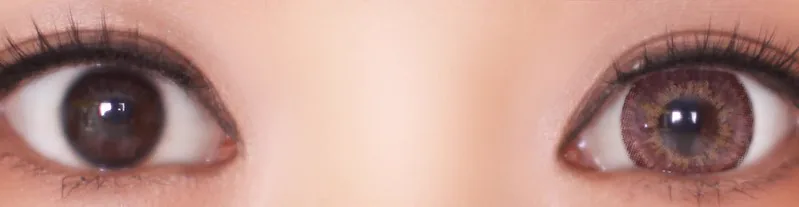
A photo comparing the right eye wearing a circle lens (colored contact lens) and the natural left eye. This corresponds to the change in iris color caused by decorative colored contact lenses discussed in the section on problems and safety.
Colored contact lenses (color CLs, decorative contact lenses) are contact lenses intended mainly to change the color or design of the iris rather than to correct vision. There are two types: with prescription power (vision correction plus color) and without power (decorative only). Prescription types have long required a prescription.
Non-prescription decorative color CLs were long treated as general merchandise, so quality standards were unclear and serious corneal damage became a social problem. In response, the Pharmaceutical Affairs Law was revised in November 2009 (now the Act on Securing Quality, Efficacy and Safety of Products Including Pharmaceuticals and Medical Devices), and decorative color CLs were also designated as highly controlled medical devices 1). Sale requires a permit to sell highly controlled medical devices, and products must display the medical device approval number 1).
Users of color CLs are mainly women in their teens to 30s, and they are often used for fashion 2). In a survey of eye injuries related to color CLs conducted by the Japan Ophthalmologists Association, reports of eye injuries related to color CLs were shown to be higher than for regular contact lenses 2). Even after the regulations were established, unapproved products and personally imported products have not been completely eliminated, and there are still many cases of use without an eye exam.
Colored contact lenses have unique risks compared with ordinary soft contact lenses (SCLs). The three major risks are direct corneal damage from the pigment structure, reduced oxygen permeability in the colored areas, and a higher risk of infection caused by poor care habits3)4)5).
QAre colored contact lenses safe?
A
If products approved as medical devices are used correctly under the prescription and guidance of an ophthalmologist, they can be used safely. However, unapproved products and privately imported products have unclear quality standards, and they are more likely to cause corneal damage from pigment leakage or low oxygen permeability. In addition, corneal infections caused by poor care (such as Acanthamoeba keratitis) can leave lasting vision problems if they become severe. Seeing an eye doctor and following proper care are essential for safe use.
2. Problems and symptoms specific to colored contact lenses
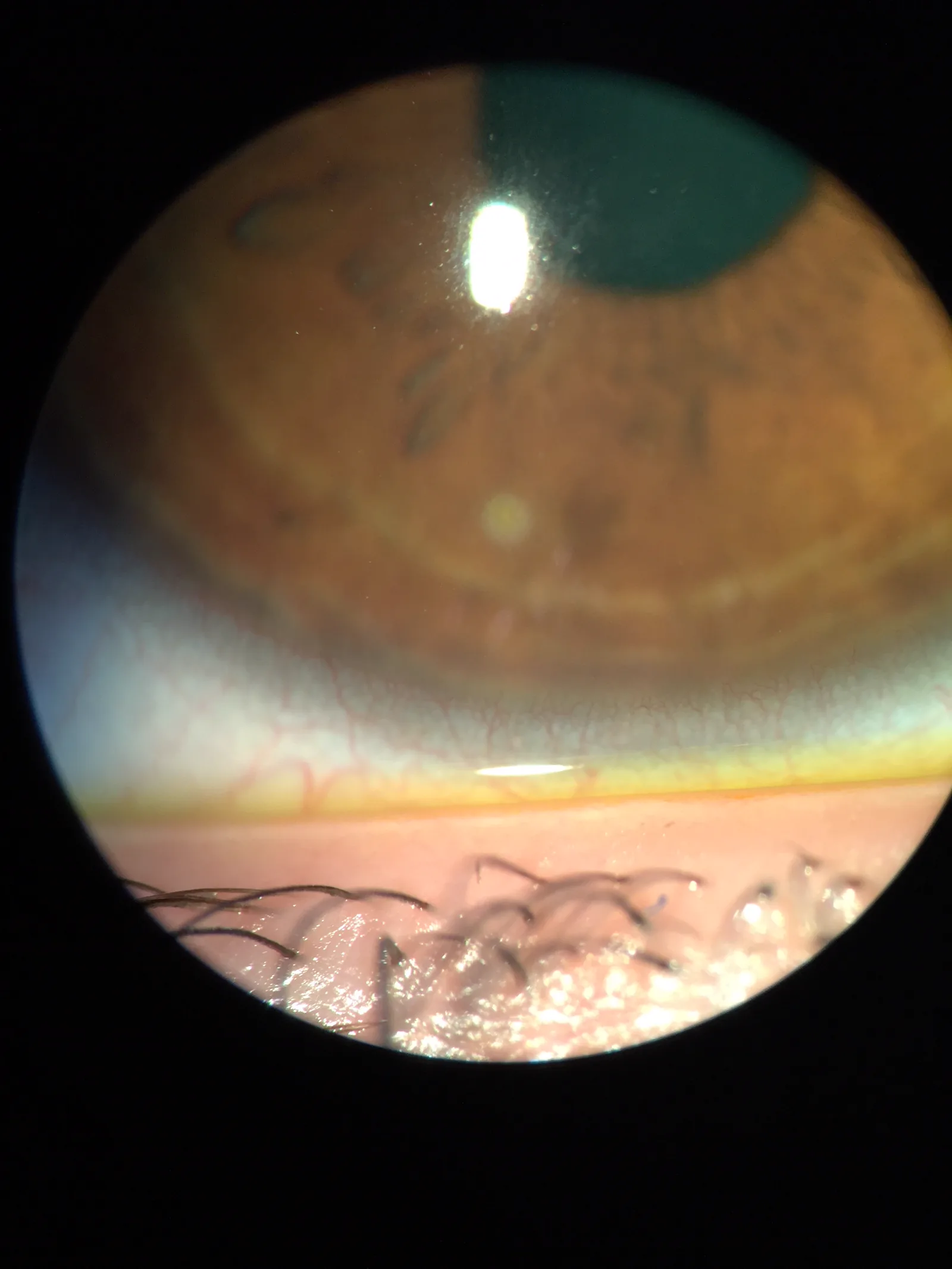
Slit-lamp image showing a small corneal ulcer caused by contact lens wear, made visible with sodium fluorescein staining. This corresponds to the corneal infections and corneal epithelial damage discussed in the section ‘Problems and symptoms specific to colored contact lenses’.
Colored contact lenses contain a pigment structure that ordinary SCLs do not have, and this creates unique risks. In addition, because many wearers are young and tend to have low adherence to care routines, various problems have been reported.
Pigment-related corneal damage
Pigment seepage and leakage: Pigment exposed on the lens surface directly damages the corneal epithelium3)
Risk of printed structures: A printed structure that applies pigment to the lens surface carries a risk of pigment flaking and corneal friction3)
Advantages of sandwich structures: A sandwich structure that encloses the pigment within the lens material is safer, but because the lens is thicker, oxygen permeability tends to decrease3)
Increased surface roughness: Pigment makes the surface rougher, lowering tear wettability and causing dry-eye-like symptoms3)
Corneal damage caused by low oxygen
Reduced oxygen permeability of the tinted part: The tinted portion of colored contact lenses has low Dk/t (oxygen transmissibility), so the cornea does not receive enough oxygen4)
Effect on corneal epithelial cells: Because of insufficient oxygen supply, the barrier function of corneal epithelial cells declines, increasing the risk of infection4)
Corneal neovascularization: Chronic low oxygen can cause new blood vessels to grow into the cornea, which can lead to vision problems4)
Corneal edema: If low oxygen continues, corneal edema occurs and can cause blurred vision and decreased visual acuity4)
Infection risk
Bacterial, fungal, and Acanthamoeba keratitis: Usually caused by poor lens care. Acanthamoeba keratitis is highly resistant to treatment, and severe cases may require corneal transplantation5)
Low adherence to care: Colored contact lens users have been reported to follow care instructions less often than regular contact lens users2)
Problems with the purchasing route: People who buy online often get colored contact lenses without seeing an eye doctor, and poor fitting and lack of care instructions tend to occur together2)
Other problems
Poor fit: If purchased without an eye exam, wearing lenses that do not match the curve of the cornea can cause mechanical irritation
The following symptoms can occur with problems caused by colored contact lenses. If you notice any of them, stop wearing the lenses immediately and see an ophthalmologist.
Redness (an early sign of corneal epithelial damage or infection)
Foreign body sensation and eye pain (pigment loss, poor fit, or infection)
Decreased vision and blurred vision (corneal edema, corneal ulcer, or neovascularization)
Increased discharge and eye mucus (bacterial infection or allergic reaction)
The development of eye injury from colored contact lenses is influenced by a combination of product factors, user factors, and purchasing route factors.
Use of unapproved or uncertified products: In products that do not meet quality standards as medical devices, pigment leakage and the safety of the lens material are not assured1)
Noncompliance with pigment safety standards: In products that fail elution testing, the pigment can directly damage the corneal epithelium3)
Low oxygen-permeability materials: Conventional hydrogel materials that do not use silicone hydrogel have low oxygen permeability, so the risk of corneal hypoxia is high4)
Printed structure (surface-coated type): Compared with sandwich structures, the risk of pigment peeling and corneal friction is higher3)
Purchasing and wearing without an eye exam: Wear is started without confirming the fit to the corneal curvature2)
Neglecting or improper care: skipping rub-and-rinse cleaning, topping off care solution, and improper handling of the lens case5)
Wearing longer than recommended: long hours of wear beyond the recommended time, especially overnight wear5)
Sharing lenses with other people: There is a risk of directly transmitting infection. Never do this2)
Rinsing and storing with tap water: a major risk factor for Acanthamoeba infection. Tap water can still contain Acanthamoeba even after chlorine disinfection5)
Online shopping, variety stores, convenience stores: because they can be purchased without an eye exam, poor fitting and insufficient care instruction are more likely1)
Personal import: it is difficult to verify whether products imported from overseas have received domestic medical device approval
Buying from unlicensed sellers: Buying from sellers without a permit to sell highly controlled medical devices is illegal, and quality is not guaranteed1)
When choosing colored contact lenses, it is important to check the following points.
Check the medical device approval number: Be sure the package shows an “approval number”1). Products without an approval number are not domestically approved medical devices
Buy from a seller with a permit to sell highly controlled medical devices: Ophthalmology clinics, licensed optical shops, pharmacies, etc.1)
Choose sandwich-structure lenses: The pigment is sandwiched inside the lens material, so it is less likely to touch the cornea directly3)
Colored contact lenses made of a highly oxygen-permeable material (silicone hydrogel): In recent years, colored contact lenses made of silicone hydrogel have also been developed, and they have a lower risk of corneal hypoxia than conventional products4)
For safe use of colored contact lenses, a prescription from an eye doctor and regular checkups are essential.
Be sure to see an eye doctor before first use: Measure the corneal curve and diameter (corneal radius of curvature and horizontal visible iris diameter) and choose lenses that fit your eyes6)
Fit check: After you start wearing them, the eye doctor checks lens movement, centering, and edge position
Regular checkups: Even color contact lens wearers should see an eye doctor at least once a year6). Even without symptoms, corneal epithelial damage and corneal vascular ingrowth may be progressing
Care for color contact lenses in the same way as regular 2-week replacement lenses and monthly SCLs (see “Proper Contact Lens Care and Regular Checkups” for details). Here we highlight points that color contact lens users should pay special attention to.
QWhere is it safe to buy colored contact lenses?
A
Purchase products that display a medical device approval number from stores with a license to sell highly controlled medical devices (eye clinics, licensed optical shops, pharmacies, etc.). For first-time use, always have an ophthalmologist check the prescription and fitting. Some products sold online, at variety stores, or convenience stores may include unapproved items that are not approved in Japan, and their safety cannot be guaranteed. It is recommended to check whether an approval number is listed before buying and to start using them only after seeing an eye doctor.
Decorative colored contact lenses were long sold as ‘general commodities’. However, due to the increase in severe eye injuries in ophthalmology practice, the Pharmaceutical Affairs Law was amended in November 2009, and non-prescription decorative colored contact lenses were also designated as ‘highly controlled medical devices (Class III)‘1). As a result, the following regulations apply.
Manufacturing and marketing license required: Manufacturing and sales in Japan require a license under the Pharmaceuticals and Medical Devices Act1)
Sales license required: Selling by businesses without a license for highly controlled medical device sales is illegal1)
Approval number display required: Only approved products are assigned a medical device approval number1)
Restrictions on personal import: When an individual imports for personal use from overseas, it may fall outside the regulations and quality assurance is difficult
The Ministry of Health, Labour and Welfare, the Consumer Affairs Agency, and the National Consumer Affairs Center have repeatedly published cases of eye injuries caused by colored contact lenses and issued warnings7).
Ministry of Health, Labour and Welfare: Continues to address the distribution of unapproved products even after the 2009 revision of the Pharmaceutical Affairs Law1)
National Consumer Affairs Center: Conducted surveys and product tests on colored contact lenses and reported the existence of products that failed the leaching test7)
Japan Ophthalmologists Association: Continues to educate medical institutions through survey reports on eye injuries caused by colored contact lenses2)
In particular, younger people (high school and university students) often do not realize the need to see an eye doctor when first using colored contact lenses, so improving safety education is an issue2).
QDo colored contact lenses require a prescription?
A
Colored contact lenses with corrective power require a prescription. Decorative colored contact lenses without corrective power have been regulated as highly controlled medical devices since 2009 and may legally be sold without a prescription, but for proper use it is strongly recommended to have an eye exam, a fitting check, and usage guidance from an eye doctor. Starting wear without seeing an eye doctor increases the risk of corneal damage from lenses that do not fit your eyes and the risk of infection from inadequate care instruction. The Consumer Affairs Agency and the Japan Ophthalmologists Association also recommend seeing an eye doctor even for non-prescription colored contact lenses2).
Pathophysiology: why colored contact lenses are prone to problems
Several pathophysiological mechanisms are involved in eye injuries caused by colored contact lenses. When these act alone or in combination, problems occur more often than with ordinary soft contact lenses.
Reduced epithelial barrier function from low oxygen
A lower Dk/t (oxygen transmissibility) in the colored part reduces oxygen delivery to corneal epithelial cells 4). If oxygen shortage continues, the metabolism of corneal epithelial cells declines and the tight junctions between epithelial cells weaken. A weakened epithelial barrier makes it easier for bacteria, fungi, and Acanthamoeba to enter, increasing the risk of infection 4). If chronic low oxygen continues, blood vessels may grow into the cornea (corneal neovascularization), which can lead to vision problems.
In printed colored contact lenses, the pigment is exposed on the lens surface and comes into direct contact with the corneal epithelium3). In a study using electron microscopy and energy-dispersive X-ray analysis (Hotta 2015), pigment components from colored contact lenses were found to adhere to and deposit on the corneal epithelium3). Increased surface roughness from the pigment reduces tear wettability and can cause dry-eye-like symptoms and instability of the tear film 3).
Many colored contact lens users are young people or people using them for fashion, and they tend to have little knowledge or experience with contact lens handling 2). A survey by the Japan Ophthalmological Society found that colored contact lens users had lower compliance with care instructions than regular contact lens users, and that risk behaviors such as skipping rubbing and cleaning, wearing them for too long, and using tap water were more common 2).
People who buy through online shops, convenience stores, or variety stores wear colored contact lenses without a fitting check to confirm that they match the curvature of the cornea2). Lenses with poor fit move less well during wear and increase mechanical stress on the corneal epithelium. Also, because they have no chance to receive guidance on care methods, wearing time, or regular checkups, they tend to delay seeing an eye doctor even when problems arise 2).
Conventional colored contact lenses made of hydrogel material have had low Dk/t, and the risk of corneal hypoxia has been a concern. In recent years, colored contact lenses using silicone hydrogel (SiHy) material have been developed and become more widespread, and techniques for adding color while maintaining oxygen permeability have improved4). In a study by Sorbara et al. (2020), the oxygen permeability characteristics of colored contact lenses were evaluated in detail, and differences in Dk/t between the colored and non-colored parts were examined, showing the improvement brought by using SiHy material4).
International standardization of dye safety standards
For the dye safety of colored contact lenses, standards are being developed by ISO (International Organization for Standardization) and JIS (Japanese Industrial Standards)3). As quality standards for elution tests, cytotoxicity tests, skin irritation tests, and similar evaluations are established, improved safety of colored contact lenses on the market is expected. A key issue is strengthening the system that ensures the biocompatibility of dye components at the product approval stage by making the strictness of dye elution tests more rigorous3).
For younger people, who make up many colored contact lens users, it has been proposed to carry out safety education campaigns using SNS and influencers2). By sharing information through digital media that can reach younger audiences effectively, better eye clinic visits and wider awareness of proper care knowledge are expected.
Contact lens wear management using smartphone apps
Development is progressing on smartphone apps with features such as recording contact lens wear time, notifying care schedules, and sending reminders for eye clinic visits. Using wear-management apps is expected to improve users’ adherence to care practices.
Steinemann TL, Fletcher M, Bonny AE, et al. Over-the-counter decorative contact lenses: cosmetic or medical devices? A case series. Eye Contact Lens. 2005;31(5):194-200.