

Cotton thread method (Phenol Red Thread Test) (Phenol Red Thread Test)
1. What is the cotton thread method (phenol red thread test)?
Section titled “1. What is the cotton thread method (phenol red thread test)?”The cotton thread method (phenol red thread test) is a test that quantitatively evaluates tear secretion by placing a cotton thread impregnated with the pH indicator phenol red in the lower conjunctival sac and measuring the tear penetration distance (mm) over 15 seconds.
It was developed in 1982 and marketed as Zone-Quick® (Menicon). Unlike the Schirmer test, the measurement time is short at 15 seconds, and it is less likely to trigger reflex tearing. For that reason, it is suitable for evaluating basic tear secretion and allows rapid outpatient screening.
The Dry Eye Clinical Practice Guideline (日本眼科学会誌 2019) lists it as a test for evaluating tear volume 1). In the 2006 diagnostic criteria, 10 mm or less by the cotton thread method was used as a positive criterion for abnormal tear secretion. From the 2016 version onward, the main diagnostic criterion changed to BUT (tear breakup time) of 5 seconds or less, but its usefulness remains as a supplemental method for evaluating tear volume 1).
Main purpose and indications:
- Screening for tear secretion in dry eye
- Follow-up of aqueous-deficient dry eye such as Sjögren syndrome
- Dry eye assessment before cataract or refractive surgery
- Minimally invasive tear assessment in children and older adults
- An alternative to or adjunct for the Schirmer test
The cotton thread method uses a phenol red-impregnated cotton thread with a diameter of 0.5 mm, and the measurement is completed in 15 seconds. The Schirmer test uses filter paper 5 mm wide and 35 mm long, and the measurement takes 5 minutes. The cotton thread method is brief, minimally invasive, and less affected by reflex tearing, but there is more evidence for the Schirmer test. The cotton thread method can be used for screening, and the Schirmer test for more detailed evaluation.
2. Examination technique and procedure
Section titled “2. Examination technique and procedure”Required equipment
Section titled “Required equipment”- Phenol red-impregnated cotton thread (Zone-Quick® or equivalent): 0.5 mm diameter
- Ruler or scale (for measuring discoloration length)
- No topical anesthesia required (minimally invasive test)
Procedure
Section titled “Procedure”- Seat the patient in a chair, face forward, and gently open the eyelids.
- Bend the last 3 mm of the cotton thread and hook the bent part into the conjunctival fornix of the outer one-third of the lower eyelid.
- Instruct the patient to keep the eyes normally open and wait quietly for 15 seconds.
- After 15 seconds, remove the cotton thread and measure the discolored length (the part that changed from yellow to red) in mm.
- Measure each eye separately and record the results.
Precautions
Section titled “Precautions”- Place it accurately on the outer side of the lower eyelid so the cotton thread does not touch the cornea.
- Topical anesthesia is not required, and the test can be performed without premedication.
- If eye drops (such as artificial tears) were administered before measurement, it is preferable to wait at least 5 to 10 minutes.
- Because strong lighting and emotional stimuli may increase reflex tearing, perform the test in a calm environment
- No special aftercare is needed after the test
The cotton thread method is a test in which a thin 0.5 mm cotton thread is lightly placed under the lower eyelid, so eye drops for anesthesia are not needed. Compared with the filter paper used in the Schirmer test, it has a smaller contact area and causes less irritation. There may be a slight foreign-body sensation, but there is almost no pain. Because the measurement time is only 15 seconds, the burden on the patient is minimal, and it is easy to perform in children and older adults.
3. Interpretation of normal and abnormal values
Section titled “3. Interpretation of normal and abnormal values”Criteria for judgment
Section titled “Criteria for judgment”| Discoloration length (15 seconds) | Evaluation | Clinical significance |
|---|---|---|
| 10 mm or more | Normal | Tear secretion is within the normal range |
| 5–9 mm | borderline | suggests mild decrease in tear secretion |
| 5 mm or less | abnormal | suggests severe aqueous-deficient dry eye |
In the 2006 dry eye diagnostic criteria, “10 mm or less by the cotton thread test” was listed as one of the positive criteria for abnormalities in tear volume and quality1).
In the 2016 revised guidelines, the main diagnostic criterion was changed to BUT (tear film breakup time) of 5 seconds or less1). Dry eye should not be diagnosed based on a positive cotton thread test alone; make a comprehensive judgment together with symptoms, BUT, and other findings.
Notes on interpreting results
Section titled “Notes on interpreting results”- Because the discoloration length varies from person to person and from day to day, observe the trend over time rather than relying on a single measurement
- Results can vary depending on room temperature, humidity, and the degree of eyelid opening during measurement
- Even if the value is within the normal range, consider evaporative dry eye when it is accompanied by a shortened BUT, fluorescein staining, or other abnormal findings
4. Clinical significance and indications
Section titled “4. Clinical significance and indications”Usefulness as a screening test
Section titled “Usefulness as a screening test”In outpatient tear film evaluation, the cotton thread method is useful as a screening test because it is quick and minimally invasive.
- Outpatient screening: The Schirmer test takes 5 minutes, but the cotton thread method is completed in 15 seconds, so it does not interrupt the flow of the examination
- Use in children: Even in children who cannot stay still for 5 minutes, 15 seconds makes it easier to obtain cooperation
- Use in older adults: It can be performed without eye-drop anesthesia even in older adults who are sensitive to pain
- Sjögren syndrome: Used to assess tear volume and monitor the course of an immune disease accompanied by reduced lacrimal gland function
- Preoperative screening: Often performed as a dry eye assessment before cataract surgery and refractive surgery such as LASIK
Position relative to other dry eye tests
Section titled “Position relative to other dry eye tests”Dry eye is diagnosed by evaluating both quantitative abnormalities in tear volume and qualitative abnormalities (shortened BUT). The cotton thread method is one way to evaluate tear volume and is used together with qualitative tests such as BUT, fluorescein corneal staining, and lissamine green conjunctival staining1).
Yes. Although it was removed from the main diagnostic criteria in the 2016 Dry Eye Clinical Practice Guideline, it continues to be used for outpatient screening and for children and older adults because it can assess tear volume quickly and with minimal invasiveness. It is often used together with, or as an alternative to, the Schirmer test.
5. Comparison with the Schirmer test and how to use each
Section titled “5. Comparison with the Schirmer test and how to use each”| Item | Cotton thread method (phenol red thread test) | Schirmer test (Schirmer I) |
|---|---|---|
| Measurement time | 15 seconds | 5 minutes |
| Device used | 0.5 mm diameter cotton thread (Zone-Quick® and others) | 5 mm wide, 35 mm long filter paper |
| What is measured | Mainly basal tear secretion (little effect from reflex tearing) | Basal tear secretion + reflex tearing (Schirmer I) |
| Topical anesthesia | Not needed | Not needed (Method I), required (Method II) |
| Invasiveness | Low (less foreign-body sensation) | Slightly higher (stimulation from the filter paper) |
| Reproducibility | Relatively good | Highly variable |
| Pain | Almost none | Has discomfort |
| Evidence base | Moderate | Extensive |
| Normal reference | 10 mm or more (15 seconds) | 10 mm or more (5 minutes, Schirmer I method) |
Clinical use and when to choose each test
Section titled “Clinical use and when to choose each test”For screening or when you want to minimize the burden on the patient, the cotton thread method is suitable. When a detailed assessment of tear secretion function is needed, such as in Sjögren syndrome, or when accumulating diagnostic evidence is important, choose the Schirmer test (especially method II).
6. Measurement principle
Section titled “6. Measurement principle”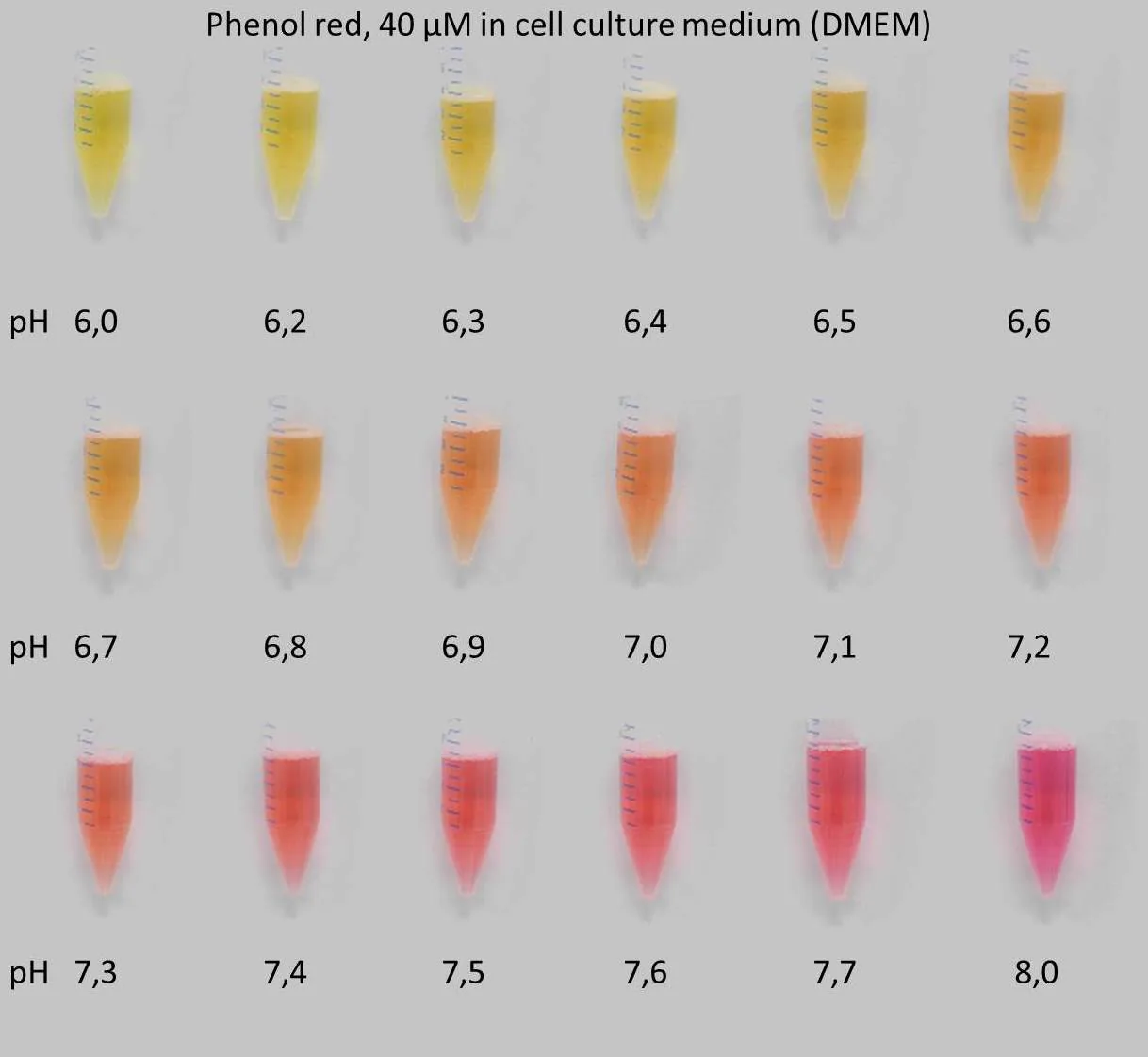

Chemical properties of phenol red
Section titled “Chemical properties of phenol red”Phenol red (phenolsulfonephthalein) is a pH indicator with the following color-changing properties.
- Color change range: pH 6.8–8.4 (low pH: yellow → high pH: red)
- Dry state (cotton thread alone): yellow (acidic side)
- After contact with tear fluid: red (tear fluid is mildly alkaline at about pH 7.4)
Although tear fluid usually has a pH of 7.0–7.8, this falls within the medium to high range of phenol red’s color change, so the part that contacts tear fluid turns a clear red. The boundary with the dry portion is distinct, making the color-change length easy to judge.
Tear fluid absorption by capillary action
Section titled “Tear fluid absorption by capillary action”Tear fluid is absorbed into the cotton thread mainly by capillary action. When the cotton thread touches the lower conjunctival sac, tear fluid is drawn up by capillary force, and phenol red changes color along the distance it is drawn up. The position of the color-change front shows the tear fluid penetration distance, and measuring it in mm indirectly quantifies tear secretion.
The reason reflex tearing is minimal is that the contact area of the thin cotton thread (0.5 mm in diameter) is small. Compared with Schirmer test filter paper (5 mm wide), it causes less irritation and is less likely to trigger reflex tearing. As a result, it is thought to measure a value close to basal secretion.
7. Latest Research and Future Prospects
Section titled “7. Latest Research and Future Prospects”Research on correlation with tear meniscus measurements
Section titled “Research on correlation with tear meniscus measurements”Measurement of tear meniscus height (TMH) with anterior segment OCT (optical coherence tomography) enables noncontact, objective assessment of tear volume. Studies comparing TMH with the wetting length in the cotton thread test are under way, and TMH below 0.2 mm has been reported to be associated with aqueous-deficient dry eye. Combining it with the cotton thread test may improve the accuracy of tear assessment.
Comparison with optical tear volume measurement
Section titled “Comparison with optical tear volume measurement”Comparative studies have been reported between a method that quantifies tear meniscus cross-sectional area with OCT and the cotton thread test. Both methods reflect tear volume, but because the site and timing of the tear pool being measured differ, it is important to use each one with an understanding of its characteristics.
Application to monitoring dry eye treatment effectiveness
Section titled “Application to monitoring dry eye treatment effectiveness”Some studies have tracked changes in cotton thread test values before and after eye drop treatment with 3% diquafosol sodium or rebamipide. The cotton thread test may be useful as an objective measure of treatment effect, and it is expected to serve as a simple way to confirm treatment effect in outpatient care.
References
Section titled “References”- 島﨑潤, 横井則彦, 渡辺仁, 他; ドライアイ研究会. ドライアイ診療ガイドライン. 日眼会誌. 2019;123(5):489-592.