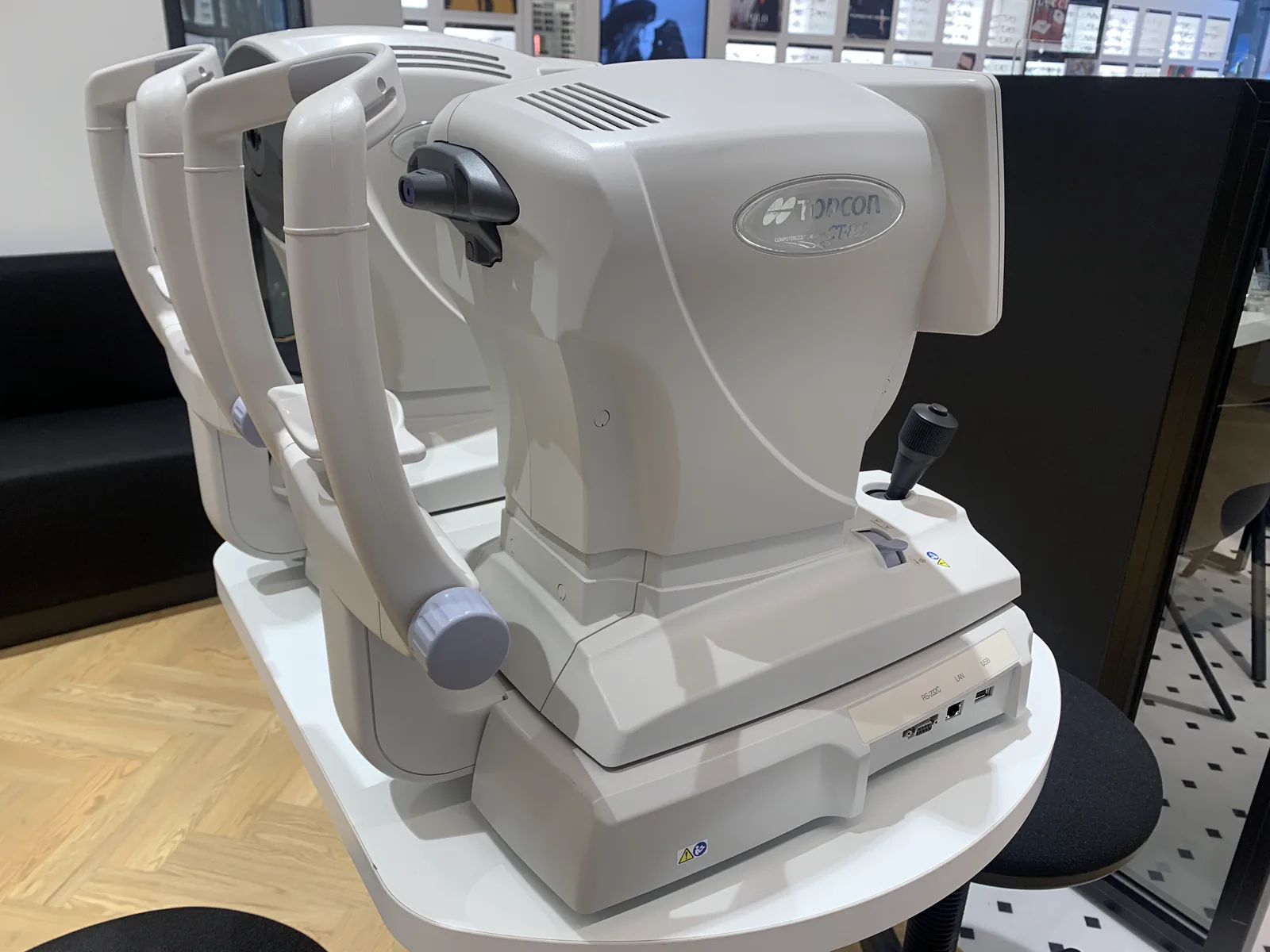
A non-contact tonometer (NCT) is a device that measures intraocular pressure without directly touching the eye. It flattens the cornea with an air puff and calculates the intraocular pressure from the time or pressure required.
Due to the following features, it has become the most widely used screening tonometer in ophthalmology clinics, health checkups, and comprehensive medical examinations in Japan.
No pretreatment required: No need for anesthetic eye drops
Simple procedure: Can be performed by non-physician staff
Reduced infection risk: No direct contact with the eye, lowering cross-infection risk
Normal intraocular pressure (IOP) is considered to be between 10 and 21 mmHg1). The average IOP in Japanese individuals is approximately 14–15 mmHg. IOP is determined by the balance between aqueous humor production and outflow resistance.
On the other hand, the Goldmann applanation tonometer (GAT) is the gold standard for IOP measurement, and the accuracy of NCT is inferior to that of GAT1). In cases requiring precise IOP measurement, GAT should be selected.
QWhat should I do if a non-contact tonometer indicates high eye pressure?
A
NCT is a tonometer intended for screening and is less accurate than GAT. It tends to measure lower, especially in the high IOP range. If NCT shows 22 mmHg or higher, re-examination with GAT is necessary. If high IOP is confirmed on re-examination, a detailed glaucoma examination (visual field test, OCT) will be performed.
Ocular hypertension is a condition in which intraocular pressure exceeds the statistically normal upper limit (21 mmHg) but no abnormalities are found in the optic nerve or visual field1).
NCT measurement tendency varies depending on the intraocular pressure range.
Normal intraocular pressure range (10–21 mmHg): Correlates to some extent with GAT
High intraocular pressure range (≥ 22 mmHg): Tends to measure lower than GAT
Low intraocular pressure range (≤ 9 mmHg): Tends to measure higher than GAT
If the measurement error exceeds 3 mmHg, remeasurement is necessary. Poor fixation or poor eyelid opening can also cause errors.
The theoretical basis of NCT is the Imbert-Fick principle. When an infinitely thin sphere with no wall rigidity is flattened by a plane, the relationship W = A × Pt holds between the flattening force W, the flattened area A, and the internal pressure Pt of the sphere.
GAT realizes this principle using a flattening prism with a diameter of 3.06 mm. NCT realizes the same principle using an air puff.
Parallel light is emitted from a light source toward the cornea.
Air with gradually increasing intensity is blown to flatten the cornea.
When the cornea is flattened, the reflected light to the light receiver increases.
The intraocular pressure value is calculated from the puff duration or air pressure at the time when the reflected light reaches its maximum.
The measurement time is very short, 1 to 3 ms (milliseconds). Therefore, it has the characteristic of being easily affected by the pulse wave (periodic fluctuation of intraocular pressure due to heartbeat).
Central corneal thickness (CCT) is a parameter that affects the accuracy of many tonometers2).
Thin cornea (< 520 μm): Intraocular pressure is underestimated.
Thick cornea (> 520 μm): Intraocular pressure is overestimated.
Effect per 10 μm of CCT: A change of approximately 0.2 mmHg occurs
The reference CCT is approximately 520 μm. However, an increase in thickness due to corneal edema is an exception; when edema is present, the cornea becomes softer, resulting in underestimation.
Thin CCT is associated with an increased risk of progression from ocular hypertension to glaucoma2). On the other hand, no generally accepted CCT correction formula has been established, and applying correction factors to individual measurements is not recommended2).
All tonometers that applanate the cornea are affected by corneal biomechanical properties2). Devices that applanate the cornea quickly with an air puff, such as NCT, are more affected2).
QIf the cornea is thin, does intraocular pressure read higher than the true value?
A
It is the opposite. When the cornea is thin, intraocular pressure is measured lower (underestimated) than the true value. With a thick cornea, it is measured higher (overestimated) than the true value. This occurs not only with GAT but also with NCT. Since no correction formula for CCT has been established, it is not recommended to individually adjust correction values. In cases where CCT deviates significantly from the normal value, consider using a more accurate tonometer.
Appearance of a Topcon non-contact tonometer (CT-1P) used in ophthalmology. It is an air-puff automatic tonometer that can measure intraocular pressure without the need for topical anesthesia, and is equipped with an alignment joystick and a chin rest arm. It corresponds to the non-contact tonometer body discussed in the section “4. Examination Methods and Procedures.”
To obtain appropriate measurements, preparation is required on both the patient and examiner sides.
Preparation
Relaxation: Tension can cause intraocular pressure to be measured higher. Ensure the patient is sufficiently relaxed before measurement.
Prevent blinking: Instruct the patient not to blink.
Assist eyelid opening: Assist in opening the eyelids, being careful not to press on the eyeball, so that the eyelids and eyelashes do not obstruct the optical path.
Measurement
Alignment: Operate the joystick to align the cornea on the monitor.
Air puff: Press the switch to release a puff of compressed air. In automatic models, the puff is triggered automatically when proper alignment is achieved.
Repeat measurements: Repeat the measurement at least 3 times, ensuring that the measurement error is within 3 mmHg.
Adopt the value: Use the average or median of the measurement results.
If NCT shows high intraocular pressure of 22 mmHg or higher, confirm with repeated measurements and then perform re-examination with GAT1). If high intraocular pressure is confirmed by GAT, perform a detailed glaucoma examination (visual field test, evaluation of optic nerve and retinal nerve fiber layer by OCT)1).
If glaucomatous changes (visual field abnormalities, optic disc cupping enlargement, etc.) are observed even though NCT is within the normal range, suspect normal-tension glaucoma. To evaluate diurnal and nocturnal variations in intraocular pressure, consider measuring intraocular pressure at multiple times or using home iCare HOME for 24-hour intraocular pressure monitoring1).
In cases with corneal opacity, corneal edema, or difficulty opening the eyelids, accurate measurement with NCT is difficult. Consider switching to GAT or a rebound tonometer (iCare).
NCT is suitable for intraocular pressure screening in health checkups and comprehensive medical examinations. Because it requires no contact, no anesthesia, and can be performed in a short time, it can be efficiently administered to many examinees.
For follow-up of the same patient, it is desirable to use the same tonometer 2). Measurement values from different models cannot be directly compared.
Corneal hysteresis (CH) is an indicator of corneal viscoelasticity. It can be measured with the Ocular Response Analyzer (ORA) and has been reported as an independent predictor of glaucoma risk2). NCT is easily affected by this because it flattens the cornea quickly2).
After refractive surgery such as LASIK or PRK, the cornea becomes thinner and flatter, causing intraocular pressure to be measured lower than actual2). It has been reported that for every 10 μm of corneal ablation, the measured pressure is 0.3–0.4 mmHg lower2). Careful visual field and OCT monitoring are necessary for glaucoma evaluation after surgery.
Even in healthy individuals, intraocular pressure fluctuates by 4–5 mmHg over the course of a day. In glaucoma patients, it may fluctuate even more. Generally, it tends to be higher in the early morning and decreases from afternoon to night, but there is considerable individual variation.
Conventional NCT has limitations as it is easily affected by central corneal thickness and corneal curvature. In response, tonometers that consider the viscoelastic properties of the cornea have been developed.
ORA (Ocular Response Analyzer): Measures corneal hysteresis from the pressure difference between two applanation points after an air puff, and calculates the corneal-compensated IOP (IOPcc).
Corvis ST: Uses high-speed Scheimpflug imaging to analyze corneal deformation in video, simultaneously evaluating IOP and corneal biomechanical properties.
These are said to provide IOP values with reduced influence of CCT, but further investigation is ongoing regarding their correspondence with GAT.
Widespread Adoption of Simultaneous Central Corneal Thickness Measurement
In recent years, an increasing number of NCT models have a function that measures CCT simultaneously with the air puff and displays an IOP value corrected for the influence of CCT. Since the correction algorithm varies by model, it is important to understand the characteristics of the measuring device before use.