Postoperative decompensated strabismus is a condition in which a previously well-controlled asymptomatic or intermittent strabismus becomes manifest after uncomplicated ophthalmic surgery.
Strabismus affects approximately 4% of the US population. Up to 3% of patients experience diplopia after cataract surgery, with decompensation of pre-existing strabismus accounting for 34% of 150 cases of postoperative diplopia—the most common cause—followed by refractive diplopia (8.5%) and disruption of central fusion (5%). The incidence of diplopia after cataract surgery is reported to be less than 1% 1), and decompensated strabismus is one of the most common neuro-ophthalmic visual disturbances after cataract surgery. Decompensation of pre-existing strabismus is also the most common cause of binocular diplopia after LASIK.
This condition can be prevented by thorough preoperative evaluation, and it is important to include the possibility of fusional decompensation and postoperative diplopia in informed consent.
QHow often does diplopia occur after cataract surgery?
A
The incidence of diplopia after cataract surgery is reported to be less than 1%1). However, some reports indicate that up to 3% of patients experience diplopia. About 34% of cases are due to decompensation of pre-existing strabismus, which is the most common cause of postoperative diplopia.
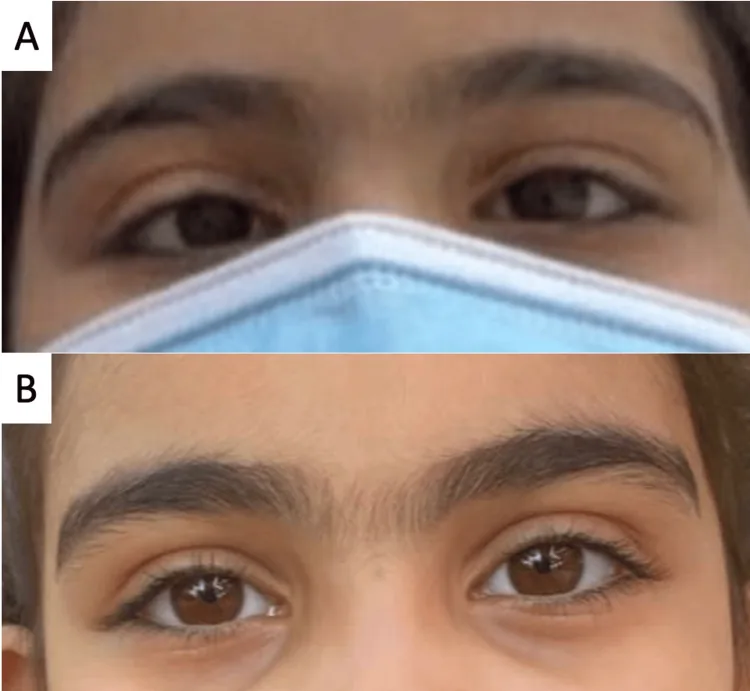
Cyclic Esotropia Managed With Botulinum A Toxin Injections: A Report of Four Cases and Literature Review. Cureus. 2023 Oct 26; 15(9):e46266. Figure 1. PMCID: PMC10615229. License: CC BY 3.0 (https://creativecommons.org/licenses/by/3.0/).
Case 1 (A) Pre-operative left esotropia; (B) Six months after botulinum toxin A injection showing the absence of any ocular deviation
Diplopia: Images appear double in both eyes after surgery. This occurs because the loss of fusion ability makes previously controlled strabismus manifest.
Headache: Occurs along with diplopia or eye muscle fatigue.
Asthenopia: Caused by overload on the eye muscles due to disruption of fusion.
Difficulty reading: Occurs because binocular vision at near distances is impaired.
Clinical Findings (Findings Confirmed by Physician Examination)
Comitant strabismus: A finding suggestive of long-standing strabismus. Characterized by large fusional amplitude, facial asymmetry, comitant deviation, and maintained monocular movements in all directions.
The main mechanism of postoperative decompensated strabismus is that temporary visual blur after surgery disrupts fusion, causing previously controlled strabismus to become manifest.
Additionally, retrobulbar/peribulbar anesthesia without hyaluronidase, injection by non-ophthalmologists, and injection into the left eye increase the risk of diplopia2).
Monovision selection: Fusion is easily disrupted because near and distance vision are intentionally divided between the eyes2).
Fixation switch diplopia: This occurs when fixation alternates between the left and right eyes, causing double vision2).
Loss of central fusion due to long-term cataract: Central fusion is lost due to long-term preoperative visual decline2).
Inhibition of sensory fusion: When the size or clarity of images becomes asymmetric due to opacities of the ocular media, changes in refractive error, or optic nerve lesions, fusion becomes difficult.
Inhibition of motor fusion: Diplopia occurs when images deviate outside Panum’s fusional area.
QAfter what types of surgery is decompensated strabismus likely to occur?
A
Eye surgeries such as cataract surgery, LASIK, glaucomafiltration surgery, scleral buckling, pterygium surgery, and blepharoplasty can be causes2). In cataract surgery, the type of anesthesia (retrobulbar or peribulbar) and postoperative inflammation or edema are also risk factors.
Thorough preoperative medical history taking: Confirm eye misalignment, history of patching in childhood, previous strabismus surgery, family history, and prism use.
Review of old photographs (FAT scan): Useful for identifying pre-existing strabismus or abnormal head posture.
It is important to rule out thyroid eye disease and myasthenia gravis. Check for systemic symptoms such as weight changes, heat/cold intolerance, difficulty swallowing, and easy fatigability, and consider blood tests when appropriate.
Observation: If symptoms are mild or transient, observation is chosen. Transient postoperative strabismus may resolve spontaneously 2).
Prism glasses (first-line): Fresnel prisms or built-in prisms can manage most cases. Dose adjustment may be needed as the deviation angle changes 2).
Occlusion therapy: Monocular occlusion with a patch, Bangerter filter, or satin tape. Used when prisms are insufficient 2).
Surgical Treatment
Indications for strabismus surgery: Considered when prism correction is not possible. Surgical procedures (e.g., recession, resection, marginal myotomy) are selected based on the amount of deviation 2).
Timing of surgery: Plan surgery after confirming stable ocular alignment for at least 4–6 months preoperatively 2).
Surgical prognosis: Generally good, but reoperation is required in 20–30% of cases.
QWhat happens if prism glasses do not work?
A
For deviations that cannot be corrected with prisms, strabismus surgery is considered. Surgery is planned after the eye position has been stable for 4 to 6 months 2). The prognosis is generally good, but reoperation is needed in 20–30% of cases. Occlusion therapy may be used to manage double vision until surgery.
Normal binocular single vision is maintained by two processes: sensory fusion and motor fusion.
Sensory Fusion
Definition: The process by which the visual cortex integrates images of similar size, shape, and clarity formed on corresponding retinal points of each eye.
Inhibitory factors: Asymmetry in image size or clarity (due to changes in refractive error, opacity of the ocular media, or optic nerve lesions) makes fusion difficult.
Effect of aniseikonia: When the difference in image size between the two eyes is 5–7% or more, maintaining fusion becomes difficult.
Motor Fusion
Definition: The ability to adjust the eyes to a position that maintains sensory fusion. Single vision is achieved by keeping the image within Panum’s fusional area.
Panum’s fusional area: The area near the fixation point is narrow in depth, while it becomes wider peripherally. Within this area, single vision is possible even for non-corresponding points.
Inhibitory factor: When an image deviates outside Panum’s fusional area, diplopia occurs.
The following three conditions are necessary to maintain fusion.
No constant strabismus
Small difference in visual acuity and refractive error between both eyes, allowing fusion (difficult to maintain with aniseikonia of 5–7% or more)
Binocular neurons exist in the visual cortex
QWhy does diplopia occur even after successful surgery?
A
It is not a complication of the surgery itself, but rather a temporary visual blur (e.g., refractive changes) after surgery that disrupts fusion. A latent strabismus previously controlled by fusion becomes manifest, and diplopia persists even after the visual blur resolves if fusion does not recover. Details are provided in the “Pathophysiology and Detailed Mechanism” section.