
Type I (Papilledema type)
Lesion: Vessels in the prelaminar region
Mechanism: Venous stasis due to nonspecific inflammation
Features: Predominantly papilledema. Steroids have been reported to be effective.

Papillophlebitis is a clinical subtype (incomplete type) of central retinal vein occlusion (CRVO) and is a rare disease that occurs in young healthy individuals under 45 years of age 1, 2). It is also called “optic disc vasculitis.”
While CRVO in middle-aged and elderly individuals is associated with aging, hypertension, and arteriosclerosis, papillophlebitis is characterized by its occurrence in healthy young people aged 20–35, especially women. Hayreh (1972) classified this disease into the following two types.
Type I (Papilledema type)
Lesion: Vessels in the prelaminar region
Mechanism: Venous stasis due to nonspecific inflammation
Features: Predominantly papilledema. Steroids have been reported to be effective.
Type II (Central retinal vein occlusion type)
Lesion: Optic disc or retrolaminar region
Mechanism: Inflammation of the central retinal vein
Features: Accompanied by venous dilation, tortuosity, and retinal hemorrhage. Some reports indicate no response to steroids
CRVO is more common in middle-aged and elderly individuals with risk factors such as hypertension, diabetes, and arteriosclerosis, and ischemic type often leads to severe visual impairment. In contrast, papillophlebitis occurs in young healthy individuals, vision is often relatively preserved, and it is a disease with a good prognosis that resolves spontaneously within 6 to 12 months. However, in young patients with CRVO, differentiation from papillophlebitis is important, and systemic steroid administration may be necessary.
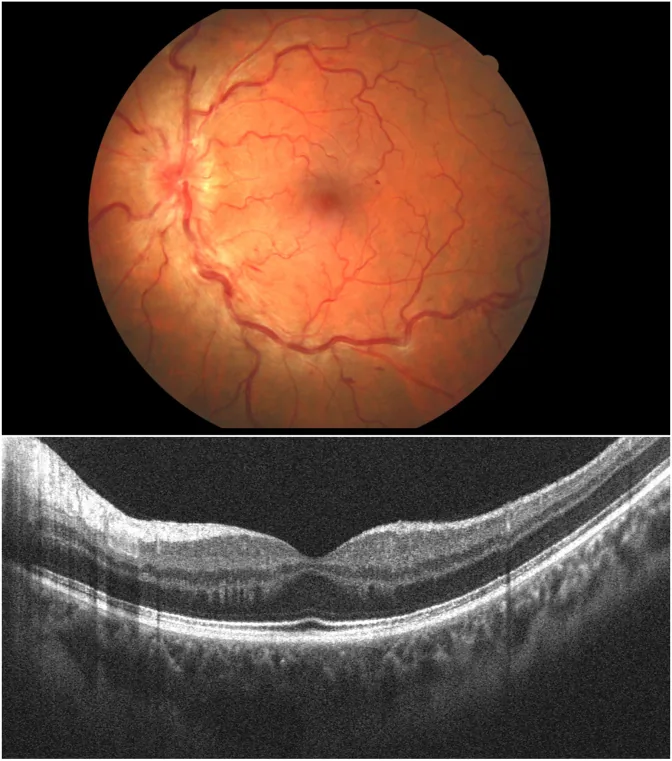
The etiology is often presumed to be idiopathic, but an association with hypercoagulable states has been reported.
The following table shows the main risk factors and rates of systemic disease complications.
| Risk factors / Associated diseases | Frequency / Notes |
|---|---|
| Diabetes | 3–9% |
| Hypertension | 23–42% |
| Inflammatory bowel disease, psoriasis | Associated |
| Pregnancy, oral contraceptives | Associated |
| High altitude, dehydration | Associated |
The association with hereditary coagulation abnormalities is also important. Factor V Leiden (FVL) mutation, the most common hereditary hypercoagulable disorder in Europe, has a high heterozygous prevalence of 15% in Greece (the highest in Europe), and cases of retinal vein inflammation due to combined FVL and MTHFR-C677T heterozygous mutations have been reported 2).
The association with COVID-19 is also noteworthy. SARS-CoV-2 causes vascular endothelial damage via ACE2 receptors and activates the coagulation system. More than 30% of COVID-19 patients develop venous or arterial thromboembolic events, and cases of retinal vein inflammation occurring 6 weeks after infection have been reported 1).
It is more common in young women aged 20–35. Coagulation abnormalities (such as Factor V Leiden mutation), post-COVID-19 infection, and use of oral contraceptives have been reported as risk factors. Some cases also involve systemic diseases (hypertension, diabetes).
Papillophlebitis is a diagnosis of exclusion, and it is important to differentiate it from more common conditions in the same age group, such as papilledema and optic neuritis.
The following tests are performed to confirm the diagnosis and investigate the cause.
The following diseases should be considered in the differential diagnosis.
No universally accepted evidence-based treatment has been established at present.
Corticosteroids are the main treatment, used because vasculitis is presumed to be involved. They are reported to be effective in Type I but ineffective in Type II. Since the disease can improve spontaneously without treatment, there is no clear evidence of a definitive advantage of steroids. Systemic steroid therapy is often considered only for clinically severe cases.
Ntora et al. (2021) reported a 22-year-old woman (heterozygous FVL + heterozygous MTHFR-C677T mutation) who started oral methylprednisolone 50 mg/day with gradual tapering, showing improvement in findings within 1 week and complete resolution at 1 month. Visual acuity and visual field remained normal at 6 months 2).
Other treatments such as antiplatelet therapy and anticoagulation have been proposed but their efficacy is not proven.
For severe macular edema, intravitreal anti-VEGF injection may be considered (not FDA-approved).
Insausti-García et al. (2022) treated a 40-year-old man who developed papillophlebitis after COVID-19 infection, initially with oral aspirin 100 mg/day and bromfenac 0.9 mg/mL eye drops twice daily. Subsequently, due to vision loss (20/200) from macular edema, an intravitreal dexamethasone sustained-release implant (Ozurdex) was injected, improving vision to 20/40 after 2 weeks 1).
This disease shows natural improvement even without treatment, and the prognosis is generally good, with spontaneous resolution expected within 6 to 12 months. However, up to 30% have a risk of progressing to ischemic venous occlusion, so regular ophthalmological follow-up is essential. For details, see the section on “Standard Treatment”.
The pathophysiology of papillophlebitis is not clear, and it is thought that the mechanism of onset is not singular.
A main hypothesis is that idiopathic inflammation of the optic disc compresses the central retinal vein, leading to secondary venous insufficiency and intraretinal hemorrhage. In Hayreh classification Type I, nonspecific inflammation of the prelaminar vessels is presumed, while in Type II, inflammation of the central retinal vein at the optic disc or retrolaminar region is estimated as the mechanism.
Regarding the COVID-19-related mechanism, the following cascade has been proposed1).
As a pattern of COVID-19-associated coagulopathy (CAC), elevated D-dimer and fibrinogen occur in parallel with inflammatory markers1).
Involvement of hereditary coagulation abnormalities has also been reported. It is estimated that the combination of FVL heterozygosity and MTHFR-C677T heterozygosity can cause coagulation imbalance and contribute to the development of papillophlebitis2). MTHFR-C677T mutation in homozygous form can cause hyperhomocysteinemia and contribute to a hypercoagulable state, but heterozygosity alone may not always lead to hyperhomocysteinemia.
The pathogenesis is not singular, but a mechanism in which inflammation of the optic disc compresses the central retinal vein is hypothesized. Since young people lack the risk factors for CRVO in middle-aged and older adults, such as hypertension and arteriosclerosis, coagulation abnormalities (hereditary factors) and post-infectious inflammation (e.g., COVID-19) become relatively important triggers.
Insausti-García et al. (2022) reported a case of a 40-year-old man who developed papillophlebitis 6 weeks after COVID-19 infection 1). Laboratory tests showed elevated coagulation and inflammatory markers: D-dimer 672 μg/L (normal <460), fibrinogen 451 mg/dL (normal 200–400), CRP 0.898 mg/dL (normal <0.500). All hereditary thrombophilia tests were normal. Visual acuity improved from 20/200 to 20/40 two weeks after intravitreal dexamethasone implant (Ozurdex) injection. The rapid improvement with dexamethasone may support the inflammation hypothesis.
Ntora et al. (2021) reported the world’s first case of papillophlebitis in a 22-year-old woman with combined FVL heterozygous and MTHFR-C677T heterozygous mutations 2). Complete remission was achieved with oral methylprednisolone alone. Genetic screening was shown to be an important search item in the diagnosis of papillophlebitis. Hematology consultation is essential for preventing future complications.
Insausti-García A, Reche-Sainz JA, Ruiz-Arranz C, López Vázquez Á, Ferro-Osuna M.. Papillophlebitis in a COVID-19 patient: Inflammation and hypercoagulable state. Eur J Ophthalmol. 2022;32(1):NP168-NP172. doi:10.1177/1120672120947591. PMID:32735134; PMCID:PMC7399568.
Ntora E, Dalianis G, Terzidou C. Papillophlebitis Associated With Coexisting Heterozygous Mutations of Factor V Leiden and Methylenetetrahydrofolate Reductase Enzyme-(C677T). Cureus. 2021;13(5):e15081. doi:10.7759/cureus.15081. PMID:34159001; PMCID:PMC8212846.
Abdel Jalil S, Amer R. The Spectrum of Papillophlebitis. Ocul Immunol Inflamm. 2024;32(10):2515-2520. PMID: 38842197.