Foville syndrome is a type of inferior medial pontine stroke syndrome. Its main features are contralateral hemiplegia, ipsilateral abducens nerve palsy, and ipsilateral peripheral facial nerve palsy.
It was first described in 1858 by the French psychiatrist Achille Louis François Foville (1831–1887). He is not to be confused with his father (1799–1878), a famous anatomist of the same name.
This syndrome classically consists of the following five symptoms.
Gaze palsy toward the side of the lesion (conjugate horizontal gaze palsy): due to damage to the paramedian pontine reticular formation (PPRF) and the abducens nucleus
Ipsilateral peripheral facial nerve palsy: due to damage to the facial nerve fibers within the pons
Loss of taste on the anterior two-thirds of the tongue: when the facial nerve is involved
Horner syndrome: when descending sympathetic fibers are damaged
Hearing loss: When the eighth cranial nerve nucleus is involved
The structures affected are divided into those that are always involved and those that are involved depending on the situation (see “Pathophysiology” section).
It is classified as one of the pontine syndromes due to ischemia of the vertebrobasilar artery system. It is a group of diseases parallel to Wallenberg syndrome of the medulla, MLF syndrome and Millard-Gubler syndrome of the pons, and Weber syndrome, Benedikt syndrome, and Parinaud syndrome of the midbrain.
There are no specific epidemiological data for Foville syndrome. The annual incidence of abducens nerve palsy overall is reported to be approximately 11/100,000 1).
QWhat is the difference between Foville syndrome and Millard-Gubler syndrome?
A
Both present with facial nerve palsy and contralateral hemiplegia, but the location of the lesion differs. Foville syndrome extends more dorsally and involves the PPRF and abducens nucleus, resulting in conjugate horizontal gaze palsy rather than simple abducens nerve palsy. Millard-Gubler syndrome involves a ventral lesion affecting only the abducens nerve fascicle, so it does not cause horizontal gaze palsy; this is the key point of differentiation.
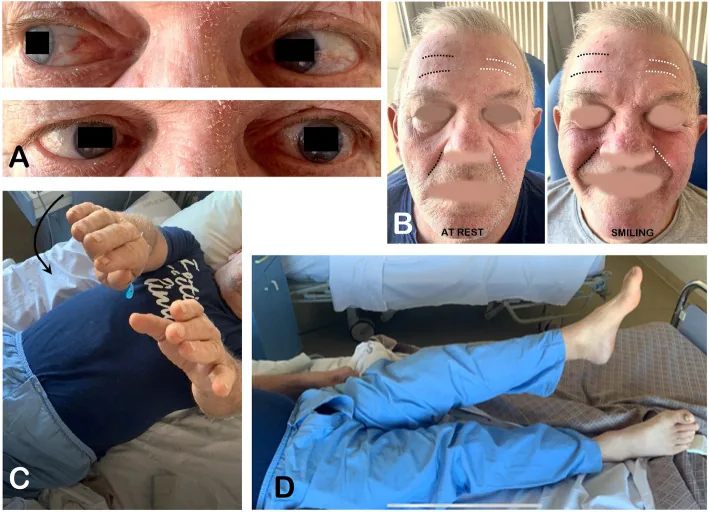
Nathan Beucler, Sébastien Boissonneau, Aurélia Ruf et al. Crossed brainstem syndrome revealing bleeding brainstem cavernous malformation: an illustrative case. BMC Neurology. 2021 May 20; 21:204. Figure 1. PMCID: PMC8136125. License: CC BY 4.0 (https://creativecommons.org/licenses/by/4.0/).
Clinical photograph of crossed brainstem syndrome. It shows left abducens nerve palsy, left peripheral facial nerve palsy, and contralateral hemiparesis with preserved facial muscle strength.
Horizontal diplopia: Caused by abduction deficit. Worsens when looking toward the healthy side.
Facial movement disorder on the affected side: Difficulty moving facial muscles. Presents with a peripheral pattern affecting forehead wrinkling and eye closure.
Contralateral limb motor impairment (hemiparesis): due to corticospinal tract involvement.
Ipsilateral facial sensory loss: when the spinal trigeminal nucleus is involved.
Ipsilateral hearing loss: when the eighth cranial nerve nucleus is involved.
Clinical Findings (Findings Confirmed by Physician Examination)
Ipsilateral abduction deficit: inability to abduct the eye due to involvement of the abducens nucleus or nerve fascicle. Results in paralytic esotropia.
Ipsilateral peripheral facial nerve palsy: Paralysis of both the upper face (forehead and eye) and lower face (mouth) due to damage to the facial nerve fibers within the pons. May be accompanied by loss of taste on the anterior two-thirds of the tongue.
Contralateral hemiparesis: Due to damage to the corticospinal tract. The face is often spared.
Conjugate horizontal gaze palsy: Inability to perform conjugate gaze toward the side of the lesion due to damage to the abducens nucleus and the paramedian pontine reticular formation (PPRF). In complete palsy, the eyes do not cross the midline even with the vestibulo-ocular reflex. In the early stage, conjugate deviation toward the healthy side may be observed.
Structures occasionally affected
Internuclear ophthalmoplegia (INO): When the medial longitudinal fasciculus (MLF) is involved. Inability to adduct the ipsilateral eye.
Horner syndrome: When descending sympathetic fibers are damaged. Ipsilateral ptosis, miosis, and anhidrosis.
Ataxia: Observed when cerebellar fibers are involved.
Loss of taste on the anterior two-thirds of the tongue: Due to involvement of the chorda tympani component of the facial nerve.
Hearing impairment: Ipsilateral sensorineural hearing loss when the cochlear nucleus (CN VIII) is involved. Ipsilateral peripheral hearing loss when the superior olivary nucleus is involved. Contralateral hearing loss when the trapezoid body or lateral lemniscus is affected.
When caused by pontine hemorrhage, it may present with fixed midline gaze and pinhole pupils (marked miosis).
QWhy does ipsilateral facial paralysis and contralateral hemiplegia occur simultaneously?
A
The facial nerve is affected while still within the pons (before decussation), resulting in ipsilateral paralysis. In contrast, the corticospinal tract decussates at the medullary pyramids, so a pontine lesion causes contralateral hemiplegia. These two structures are located close together in the lower pons, so a single lesion can affect both simultaneously.
Ischemic cerebral infarction (most common): Blood flow insufficiency to the lower medial pons from basilar artery perforating branches. Main mechanisms are atheromatous branch occlusion or small vessel occlusion (lacunar infarction).
Pontine hemorrhage: Rupture of basilar artery perforating branches. Often presents with fixed midline eyes and marked miosis.
Subarachnoid hemorrhage
Demyelinating disease (multiple sclerosis): Pontine lesions can cause abducens nerve palsy and facial nerve palsy. Common cause of PPRF impairment in young individuals 1).
Infection (e.g., tuberculosis): Direct invasion of the pons or spread from surrounding areas.
Tumor: Cerebellar tumors, bronchogenic carcinoma, etc. In children, brainstem glioma is the most common tumorous cause (excluding trauma).
Basilar artery aneurysm: Reported as a lesion in the upper pons.
In ischemic cases, the following are risk factors1).
Hypertension (most common)
Diabetes
Hyperlipidemia
Smoking
QCan Foville syndrome occur in young people?
A
In addition to ischemic causes, multiple sclerosis, infections such as tuberculosis, and brainstem tumors can also be causes, so it can occur in young people. In particular, multiple sclerosis is a common cause of PPRF lesions in young individuals 1).
There are no established diagnostic criteria. Diagnosis is made by combining clinical features and radiographic findings to confirm localization to the dorsal pons.
Cover test: Confirms the presence and degree of abduction limitation
Hess chart: Records the direction and degree of abduction deficit
Confirmation of horizontal gaze palsy: Checks limitation of movement of both eyes toward the affected side. Poor optokinetic nystagmus is also a supportive finding.
Millard-Gubler syndrome: Presents with abducens nerve palsy + facial nerve palsy + contralateral hemiparesis, but the lesion is more ventral and involves only the abducens nerve fascicle. The absence of horizontal gaze palsy is a key differentiating point.
Medial longitudinal fasciculus syndrome vs oculomotor nerve palsy: MLF syndrome is distinguished by no limitation of upward or downward gaze, no ptosis, no mydriasis, and no diminished light reflex.
Pseudo-MLF syndrome: Myasthenia gravis (differentiated by no diurnal variation and no improvement with Tensilon test), Fisher syndrome (differentiated by not being bilaterally symmetric and no truncal ataxia).
Inflammatory diseases, neoplastic lesions, hemorrhage, arteriovenous malformations: Differentiated by MRI findings and clinical course.
If an infarct is confirmed on DWI within 4.5 hours of onset, intravenous t-PA (tissue plasminogen activator) therapy may be indicated. In practice, these treatments are rarely performed for ocular motor abnormalities alone.
For ocular motor abnormalities alone, observation is often performed while administering 3 tablets of Mecobal® (500 μg) + 3 tablets of Kallikrein® (10 units) (divided into 3 doses).
Vertical rectus muscle transposition. In recent years, a minimally invasive full-width vertical rectus muscle transposition without tenotomy or splitting has been developed, and good ocular alignment improvement has been confirmed.
In surgical procedures requiring tenotomy of multiple muscles, attention should be paid to anterior segment ischemia.
Wernicke encephalopathy: Vitamin B₁ therapy (in cooperation with neurology). With early treatment, eye movement abnormalities often resolve within 1–2 weeks.
Rehabilitation is performed based on evaluation by the rehabilitation department, physical therapists, and occupational therapists. After discharge, outpatient follow-up continues to monitor complications and confirm recovery.
Prognosis is relatively good for cases caused by cerebrovascular disorders.
Mild infarcts that cannot be identified on imaging may heal within a few days.
Multiple sclerosis often leaves mild residual deficits, but the prognosis of MS itself when presenting with ocular motor abnormalities is relatively good.
QDoes diplopia due to abducens nerve palsy improve?
A
In ischemic cases, most improve spontaneously within 3 to 6 months. If not, prism glasses or extraocular muscle surgery can be used. The prognosis for cerebrovascular disease is relatively good, and mild infarcts may heal within a few days.
6. Pathophysiology and Detailed Mechanism of Onset
The pathology of Foville syndrome is explained by the simultaneous impairment of multiple neural structures concentrated in the lower pontine tegmentum.
Large cell group: Motor neurons to the ipsilateral lateral rectus muscle. Damage to this group causes ipsilateral abducens palsy.
Small cell group: Internuclear neurons to the contralateral oculomotor nucleus medial rectus subnucleus (via the MLF). Damage to this group causes internuclear ophthalmoplegia.
Protrusion into the floor of the fourth ventricle: The facial nerve loops around the abducens nucleus, forming the facial colliculus.
Facial nerve and corticospinal tract
Course of the facial nerve: Within the pons, it loops around the abducens nucleus (in a U-shape). Therefore, lesions of the abducens nucleus often simultaneously affect the facial nerve. Due to peripheral paralysis, the entire face including the upper face is paralyzed (a distinguishing point from central paralysis).
Corticospinal tract (pyramidal tract): Runs in the ventral pons. When the abducens nerve fibers exit at the pontomedullary junction, they pass through the pyramidal tract, so the same lesion can cause contralateral hemiparesis1).
PPRF and MLF
PPRF (paramedian pontine reticular formation): Relays commands for horizontal conjugate gaze to the abducens nucleus. Because it is located close to the abducens nucleus, PPRF lesions cause inability to perform conjugate horizontal gaze toward the lesion side (horizontal gaze palsy).
MLF (medial longitudinal fasciculus): A bridge from the small cell group of the abducens nucleus to the contralateral oculomotor nucleus medial rectus subnucleus. MLF lesions impair adduction of the ipsilateral eye (internuclear ophthalmoplegia).
Horizontal conjugate eye movements (conjugate gaze) are established by the following two pathways.
From the PPRF to the ipsilateral abducens nucleus → abducens nerve → ipsilateral lateral rectus muscle
From the small cell group of the abducens nucleus via the MLF to the contralateral oculomotor nucleus medial rectus subnucleus → contralateral medial rectus muscle
These two pathways allow both eyes to move in the same direction (final common pathway for horizontal conjugate gaze). Damage to the abducens nucleus or PPRF interrupts signals to both the ipsilateral lateral rectus and contralateral medial rectus, resulting in ipsilateral horizontal gaze palsy1).
Perforating branches of the basilar artery perfuse the medial part of the lower pons. The vertebrobasilar system supplies the brainstem and occipital lobe, and ischemia in this system is the main cause of Foville syndrome. When the lesion extends to the medial lemniscus, spinal trigeminal nucleus, sympathetic fibers, and the eighth cranial nerve nucleus, additional clinical signs appear.
American Academy of Ophthalmology Pediatric Ophthalmology/Strabismus Preferred Practice Pattern Panel. Adult Strabismus Preferred Practice Pattern®. Ophthalmology. 2024.