Traumatic optic neuropathy (TON) is a condition in which a strong blow to the forehead or frontal region, especially the eyebrow area, causes transmitted force (force that propagates rather than direct impact) to act on the optic canal, resulting in contusion of the optic nerve. Importantly, it is not necessarily associated with optic canal fracture; severe optic nerve damage can occur even in cases without fracture.
Typically, it develops after blunt trauma to the superolateral eyebrow area, so most cases show subcutaneous hemorrhage or contusion lacerations on the lateral side of the eyebrow.
TON is reported to occur in 0.5–5% of all head injuries. Common mechanisms include traffic accidents, sports injuries, and falls, with a typical pattern of blunt trauma to the superolateral brow. Only a minority of cases show optic canal deformity on plain X-ray or CT.
In the 2021 Beirut port explosion, 39 patients (48 eyes) were evaluated ophthalmologically. Orbital fractures were found in 14 eyes (29.2%), open globe injuries in 10 eyes (20.8%), and 53.8% required surgical intervention 1). Explosive trauma can also cause TON (see “Causes and Risk Factors” section for blast-induced traumatic optic neuropathy).
QHow is traumatic optic neuropathy different from optic nerve head avulsion?
A
Traumatic optic neuropathy is a condition in which the optic nerve is damaged at the optic canal due to indirect force from blunt trauma to the brow area. In contrast, optic nerve head avulsion is a severe injury where the optic nerve is physically torn at the level of the lamina cribrosa, and the avulsion site can be seen on fundus examination immediately after injury. A key distinguishing feature is that the fundus is usually normal immediately after injury in traumatic optic neuropathy.
GCC thickness becomes thinner and falls below normal range
6–8 weeks after injury and later
Progressive optic atrophy and optic disc pallor
GCC thickness stabilizes around 30–50 days
Relative afferent pupillary defect (RAPD) is the most important objective finding in unilateral or asymmetric bilateral cases, and is confirmed as Marcus-Gunn pupil (positive swinging flashlight test in the affected eye).
QCan traumatic optic neuropathy be ruled out even if the fundus is normal immediately after injury?
A
It cannot be ruled out. Immediately after injury, the fundus is often normal. Optic atrophy and optic disc pallor appear 6–8 weeks after injury, and thinning of GCC thickness on OCT is observed from about 2 weeks after injury. A normal fundus immediately after injury is not grounds for excluding the diagnosis; functional assessments such as RAPD (swinging flashlight test) are important.
Blunt trauma to the superolateral brow is the most common mechanism of injury. The impact propagates through the optic canal, causing vasogenic edema within the optic nerve parenchyma (see Pathophysiology section for details on pathophysiology).
Main causes:
Traffic accidents: Most common. Contact with windshield, airbag, or steering wheel.
Sports injuries: Collision with racket, ball, or ground.
Falls: Impact of face or forehead with the ground.
Assault: Direct blunt force to the face from fists or blunt objects.
Shock waves from blast overpressure propagate through ocular structures to the optic nerve, causing shear forces and stress that damage optic nerve fibers. It is characterized by the absence of penetrating injury or significant blunt trauma, and optic neuropathy can occur even without visible external signs of injury.
Military personnel, emergency responders, and civilians exposed to explosives are at high risk.
65–68% of blast-injured soldiers with traumatic brain injury (TBI) report visual problems.
Animal models have confirmed a dose-response relationship between total blast exposure and the degree of optic nerve degeneration.
Elevation of IL-1α and IL-1β in the optic nerve and retina has been demonstrated in animal models.
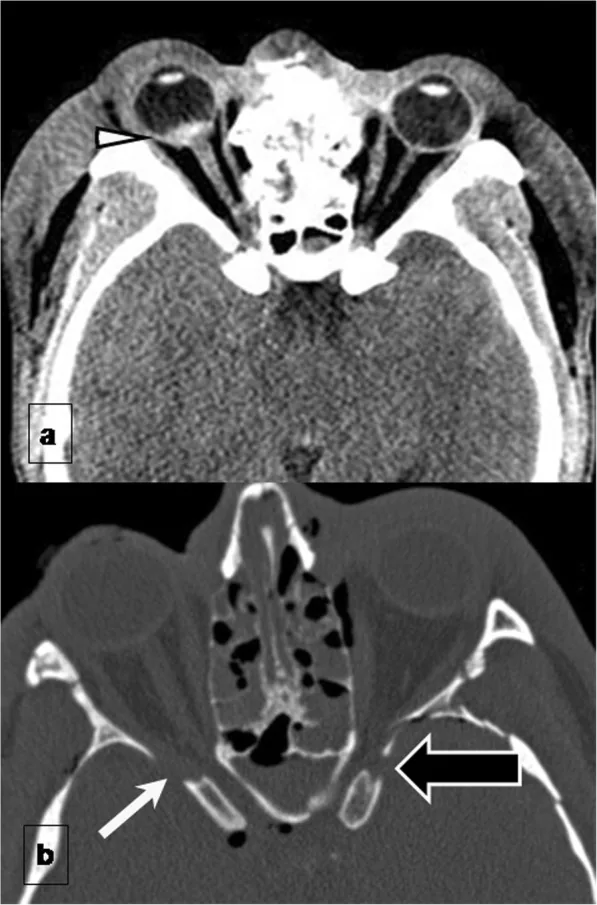
Gómez Roselló E, Quiles Granado AM, Artajona Garcia M, et al. Facial fractures: classification and highlights for a useful report. Insights Imaging. 2020;11(1):49. Figure 2. PMID: 32193796; PMCID: PMC7082488; DOI: 10.1186/s13244-020-00847-w. License: CC BY 4.0 (https://creativecommons.org/licenses/by/4.0/).
Axial non-contrast CT of the orbit shows (a) hematoma at the posterior pole of the globe extending to the optic disc (arrowhead) and (b) bone fragment within the muscle cone causing optic nerve injury (black arrow: bone fragment, white arrow: optic nerve transection). This corresponds to the diagnostic findings of orbital fracture and optic nerve injury on CT discussed in the section “4. Diagnosis and Examination Methods.”
The most important test for diagnosing optic neuropathy is the swinging flashlight test. In the affected eye, the pupil dilates when light is shone, confirming a positive relative afferent pupillary defect (RAPD) (Marcus Gunn pupil). Even if visual acuity and fundus findings are good, this finding indicates the presence of optic nerve injury.
The following tests are used in combination for evaluation.
QIs it possible to have traumatic optic neuropathy even with good visual acuity?
A
Yes. In traumatic optic neuropathy, even if visual acuity is relatively preserved, visual field abnormalities, decreased contrast sensitivity, color vision abnormalities, and positive RAPD may be present. Evaluation using only high-contrast visual acuity risks missing the impairment. Assessment with RAPD (swinging flashlight test) is essential.
Evaluate visual function and associated orbital and head injuries early, and assess whether there is direct compression from bone fragments or a hematoma. Especially in indirect TON, there is no consensus on whether steroid therapy, optic canal decompression, or observation should be prioritized, and no clear superiority of pharmacotherapy or surgery has been established4)10). The following distinguishes treatment objectives from methods used in studies.
Pharmacotherapy
Example of steroid therapy: In a randomized controlled trial by Entezari et al., 31 patients injured within 7 days were studied; 16 patients in the treatment group received intravenous methylprednisolone 250 mg every 6 hours for 3 days, followed by oral prednisolone 1 mg/kg for 14 days. At 3 months, visual acuity and the rate of visual improvement did not differ significantly from those in the 15-patient placebo group11). This was the regimen used in the trial and does not indicate a uniform recommended dose or duration.
Example of combination therapy with a hyperosmotic agent: Hokazono et al. combined mannitol with steroid administration after decompression surgery in one case of optic canal fracture with optic nerve compression by a bone fragment12). This was a case report of combination treatment including surgery and does not support the effect of mannitol alone or routine combination therapy for TON in general.
Surgical Treatment
Optic canal decompression: There is much controversy regarding the indications for open surgery. Many believe that reducing edema within the optic nerve parenchyma is difficult to achieve surgically, except in cases where the optic nerve is clearly compromised due to marked deformation of the optic canal or significant displacement of bone fragments.
Transnasal endoscopic approach: In recent years, a minimally invasive transnasal endoscopic approach has become feasible.
Limited indications: Cases with marked deformation of the optic canal or significant displacement of bone fragments are considered appropriate for surgery.
Severe cases where loss of light perception does not recover quickly: These cases tend to respond poorly to treatment.
Longitudinal evaluation: Track changes in visual acuity, visual fields, and optic atrophy. The visual function improvement effect of pharmacotherapy in cases where time has elapsed since injury has also not been established4)10).
Spontaneous recovery: In general traumatic optic neuropathy, spontaneous recovery is reported in a certain proportion of cases, and prognosis is considered better in children than in adults.
Findings from IONTS (International Optic Nerve Trauma Study)
The IONTS compared steroid therapy, optic canal decompression, and observation, and none showed a significant advantage over the others2). Treatment selection should be individualized based on the patient’s general condition, severity of injury, and presence of fractures.
QHow effective is steroid treatment?
A
Especially in indirect TON, an effect superior to observation has not been established10). A randomized controlled trial of 31 patients examined intravenous methylprednisolone followed by oral prednisolone, but found no significant difference from placebo in visual improvement at 3 months11). Because spontaneous recovery also occurs, improvement after treatment alone cannot be used to determine the drug’s effectiveness2)3).
The effectiveness of high-dose steroids remains under debate. In addition to reports since IONTS finding no significant difference in visual function outcomes among untreated, steroid, and optic canal decompression groups, a Cochrane systematic review also found no clear effectiveness of steroids for traumatic optic neuropathy3). Recent systematic reviews have likewise concluded that high-quality evidence is scarce for steroids, surgery, and observation4). Furthermore, in the MRC CRASH trial of head injuries, mortality was reported to increase significantly in the methylprednisolone group, requiring cautious decisions about administration while considering the presence or absence of associated head injuries5)6).
Endoscopic transnasal optic canal decompression may be selected as a minimally invasive procedure, but further data are needed regarding indications and long-term outcomes. A tendency toward higher improvement rates with surgery early after injury, particularly within 3 days, has been reported7). On the other hand, meta-analyses comparing surgical decompression with conservative treatment have yielded inconsistent results, and randomized controlled trials have not been established8)9).
The main cause of optic nerve damage is thought to be vasogenic edema within the optic nerve parenchyma (tissue corresponding to the white matter of the brain) caused by blunt trauma. This is similar to brain edema after head trauma, and direct damage to optic nerve fibers in the optic canal due to hematoma or bone fragments is relatively rare.
This vasogenic edema compresses the optic nerve within the bony optic canal, leading to impaired blood flow, ischemia, and axonal damage through a mechanism similar to compartment syndrome.
Shock waves generated by blast overpressure propagate through ocular structures, causing shear stress on optic nerve fibers. This leads to traumatic axonal injury, progressing to neuroinflammation and functional impairment. While macroscopic damage is absent, axonal injury, gliosis, and inflammation occur at the tissue level.
Animal models (Rex et al.) have confirmed the following:
Transient elevation of intraocular pressure is induced
Death of retinal ganglion cells (RGCs) and axonal degeneration of the entire optic nerve occur
IL-1α and IL-1β are selectively elevated in the optic nerve and retina (other cytokines remain unchanged)
There is a dose-response relationship between the number of blast exposures and the degree of neurodegeneration
In a pilot study by Kashkouli et al., administration of EPO to patients with traumatic optic neuropathy was reported to improve visual outcomes. Direct application to blast-induced cases requires further research.
Research targeting enhancement of neuroprotective and neuroregenerative factors, and suppression of neurodegeneration and inflammatory factors is currently ongoing, and future clinical application is expected.
Blanch RJ, Joseph IJ, Cockerham K. Traumatic optic neuropathy management: a systematic review. Eye (Lond). 2024;38(12):2312-2318. PMID:38862644.
Roberts I, Yates D, Sandercock P, et al; CRASH trial collaborators. Effect of intravenous corticosteroids on death within 14 days in 10008 adults with clinically significant head injury (MRC CRASH trial): randomised placebo-controlled trial. Lancet. 2004;364(9442):1321-1328. PMID:15474134.
Steinsapir KD, Goldberg RA. Traumatic optic neuropathy: an evolving understanding. Am J Ophthalmol. 2011;151(6):928-933.e2. PMID:21529765.
Yu B, Ma Y, Tu Y, Wu W. The Outcome of Endoscopic Transethmosphenoid Optic Canal Decompression for Indirect Traumatic Optic Neuropathy with No-Light-Perception. J Ophthalmol. 2016;2016:6492858. PMID:27965891.
Martinez-Perez R, Albonette-Felicio T, Hardesty DA, Carrau RL, Prevedello DM. Outcome of the surgical decompression for traumatic optic neuropathy: a systematic review and meta-analysis. Neurosurg Rev. 2021;44(2):633-641. PMID:32088777.
Fallahzadeh M, Veisi A, Tajari F, et al. The Management of Traumatic Optic Neuropathy: A Systematic Review and Meta-Analysis. Arch Acad Emerg Med. 2024;13(1):e19. PMID:39670238.
Wladis EJ, Aakalu VK, Sobel RK, et al. Interventions for Indirect Traumatic Optic Neuropathy: A Report by the American Academy of Ophthalmology. Ophthalmology. 2021;128(6):928-937. doi:10.1016/j.ophtha.2020.10.038. PMID:33161071.
Entezari M, Rajavi Z, Sedighi N, Daftarian N, Sanagoo M. High-dose intravenous methylprednisolone in recent traumatic optic neuropathy; a randomized double-masked placebo-controlled clinical trial. Graefes Arch Clin Exp Ophthalmol. 2007;245(9):1267-1271. doi:10.1007/s00417-006-0441-0. PMID:17265030.
Hokazono Y, Umezawa H, Kurokawa Y, Ogawa R. Optic Canal Decompression with a Lateral Approach for Optic Nerve Injury Associated with Traumatic Optic Canal Fracture. Plast Reconstr Surg Glob Open. 2019;7(10):e2489. doi:10.1097/GOX.0000000000002489. PMID:31772908.
Copy the article text and paste it into your preferred AI assistant.
Article copied to clipboard
Open an AI assistant below and paste the copied text into the chat box.