Corneal allograft rejection is an alloimmune response of the recipient against the donor corneal tissue. The pathology is classified as a delayed-type hypersensitivity reaction and is a complication that occurs in a certain proportion of cases after corneal transplantation. The incidence of rejection after penetrating keratoplasty (PKP) is approximately 10–30%, making it one of the main causes of corneal graft failure. Rejection, glaucoma, and infection are the three major complications of corneal transplantation.
Corneal transplantation is among the most successful types of organ transplantation. For first-time PKP in low-risk eyes, the 5-year graft survival rate reaches approximately 95% 1). This high success rate is supported by the immune privilege of the cornea.
The main factors that constitute corneal immune privilege are as follows:
Lack of blood vessels: Acts as a physical barrier to the delivery of immune cells and complement components.
Lack of lymphatics: Limits the transport of antigen-presenting cells to regional lymph nodes.
Expression of Fas ligand: Induces apoptosis in infiltrating activated T cells.
Low expression of MHC class II antigens: Inherently limits antigen-presenting capacity.
Immune privilege is not absolute. In high-risk eyes with corneal neovascularization, the graft failure rate at 3 years postoperatively can exceed 35%. The most common cause of graft failure is irreversible immunological rejection, and the rate of progression from rejection to graft failure is reported to be approximately 49% 1).
“Graft rejection” refers to the recipient’s specific immune response against the donor cornea. In contrast, primary graft failure is due to defects in the donor tissue itself, surgical trauma, or improper preservation, and is defined as the graft never becoming clear within 8 weeks postoperatively. Primary graft failure is not immune-mediated and occurs in approximately 0.1% of PKP cases 3).
The diagnosis of rejection is only established for grafts that have maintained clarity for at least 2 weeks postoperatively. More than half of rejection episodes occur within the first year after surgery, with a peak between 6 months and 1 year. However, there are cases where the first rejection episode occurs more than 20 years after surgery.
Corneal transplantation is the most frequently performed tissue transplant worldwide. According to an international survey in 2012, PKP accounted for approximately 70% of all corneal transplants 1). In recent years, DSAEK and DMEK for endothelial diseases have rapidly become widespread, and DALK for keratoconus and post-keratitis scars has become a standard option, so the composition of surgical procedures has changed significantly 1). However, PKP remains essential for extensive corneal opacities and deformities, and it carries the highest risk of rejection among surgical techniques 1).
For first-time PKP, the incidence of rejection is reported to range from approximately 10% to 30%, with most episodes occurring between 6 months and 1 year postoperatively. The rate of progression from a rejection episode to graft failure is approximately 49%, and grafts that have experienced even one rejection episode have reduced long-term survival 1). Therefore, early detection of rejection and prompt initiation of treatment are decisive factors for graft survival.
QWhen is corneal transplant rejection most likely to occur?
A
More than half of episodes occur within the first year after surgery, especially between 6 months and 1 year. However, rejection can also occur long after surgery, so if symptoms such as redness, blurred vision, or decreased vision appear even years later, prompt medical attention is necessary. There are reports of rejection triggered by vaccination more than 20 years after surgery 10).
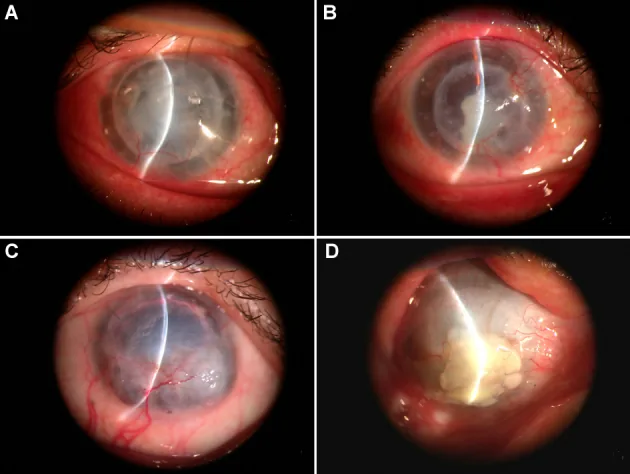
Corneas with mild oedema and neovascularisation caused by rejection (A, B), and corneas with extensive neovascularisation and perforation (C, D). These correspond to the corneal opacity discussed in section 2, Main Symptoms and Clinical Findings.
Criteria for rejection include any of the following: redness, photophobia, decreased vision, anterior chamber cells, keratic precipitates (KP), endothelial or epithelial rejection lines, subepithelial infiltrates, and localized graft edema 1). Localized KP on the graft is the most characteristic feature, and the absence of KP on the recipient cornea is an important distinguishing point from viral endotheliitis.
Rejection is classified into three types based on the layer affected: epithelial, stromal, and endothelial. Endothelial rejection has the greatest impact on graft prognosis, and delayed treatment leads to irreversible endothelial failure and vision loss.
Epithelial rejection
Frequency is low, accounting for about 2% of all rejections.
As a precursor lesion, a round subepithelial infiltrate of 0.2–0.5 mm directly under Bowman’s membrane is observed.
As it progresses, it forms an edematous, raised linear lesion (epithelial rejection line).
It has little effect on the clear healing of the graft itself.
Caution is needed because it can trigger endothelial rejection.
Stromal rejection
Stromal edema is the only finding.
It is easier to diagnose in eyes that have undergone deep lamellar keratoplasty (without endothelial rejection).
Differentiation from corneal edema due to endothelial rejection in PKP eyes is difficult.
In DALK, stromal immune rejection may present with stromal infiltration and interface neovascularization4).
Endothelial rejection
It accounts for about 50% of all rejection episodes and is clinically the most important.
Localized corneal endothelial deposits within the graft are a key finding.
KP may be scattered over the entire graft endothelium or form a Khodadoust line (rejection line).
When a Khodadoust line forms, stromal edema is present in the same area.
It is accompanied by ciliary injection and anterior chamber inflammation, but often milder than typical uveitis.
Mixed type (e.g., epithelial + endothelial) accounts for approximately 30% of rejection reactions.
QWhat is the Khodadoust line?
A
The Khodadoust line is a linear corneal endothelial deposit characteristic of endothelial rejection. It represents the advancing front of rejection that progressively moves across the graft endothelial surface. In the area where the line has passed, endothelial cells are damaged, leading to stromal edema. When a Khodadoust line is observed, prompt and intensive steroid therapy should be initiated.
Features: The carrier is the posterior stroma approximately 50–100 μm. Most cases are mild, with only scattered fine KP or pigmentation on the posterior corneal surface.
Descemet Membrane Endothelial Keratoplasty (DMEK)
Rejection rate: Mean 1.9% (range 0–5.9%)3, 7)
Primary failure rate: 1.7%
Features: Only Descemet membrane and endothelial layer are transplanted, minimizing antigen load. Suture-related rejection is absent because no sutures are used.
Large cohort studies have shown that DMEK has a significantly lower risk of rejection compared to PKP and DSAEK3). However, a meta-analysis of 8 studies (376 eyes) comparing UT-DSAEK (ultrathin DSAEK, graft thickness <130 μm) and DMEK found no significant difference in rejection risk at 12 months postoperatively2). In the same meta-analysis, DMEK showed better logMAR corrected visual acuity at 12 months than UT-DSAEK (mean difference −0.06, 95% CI −0.10 to −0.02), but the risk of rebubbling (air reinjection) was significantly higher in the DMEK group (OR 2.76, 95% CI 1.46–5.22)2). A Dutch multicenter randomized controlled trial of 54 eyes also found that the DMEK group had a significantly higher rate of achieving 20/25 or better at 12 months than the DSAEK group (66% vs 33%, P=0.02), while there were no significant differences in endothelial cell density or refractive change11).
Differential Diagnosis of Corneal Endothelial Deposits
Endothelial rejection and viral endotheliitis have similar clinical presentations; the pattern of KP attachment is the most reliable distinguishing feature.
Finding
Rejection
HSV/VZV endotheliitis
CMV endotheliitis
KP distribution
Confined to graft
Also outside graft
Also outside graft
KP color
White to gray-white
Brown
Brown to white
Characteristic findings
Khodadoust line
Arlt’s triangle
Coin lesion
In rejection, graft-localized KP is the most characteristic feature, and this distinguishes it from viral endotheliitis, where KP is present on the recipient cornea. Since corneal endothelial deposits may also be donor-derived at the time of corneal transplantation, recording the distribution of KP during daily examinations is extremely useful for differentiation.
Steroid tapering: Rapid tapering can trigger rejection.
Peripheral anterior synechiae (PAS): Confirmed in animal models to increase rejection risk7).
History of herpes infection
Physical stress on the endothelium despite sutureless technique: Graft detachment or need for rebubbling
In DMEK, endothelial rejection is rare but can be triggered during steroid tapering. A case of rejection has been reported after switching from betamethasone to fluorometholone at 15 months post-DMEK7). Additionally, cases with peripheral anterior synechiae have been shown to have a higher risk of rejection after DMEK7).
In solid organ transplantation, the effect of HLA matching in suppressing rejection is well established, but in corneal transplantation, research results are inconsistent 1). The Corneal Transplant Follow-up Study II (CTFS II) conducted in the UK is a large-scale clinical trial that prospectively investigated the impact of HLA class II (HLA-DR) matching in high-risk PKP1). From 1998 to 2011, 1133 transplants were accumulated, and under the condition of ≤2 HLA class I mismatches, patients were stratified into 0, 1, or 2 HLA-DR mismatch groups and assigned using the cohort minimization method 1). To avoid errors from serological methods, DNA-based techniques (PCR-SSP/PCR-SSO) were used for donor and recipient tissue typing 1).
In CTFS II, no clear relationship was found between the number of HLA-DR mismatches and the incidence of rejection 1). As shown in rodent models, multiple different immune pathways are involved in corneal transplant rejection, and this redundancy of immune responses is thought to partly explain the inconsistent results of HLA matching studies 1). On the other hand, there is a consensus that HLA class I matching tends to be beneficial in high-risk transplants 1).
Corneal transplant rejection after COVID-19 vaccination has been reported with mRNA vaccines (BNT162b2), viral vector vaccines (ChAdOx1), and inactivated vaccines (Sinopharm).
BNT162b2 vaccine: Two cases of acute PKP rejection approximately 2 weeks after the first dose have been reported, both responding well to topical and systemic steroids 6). There is also a case of rejection occurring 10 days after BNT162b2 vaccination in a PKP more than 20 years post-surgery 10).
ChAdOx1 vaccine: A case of endothelial rejection of femtosecond laserPKP occurred 2 weeks after vaccination, with Khodadoust line and anterior chamber inflammation, which recovered after 5 weeks of steroid treatment 8).
Sinopharm inactivated vaccine: Two cases of rejection after vaccination have been reported 9).
There are more than 20 case reports involving multiple vaccines and surgical techniques, and the majority recovered with steroid treatment 9). Although causality is not established, it has been hypothesized that systemic immune activation from vaccination may trigger rejection through cross-reactivity or non-specific immune activation against the transplanted cornea6, 9).
QCan rejection occur after COVID-19 vaccination?
A
Rejection reactions occurring 1 to 3 weeks after vaccination have been reported with mRNA vaccines, viral vector vaccines, and inactivated vaccines. Most cases recover with steroid treatment 9). Patients with a history of corneal transplantation are advised to consult their physician about increasing preoperative steroid eye drops and postoperative self-monitoring (vision, redness, eye pain).
Corneal pachymetry: Increased corneal thickness is an early indicator of endothelial dysfunction. Baseline data before surgery is useful for early detection of rejection 3).
Anterior segment OCT: Evaluates the adhesion between the graft and host cornea, distribution of stromal edema, and poor adhesion of DSAEK grafts.
Specular microscope: Quantitatively evaluates corneal endothelial cell density. The minimum endothelial cell density for donor corneas is 2200 cells/mm² according to CTFS II, with a mean of 2684 (SD 231) cells/mm²1).
Anterior chamber PCR: Performed when differentiation from herpes virus or CMV infection is difficult7).
Fluorescein angiography (FA) and indocyanine green angiography: May be used to evaluate graft neovascularization and activity of new vessels.
Confocal microscopy: Allows evaluation of dendritic cell infiltration and inflammatory cells in the cornea, and its use is expanding in research.
The main conditions requiring differentiation from endothelial rejection are as follows.
Herpetic keratouveitis: Extremely difficult to differentiate from endothelial rejection. It can occur even in patients without a clear history of herpes keratitis. Since herpetic keratouveitis can also be treated with anti-rejection therapy, clinical diagnosis becomes even more challenging. The only distinguishing feature is the pattern of keratic precipitates (KP): in herpes, they attach not only to the graft but also to the surrounding recipient cornea.
CMV corneal endotheliitis: Characterized by coin lesion-like KP and chronic persistent intraocular pressure elevation. Anterior chamber PCR is useful for definitive diagnosis.
Graft endothelial dysfunction: Endothelial cell density gradually decreases without rejection, leading to dysfunction over time. Differentiation is based on history of inflammatory reactions, but it is often difficult when corneal edema occurs during a long interval between examinations.
Postoperative infection: After corneal transplantation, the eye is susceptible to infection. It is necessary to rule out bacterial, fungal, and herpetic infections before intensifying immunosuppression. Exposed suture sites are particularly prone to infection; culture (bacterial and fungal) and microscopy of scrapings should be performed, and treatment should be based on the causative organism and drug sensitivity. More than half of late-onset infections are attributed to sutures.
Steroid-responsive ocular hypertension: When intraocular pressure rises during long-term steroid use, differentiation from steroid-induced glaucoma is necessary. Consider switching to a steroid with lower intraocular pressure effects, such as loteprednol or fluorometholone.
QHow do you differentiate rejection from herpetic corneal endotheliitis?
A
The most important distinguishing feature is the distribution of KP. In rejection, KP is generally confined to the graft, whereas in HSV/VZV endotheliitis, KP also attaches to the recipient cornea outside the graft. CMV endotheliitis is characterized by coin lesion-like KP and chronic persistent intraocular pressure elevation. If definitive diagnosis is difficult, comprehensively evaluate anterior chamber PCR, serum antibody tests, and response to steroid therapy.
Treatment of rejection is fundamentally based on anti-inflammatory therapy with steroids. For epithelial and stromal types, steroid eye drops alone are often sufficient, but for endothelial type, prompt anti-inflammatory treatment is essential to protect endothelial cells. Immunosuppressive drugs are not effective alone for acute treatment because they take time to take effect, and they are used in combination with steroids.
Start with Rinderon PF Otic and Ophthalmic Solution 0.1% (betamethasone sodium phosphate, preservative-free) instilled 6 to 8 times daily.
Choose a preservative-free steroid eye drop to minimize effects on the epithelium.
Taper over 6 to 8 weeks.
Severe (endothelial type, Khodadoust line positive)
Instill Rinderon PF Otic and Ophthalmic Solution 0.1% every hour.
If necessary, administer Solu-Medrol Injection (methylprednisolone sodium succinate) 250 mg/day intravenously for 3 days (mini-pulse therapy).
Dexamethasone or betamethasone may also be injected subconjunctivally.
After remission, continue betamethasone 0.1% four times daily for at least one year, then switch to a lower concentration steroid for long-term maintenance.
With early treatment, more than 50% of acute rejection episodes recover, but delayed treatment can lead to irreversible endothelial cell loss and graft failure. Patient education is important: patients should be aware of postoperative symptoms (redness, blurred vision, eye pain, photophobia) and seek early medical attention if any changes occur.
For prevention of rejection after corneal transplantation, a two-tier protocol based on risk stratification is used.
Postoperative Management for Normal-Risk Eyes
Antibacterial eye drops: Cravit ophthalmic solution 1.5% (levofloxacin) 5 times daily → taper and discontinue
Steroid eye drops: Rinderon ophthalmic solution 0.01% (betamethasone) 5 times daily → switch to Flumetholon ophthalmic solution 0.1% (fluorometholone) 2-3 times daily
Adjuvant: Lindeta PF otic/ophthalmic solution 0.1% used concomitantly when epithelial damage is severe
Systemic: Flumarin for intravenous injection 1 g/day (flomoxef sodium) infused for several days starting on the day of surgery
Postoperative management for high-risk eyes
Steroid eye drops: Initiate as for normal-risk eyes and continue for at least 1 year
Systemic steroids: Rinderon injection 0.4% 2 mg once daily intravenously for 3 days from surgery day, then Rinderon tablets 0.5 mg 2 tablets once daily tapered over 2 weeks
Cyclosporine A is used in high-risk cases such as those with corneal stromal vascular invasion involving 2 or more quadrants, regrafts, history of rejection, or allogeneic limbal transplantation. The dose is adjusted based on C2 level (blood concentration 2 hours after oral administration) or trough level, and continued for about 6 months postoperatively. Systemic side effects, especially renal function, are monitored as needed.
Tacrolimus is used as a switch drug for cases that develop rejection while on oral cyclosporine. The target trough level is 8-10 ng/mL until 2 months postoperatively, and 5-6 ng/mL thereafter. Topical 0.03% tacrolimus eye drops are also used to prevent rejection in high-risk corneal transplantation.
Cyclosporine A 1% eye drops are useful as an alternative to allow early tapering of steroids in cases with steroid-responsive ocular hypertension. In an 18-year-old PKP case with bilateral simultaneous rejection, remission was achieved with methylprednisolone pulse therapy, then switched to CsA 1% eye drops for successful maintenance5). CsA 1% eye drops enable early tapering of potent steroids and contribute to long-term graft survival5).
After remission, long-term continuation of steroid eye drops is expected to suppress recurrence3). Sutures should be removed promptly when loosening or breakage is detected. Exposed sutures can trigger both rejection and late infection, so they are a key point in follow-up. Since local inflammation from suture removal can also trigger rejection, steroid and antibiotic eye drop therapy should be temporarily intensified after suture removal.
Suture management is a key factor influencing long-term prognosis after corneal transplantation. Using fluorescein staining with slit-lamp microscopy makes it easier to detect loose or broken sutures and surrounding epithelial damage. In principle, all continuous sutures should be removed, and it is desirable to perform removal one year or more after surgery when it can be done safely. To achieve better visual acuity after penetrating keratoplasty, reducing astigmatism is essential, and suture adjustment should be performed repeatedly from the early postoperative period while evaluating with mire rings and topography. Hyperopic astigmatism of 5 diopters or more is a good indication for complete suture removal.
Even after successful acute treatment of rejection, abrupt discontinuation of steroids can trigger recurrence, so tapering should be done carefully over weeks to months. When starting with betamethasone 0.1%, first continue a maintenance dose of 4 times daily for several months to a year, then switch to a low-concentration steroid such as fluorometholone 0.1% and maintain at 1–2 times daily long-term. If intraocular pressure rises, consider changing to loteprednol or adding glaucoma eye drops (prostaglandin analogs, beta-blockers, etc.).
QHow long should steroids be continued in high-risk eyes?
A
In high-risk PKP eyes, the standard is to continue topical betamethasone 0.1% four times daily for at least one year, then switch to a low-concentration steroid (e.g., fluorometholone) for long-term maintenance. Systemic immunosuppressants (Neoral, Prograf) are continued for about six months postoperatively, adjusted while monitoring renal function and blood trough levels. Early dose reduction can trigger rejection, so tapering should be done cautiously.
QHow much do rejection rates differ between PKP and DMEK?
A
The rejection rate for PKP is approximately 10–30% (range 4.9–28.9% in the literature), whereas for DMEK it is significantly lower at an average of 1.9% (range 0–5.9%) 2, 3). This difference is mainly due to the amount of donor tissue and antigen load transplanted. PKP transplants epithelium and stroma containing dendritic cells, resulting in high antigenicity, and sutures also trigger immune responses. In contrast, DMEK transplants only Descemet’s membrane and endothelium, with minimal antigen load and no sutures, reducing risk. However, even with DMEK, about 6% of cases experience rejection after steroid discontinuation, highlighting the importance of long-term steroid continuation.
The cornea maintains physiological immune tolerance through anterior chamber-associated immune deviation (ACAID). In ACAID, antigen-presenting cells become tolerogenic in a TGF-β-dominant environment, suppressing delayed-type hypersensitivity and complement-fixing antibody production against donor antigens. However, when high-risk factors such as neovascularization, inflammation, or suture loosening are present, this immune privilege is easily disrupted.
The central mechanism of rejection is delayed-type hypersensitivity, and the main effector cells are CD4+ Th1 cells. Activated Th1 cells produce IFN-γ, which induces MHC class II antigen-presenting cells throughout the transplanted cornea, leading to self-amplifying progression of the cellular immune response8). Dendritic cells are abundant in the superficial stroma and limbus, presenting donor-derived antigens to the recipient’s regional lymph nodes to establish sensitization. Activated effector T cells infiltrate the transplanted cornea from limbal blood vessels and damage donor endothelial cells and stromal cells.
The involvement of antibody-mediated mechanisms has also gained attention in recent years. It has been suggested that anti-HLA antibodies may cause chronic endothelial cell damage via complement activation, which could contribute to late endothelial failure after long-term follow-up1). The concept of antibody-mediated rejection established in solid organ transplantation is now being applied to corneal transplantation1).
Immunological Differences Between Surgical Techniques
Differences in rejection rates among surgical techniques are primarily due to the amount and antigenicity of transplanted donor tissue3).
PKP: Since the full thickness is transplanted, dendritic cells abundant in the superficial stroma and donor epithelium act as a large amount of antigen. Neovascularization at the suture site near the corneal limbus and suture loosening further increase the risk of rejection.
DALK: Because the donor endothelium is not included, the most severe endothelial rejection does not occur in principle. However, stromal rejection can still occur.
DSAEK: This is an endothelial transplant using a carrier of about 50–100 μm of posterior stroma, with less antigen than PKP. Rejection often presents only as mild KP or scattered pigmentation.
DMEK: Only the Descemet membrane and endothelial cell layer are transplanted, minimizing antigen load. It is sutureless, so there are no suture-related triggers.
DSAEK donor lenticules are created using a microkeratome to produce a free cap of 300–350 μm thickness, and the remaining approximately 100 μm is used for surgery. The donor cornea is punched with an 8 mm trephine, inserted into the anterior chamber using specialized pull-through instruments (e.g., Busin glide, NS Endo-Inserter), and attached to the posterior corneal surface with air tamponade. In DMEK, the Descemet membrane and endothelial cell layer are stripped, and the graft stained with trypan blue is injected from the anterior chamber. Rebubbling (air reinjection) after DMEK may be required to repair graft detachment, and meta-analysis has shown it is significantly more frequent in the DMEK group than in the UT-DSAEK group (OR 2.76, 95% CI 1.46–5.22) 2).
Peripheral anterior synechiae (PAS) have been noted as a risk factor for rejection after DMEK. In a mouse corneal transplantation model, the group with PAS showed significantly increased rejection, suggesting that direct contact between the iris and donor endothelium via PAS induces cytotoxic T lymphocyte activity and promotes rejection 7). Clinically, there have been reports of rejection in cases with PAS after DMEK7).
Corneal transplant rejection is primarily mediated by cellular immunity, but rodent studies have identified multiple distinct immune pathways leading to rejection 1). This redundancy of immune response is considered one reason for inconsistent results in HLA matching studies 1). The CTFS II used a large cohort of 1133 transplants and DNA-based high-precision tissue typing to examine the impact of HLA class II matching, providing a foundation for deeper immunological understanding in the field of corneal transplantation 1). In recent years, the role of anti-HLA antibodies and antibody-mediated rejection has also gained attention, potentially leading to elucidation of the mechanism of late endothelial failure 1).
Presumed Mechanism of Vaccine-Associated Rejection
COVID-19 vaccination elicits a systemic immune response, inducing SARS-CoV-2 neutralizing antibodies as well as antigen-specific CD8+ and Th1-type CD4+ T cell responses 6). It is presumed that this immune activation may trigger rejection via cross-reactivity or nonspecific immune activation against the transplanted cornea6). For inactivated vaccines, the immunogenicity of the adjuvant (aluminum hydroxide) may also contribute 9). However, at the meta-analysis level, no increase in rejection after COVID-19 vaccination has been confirmed in solid organ transplantation, and a causal relationship in corneal transplantation has not been established at present.
Case accumulation of corneal graft rejection associated with COVID-19 vaccines is progressing worldwide, with at least 20 cases reported 9). Most cases are regrafts, occurring 1–2 weeks after vaccination, and the majority recover with steroid treatment 9). Prophylactic steroid increase before vaccination has been proposed, but no randomized controlled trials exist, and decisions must be made on a case-by-case basis 8, 9).
Regarding the clinical significance of HLA matching, the CTFS II has completed a large-scale prospective validation 1). Currently, no clear clinical benefit of HLA-DR matching in corneal transplantation has been demonstrated, but the role of anti-HLA antibodies and antibody-mediated rejection is becoming clearer, which may lead to elucidation of the mechanism of late endothelial failure and discovery of new therapeutic targets 1).
In comparisons between DMEK and UT-DSAEK, both the Sela 2023 meta-analysis 2) and the Dunker 2020 multicenter RCT 11) showed no significant difference in 12-month rejection rates, while the DMEK group achieved better corrected visual acuity. However, graft failure tended to be slightly higher in the DMEK group 2), and the risk of rebubbling (air reinjection) was also higher in the DMEK group (OR 2.76) 2). Surgical technique selection should be based on a comprehensive assessment of the patient’s individual ocular pathology, history, and facility experience 2, 11).
The following directions are attracting attention for the future.
Rho kinase inhibitors (ripasudil, netarsudil): Expected to promote corneal endothelial cell proliferation and have anti-inflammatory effects. Animal experiments have shown recovery of corneal endothelial cell density, opening the possibility of regenerating the corneal endothelium, which was previously thought to be non-regenerative.
Preoperative anti-VEGF agents: Investigated to reduce rejection rates in high-risk eyes by regressing corneal neovascularization. Clinical trials of subconjunctival injection or eye drops of bevacizumab are ongoing.
Cytokine profiling: Efforts are underway to measure cytokine concentrations such as IFN-γ, IL-6, and IL-17 in tears and aqueous humor to stratify high-risk patients and provide a basis for individualized immunosuppression.
Injection therapy of cultured corneal endothelial cells: As a regenerative medicine approach to avoid donor shortage and rejection issues, clinical research is progressing on injecting autologous or allogeneic cultured endothelial cells into the anterior chamber.
iPS cell-derived corneal cells: The use of allogeneic iPS cell banks with special HLA types of low immunogenicity and the production of cultured corneal epithelial cell sheets have been reported, and rejection-free transplantation in the future is being explored.
Gene therapy and immunomodulatory therapy: Novel approaches targeting suppression of antigen presentation by dendritic cells and induction of regulatory T cells are being investigated at the preclinical stage.
Artificial cornea (Boston KPro): For cases with severe corneal scarring and neovascularization where conventional PKP carries an extremely high risk of rejection, artificial corneal replacement is an option. While immunological rejection can be avoided, long-term complications such as infection, glaucoma, and retroprosthetic membrane remain challenges.
Corneal bioprinting: Research is underway to create corneal tissue using 3D bioprinters, which is expected to be a technology that resolves both donor dependence and rejection in the future.
Armitage WJ, Winton HL, Jones MNA, Crewe JM, Rogers CA, Tole DM, Dick AD. Corneal transplant follow-up study II (CTFS II): a prospective clinical trial to determine the influence of HLA class II matching on corneal transplant rejection: baseline donor and recipient characteristics. Br J Ophthalmol. 2019;103(1):132-136. doi:10.1136/bjophthalmol-2017-311342.
Farid M, Rhee MK, Akpek EK, Amescua G, Garcia-Ferrer FJ, Lin A, et al. Corneal Edema and Opacification Preferred Practice Pattern®. Ophthalmology. 2019;126(1):P216-P285. doi:10.1016/j.ophtha.2018.10.022. PMID:30366795.
Jhanji V, Ahmad S, Amescua G, et al. Corneal Ectasia Preferred Practice Pattern. Ophthalmology. 2024 Apr;131(4):P205-P246. doi:10.1016/j.ophtha.2023.12.038.
Hajer I Alsawad, Fatema M Aljufairi, Abdulhameed H Mahmood. Unexplained Bilateral Simultaneous Corneal Graft Rejection in a Healthy 18-Year-Old Male. Cureus. 2021. doi:10.7759/cureus.14612.
Wasser LM, Roditi E, Zadok D, Berkowitz L, Weill Y. Keratoplasty Rejection After the BNT162b2 messenger RNA Vaccine. Cornea. 2021;40(8):1070-1072. doi:10.1097/ICO.0000000000002761. PMID:34029238; PMCID:PMC8244807.
Miyoshi Y, Ono T, Seki S, Toyono T, Kitamoto K, Hayashi T, et al. Corneal Graft Rejection after Descemet’s Membrane Endothelial Keratoplasty with Peripheral Anterior Synechiae. Case reports in ophthalmology. 2022;13(1):17-22. doi:10.1159/000520877. PMID:35221975; PMCID:PMC8832220.
Nahata H, Nagaraja H, Shetty R. A case of acute endothelial corneal transplant rejection following immunization with ChAdOx1 nCoV-19 coronavirus vaccine. Indian journal of ophthalmology. 2022;70(5):1817-1818. doi:10.4103/ijo.IJO_66_22. PMID:35502082; PMCID:PMC9332947.
Mohammadzadeh M, Hooshmandi S, Jafari M, Hassanpour K. Presumably Corneal Graft Rejection after COVID-19 Vaccination. Case reports in ophthalmology. 2022;13(2):562-569. doi:10.1159/000525631. PMID:36160489; PMCID:PMC9386427.
Andrade e Andrade ME, Rodrigues JC, Ferreira Junior E, de Lima MHC. Keratoplasty rejection after messenger RNA vaccine (BNT162b2) for COVID-19. Indian J Ophthalmol. 2022;70(8):3134-3136. doi:10.4103/ijo.IJO_1021_22. PMID:35918988; PMCID:PMC9672786.