Orbital cellulitis is an infection of the soft tissues within the orbit posterior to the orbital septum (a fibrous membrane at the front of the eyelid). It is an ophthalmic emergency that can cause visual impairment and intracranial complications 8).
Orbital infections are classified by the Chandler classification (grades I–V), which describes the extent of spread from preseptal cellulitis to cavernous sinus thrombosis 8).
Chandler I–III
Grade I (periorbital cellulitis): Edema of the eyelids and surrounding soft tissues, limited to the area anterior to the orbital septum. No proptosis or ophthalmoplegia.
Grade II (orbital cellulitis): Spread of infection to the orbital fat. Associated with proptosis and ophthalmoplegia.
Grade III (subperiosteal abscess): Abscess formation between the orbital periosteum and the orbital wall. Often requires surgical drainage.
Chandler IV–V
Grade IV (orbital abscess): Abscess formation within the orbital fat. Marked proptosis and complete restriction of eye movement. Significant vision loss. Indication for urgent drainage.
Grade V (cavernous sinus thrombosis): Intracranial spread of infection. The most severe form, with bilateral findings and altered consciousness. Life-threatening.
This condition is more common in children and is closely associated with sinusitis (especially ethmoid sinusitis). Infection can spread to the orbit through the thin medial orbital wall and valveless venous system. In adults, dental infections and trauma are also causes 7,8). Suspect this condition if there is rapid eyelid swelling, pain, proptosis, and pain with eye movement.
QWhat is the difference between preseptal cellulitis (eyelid cellulitis) and orbital cellulitis?
A
Preseptal cellulitis is an infection limited to the area anterior to the orbital septum (eyelid side) and usually does not involve proptosis, ophthalmoplegia, or vision loss. Orbital cellulitis involves infection extending posterior to the septum into the orbit, adding these findings. CT is useful when orbital involvement is suspected clinically 8).
In a study of 9 cases of orbital cellulitis caused by MRSA (methicillin-resistant Staphylococcus aureus), eyelid edema (88.9%), pain (88.9%), proptosis (66.7%), restricted eye movement (66.7%), and fever (55.5%) were recorded. Mean CRP was 178.0±100.9 mg/L and mean WBC was 17.9±5.2×10⁹/L. 1)
Finding
Characteristic
Proptosis
Caused by increased orbital contents due to abscess or edema. Greater severity indicates more severe disease.
Restricted eye movement
Due to inflammatory infiltration of extraocular muscles or nerve dysfunction. In hematogenous cases, prolonged restriction has been reported. 3)
Eyelid edema and conjunctival edema (chemosis)
Due to impaired venous and lymphatic drainage.
Elevated intraocular pressure, optic disc edema
Findings indicating visual function is threatened by increased orbital pressure
QIs emergency surgery necessary if there is vision loss?
A
Vision loss is a dangerous sign indicating optic nerve damage and requires urgent evaluation and treatment. Surgical indication is determined by comprehensively assessing visual function, abscess size and location on CT, age, and response to antibiotic therapy4,8).
The routes of onset of orbital cellulitis are mainly classified into three categories.
Direct extension from sinusitis: The most common route. In pediatric orbital infections, 60–91% are reported to be associated with sinusitis7, 8). Infection easily spreads into the orbit through the thin lamina papyracea (medial orbital wall). Hematogenous spread via valveless veins also contributes7).
Hematogenous infection (bacteremia): Infection can occur via the bloodstream in immunocompromised individuals and neonates.
Exogenous infection: Direct extension from periorbital trauma, ophthalmic surgery, or surrounding tissues. In adults, dental infection is also an important route.
Major bacterial species: Staphylococcus aureus (S. aureus), Streptococcus pyogenes (S. pyogenes), and Streptococcus pneumoniae (S. pneumoniae) are the typical causative organisms.
MRSA: The frequency varies by region, facility, and time period. Studies from a single institution in Taiwan and reports from Australia indicate that MRSA accounts for a certain proportion, and empirical treatment should be determined based on local epidemiology1). PVL (Panton-Valentine leukocidin) toxin has been reported to be associated with abscess formation1).
Immunocompromised patients (HOC; hematogenous orbital cellulitis): This is a rare form, and various pathogens such as Candida, MRSA, Klebsiella, enterococci, and zygomycetes may be involved3).
Neonates: A single case of orbital cellulitis with MSSA (methicillin-susceptible Staphylococcus aureus) bacteremia and meningitis has been reported2). This does not represent the general frequency of causative organisms or complication rates in neonates.
Fungi (Aspergillus, Mucor): In immunocompromised patients and patients with diabetes, invasive fungal infection should be considered, and urgent specialist evaluation is required8). The mortality rate for rhino-orbital-cerebral mucormycosis is high, reported at 35–66%, and increases further with intracranial extension. Combined surgical debridement and systemic antifungal therapy improve prognosis.
Upper respiratory tract infection, sinusitis, facial trauma, odontogenic infection, and immunocompromised status (including HIV infection) are the main risk factors. 8)
Pott’s puffy tumor is a subperiosteal abscess and osteomyelitis of the frontal bone associated with frontal sinusitis, and it can present as orbital cellulitis. A case of a 12-year-old boy with combined intraorbital and temporal subperiosteal abscess and intracranial epidural abscess has been reported; in orbital infections with frontal swelling, this condition should be considered in the differential diagnosis. 10)
QWhy does infection spread from sinusitis to the eye?
A
The lamina papyracea, which forms the medial wall of the orbit, is very thin and adjacent to the ethmoid sinus. Additionally, valveless veins run between the paranasal sinuses and the orbit, allowing infection to spread bidirectionally. 7) Therefore, ethmoid sinusitis can easily spread directly into the orbit.
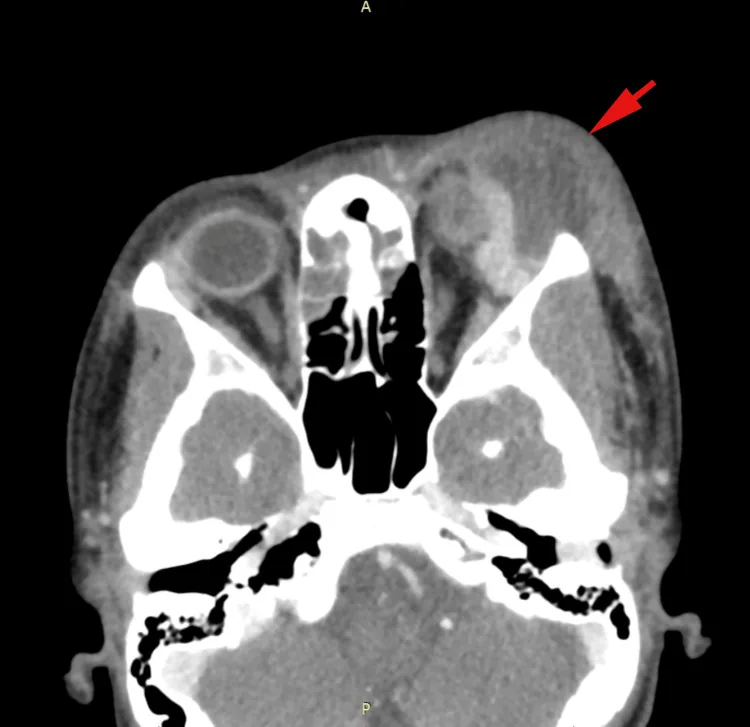
Celebi TB, Shamulzai A, Dahhan H. Worsening preseptal cellulitis with an orbital abscess and intracranial extension in a pediatric patient. Cureus. 2024;16(11):e73772. Figure 1. PMID: 39677106; PMCID: PMC11646562. DOI: 10.7759/cureus.73772. License: CC BY 4.0.
Contrast-enhanced CT axial image (pediatric case) showing a large abscess (red arrow) formed under the periosteum of the left orbit, displacing the globe, superior rectus muscle, and lacrimal gland, with near-complete opacification (purulent retention) of the ethmoid and frontal sinuses. This corresponds to the CT findings of subperiosteal abscess (low-density area, associated sinusitis, mass effect on the globe) discussed in the “Diagnosis and Examination Methods” section.
Examination
Use/Features
CT (contrast-enhanced)
First choice. Evaluates presence, size, and location of subperiosteal abscess. Also assesses concurrent sinusitis.
MRI (STIR sequence)
Detailed evaluation of soft tissues, osteomyelitis, and intracranial lesions. Can detect osteomyelitis that is difficult to identify on CT.
Contrast-enhanced CT is the basic imaging study to evaluate the extent of orbital infection, subperiosteal abscess, orbital abscess, and sinusitis 8).
MRI (especially STIR sequence) provides excellent soft tissue contrast and is useful for evaluating intraorbital soft tissues, osteomyelitis, and intracranial complications 8,11). DWI (diffusion-weighted imaging) also helps confirm abscess formation 1).
Blood tests: Evaluate WBC, CRP, etc., to assess systemic inflammation and treatment response 8).
Blood culture: The reported positivity rate in typical orbital cellulitis is approximately 2–7.9%. In a case series of 4 patients with hematogenous orbital cellulitis (HOC) in immunocompromised individuals, blood cultures were positive in 3 cases3).
Next-generation sequencing (NGS): Used in 1 of the same 4 cases, it identified the pathogen within 48 hours3). This does not represent general test performance.
Visual acuity and pupillary examination: Assess visual acuity, color vision, and relative afferent pupillary defect (RAPD) to evaluate optic nerve function8).
Ocular motility examination: Evaluate the degree of restriction to assess severity.
Orbital tumor/lymphoma: In recurrent treatment-resistant cases, tumor must be ruled out. In culture-negative recurrent cases, consider the possibility of malignant lymphoma. 9)
Orbital cellulitis is managed with hospitalization and intravenous antibiotic therapy as a rule. Ophthalmology and otorhinolaryngology collaborate to determine antibiotic therapy and surgical indications based on visual function, systemic status, imaging findings, culture results, and treatment response4,8).
Empiric therapy is based on intravenous broad-spectrum antibiotics covering Staphylococcus aureus, Streptococcus, and Gram-negative bacteria8). MRSA coverage should be considered based on local epidemiology, history, and severity1,8). If anaerobic involvement is suspected, such as odontogenic infection or intracranial extension, anaerobic coverage should be added8). Specific drugs and doses should follow institutional and infectious disease department protocols, adjusted according to age, infection source, renal function, culture and sensitivity results, and clinical response. Total duration of treatment for uncomplicated orbital cellulitis is continued until all orbital signs resolve, targeting at least 2–3 weeks. For severe ethmoid sinusitis with bone destruction, a minimum of 4 weeks of therapy is recommended.
In a single neonatal case, a 3-week course of vancomycin and meropenem has been reported, but this does not justify applying the same drugs and duration to all patients2).
Transition to outpatient parenteral antibiotic therapy (OPAT) or oral antibiotics should be considered after confirming defervescence, improvement in inflammatory response, and stabilization of ocular findings4, 8).
Non-response to antibiotics: Worsening or no improvement after appropriate antibiotic therapy.
Intracranial extension: When spread to epidural abscess or brain abscess is observed.
Surgical Procedures
FESS (Functional Endoscopic Sinus Surgery): Drainage of sinusitis. Performed in 88.9% of MRSA cases. 1)
External orbital drainage: Abscess drainage via external incision. Combined approach with endoscopic surgery is also performed. 4)
Multidisciplinary collaboration: Collaboration among otorhinolaryngology, ophthalmology, and neurosurgery is essential in severe cases. 4)
Not all subperiosteal abscesses require surgery. If visual function is preserved, abscess size, location, and age are suitable for conservative treatment, and there is a good response to antibiotics, conservative management under close monitoring can be considered4,8).
A randomized controlled trial (21 cases) evaluated adding oral corticosteroids after confirming initial response to antibiotic therapy, reporting reduced IV antibiotic duration and hospital stay length13). A meta-analysis of 7 studies also showed a significant reduction in length of hospital stay, but heterogeneity among studies is large14). On the other hand, a Cochrane review concluded that “high-quality evidence sufficient to guide decision-making is insufficient” because the above single study was the only eligible study15); indications, timing of initiation, dosage, and impact on infection control are not established, and they cannot be uniformly recommended as standard treatment. When used, it should be decided individually under the management of infectious disease, ophthalmology, and otorhinolaryngology specialists.
Not all SPAs require surgical drainage. If visual function is preserved and the size, location, age, and response to antibiotics are suitable for conservative management, observation under strict monitoring may be considered. If visual function declines, intracranial extension occurs, or the abscess is unresponsive to antibiotics, early drainage should be considered 4,8).
The lamina papyracea, the thin medial wall of the orbit that contacts the ethmoid sinus, is anatomically close, contributing to the spread of infection from ethmoid sinusitis to the orbit7,8).
Between the paranasal sinuses and the orbit, there are valveless veins that allow bidirectional hematogenous spread of infection 7). Frontal sinusitis can also directly extend to the epidural space and intracranially 4).
Infection of the ethmoid and frontal sinuses can spread directly through the bone wall or via the venous system to the subperiosteal space, orbit, and intracranially 7,8).
PVL toxin (Panton-Valentine leukocidin): A toxin produced by community-acquired MRSA, strongly associated with leukocyte damage and abscess formation. 1)
Intracranial spread via valveless veins: The infection of the frontal sinus can extend to the orbit and further to the epidural space and brain. 7)
Severity in immunocompromised (HOC): In immunocompromised individuals, hematogenous orbital cellulitis (HOC) can develop, involving multiple opportunistic pathogens. 3) Recovery of ocular motor palsy may take up to 18 months. 3)
Fungal pathology: In immunocompromised and diabetic patients, invasive fungal infection can progress rapidly, making early diagnosis and treatment crucial 8).
Pott’s puffy tumor: A condition where frontal sinusitis leads to frontal bone osteomyelitis and subperiosteal abscess, extending to the orbit and intracranial space. 10)
With early diagnosis and appropriate antibiotics and necessary drainage, recovery is expected. However, optic neuropathy, cavernous sinus thrombosis, intracranial extension, and invasive fungal infection threaten vision and life prognosis 8).
In a retrospective study of 9 cases by Ang et al., the average hospital stay for MRSA orbital cellulitis was 13.7±6.9 days, and all 9 cases underwent surgical procedures 1). Since the proportion of MRSA varies by region, local epidemiology and drug susceptibility information are important for antibiotic selection.
Diagnostic Application of Next-Generation Sequencing (NGS)
Among 4 cases of HOC in immunocompromised patients reported by Tang et al., NGS identified the pathogen within 48 hours in one case 3). These are results from a small number of cases, and the test performance and turnaround time for HOC in general have not been established.
Hári-Kovács et al. reported a 72-year-old man who developed orbital cellulitis-like inflammation without sinusitis 9 days after the second dose of VeroCell (inactivated COVID-19 vaccine), which improved with dexamethasone 5). This is a temporal association in a single case, and a causal relationship with the vaccine has not been established.
Ishak et al. reported a case repeatedly treated as culture-negative “orbital cellulitis” that was ultimately found to be B-cell lymphoma. 9) In treatment-resistant or recurrent orbital cellulitis, early suspicion of tumor or granulomatous disease and thorough investigation including biopsy are essential.
Colombe et al. reported a 14-year-old girl who developed orbital abscess and orbital cellulitis from acute ethmoid sinusitis, which further progressed to frontal cerebral empyema 12). On admission, she had marked inflammatory response with WBC 17,000/μL, CRP 107 mg/L, and procalcitonin 5.04 ng/mL. Pediatric orbital infections are mostly associated with sinusitis (especially ethmoid sinusitis), and spread via the lamina papyracea and transmission through valveless veins can lead to rapid intracranial complications. In cases of rapid frontal or orbital deterioration, neuroimaging evaluation should be considered for intracranial extension.
Deng & Shinder reported a 12-year-old boy with Pott’s puffy tumor presenting as orbital cellulitis from frontal sinusitis. He had orbital and temporal subperiosteal abscesses and intracranial epidural abscess, treated with IV antibiotics, endoscopic sinus drainage, and craniotomy for epidural abscess drainage, with improvement after 6 weeks of antibiotics. 10) Orbital infection with frontal swelling should raise suspicion for this condition.
Ang T, Cameron C, Tong JY, Wilcsek G, Selva D. Methicillin-resistant Staphylococcus aureus-associated orbital cellulitis: a case series. Int Ophthalmol. 2023;43(8):2925-2933. doi:10.1007/s10792-023-02698-y. PMID:37029211; PMCID:PMC10371901.
Kulkarni V, Sundaram V, Sameeksha TH. Overwhelming orbital cellulitis in a neonate. BMJ Case Rep. 2023;16(7):e252390. doi:10.1136/bcr-2022-252390. PMID: 37491125.
Tang X, Li H. A rare ocular complication of septicemia: a case series report and literature review. BMC Infect Dis. 2023;23:522. doi:10.1186/s12879-023-08489-1.
Wong SJ, Levi J. Management of pediatric orbital cellulitis: a systematic review. Int J Pediatr Otorhinolaryngol. 2018;110:123-129. doi:10.1016/j.ijporl.2018.05.006. PMID: 29859573.
Hári-Kovács A, Vass A, Lovas P, Vince V, Végh M, Tóth-Molnár E. Orbital Cellulitis following COVID-19 Vaccination. Case Rep Ophthalmol. 2022;13(1):210-214. doi:10.1159/000523803. PMID:35611007; PMCID:PMC9082144.
AlQahtani DS, Alsaif MA, AlSulaiman N, Alsuhaibani AH. A child with refractory orbital cellulitis after water pipe smoking. Saudi J Ophthalmol. 2021;35(3):261-262. doi:10.4103/SJOPT.SJOPT_24_21. PMID:35601865; PMCID:PMC9116089.
Torretta S, Guastella C, Marchisio P, et al. Sinonasal-related orbital infections in children: a clinical and therapeutic overview. J Clin Med. 2019;8(1):101. doi:10.3390/jcm8010101. PMID: 30654566.
Tsirouki T, Dastiridou AI, Ibáñez Flores N, et al. Orbital cellulitis. Surv Ophthalmol. 2018;63(4):534-553. doi:10.1016/j.survophthal.2017.12.001. PMID: 29248536.
Ishak F, Hassan S, Abdul Rahim A, et al. Orbital Lymphoma Presenting As Recurrent Orbital Cellulitis: A Diagnostic Challenge. Cureus. 2024;16(10):e70759. doi:10.7759/cureus.70759.
Deng W, Shinder R. Pott’s Puffy Tumor Presenting as Orbital Cellulitis. Ophthalmology. 2025;132(4):e75. doi:10.1016/j.ophtha.2024.06.026. PMID:39046376.
Kotwal T, Goh S, Bhargava E, Touska P, Possamai V. A Rare Case of Orbital Cellulitis with Progressive Calvarial Osteomyelitis. Glob Pediatr Health. 2021;8:2333794X211042121. doi:10.1177/2333794X211042121. PMID:34471650; PMCID:PMC8404617.
Colombe MM, Heri Nabuloho E, Manga Opondjo F, et al. Acute ethmoiditis complicated by intraorbital abscess, orbital cellulitis, and cerebral empyema in a 14‐year‐old girl. Clin Case Rep. 2023;11(2):e6984. doi:10.1002/ccr3.6984.
Pushker N, Tejwani LK, Bajaj MS, Khurana S. Role of oral corticosteroids in orbital cellulitis. Am J Ophthalmol. 2013;156(1):178-183.e1. doi:10.1016/j.ajo.2013.01.031. PMID:23622565.
Kim BY, Bae JH. Role of systemic corticosteroids in orbital cellulitis: a meta-analysis and literature review. Braz J Otorhinolaryngol. 2022;88(2):257-262. doi:10.1016/j.bjorl.2021.02.003. PMID:33722520; PMCID:PMC9422736.
Kornelsen E, Mahant S, Parkin P, Ren LY. Corticosteroids for periorbital and orbital cellulitis. Cochrane Database Syst Rev. 2021;4(4):CD013535. doi:10.1002/14651858.CD013535.pub2. PMID:33908631; PMCID:PMC8092453.
Copy the article text and paste it into your preferred AI assistant.
Article copied to clipboard
Open an AI assistant below and paste the copied text into the chat box.