

Canaloplasty (Schlemm's Canal Surgery)
Key Points at a Glance
Section titled “Key Points at a Glance”1. What is Canaloplasty?
Section titled “1. What is Canaloplasty?”Canaloplasty is a non-penetrating glaucoma surgery that uses a flexible microcatheter to dilate Schlemm’s canal (SC) 360 degrees, promoting drainage through the physiological aqueous outflow pathway 1).
While trabeculectomy creates a new outflow pathway (fistula) from the anterior chamber to the subconjunctival space, canaloplasty restores the physiological outflow pathway: trabecular meshwork → Schlemm’s canal → collector channels → aqueous veins 1)8). Because aqueous humor does not drain below episcleral venous pressure, hypotony and its related complications are less likely to occur.
Canaloplasty is a modification of viscocanalostomy. In viscocanalostomy, a metal cannula is used to dilate only a limited portion of Schlemm’s canal, whereas canaloplasty uses a flexible microcatheter to dilate the entire length of the canal 8).
According to the EGS guidelines, canaloplasty is classified as a non-penetrating glaucoma surgery along with deep sclerectomy and viscocanalostomy 10). The AAO PPP describes it as a procedure characterized by circumferential viscoelastic dilation of Schlemm’s canal and placement of an intraluminal tension suture 9).
Trabeculectomy creates a fistula to the subconjunctival space to bypass aqueous humor. Canaloplasty dilates Schlemm’s canal to restore the physiological outflow pathway and does not form a filtering bleb 1). Therefore, complications related to hypotony and filtering blebs are significantly fewer, but the achievable intraocular pressure is generally higher than with trabeculectomy.
2. Main Symptoms and Clinical Findings
Section titled “2. Main Symptoms and Clinical Findings”Subjective Symptoms
Section titled “Subjective Symptoms”Canaloplasty is indicated for patients with open-angle glaucoma (OAG) who present with the following symptoms and conditions.
- Visual field defect: Progressive glaucomatous visual field loss
- Eye pain/headache: May be associated with high intraocular pressure
- Intolerance to eye drops: Due to side effects or poor adherence
Clinical Findings
Section titled “Clinical Findings”The following findings should be evaluated to determine surgical indication.
- Intraocular pressure: Surgery is indicated when target pressure is not achieved with medication or when eye drops are not tolerated
- Angle findings: Gonioscopy must show open angle of Shaffer grade 3–4. Closed angle is an absolute contraindication
- Optic disc: The degree of cupping and RNFL thinning determines the timing of surgery
- Visual field test: Surgery is considered when progressive visual field loss is confirmed
3. Causes and Risk Factors
Section titled “3. Causes and Risk Factors”Indications and contraindications for canaloplasty are as follows.
Indications
Section titled “Indications”- Open-angle glaucoma (including primary open-angle glaucoma [POAG], exfoliation glaucoma, pigmentary glaucoma, and steroid glaucoma) 1)8)
- When target intraocular pressure is not achieved with medication or laser therapy
- Young patients with clear lens (low risk of cataract progression)
- High myopia (when trabeculectomy carries a high risk of hypotony)
- Aphakic eyes (when vitreous may block the fistula)
- Failed trabeculectomy cases 2)
Contraindications
Section titled “Contraindications”- Absolute contraindication: Angle-closure glaucoma 1)
- Relative contraindications: Congenital glaucoma, angle recession, neovascular glaucoma, elevated episcleral venous pressure 1)
4. Surgical technique
Section titled “4. Surgical technique”Ab externo approach (conventional method)
Section titled “Ab externo approach (conventional method)”In the ab externo approach, after conjunctival incision and creation of a scleral flap, Schlemm’s canal is exposed and a microcatheter (iTrack, Nova Eye Medical) is inserted 360° 1)8).
The main steps are as follows:
- Perform a conjunctival incision at the limbal base.
- Create a 5×5 mm superficial scleral flap.
- Create a 4×4 mm deep scleral flap to expose the trabecular meshwork and Descemet’s window.
- Identify Schlemm’s canal and insert a microcatheter with an optical fiber 360°.
- Inject viscoelastic material (OVD) during catheter withdrawal to dilate Schlemm’s canal.
- Place a 10-0 polypropylene (Prolene) suture inside the canal to apply tension to the trabecular meshwork.
- Close the scleral flap in a watertight manner (to avoid bleb formation).
The intraluminal tension suture has a dual effect of maintaining Schlemm’s canal patency and applying tension to the trabecular meshwork 9).
Ab interno method (ABiC)
Section titled “Ab interno method (ABiC)”Ab interno canaloplasty (ABiC) is a minimally invasive technique that does not require conjunctival or scleral incisions 1)10).
- Approach via a clear corneal incision under gonioscopy.
- Insert a microcatheter through a limited goniotomy and inject OVD while withdrawing.
- No tension suture is used.
- Classified as MIGS (minimally invasive glaucoma surgery) 5).
OMNI system
Section titled “OMNI system”The OMNI Surgical System is a technique that allows canaloplasty (Schlemm’s canal viscodilation) and trabeculotomy to be performed with a single device 1)4). In addition to 360° catheter insertion and viscodilation, it simultaneously performs a 180° trabeculotomy.
STREAMLINE System
Section titled “STREAMLINE System”The STREAMLINE Surgical System (FDA approved in 2021) is an ab interno method that punctures the trabecular meshwork and injects OVD directly into Schlemm’s canal 3)6). It dilates Schlemm’s canal segmentally with 3 to 8 injections (approximately 7 µL each).
The ab externo method allows placement of an intraluminal tension suture, which is expected to maintain long-term patency of Schlemm’s canal, but requires conjunctival and scleral incisions. The ab interno method (ABiC) is a minimally invasive technique that preserves the conjunctiva and is classified as MIGS, but does not use a tension suture 1)5). A study comparing three modified techniques reported no significant difference in intraocular pressure reduction 5).
5. Standard Treatment Outcomes
Section titled “5. Standard Treatment Outcomes”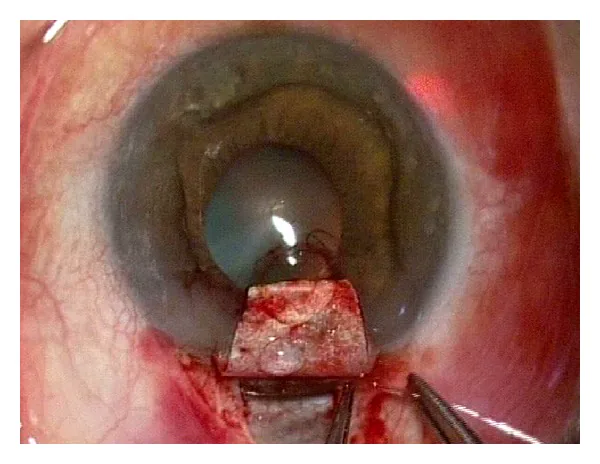
Intraocular Pressure Lowering Effect
Section titled “Intraocular Pressure Lowering Effect”The intraocular pressure reduction rate of canaloplasty varies depending on the surgical technique and baseline IOP, but is generally 25–56% (ab externo alone 30–34%, combined cataract surgery 41–56%) 1)8).
The main study results are summarized below.
| Study/Surgery | IOP Reduction Rate | Final IOP |
|---|---|---|
| Ab externo alone (3 years) | 34% | 15.1 mmHg |
| Ab externo + cataract (3 years) | 43% | 13.8 mmHg |
Bull et al. (2011) reported in a multicenter trial of 109 eyes that IOP decreased from 23.0 to 15.1 mmHg (-34.3%) with ab externo canaloplasty alone, and from 24.3 to 13.8 mmHg (-43.2%) with combined cataract surgery5)7).
In the GEMINI study (Gallardo et al. 2022), 120 eyes treated with the OMNI system plus cataract surgery showed a reduction in medication-free IOP from 23.8 to 15.6 mmHg (-34%) at 12 months, and 80% were medication-free4).
Lazcano-Gomez et al. (2024) reported a decrease from 23.0 to 15.3 mmHg (-33.5%) at 12 months in 40 eyes undergoing STREAMLINE plus cataract surgery, with 70% being medication-free6).
Comparison with trabeculectomy
Section titled “Comparison with trabeculectomy”In the TVC study (Matlach et al. 2015, RCT, 62 eyes), the 2-year IOP was 14.4 mmHg with canaloplasty and 10.8 mmHg with trabeculectomy2)5). However, the trabeculectomy group had high complication rates: transient hypotony 37.5%, hypotony lasting ≥90 days 18.8%, and choroidal detachment 12.5%. The long-term hypotony rate with canaloplasty was less than 1%2).
Comparison with iStent inject W (VENICE study)
Section titled “Comparison with iStent inject W (VENICE study)”Goldberg et al. (2024, VENICE study) conducted the first RCT comparing STREAMLINE (35 eyes) and iStent inject W (37 eyes) combined with cataract surgery3). At 6 months, IOP was 16.5 mmHg with STREAMLINE vs. 16.1 mmHg with iStent inject W (no significant difference, P=0.596). Medication-free rates were 81.8% and 78.4%, respectively3).
Modified technique: Suprachoroidal drainage (ScD)
Section titled “Modified technique: Suprachoroidal drainage (ScD)”Szurman (2023) reported a comparative study of 417 eyes in which canaloplasty plus suprachoroidal drainage (ScD) achieved a 35.9% IOP reduction (20.9 to 13.1 mmHg), surpassing the 31.2% reduction (20.8 to 14.0 mmHg) with the conventional method2). Combined cataract surgery plus ScD reached a 47.4% IOP reduction (23.2 to 12.2 mmHg), for the first time yielding results comparable to successful trabeculectomy2).
Complications
Section titled “Complications”The main complications are as follows1)5)7).
- Microhyphema (microscopic anterior chamber hemorrhage): Most frequent (1.6–12.8%). Most resolve spontaneously within 1 month.
- Descemet membrane detachment: 1.6–6.1%. Caused by excessive injection of viscoelastic material.
- Transient intraocular pressure elevation (>30 mmHg): 1.6–8.7%.
- Hypotony: Less than 1%. Extremely rare compared to trabeculectomy (18.8%)2).
Traditionally, mild to moderate glaucoma was the main indication, but recent reports indicate that even in severe glaucoma, a similar intraocular pressure reduction rate (approximately 33%) can be achieved as in mild to moderate cases1). Furthermore, improved techniques such as suprachoroidal drainage (ScD) are expected to provide further intraocular pressure reduction2).
6. Pathophysiology and detailed mechanism
Section titled “6. Pathophysiology and detailed mechanism”Anatomy and resistance of aqueous humor outflow pathways
Section titled “Anatomy and resistance of aqueous humor outflow pathways”The main pathway of aqueous humor (conventional outflow pathway) is trabecular meshwork → Schlemm’s canal → collector channels → aqueous veins → episcleral veins → systemic circulation. The main pathway accounts for 83–96% of total aqueous outflow5).
The main site of outflow resistance is the juxtacanalicular tissue (JCT) and endothelial cell layer of the inner wall of Schlemm’s canal5). In glaucoma, elevated intraocular pressure causes collapse of Schlemm’s canal, leading to chronic structural changes in the canal wall and trabecular meshwork, further increasing resistance, forming a vicious cycle1).
Mechanism of action of canaloplasty
Section titled “Mechanism of action of canaloplasty”Canaloplasty reduces outflow resistance through the following mechanisms1)8):
- Viscoelastic dilation of Schlemm’s canal: Physically expands the collapsed lumen and reopens more collector channel openings.
- Tension from the tension suture (ab externo method): Applies continuous inward tension on the inner wall and trabecular meshwork, maintaining patency of the lumen. It also improves the aqueous humor permeability of the trabecular meshwork.
- Microruptures: The pressure during OVD injection creates small ruptures in the inner wall of Schlemm’s canal and adjacent trabecular meshwork, establishing direct communication between the anterior chamber and the canal lumen.
Advantages of Using the Physiological Outflow Pathway
Section titled “Advantages of Using the Physiological Outflow Pathway”Since aqueous humor drains through Schlemm’s canal, intraocular pressure cannot fall below the episcleral venous pressure (normally 8–10 mmHg). Therefore, hypotony (<5 mmHg) and associated complications such as choroidal detachment, shallow anterior chamber, and maculopathy, which are problematic in filtration surgery, are less likely to occur1)2).
7. Latest Research and Future Perspectives
Section titled “7. Latest Research and Future Perspectives”Suprachoroidal Drainage + Collagen Implant
Section titled “Suprachoroidal Drainage + Collagen Implant”Szurman (2023) reported outcomes of canaloplasty + ScD + Ologen collagen implant2). In a retrospective study of 1034 eyes, the IOP reduction rate at 12 months was 45.8% (12.7 mmHg), which remained stable at 45.1% at 4 years.
Eyemate-SC Intraocular Pressure Sensor
Section titled “Eyemate-SC Intraocular Pressure Sensor”A technique has been developed to implant a telemetric IOP sensor (Eyemate-SC) into the suprachoroidal space simultaneously with canaloplasty + ScD2). A 12-month study showed high agreement with GAT, with a mean difference of 0.23 mmHg.
Long-Term Follow-up of the VENICE Trial
Section titled “Long-Term Follow-up of the VENICE Trial”The VENICE trial (STREAMLINE vs iStent inject W) is at the 6-month interim analysis stage3), and future long-term follow-up data will provide important information for comparing the two procedures.
Mitomycin C-Augmented Canaloplasty
Section titled “Mitomycin C-Augmented Canaloplasty”In the “filtration-type” canaloplasty with mitomycin C, a 42.7% IOP reduction and zero medications were reported at 12 months, but the hypotony rate was 15%, significantly higher than the conventional method (1.1%)2). Meta-analysis showed improved IOP reduction in the mitomycin C group, but no significant difference in complication rates.
8. References
Section titled “8. References”- Wagner IV, Towne C, Saade MC, Lentz PC, Rashedi A, Vasu P, et al. A Review of Canaloplasty in the Treatment and Management of Glaucoma. Journal of current glaucoma practice. 2024;18(2):79-85. doi:10.5005/jp-journals-10078-1442. PMID:39144728; PMCID:PMC11320757.
- Szurman P. Advances in Canaloplasty-Modified Techniques Yield Strong Pressure Reduction with Low Risk Profile. Journal of clinical medicine. 2023;12(8). doi:10.3390/jcm12083031. PMID:37109367; PMCID:PMC10145862.
- Goldberg DF, Orlich C, Flowers BE, Singh IP, Tyson S, Seibold LK, ElMallah MK, Ison EM, et al. A Randomized Controlled Trial Comparing STREAMLINE Canaloplasty to Trabecular Micro-Bypass Stent Implantation in Primary Open-Angle Glaucoma. Clinical ophthalmology (Auckland, N.Z.). 2024;18:2917-2928. doi:10.2147/OPTH.S481945. PMID:39429442; PMCID:PMC11491083.
- Gallardo MJ, Pyfer MF, Vold SD, Sarkisian SR Jr, Campbell A, Singh IP, et al. Canaloplasty and Trabeculotomy Combined with Phacoemulsification for Glaucoma: 12-Month Results of the GEMINI Study. Clinical ophthalmology (Auckland, N.Z.). 2022;16:1225-1234. doi:10.2147/OPTH.S362932. PMID:35493971; PMCID:PMC9039153.
- Cwiklinska-Haszcz A, Bak E, Wierzbowska J. Revolution in Glaucoma Treatment: A Review Elucidating Canaloplasty and Gonioscopy-Assisted Transluminal Trabeculotomy. Front Med. 2025;12:1547345.
- Lazcano-Gomez G, Orlich C, Batlle JF, Ison EM, Reynolds HP, Harbin M, et al. Safety and Efficacy of STREAMLINE Canaloplasty with Phacoemulsification in Hispanic Adults with Open-Angle Glaucoma: 12-Month Outcomes. Clinical ophthalmology (Auckland, N.Z.). 2024;18:3967-3976. doi:10.2147/OPTH.S473981. PMID:39741793; PMCID:PMC11687135.
- Golaszewska K, Skrzypczak-Jankun E, Jankun J. Evaluation of the Efficacy and Safety of Canaloplasty and iStent Bypass Implantation in Patients with Open-Angle Glaucoma: A Review. J Clin Med. 2021;10(22):5309.
- Beres H, Scharioth GB. Canaloplasty in the spotlight: surgical alternatives and future perspectives. Romanian journal of ophthalmology. 2022;66(3):225-232. doi:10.22336/rjo.2022.44. PMID:36349177; PMCID:PMC9585494.
- Gedde SJ, Vinod K, Wright MM, et al. Primary Open-Angle Glaucoma Preferred Practice Pattern. Ophthalmology. 2021 Jan;128(1):P71-P150. doi:10.1016/j.ophtha.2020.10.022. PMID:34933745.
- Pazos M, Traverso CE, Viswanathan A; European Glaucoma Society. European Glaucoma Society - Terminology and guidelines for glaucoma, 6th Edition. Br J Ophthalmol. 2025;109(Suppl 1):1-212. doi:10.1136/bjophthalmol-2025-egsguidelines. PMID:41026937.