

Tear clearance test (Fluorescein Dye Dilution Test)
1. What is the tear clearance test?
Section titled “1. What is the tear clearance test?”The tear clearance test (Fluorescein Dye Dilution Test) is a general term for a group of ophthalmic examinations that evaluate the rate of tear outflow (turnover) by instilling fluorescein into the conjunctival sac and measuring the amount (or concentration) of fluorescein remaining in the tear film after a set period of time.
Tears are secreted by the lacrimal gland and accessory lacrimal glands, and are drained through the lacrimal drainage system (nasolacrimal duct). The balance between production and drainage is called ‘tear clearance,’ and when this function declines, instilled medications and preservatives can remain in the conjunctival sac for a long time and adversely affect the ocular surface. Reduced tear clearance is clearly positioned in the dry eye treatment guidelines1) as a risk factor upstream of the core mechanism in dry eye (tear-deficient type).
The main clinical significance is as follows.
- Differential diagnosis of dry eye subtypes (tear-deficient type vs evaporative type)
- Differentiating it from functional epiphora (without nasolacrimal duct obstruction)
- Assessing lacrimal gland function in severe dry eye such as Sjögren syndrome, GVHD, and ocular cicatricial pemphigoid
- Assessing tear retention time to help choose eye drops (BAK-containing or preservative-free)
Fluorescein is a water-soluble fluorescent dye in the xanthene family. It has an excitation wavelength of 494 nm and an emission wavelength of 521 nm. Because the fluorescence intensity in the conjunctival sac is proportional to concentration, it can be easily and semi-quantitatively evaluated under a cobalt blue filter on a slit-lamp microscope.
Reduced tear clearance does more than simply decrease tear volume; it also leads to accumulation of inflammatory cytokines and preservatives on the ocular surface, especially BAK: benzalkonium chloride. The Dry Eye Clinical Practice Guidelines1) clearly define reduced tear clearance as an “upstream risk factor” for dry eye and provide important information that directly affects disease classification and treatment choices, such as whether to use preservative-free eye drops or whether to indicate punctal plugs.
2. Test technique and procedure
Section titled “2. Test technique and procedure”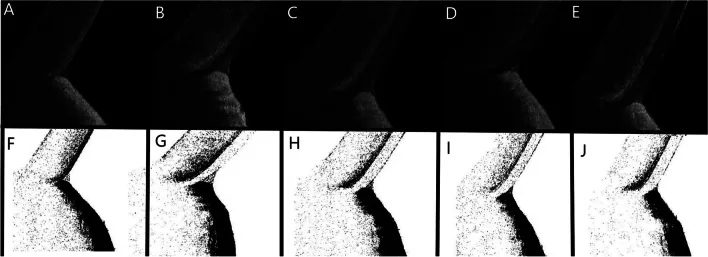
Fluorescein Dye Disappearance Test (FDDT)
Section titled “Fluorescein Dye Disappearance Test (FDDT)”The dye disappearance test is the most widely used method for evaluating tear clearance. It does not require special equipment and can be performed immediately in the outpatient clinic; the standard procedure is as follows.
- Fluorescein instillation: Stain the lower conjunctival sac with a fluorescein test strip (or 1–2 μL of a 1–2% fluorescein solution)
- Wait: Wait 5 minutes while blinking naturally (the standard assessment time is 5 minutes; a 15-minute check may also be added).
- Observation: Observe the amount of residual dye under the cobalt blue filter of the slit-lamp microscope.
- Scoring: Record the result as a semi-quantitative score from Grade 0 to 3.
This test is based on the principle that the faster tears are drained, the faster the dye disappears.
Calculation of the Tear Function Index (TFI)
Section titled “Calculation of the Tear Function Index (TFI)”The Tear Function Index (TFI) is a composite measure that combines the Schirmer test and the dye disappearance test, and it is also mentioned as an item for evaluating tear function in the Dry Eye Diagnostic Guideline 1).
The formula is as follows.
TFI = Schirmer value (5 minutes, mm) ÷ dye retention score (Grade 1–3)
- High TFI: greater tear production and good clearance
- Low TFI: reduced tear production, reduced clearance, or both
If the dye retention score is “0 (no retention)”, the denominator becomes 0, so in clinical practice it is corrected to a minimum score of 0.5, or recorded qualitatively as “normal clearance”.
Fluorophotometry
Section titled “Fluorophotometry”When a more precise quantitative assessment is needed, a flow measurement method using a fluorophotometer is used.
- Instill a fluorescein solution of known concentration into the eye
- Measure the fluorescein concentration in the tear fluid at regular intervals
- Calculate the tear flow rate (µL/min) from the concentration decay curve
This method allows accurate quantitative assessment, but it requires special equipment, so it is used mainly in research facilities3).
Combined with tear meniscus observation
Section titled “Combined with tear meniscus observation”By observing the height of the lower tear meniscus under fluorescein staining with a slit-lamp microscope, the amount of tear retention and the drainage rate can be evaluated at the same time. Combining this with quantitative measurement of tear meniscus height by anterior segment OCT (normal value ≥ 0.2 mm) makes a more objective assessment of clearance possible.
3. Interpretation of normal and abnormal values
Section titled “3. Interpretation of normal and abnormal values”Grade classification of the dye retention test
Section titled “Grade classification of the dye retention test”A semiquantitative evaluation based on the amount of dye remaining after 5 minutes is shown below.
| Grade | Residual dye after 5 minutes | Clinical significance |
|---|---|---|
| 0 | None | Normal clearance |
| 1 | Very slight (faint fluorescence) | Borderline (possible mild decrease) |
| 2 | Moderate retention (clear fluorescence remains) | Reduced tear clearance |
| 3 | Marked retention (strong fluorescence persists over a wide area) | Severe reduction (suspect Sjögren syndrome, GVHD, etc.) |
Grade 2 or higher is a guide for judging reduced tear clearance. Grade 1 is borderline and should be evaluated together with other tear test findings.
Reference values for tear turnover rate
Section titled “Reference values for tear turnover rate”The normal tear turnover rate is said to be about 16%/min (each minute, about 16% of the tears in the conjunctival sac are replaced by fresh tears)2). When this is reduced, substances in the conjunctival sac (preservatives, metabolites, inflammatory cytokines, etc.) are more likely to remain there.
In Sjögren syndrome and severe tear secretion reduction, the turnover rate may decrease markedly (for example, to 5%/min or less).
The fact that fluorescein remains in the conjunctival sac after 5 minutes indicates that tear outflow speed (clearance) is reduced. When clearance is reduced, instilled medications and preservatives (such as BAK) stay on the ocular surface longer than usual, increasing toxicity to ocular surface epithelial cells. In addition, an environment in which inflammatory cytokines (such as IL-1β and TNF-α) become concentrated is created, making it easier to enter the worsening cycle of dry eye. In particular, marked Grade 3 retention is often seen in Sjögren syndrome and GVHD.
4. Clinical significance and indications
Section titled “4. Clinical significance and indications”Classification diagnosis of dry eye
Section titled “Classification diagnosis of dry eye”The tear clearance test is used in differential diagnosis of dry eye as follows.
Aqueous-deficient dry eye:
- Because tear production is reduced, tear turnover is markedly reduced.
- On dye retention testing, it often shows high scores of Grade 2 to 3.
- Schirmer test values are also low (5 mm or less), and the TFI decreases
Evaporative dry eye type (evaporative dry eye):
- Because tear production is relatively preserved, clearance is normal or only slightly reduced
- The dye retention test is often Grade 0 to 1
- BUT is shortened, but Schirmer test values are often within the normal range
Differentiation from functional epiphora (epiphora)
Section titled “Differentiation from functional epiphora (epiphora)”In patients whose main symptom is tearing, the tear clearance test helps distinguish tearing caused by lacrimal passage obstruction from functional tearing (the lacrimal passages are open but tear production is excessive).
- If there is lacrimal passage obstruction: the dye retention test shows marked retention (Grade 2 to 3)
- In excessive-secretion tearing, dye retention is mild or normal (Grade 0 to 1), and the retention test clears quickly
Evaluation of severe dry eye
Section titled “Evaluation of severe dry eye”Tear clearance is known to be markedly reduced in the following diseases.
- Sjögren syndrome (primary and secondary): secretion drops sharply due to autoimmune destruction of the lacrimal glands
- GVHD after hematopoietic stem cell transplantation: immune attack on the lacrimal glands
- Ocular cicatricial pemphigoid: changes in the tear drainage and outflow function due to conjunctival scarring
- Sequelae of Stevens-Johnson syndrome: reduced tear production due to destruction of the accessory lacrimal glands
Basis for choosing BAK-free eye drops
Section titled “Basis for choosing BAK-free eye drops”In patients with severely reduced tear clearance, eye drops containing BAK (benzalkonium chloride) remain on the ocular surface longer than usual. The Dry Eye Clinical Practice Guidelines1) recommend using BAK-free eye drops in dry eye with marked tear secretion reduction, and the tear clearance test provides objective evidence for this treatment decision.
5. Related treatment guidelines
Section titled “5. Related treatment guidelines”The treatment approach based on the results of tear clearance assessment is as follows.
Mild to moderate clearance reduction (Grade 1–2):
- Frequent instillation of artificial tears (prefer preservative-free formulations)
- 3% diquafosol sodium eye drops (6 times daily): stabilizes the mucin and aqueous layers1)
- 2% rebamipide eye drops (4 times daily): promotes mucin production1)
Marked clearance reduction (Grade 3):
- Choosing BAK-free eye drops is essential1)
- Punctal plug insertion: reduces tear drainage and keeps tears on the ocular surface1)
- Cyclosporine eye drops: are expected to reduce inflammation in the lacrimal glands and help restore secretion
Aqueous-deficient dry eye in general:
- In the Dry Eye Clinical Practice Guidelines1), punctal plugs are considered a standard treatment for aqueous-deficient dry eye
- Silicone punctal plugs can be inserted and removed easily and can be performed as an outpatient procedure
6. Relationship between measurement principles and other tests
Section titled “6. Relationship between measurement principles and other tests”Fluorescein fluorescence properties and measurement principle
Section titled “Fluorescein fluorescence properties and measurement principle”Fluorescein fluoresces when excited at 494 nm (cobalt blue light) and emits at 521 nm (green). Because the amount of fluorescein in the conjunctival sac is proportional to the fluorescence intensity, semi-quantitative evaluation is possible by observing through the cobalt blue filter of a slit-lamp microscope.
Main indicators related to tear production and drainage:
- Normal turnover rate: about 16%/min (about 16% of the conjunctival sac volume is renewed per minute)2)
- Normal tear flow rate: about 1–2 µL/min (measured by fluorophotometry)3)
- Tear volume stored in the conjunctival sac: about 7–9 µL (with the eyes open at rest)
From these numbers, it can be understood that under normal conditions, most of the instilled solution is drained within 5–10 minutes. If clearance is reduced, this drainage time is prolonged.
Complementary relationship among tear tests
Section titled “Complementary relationship among tear tests”Tear clearance testing is more informative when combined with other tear tests rather than used alone.
BUT test (tear film break-up time):
- Evaluates the ‘quality (stability)’ of tears
- Main criterion in the Dry Eye Clinical Practice Guidelines1) (5 seconds or less is considered positive)
- Especially shortened in evaporative type
- Evaluates the ‘amount of secretion’ of tears (5 mm or less is used as a sign of reduced secretion)
- TFI can be calculated by combining it with the tear clearance test as a reference measure1)
Anterior segment OCT tear meniscus measurement:
- A lower tear meniscus height of ≥ 0.2 mm is a normal guideline
- Noninvasive, quantitative, and highly reproducible
- Excellent for objective assessment of tear volume
Tear osmolarity measurement:
- 316 mOsm/L or higher is used as the threshold for a positive dry eye finding
- High osmolarity acts as a factor that promotes inflammation of the ocular surface
Tear turnover is the rate at which the tears in the conjunctival sac are replaced by fresh tears. Normally, they are renewed at a rate of about 16% per minute, and instilled medications, foreign bodies, and metabolic byproducts are continuously washed away from the ocular surface. When turnover decreases, tear stagnation occurs, making it easier for preservatives such as BAK and inflammatory cytokines to accumulate. The tear clearance test is the only clinical test that evaluates this turnover, and it is especially useful in patients suspected of a marked decrease in tear secretion.
7. Latest research and future prospects
Section titled “7. Latest research and future prospects”Research on noninvasive clearance assessment methods
Section titled “Research on noninvasive clearance assessment methods”Because fluorescein is a water-soluble fluorescent dye, direct eye instillation is required. In recent years, noninvasive observation of tear meniscus dynamics using anterior segment OCT and evaluation of lipid layer stability using tear interferometry have been studied as alternative indicators of tear clearance. Because these methods can assess tear dynamics without fluorescein staining, measurement is possible under a more natural physiological state.
Quantification by fluorophotometry
Section titled “Quantification by fluorophotometry”In research facilities, precise tear clearance measurements using a fluorophotometer are being performed. This method can calculate tear flow (µL/min) more accurately and is also used in pharmacokinetic studies and in evaluating the bioavailability of eye drops 3). If miniaturization and cost reduction progress, it may become practical for use in general outpatient clinics in the future.
Application in tear cytokine clearance
Section titled “Application in tear cytokine clearance”Reduced tear clearance leads to increased concentrations of inflammatory cytokines (IL-1β, TNF-α, MMP-9, etc.) within the conjunctival sac. From this perspective, combining it with tear biomarkers (such as MMP-9 testing) is expected to improve the diagnostic accuracy of ‘inflammatory dry eye’.
8. References
Section titled “8. References”- ドライアイ研究会診療ガイドライン作成委員会(島﨑潤, 横井則彦, 渡辺仁, 他). ドライアイ診療ガイドライン. 日本眼科学会雑誌. 2019;123(5):489-592.
- Mishima S, Gasset A, Klyce SD, Baum JL.. Determination of tear volume and tear flow. Invest Ophthalmol. 1966;5(3):264-276. PMID:5947945.
- Xu KP, Tsubota K. Correlation of tear clearance rate and fluorescein staining of the corneal and conjunctival epithelium. Br J Ophthalmol. 1995;79(12):1042-1047.