Ophthalmic telemedicine (teleophthalmology) is a system that provides eye care remotely using information and communication technology. It combines communication technology with ophthalmic examination data for remote evaluation of eye diseases and support for care 5).
There are two main approaches: asynchronous store-and-forward, in which standardized image data such as fundus camera, OCT, and visual field test results are sent for a specialist to read later, and real-time examinations by video call 5). Because ophthalmic image data are highly standardized, this field is considered especially well suited to store-and-forward care.
Online medical consultations began to be covered by insurance in the 2018 medical fee revision 3). With the COVID-19 pandemic (from 2020 onward), online consultations from the first visit were temporarily allowed, and they were made permanent in the 2022 revision 3). In ophthalmology, many tests—such as intraocular pressure measurement, fundus examination, and visual field testing—can only be done in person, so remote care has spread more limitedly than in other specialties. Its usefulness is drawing attention in areas where access to eye doctors is difficult, such as rural areas and remote islands, and for contactless visits during infectious disease outbreaks.
QCan ophthalmology online consultations be received?
A
Online consultations are now available as covered care, but many tests such as fundus examination, intraocular pressure measurement, visual field testing, and slit-lamp microscopy can only be performed in person, so the scope of use is limited. It is used for progress updates and prescription renewals in stable chronic diseases (glaucoma, AMD, etc.), postoperative follow-up questions, and consultations about external eye conditions. In principle, initial assessment and acute symptoms require an in-person visit.
TECS standard setup: A certified ophthalmic assistant measures visual acuity, refraction, and intraocular pressure, takes three fundus photos and external eye photos, and a specialist remotely interprets and prescribes1)
Real-time (synchronous)
How it works: Examination by video call
Applications: History taking, vision check, subjective symptom assessment, and medication management
Features: Rapidly expanded during the COVID-19 pandemic, but declined sharply within months2)
Challenges: It is harder to obtain physical findings than in an in-person examination
Advanced TECS (multifunctional)
How it works: advanced teleconsultation combining OCT and perimetry
Indications: teleglaucoma and tele-macula consultations
Features: especially useful for long-term monitoring of chronic diseases1)
Challenges: requires expensive equipment, so the number of facilities that can adopt it is limited
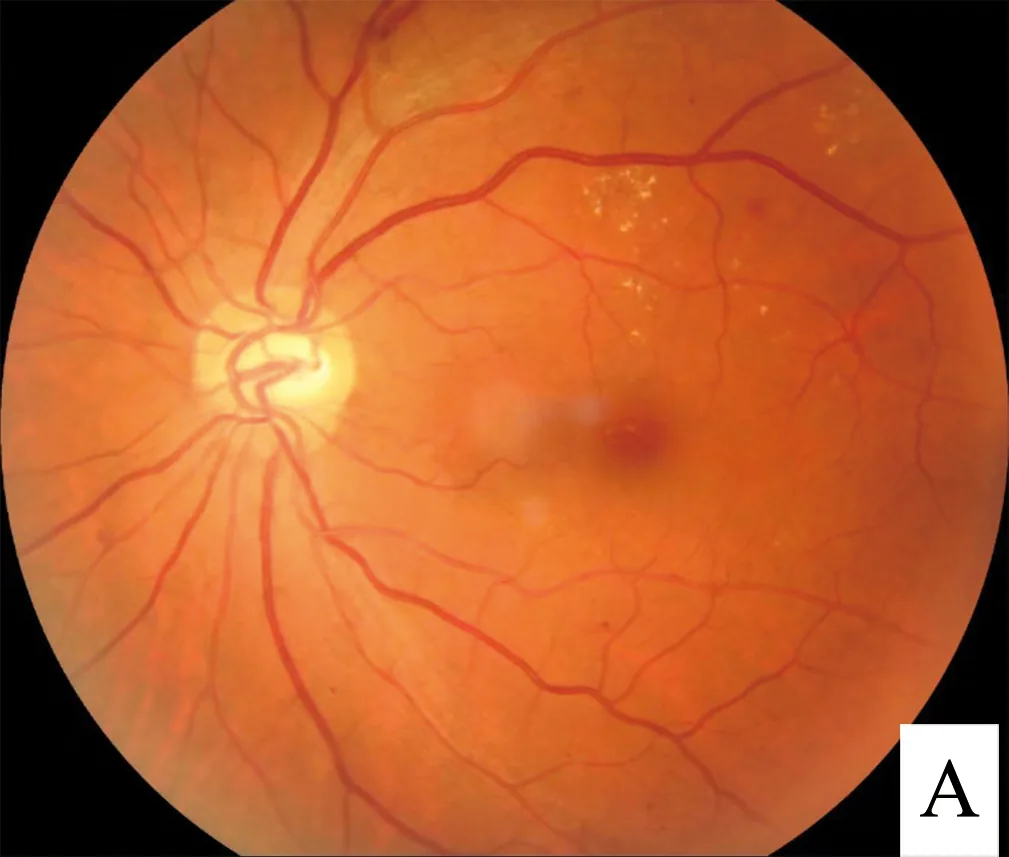
Hao S, Liu C, Li N, et al. Clinical evaluation of AI-assisted screening for diabetic retinopathy in rural areas of midwest China. PLoS One. 2022;17(10):e0275983. Figure 1A. DOI: 10.1371/journal.pone.0275983. License: CC BY 4.0 (https://creativecommons.org/licenses/by/4.0/).
Fundus photo of diabetic retinopathy showing scattered yellow-white hard exudates, small bulges in vessel walls (microaneurysms), and blurred red spots (retinal hemorrhages). Corresponds to the remote screening for diabetic retinopathy covered in the “Indications and outcome data” section.
Diabetic retinopathy screening is the most established use of teleophthalmology.
At the U.S. Department of Veterans Affairs (VA) TECS (Technology-based Eye Care Services), 67 sites were established from 2015 to 2022, and 83.6% of sites were still operating as of the first quarter of 20221). In fiscal year 2021, it served 21,712 people, with a mean age of 64.7 years. Of the patients served, 52.1% lived in rural or highly rural areas, and the risk of vision-threatening disease in rural and highly rural areas is said to be 1.3 to 2.5 times that of urban areas1).
A meta-analysis of teleglaucoma accuracy (45 studies) reported 83% sensitivity and 79% specificity for glaucoma screening4). Remote performance of tonometry, visual field testing, and gonioscopy has been identified as a technical challenge, and its main use has been in follow-up care for stable disease2).
OCT-based remote monitoring is being used to follow stable AMD1). However, there is a risk of missing active lesions, so if the OCT findings change, an in-person visit is needed.
Disease prevalence and telemedicine efficiency in TECS patients
Reports have shown that introducing telemedicine reduced patients’ travel time by an average of 61 hours and cut the waiting time to see a doctor by 30%4).
QWhich eye diseases are suitable for online consultations?
A
Suitable examples include diabetic retinopathy screening (store-and-forward), follow-up for stable glaucoma and AMD, and history-taking for corneal and conjunctival diseases. For DR screening, the method of remotely sending fundus photographs is the most established, and sensitivity of 83-97% has been reported4). In acute diseases or when detailed tests such as intraocular pressure measurement, visual field testing, or slit-lamp examination are needed, an in-person visit is essential.
Corneal thickness measurement (pachymetry): assessment of glaucoma risk
Visual field testing: requires a dedicated automated perimeter
Fluorescein fundus angiography: evaluation of neovascularization and nonperfusion areas
Refraction testing (an accurate prescription requires testing under cycloplegia)
QCan fundus examination or visual field testing be done through telemedicine?
A
Detailed tests such as fundus examination, visual field testing, and intraocular pressure measurement require special equipment, so they cannot be performed through telemedicine. Fundus examination requires an indirect ophthalmoscope or a slit-lamp microscope with a front lens, and visual field testing requires an automated perimeter2). If these tests are needed, an in-person visit is essential; if you have emergency symptoms such as sudden vision loss, eye pain, or a sudden increase in floaters, see an ophthalmologist immediately.
Telemedicine has been gradually developed through regulatory reform.
2018: Online consultations became covered by insurance after a fee revision (follow-up visits only; in-person visits remained the principle)
April 2020: As a COVID-19 measure, online consultations from the first visit were temporarily allowed. Telephone and online care expanded sharply for a time
2022: Online consultations were made permanent through a fee revision. Online consultations from the first visit were allowed under certain conditions
Requirements for billing online consultation fees: an examination using information and communication devices, and two-way real-time transmission of visual and audio information, are required
According to the Ministry of Health, Labour and Welfare guidelines, online care is care delivered by a doctor and patient sharing visual and audio information in real time. Because the medical information is limited, it should be used with a system for switching to in-person care when needed, and on the basis of a trusting doctor-patient relationship3).
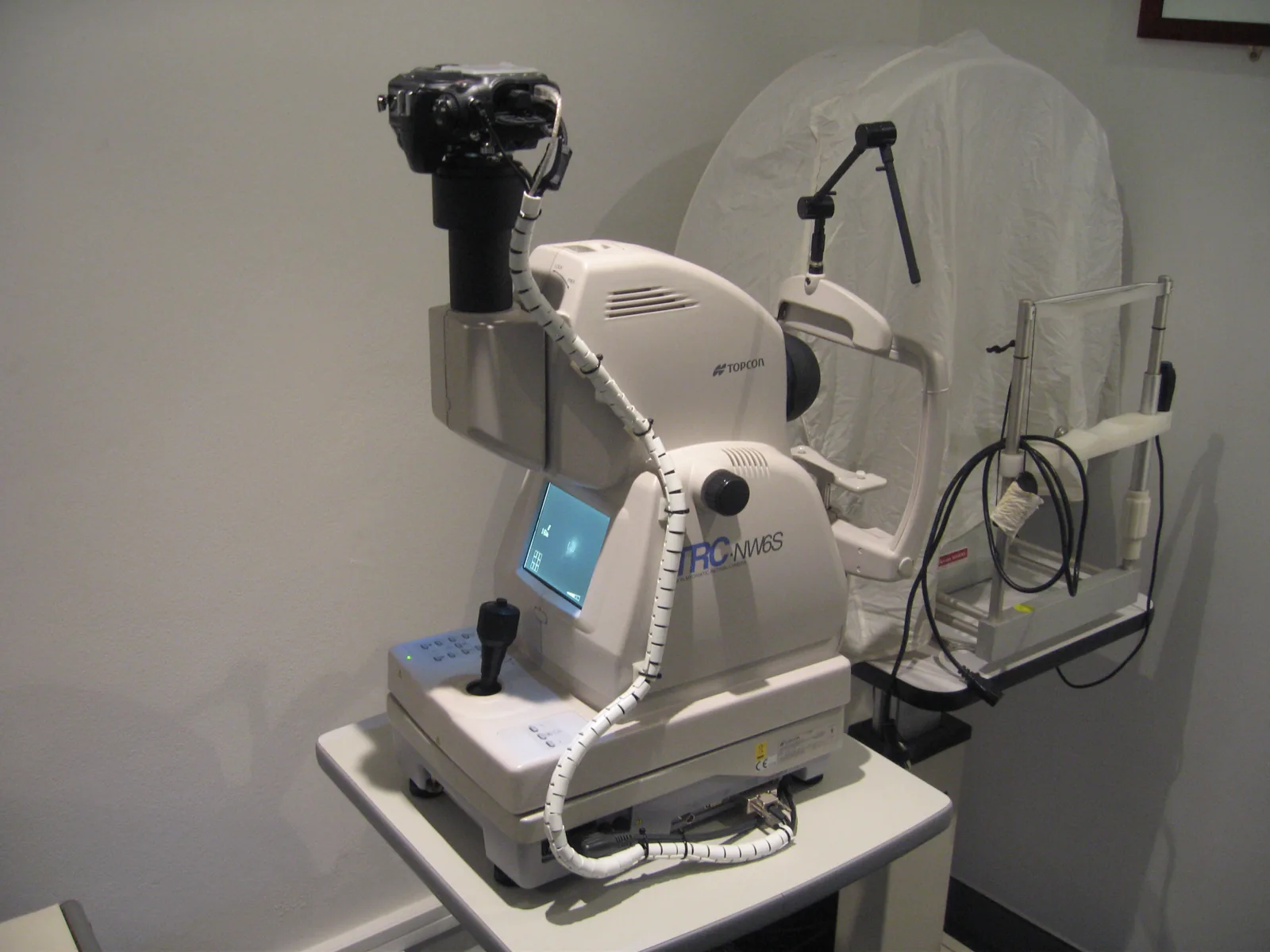
Ruck J. Non-mydriatic Topcon retinal camera. Wikimedia Commons. 2007. Figure 1. Source ID: File:Retinal_camera.jpg. License: CC BY-SA 3.0 (https://creativecommons.org/licenses/by-sa/3.0/).
Overall view of a tabletop nonmydriatic fundus camera made by Topcon, showing the patient forehead-and-chin rest and the imaging lens section. This corresponds to the imaging equipment used for store-and-forward teleophthalmology discussed in the section “Technical foundation and required equipment.”
The equipment and system setup needed to provide teleophthalmology care differ depending on the method.
During the COVID-19 pandemic, telemedicine use surged in New York City (NYC), but fell sharply within a few months. For most of the doctors interviewed, telemedicine was no longer part of routine care, although some remained optimistic about future technological advances2).
Closing the access gap in rural and remote island areas: Expanding tele-screening in regions with a shortage of ophthalmology specialists1)
Integration with AI image diagnosis: Improved automatic classification accuracy is expected to further improve diagnostic efficiency (see the separate article on AI ophthalmic diagnosis)6)
Wider use of home devices: If home tonometers and smartphone fundus cameras become widespread, the scope of remote monitoring will expand greatly
Development of 5G and high-speed communications: High-definition images can be transmitted in real time, improving examination accuracy
Digital collection of patient-reported outcomes (PRO): Continuous evaluation of visual function and symptoms can be carried out remotely
Limitations in examination accuracy: It is difficult to perform intraocular pressure, visual field, and slit-lamp examinations remotely, so there are limits in diseases such as glaucoma that require detailed testing2)
Trust between doctor and patient: Relationship building is more limited than in face-to-face consultations
Information security and personal data protection: Secure systems for transmitting and storing medical information need to be established
Infrastructure disparities: In medically underserved areas, even internet access itself may not be in place
Trends in medical reimbursement and regulation: Ongoing adaptation to system changes is necessary3)
Simon LS, Davis ML, Medunjanin D, et al. National Experience of Technology-based Eye Care Services: A Comprehensive Ophthalmology Telemedicine Initiative. Ophthalmology. 2025;132(4):442-451.
Liu H, Ying S, Kamat S, Tukel C, Serle J, Fallar R, et al. The Role of Telemedicine in Glaucoma Care Triggered by the SARS-CoV-2 Pandemic: A Qualitative Study. Clinical ophthalmology (Auckland, N.Z.). 2023;17:2251-2266. doi:10.2147/OPTH.S418502. PMID:37575208; PMCID:PMC10422957.
Thomas SM, Jeyaraman MM, Hodge WG, et al. The effectiveness of teleglaucoma versus in-patient examination for glaucoma screening: a systematic review and meta-analysis. PLoS One. 2014;9(12):e0113779. doi:10.1371/journal.pone.0113779.
Than J, Sim PY, Muttuvelu D, et al. Teleophthalmology and retina: a review of current tools, pathways and services. Int J Retina Vitreous. 2023;9(1):76. doi:10.1186/s40942-023-00502-8. PMID:38053188; PMCID:PMC10699065.
Ting DSW, Gunasekeran DV, Wickham L, et al. Next generation telemedicine platforms to screen and triage. Br J Ophthalmol. 2020;104(3):299-300.
Copy the article text and paste it into your preferred AI assistant.
Article copied to clipboard
Open an AI assistant below and paste the copied text into the chat box.