

Ocular symptoms caused by Sick House Syndrome (Sick House Syndrome and Ocular Symptoms)
Key points at a glance
Section titled “Key points at a glance”1. What is sick house syndrome and what are its eye symptoms?
Section titled “1. What is sick house syndrome and what are its eye symptoms?”Sick house syndrome refers to a range of symptoms, including irritation of the eyes, nose, and throat, that appear after indoor exposure to volatile organic compounds (VOCs) released from new building materials, furniture, adhesives, and similar sources. When similar symptoms occur in poorly ventilated buildings such as offices or schools, it is called sick building syndrome. Both are included in the concept of multiple chemical sensitivity (MCS), in which even very small exposures to chemicals or substances from daily life can cause health problems, and there is large individual variation.
The eyes are mucosal organs that are easily affected by VOC irritation, and eye strain, conjunctival redness, and dry-eye-like symptoms often appear. In ophthalmology, it is notable that symptoms are far more often seen as higher brain function problems related to vision rather than as structural damage to the eyeball itself.
The main causative substances and the Ministry of Health, Labour and Welfare’s indoor concentration guideline values are shown below2).
- Formaldehyde: Released from plywood and wallpaper adhesives. The strongest direct irritant to the eyes and nasal mucosa. Guideline value: 0.08 ppm (100 μg/m³)
- Toluene: Derived from paints and adhesives. Strong effect on the central nervous system. Guideline value: 0.07 ppm (260 μg/m³)
- Xylene: Derived from paints and solvents. Guideline value: 0.20 ppm (870 μg/m³)
- Paradichlorobenzene: Derived from mothballs and toilet deodorizers. Guideline value: 0.04 ppm (240 μg/m³)
- TVOC (total volatile organic compounds): provisional target value 400 μg/m³2)
In the 2003 revision of the Building Standards Act (measures against sick house syndrome), 24-hour ventilation systems became mandatory for essentially all buildings2). A labeling system for building materials based on formaldehyde emissions (F☆☆☆☆ is the highest grade) was also introduced, and low-VOC materials have become more widely used.
The eye is a mucosal organ easily exposed to direct irritation from VOCs, so eye symptoms occur frequently in sick house syndrome. The main symptoms are eye strain, redness, dryness (dry-eye-like symptoms), photophobia, and eye pain. It is also known that chemicals can affect the central nervous system and cause higher brain dysfunction related to vision (fluctuating vision, visual discomfort, and accommodative dysfunction). If symptoms began after moving into a new building, renovation, or relocation, sick house syndrome should be considered.
2. Characteristics of eye symptoms
Section titled “2. Characteristics of eye symptoms”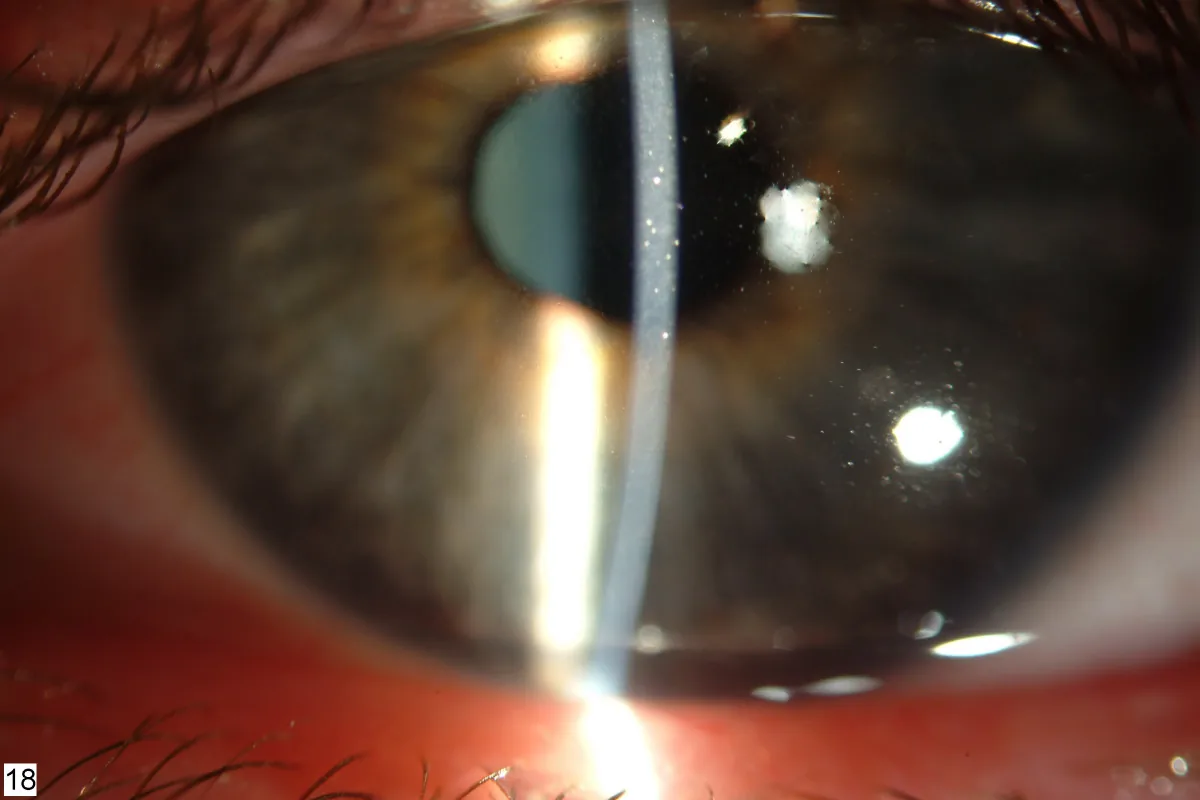
The main characteristics of eye symptoms in sick house syndrome are as follows.
- Eye strain (asthenopia): The most common eye symptom. It arises from a combination of accommodative load and effects on the central nervous system3)
- Dry-eye-like symptoms: Abnormalities of the ocular surface caused by increased tear evaporation and goblet cell damage4). They appear as dryness, foreign-body sensation, and eye discomfort
- Conjunctival redness and itching: Direct chemical irritation of the conjunctival mucosa by VOCs3)
- Photophobia (light sensitivity): Light hypersensitivity mediated by trigeminal nerve stimulation
- Eye pain: Pain caused by chemical irritation and neurogenic inflammation3)
- Visual higher-order brain dysfunction: fluctuating vision, visual discomfort, and accommodative problems. Symptoms often appear this way rather than from the eyeball itself
A dose-response relationship has been observed between formaldehyde exposure levels and the appearance of eye symptoms. When indoor levels exceed the guideline value (0.08 ppm), reports of eye symptoms increase significantly1).
| VOC / indoor concentration | Eye and nasal mucosal irritation | Nervous system symptoms |
|---|---|---|
| Formaldehyde 0.08 ppm or higher | Increased eye and nasal irritation symptoms | Headache |
| Formaldehyde 0.5–1.0 ppm | Strong eye and nasal irritation | Fatigue and reduced concentration |
| Toluene 0.07 ppm or higher | Mild eye irritation | Predominantly central nervous system symptoms |
| TVOC 400 μg/m³ or higher | combined mucosal irritation | increase in nonspecific complaints |
Eye symptoms of sick building syndrome can resemble allergic conjunctivitis, so it is important to differentiate them5). Allergic conjunctivitis is mediated by antigen-specific IgE, whereas sick building syndrome is mainly caused by chemical irritation of the mucosa.
Allergic conjunctivitis involves antigen-specific IgE antibodies against antigens such as pollen and dust mites, and is an immune reaction in which itching, redness, and tearing occur each time there is antigen exposure. In contrast, eye symptoms of sick building syndrome are mainly caused by direct irritation of the mucosa by chemicals such as VOCs, and are independent of the immune mechanism (IgE). In the history, it is important to check the timing in relation to environmental changes such as a new home, remodeling, or moving, and to confirm whether symptoms improve with ventilation or after going outside. Even if blood tests (specific IgE antibodies) are negative, chemical sensitivity may still be possible.
3. Causative substances and disease mechanism
Section titled “3. Causative substances and disease mechanism”Main causative substances
Section titled “Main causative substances”The main causative substances in sick building syndrome and their sources are shown below1).
| Substance name | Main source | Main effects on the eyes and nervous system | Guideline value |
|---|---|---|---|
| Formaldehyde | Plywood, MDF, wallpaper adhesive, insulation material | Direct irritation of the eyes and nasal mucosa (strongest) | 0.08 ppm (100 μg/m³)2) |
| Toluene | Paints, adhesives, lacquer | Mainly central nervous system symptoms (headache, fatigue) | 0.07 ppm (260 μg/m³)2) |
| Xylene | Paints, solvents, caulking compounds | Central nervous system and eye irritation | 0.20 ppm (870 μg/m³)2) |
| Paradichlorobenzene | Moth repellent / toilet deodorizer | Eye and nasal mucosal irritation | 0.04 ppm (240 μg/m³)2) |
| Styrene | Polystyrene insulation material | Eye irritation and fatigue | 0.05 ppm (220 μg/m³)2) |
VOC emissions increase as room temperature and humidity rise. In hot, humid summer conditions, especially high concentrations of VOCs are emitted soon after new construction or renovation6).
Transition to Multiple Chemical Sensitivity (MCS)
Section titled “Transition to Multiple Chemical Sensitivity (MCS)”Multiple Chemical Sensitivity (MCS) is a condition in which exposure to trace amounts of chemicals triggers symptoms across multiple organs and systems, and it is sometimes considered a chronic form of sick house syndrome7). Involvement of central sensitization has been suggested, and once sensitized, reactions can occur even with extremely small exposures. Diagnostic criteria for MCS remain debated, and no objective biomarker has been established at present7).
4. Diagnosis and testing methods
Section titled “4. Diagnosis and testing methods”Ophthalmic diagnosis of Sick House Syndrome is mainly an exclusion diagnosis, and the key points are history taking and evaluation of environmental factors.
History taking (most important)
Section titled “History taking (most important)”- Check whether symptoms are related in time to new construction, renovation, or moving.
- Symptoms appearing at work, school, etc. (possible sick building syndrome)
- Changes in symptoms with ventilation, going outside, or travel (if they improve with an environmental change, this strongly suggests it)
- Whether housemates or coworkers have similar symptoms
- Types of building materials, furniture, insect repellents, and air fresheners used
Ophthalmic diagnostic criteria
Section titled “Ophthalmic diagnostic criteria”According to the ophthalmic diagnostic criteria proposed by Tetsu Ishikawa and colleagues, the requirements are: 1) the presence of eye symptoms, 2) confirmation of environmental exposure history (new construction, renovation, etc.), and 3) improvement of symptoms after removing the cause8). A definitive diagnosis based on ophthalmology alone is difficult, and collaboration with indoor air environment measurements is essential.
Ophthalmic examination items
Section titled “Ophthalmic examination items”- Visual acuity and refraction tests: Evaluate underlying causes of the symptoms (such as refractive error)
- Tear tests: Confirm reduced Schirmer test results (tear secretion) and shortened BUT (tear film break-up time)
- Anterior segment slit-lamp microscopy: Presence or absence of conjunctival hyperemia, papillary hypertrophy, and corneal epithelial damage
- Accommodation function test: Evaluation of accommodative spasm and accommodative insufficiency. Estimation of higher brain dysfunction related to vision3)
- Allergy testing: Differentiation from allergic conjunctivitis by blood test (specific IgE antibodies)5)
Environmental assessment
Section titled “Environmental assessment”- Indoor air quality measurement: direct measurement of formaldehyde and TVOC concentrations2)
- QOL questionnaire: quantitative assessment of systemic symptoms using the Indoor Air Quality Health Impact Survey9)
Definitive diagnosis based on ophthalmology alone is difficult. In eye care, the role is to quantitatively assess eye symptoms (tear tests, accommodation function tests, allergy tests, etc.) and rule out other conditions such as allergic conjunctivitis, dry eye, and VDT syndrome. A definitive diagnosis requires coordination with indoor air quality measurements (formaldehyde and TVOC concentrations), and multidisciplinary collaboration with architects, environmental medicine specialists, internal medicine, and psychosomatic medicine is recommended. If the history shows that symptoms started after moving into a new home, remodeling, or relocating, and improve after ventilation or going outside, that strongly supports the suspicion.
5. Standard treatment
Section titled “5. Standard treatment”Avoiding the cause (most important)
Section titled “Avoiding the cause (most important)”Avoiding exposure is the core of treatment for sick house syndrome.
- Thorough ventilation: Proper operation of 24-hour ventilation systems. Actively ventilate by opening windows2)
- Bake-out method: A method that promotes VOC release by repeating high heat and ventilation. Before moving in, ventilate for 3 to 7 days at 20 to 30°C to lower VOC levels6)
- Choose low-VOC building materials: Select materials rated F☆☆☆☆ (formaldehyde emission 0.005 mg/m²·h or less)2)
- Ventilation period after new construction or renovation: Make sure there is enough ventilation time before moving in (at least 1 to 3 months)
- Remove the source: Review the use of insect repellents and air fresheners
Symptomatic treatment for eye symptoms
Section titled “Symptomatic treatment for eye symptoms”- Artificial tear eye drops: Protect the ocular surface and replace moisture. Preservative-free products such as Soft Santear are preferable. Use 5–6 times a day
- Hyaluronic acid eye drops (Hyalein 0.1%): Effective when there is corneal epithelial damage. Use 5–6 times a day
- Choosing preservative-free eye drops: Patients with sick house syndrome may have heightened sensitivity to chemicals, so it is preferable to avoid added irritation from preservatives (such as benzalkonium chloride)
- Managing accommodative dysfunction: Improve the VDT work environment (screen position, distance, lighting) and provide appropriate refractive correction3)
- Cases with allergies: Use antiallergy eye drops (antihistamines and mediator-release inhibitors) as appropriate
Systemic management and multidisciplinary collaboration
Section titled “Systemic management and multidisciplinary collaboration”- Severe cases or suspected MCS: Collaboration with an environmental medicine clinic, psychosomatic medicine, and internal medicine is needed7)
- Diagnosis and treatment of chemical sensitivity: Evaluation at a specialized facility is recommended
- Cases caused by the work environment: Consider collaboration with an occupational physician and an occupational health consultant
The most important measure is to avoid exposure to the causative substance (VOC). Proper use of 24-hour ventilation systems, regular window ventilation, use of low-VOC building materials, and carrying out the bake-out method are the fundamental measures to lower indoor VOC levels below the guideline values. For eye symptoms, combine preservative-free artificial tears (5–6 times a day) with hyaluronic acid eye drops (Hyalein 0.1%) as symptomatic treatment. If symptoms do not improve or systemic symptoms are strong, consider referral to a specialist in environmental medicine.
6. Pathophysiology and detailed mechanism of onset
Section titled “6. Pathophysiology and detailed mechanism of onset”Ocular surface injury caused by VOCs
Section titled “Ocular surface injury caused by VOCs”VOCs, including formaldehyde, directly damage the epithelial cells of the cornea and conjunctiva. When the mucosal barrier breaks down, the tear film becomes unstable and dry-eye-like symptoms appear4). Goblet cells, which are essential for producing mucin in the tear film, are also damaged by VOC irritation, further reducing tear film stability4).
Trigeminal nerve stimulation and neurogenic inflammation
Section titled “Trigeminal nerve stimulation and neurogenic inflammation”Formaldehyde directly stimulates the trigeminal nerve endings of the cornea and conjunctiva (TRPA1 channel)1). Stimulation of the trigeminal nerve causes eye pain and light sensitivity. In addition, release of substance P and CGRP (calcitonin gene-related peptide) from nerve endings triggers neurogenic inflammation, leading to dilation of the conjunctival blood vessels (redness) and increased vascular permeability10).
Oxidative stress and ocular surface injury
Section titled “Oxidative stress and ocular surface injury”Metabolites of VOCs promote the production of reactive oxygen species (ROS). Oxidative stress damages the cell membranes of the ocular surface epithelium and increases the production of inflammatory cytokines10). This process is similar to dry-eye pathology in dry environments, and VOC-related eye symptoms and dry eye may overlap.
Higher brain dysfunction affecting vision
Section titled “Higher brain dysfunction affecting vision”The effects of chemicals on the central nervous system may appear more in the visual center (occipital and frontal lobes) than in the eyeball itself. They may present as fluctuating vision, visual discomfort, and accommodation problems, and it is a characteristic pattern of sick house syndrome and MCS to complain of strong eye symptoms despite few findings in the eye.
Central sensitization in multiple chemical sensitivity
Section titled “Central sensitization in multiple chemical sensitivity”In MCS, repeated low-dose exposure to VOCs is thought to cause central sensitization7). After sensitization, even trace amounts of chemicals that do not affect healthy people can continue to trigger multi-organ, multisystem reactions. This mechanism can make sick house syndrome chronic and difficult to cure in some cases.
7. Latest research and future outlook
Section titled “7. Latest research and future outlook”Research on the correlation between indoor air quality and ocular surface parameters
Section titled “Research on the correlation between indoor air quality and ocular surface parameters”Epidemiological studies evaluating correlations between indoor VOC concentrations and tear film BUT and corneal staining scores are accumulating4). Improvements in ocular surface parameters with lower VOC concentrations have been reported, and quantifying the ophthalmic effects of improving indoor air quality remains a future challenge.
Large-scale epidemiological studies in workplace and school settings
Section titled “Large-scale epidemiological studies in workplace and school settings”Large-scale epidemiological studies are under way, mainly in Northern Europe, evaluating the relationship between the prevalence of sick building syndrome in office and school environments and indoor microbial, VOC, and TVOC concentrations9). Its position as an occupational eye disease is being strengthened, and collaboration with occupational health management is advancing.
RCTs of low-VOC environmental interventions
Section titled “RCTs of low-VOC environmental interventions”RCTs evaluating the effects of interventions such as improved ventilation and switching to low-VOC building materials have been conducted6), and significant correlations have been shown between the post-intervention decrease in formaldehyde concentrations and improvement in eye and nasal symptoms. Accumulation of large-scale, long-term follow-up data is expected in the future.
Assessment of new VOC sources
Section titled “Assessment of new VOC sources”Electronic devices (3D printers, consumer laser printers, etc.) and e-cigarettes are drawing attention as new VOC sources. In particular, use in enclosed indoor spaces may be associated with increased eye symptoms, and evaluation studies are ongoing.
Objective diagnosis of multiple chemical sensitivity using biomarkers
Section titled “Objective diagnosis of multiple chemical sensitivity using biomarkers”There are no established biomarkers for MCS, making objective diagnosis difficult. Development is under way of objective diagnostic methods that combine oxidative stress markers, inflammatory cytokines, and neuro-sensitization markers7). If put into practical use, they are expected to make objective assessment of sick house syndrome and evaluation of treatment effects possible.
8. References
Section titled “8. References”-
Wolkoff P. Indoor air pollutants in office environments: assessment of comfort, health, and performance. International journal of hygiene and environmental health. 2013;216(4):371-94. doi:10.1016/j.ijheh.2012.08.001. PMID:22954455.
-
厚生労働省. シックハウス(室内空気汚染)問題に関する検討会 中間報告書. 2002.
-
Norbäck D, Nordström K, Zhao Z. Carbon dioxide (CO2) demand-controlled ventilation in university computer classrooms and possible effects on headache, fatigue and perceived indoor environment: an intervention study. International archives of occupational and environmental health. 2013;86(2):199-209. doi:10.1007/s00420-012-0756-6. PMID:22422010.
-
Wolkoff P. Ocular discomfort by environmental and personal risk factors altering the precorneal tear film. Toxicology letters. 2010;199(3):203-12. doi:10.1016/j.toxlet.2010.09.001. PMID:20833234.
-
Bielory L, Friedlaender MH. Allergic conjunctivitis. Immunol Allergy Clin North Am. 2008;28(1):43-58. doi:10.1016/j.iac.2007.12.005.
-
Hodgson AT, Beal D, McIlvaine JER. Sources of formaldehyde, other aldehydes and terpenes in a new manufactured house. Indoor Air. 2002;12(4):235-242. doi:10.1034/j.1600-0668.2002.01129.x.
-
Michael Lacour, Thomas Zunder, Klaus Schmidtke, Peter Vaith, Carl Scheidt. Multiple Chemical Sensitivity Syndrome (MCS) – suggestions for an extension of the US MCS-case definition. International Journal of Hygiene and Environmental Health. 2005;208(3):141-151. doi:10.1016/j.ijheh.2005.01.017.
-
石川 哲, 宮田幹夫, 坂部 貢. 化学物質過敏症の眼科的診断基準. 日本医事新報. 1998;3857:25-29.
-
Sahlberg B, Gunnbjörnsdottir M, Soon A, Jogi R, Gislason T, Wieslander G, et al. Airborne molds and bacteria, microbial volatile organic compounds (MVOC), plasticizers and formaldehyde in dwellings in three North European cities in relation to sick building syndrome (SBS). The Science of the total environment. 2013;444:433-40. doi:10.1016/j.scitotenv.2012.10.114. PMID:23280302.
-
Baudouin C, Aragona P, Messmer EM, Tomlinson A, Calonge M, Boboridis KG, et al. Role of hyperosmolarity in the pathogenesis and management of dry eye disease: proceedings of the OCEAN group meeting. The ocular surface. 2013;11(4):246-58. doi:10.1016/j.jtos.2013.07.003. PMID:24112228.