

Punctiform Polychromatic Pre-Descemet Corneal Dystrophy
Key Points at a Glance
Section titled “Key Points at a Glance”1. What is punctiform and polychromatic pre-Descemet’s corneal dystrophy?
Section titled “1. What is punctiform and polychromatic pre-Descemet’s corneal dystrophy?”Punctiform and polychromatic pre-Descemet’s corneal dystrophy (PPPCD) is a very rare hereditary corneal dystrophy characterized by punctiform and polychromatic micro-opacities in the posterior stromal layer anterior to Descemet’s membrane. It was first described in 1979 by Fernandez-Sasso et al. in a four-generation Argentine family 1.
Position in the IC3D classification
Section titled “Position in the IC3D classification”The International Committee for Classification of Corneal Dystrophies (IC3D) published its third edition in 2024. Following the identification of the causative gene (PRDX3), PPPCD was upgraded from the previous Category 4 to Category 1 (a corneal dystrophy established as an independent disease entity with genetic evidence) 5. Note that the broader “pre-Descemet’s corneal dystrophy (PDCD)” remains in Category 4, and PPPCD is positioned as an independent hereditary disease within that framework 5.
Since its first report in 1979, PPPCD is an extremely rare corneal dystrophy with only a very small number of families reported worldwide 12. It was long classified as Category 4 in the IC3D classification, but after the identification of PRDX3 gene mutations in 2020, it was reclassified as Category 1 (a disease entity with established genetic basis) in the 2024 IC3D third edition 35.
2. Main symptoms and clinical findings
Section titled “2. Main symptoms and clinical findings”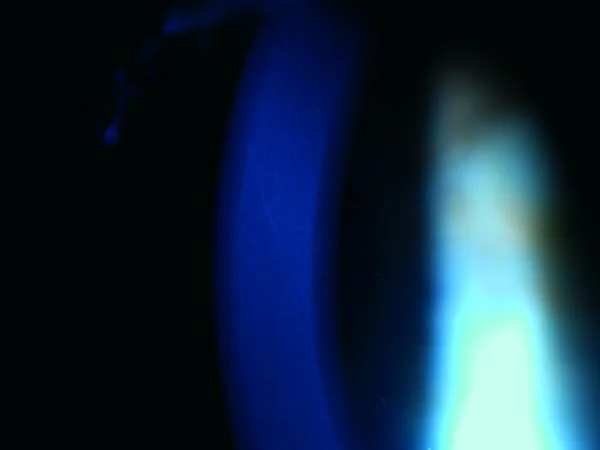
Subjective symptoms
Section titled “Subjective symptoms”Patients with PPPCD are asymptomatic 12. There have been no reports of visual impairment, eye disease, or systemic symptoms; it is discovered incidentally during slit-lamp examination. In the first report by Fernandez-Sasso et al. in 1979, all affected individuals were asymptomatic and it was noted that vision was not affected 1. In a 2016 familial case by Lagrou et al. (a 9-year-old boy, his father, and sibling), no symptom onset or progression of opacities was observed during 6 months of follow-up 2.
Clinical Findings
Section titled “Clinical Findings”Slit-lamp examination reveals the following findings 13:
- Punctate opacities: Numerous punctate opacities approximately 10–15 μm in size are uniformly distributed in the posterior corneal stroma anterior to Descemet’s membrane 3
- Polychromatic appearance: The opacities are highly reflective and exhibit yellow, green, and red hues 1
- Distribution: Found throughout the posterior corneal stroma, but densest in the deepest layer (pre-Descemet region) 3
- Increased corneal stiffness: Alió Del Barrio et al. reported significantly increased corneal stiffness in affected eyes using Corvis ST corneal biomechanical evaluation 3
- Anterior subcapsular lens opacity: Choo et al. first recorded bilateral anterior subcapsular lens opacities in a Spanish proband with the PRDX3 c.568G>C mutation, suggesting that deposits in this disease may not be limited to the posterior corneal stroma 4
Unlike other corneal dystrophies, keratocyte morphology and corneal endothelium are generally normal 2.
When the minute opacities in the pre-Descemet layer scatter and reflect light, they exhibit yellow, green, and red hues. This polychromatic appearance is a characteristic finding of PPPCD and is useful for differentiating it from other deep corneal opacities.
3. Causes and Risk Factors
Section titled “3. Causes and Risk Factors”PPPCD follows an autosomal dominant inheritance pattern with high penetrance and minimal phenotypic variability 13. In the first report in 1979, 8 of 46 family members across four generations were affected, demonstrating a typical autosomal dominant pattern 1.
Related Genes
Section titled “Related Genes”In 2020, Alió Del Barrio et al. investigated 21 individuals from three previously unreported Spanish families using whole-exome sequencing (WES) and Sanger sequencing, identifying candidate mutations segregating with affected individuals 3.
- PRDX3 gene: Located on human chromosome 10q26.11. A novel missense mutation c.568G>C (p.Asp190His) has been identified3. PRDX3 is a mitochondria-specific antioxidant enzyme belonging to the peroxiredoxin family, and in silico prediction tools also predict this mutation to be damaging to protein function3. In a 2022 replication study by Choo et al., it was confirmed that in another Spanish family, only PRDX3 c.568G>C segregated without PDZD8 mutation, leading to the conclusion that PRDX3 is the causative gene for PPPCD4.
- PDZD8 gene: Located on chromosome 10q25.3-q26.11. Although a rare intronic mutation c.872+10A>T segregated alongside the PRDX3 mutation in the three families initially reported by Alió Del Barrio et al.3, this PDZD8 mutation was not found in the additional family reported by Choo et al., so it is now considered unlikely to be an essential factor for PPPCD and may be a modifier gene4.
- OR2M5 gene: A missense mutation c.773T>C has been described as a candidate, but evidence supporting its association with the disease is limited compared to PRDX3 and PDZD83.
PPPCD follows an autosomal dominant inheritance pattern with high penetrance. If one parent has PPPCD, the probability of passing it to a child is theoretically 50%. Genetic counseling may be helpful.
4. Diagnosis and Testing Methods
Section titled “4. Diagnosis and Testing Methods”The diagnosis of PPPCD is primarily clinical, based on slit-lamp microscopy. Because the phenotypic variability is minimal, it can be diagnosed relatively easily from its characteristic appearance.
Imaging Tests
Section titled “Imaging Tests”- Slit-lamp microscopy: Direct observation of punctiform polychromatic opacities in the pre-Descemet layer. This is the most basic and important examination1.
- Confocal microscopy: In the report by Lagrou et al., hyperreflective punctiform opacities were confirmed in the pre-Descemet region, and endothelial cell morphology was normal2. It is also useful for differentiation from other deep corneal dystrophies.
- Anterior segment optical coherence tomography (OCT): Useful for structural evaluation of each corneal layer.
- Corneal biomechanics testing (e.g., Corvis ST): Alió Del Barrio et al. reported a significant increase in corneal stiffness in affected eyes, which may be helpful in differentiating from deep stromal dystrophies3
- Specular microscopy: Used to evaluate corneal endothelial cells
Genetic testing
Section titled “Genetic testing”Sanger sequencing or whole exome sequencing (WES) can screen for PRDX3 c.568G>C, among others34.
Differential diagnosis
Section titled “Differential diagnosis”Diseases presenting with deep corneal opacities that should be differentiated from PPPCD are listed below.
| Differential diagnosis | Features |
|---|---|
| Corneal farinata | Fine granular opacities in the deep corneal stroma |
| Deep filiform dystrophy | Filiform deep opacities |
| Macular corneal dystrophy | Diffuse corneal opacities, CHST6 gene mutation |
In the study by Alió Del Barrio et al., although corneal physical stiffness was significantly increased in PPPCD-affected eyes, no abnormalities in refractive values or corneal topography were observed3. This feature may help differentiate it from similar deep stromal dystrophies.
Increased corneal stiffness has been reported in PPPCD 3. Since intraocular pressure measurement (especially with Goldmann applanation tonometry) is affected by the physical properties of the cornea, higher corneal stiffness may lead to a higher reading than the actual intraocular pressure (pseudo-elevation).
5. Standard Treatment
Section titled “5. Standard Treatment”PPPCD is an asymptomatic disease, and since its first description in 1979, there have been no consistent reports of it affecting vision 12. Therefore, treatment is generally not required.
- Observation: Regular eye examinations may be recommended. In the follow-up by Lagrou et al., no progression was observed during the 6-month follow-up period 2.
- Corneal transplantation: Theoretically indicated only if extensive stromal lesions cause significant visual impairment, but no cases requiring corneal transplantation have been reported to date.
6. Pathophysiology and Detailed Mechanisms
Section titled “6. Pathophysiology and Detailed Mechanisms”The pathophysiology of PPPCD is not fully understood, but the following findings have been reported.
Role of PRDX3
Section titled “Role of PRDX3”PRDX3 is a mitochondrial peroxidase involved in antioxidant defense in the mitochondrial respiratory chain. The missense mutation c.568G>C (p.Asp190His) associated with PPPCD is predicted by in silico tools to impair protein function 3. Since Choo et al. confirmed that this mutation segregated in another family without PDZD8 mutation, PRDX3 is currently considered the main causative gene for PPPCD 4. It is speculated that PRDX3 dysfunction disrupts mitochondrial redox balance, leading to opacity formation in the pre-Descemet region, but the detailed mechanism remains unclear.
Role of PDZD8
Section titled “Role of PDZD8”The intronic mutation c.872+10A>T in PDZD8 has been reported to create a cryptic donor splice site within the intron, producing an abnormal transcript isoform in an in vivo splice assay 3. Since PDZD8 localizes to the endoplasmic reticulum membrane and mitochondria-associated membranes (MAM), it is thought that abnormal ER-mitochondria communication may affect downstream processes. However, because no PDZD8 mutation was found in the additional family studied by Choo et al., it is likely that PDZD8 plays only a modifying role 4.
Characteristics of Deposits and Keratocyte Retention
Section titled “Characteristics of Deposits and Keratocyte Retention”In confocal microscopy images by Lagrou et al., highly reflective punctate opacities are observed in the pre-Descemet region, while the corneal endothelial cells maintain a normal hexagonal arrangement 2. In the case report by Lanza et al., deposits were found in both the stromal matrix and keratocyte cytoplasm, but no impact on visual function or clinical course was confirmed 6. This suggests that the opacities are primarily due to deposition of extracellular material and are not accompanied by severe degeneration of the stromal cells themselves.
7. References
Section titled “7. References”Fernandez-Sasso D, Acosta JE, Malbran E. Punctiform and polychromatic pre-Descemet’s dominant corneal dystrophy. Br J Ophthalmol. 1979;63(5):336-338. PMID: 313810; PMCID: PMC1043483.
Lagrou L, Midgley J, Romanchuk KG. Punctiform and Polychromatophilic Dominant Pre-Descemet Corneal Dystrophy. Cornea. 2016;35(4):572-575. PMID: 26845315.
Alió Del Barrio JL, Chung DD, Al-Shymali O, et al. Punctiform and Polychromatic Pre-Descemet Corneal Dystrophy: Clinical Evaluation and Identification of the Genetic Basis. Am J Ophthalmol. 2020;212:88-97. PMID: 31782998; PMCID: PMC7113114.
Choo CH, Boto de Los Bueis A, Chung DD, Aldave AJ. Confirmation of PRDX3 c.568G>C as the Genetic Basis of Punctiform and Polychromatic Pre-Descemet Corneal Dystrophy. Cornea. 2022;41(6):779-781. PMID: 34369396; PMCID: PMC8818053.
Weiss JS, Rapuano CJ, Seitz B, et al. IC3D Classification of Corneal Dystrophies—Edition 3. Cornea. 2024;43(4):466-527. PMID: 38359414; PMCID: PMC10906208.
Lanza M, Borrelli M, Benusiglio E, Rosa N. In vivo confocal microscopy of an apparent deep stroma corneal dystrophy: a case report. Cases J. 2009;2:9317. PMID: 20062640; PMCID: PMC2803980.