Glaucoma is an optic neuropathy characterized by progressive degeneration of retinal ganglion cells and visual field loss 4). Intraocular pressure is the only modifiable risk factor for glaucoma, and intraocular pressure management is the cornerstone of treatment 1)4).
In recent years, lifestyle factors such as smoking, caffeine intake, alcohol consumption, nutrition, exercise, and meditation have been suggested to be associated with the onset or worsening of glaucoma1). Both pressure-dependent and non-pressure-dependent mechanisms are thought to be involved, but there are many inconsistencies in the findings, and currently strong recommendations regarding lifestyle cannot be made 1).
Other reported risk factors for glaucoma include age, race, family history, myopia, central corneal thickness, diabetes, systemic hypertension, migraine, and obstructive sleep apnea syndrome 4)5).
QCan glaucoma be cured by changing lifestyle?
A
Glaucoma cannot be cured by lifestyle changes alone. Glaucoma is an irreversible optic nerve disorder, and intraocular pressure management through medication, laser treatment, or surgery is the mainstay of treatment. However, moderate exercise and a balanced diet may contribute adjunctively to intraocular pressure management and are important as part of overall health management.
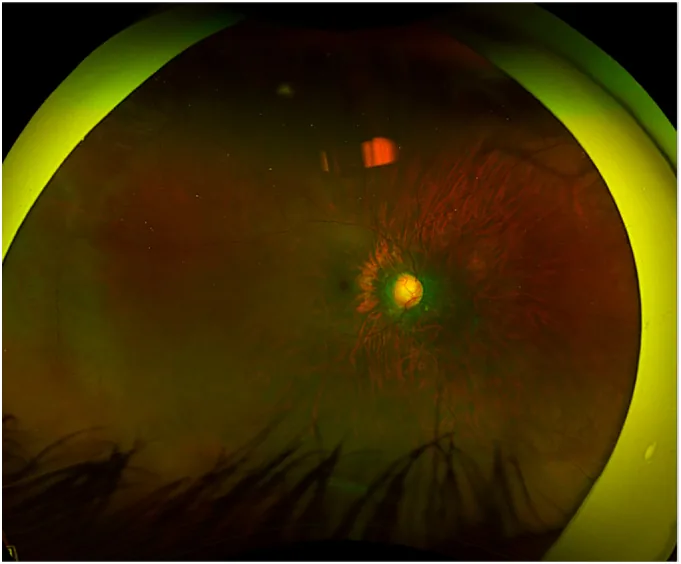
Wide-angle fundus photograph showing enlargement of the optic disc cup in the right eye consistent with glaucoma progression, observed before repeat deep sclerectomy. This corresponds to the optic disc cupping discussed in the section “2. Diet, Nutrition, and Glaucoma.”
Dietary nitrate, abundant in green leafy vegetables, is converted to nitric oxide in the body. Nitric oxide is thought to protect against glaucoma through vasodilation, increased aqueous humor outflow, and decreased episcleral venous pressure. Large cohort studies (e.g., Nurses’ Health Study) have shown that patients with higher dietary nitrate intake have a 20–30% lower risk of developing primary open-angle glaucoma (POAG).
Omega-3 fatty acids (EPA and DHA) regulate systemic microcirculation and ocular blood flow. In a prospective study of patients with pseudoexfoliation glaucoma, oral DHA intake for 6 months resulted in significant intraocular pressure reduction. However, a high ratio of omega-3 to omega-6 may increase glaucoma risk, and conclusions remain inconclusive.
Vitamin B3 (nicotinamide) reduces vulnerability to glaucoma in mouse models, and clinical trials have shown improvement in inner retinal function. In clinical trials, the combination of nicotinamide and pyruvate was associated with improved pattern standard deviation. However, at present, there is insufficient evidence that any specific vitamin supplement reduces glaucoma risk.
A meta-analysis of flavonoids (abundant in red wine, dark chocolate, berries, citrus fruits, and tea) reported a significant improvement in the mean deviation of the visual field.
Alcohol consumption temporarily lowers intraocular pressure, but chronic intake may increase the risk of open-angle glaucoma by 1.18 times. A systematic review including 10 studies found that chronic alcohol consumption was associated with elevated intraocular pressure and a higher prevalence of ocular hypertension. However, the certainty of the evidence is very low.
Caffeine intake is not associated with increased intraocular pressure in healthy individuals, but in patients with a history of glaucoma or ocular hypertension, it is associated with a temporary increase of about 2.4 mmHg one hour after consumption. In patients with a positive family history of glaucoma or genetic predisposition, an association between caffeine intake and the prevalence of glaucoma has been suggested.
QShould glaucoma patients avoid coffee?
A
Moderate coffee consumption is generally considered not a major problem. However, in patients with glaucoma or ocular hypertension, a temporary increase in intraocular pressure (about 2.4 mmHg) has been reported after caffeine intake. Especially for those with a family history of glaucoma or insufficient intraocular pressure control, it is advisable to avoid high caffeine intake (more than 2-3 cups of coffee per day).
Walking/Cycling: A mild increase in intraocular pressure during activity, followed by a sustained decrease in intraocular pressure.
Running: Intraocular pressure decreases by about 2 mmHg, but returns to baseline within 30 minutes after exercise.
Suppression of visual field progression: Each 5,000 steps of walking or 2.5 hours of non-sedentary time per day reduces visual field progression by 10%.
Protective effect on the retina: Increased physical activity is associated with a slower rate of thinning of the ganglion cell-inner plexiform layer.
Exercises Requiring Caution
Weightlifting: Isometric holds can cause a temporary increase in intraocular pressure (approximately 41 mmHg during leg press).
Yoga (inverted poses): Poses where the head is lower than the heart (such as Downward Dog) significantly raise intraocular pressure. In headstands, intraocular pressure approximately doubles.
High-intensity workouts: Daily vigorous exercise is associated with a higher prevalence of glaucoma compared to exercising three days per week. Increased oxidative stress from free radicals may be involved.
Swimming goggles: Can cause a temporary and significant increase in intraocular pressure while worn.
A study of newly diagnosed glaucoma patients (Hetch 2015) found that a group exercising 30 minutes daily showed a significant reduction in intraocular pressure compared to a medication-only group. This supports the protective role of moderate aerobic exercise in glaucoma management.
QShould glaucoma patients avoid yoga?
A
It is not necessary to avoid all yoga, but poses where the head is lower than the heart, such as Downward Dog, forward bends, and headstands, are recommended to be avoided as they significantly raise intraocular pressure. Caution is especially needed in patients at high risk of progression. Poses that can be performed while sitting or standing are usually not problematic.
Intraocular pressure is affected by body position 2). Changing from sitting to supine position increases intraocular pressure by 1–2 mmHg in healthy individuals and by 4 mmHg in glaucoma patients. When measured considering daily posture (sitting during the day, supine during sleep), intraocular pressure during sleep is higher than during the day even in normal individuals 2). The main mechanism of this supine intraocular pressure increase during sleep is the rise in episcleral venous pressure due to postural change 2).
In the lateral decubitus position, intraocular pressure in the lower eye increases by approximately 1.5–2 mmHg. In glaucoma patients, if there is a habit of sleeping on the side with more advanced damage, the risk of visual field progression may increase.
Obstructive sleep apnea syndrome has been reported as a risk factor for glaucoma5). However, this association is not consistently shown in all studies 4).
Smoking is listed as one of the risk factors for glaucoma1). It is thought that increased oxidative stress from smoking, impaired retinal microcirculation, and direct toxicity to the optic nerve are involved, but large-scale studies clearly demonstrating the link between smoking and glaucoma are limited.
The association between systemic hypertension and glaucoma is debated4). Low diastolic blood pressure may increase glaucoma risk through reduced perfusion pressure4). Diabetes has been suggested to be associated with elevated intraocular pressure and increased glaucoma risk5).
Diurnal variation in intraocular pressure (IOP) is important in glaucoma management. In healthy individuals, IOP fluctuates by about 3–6 mmHg throughout the day2). In glaucoma patients, the fluctuation range is larger due to reduced aqueous humor outflow2). Peak IOP often occurs in the morning, and trough IOP in the evening to nighttime2).
IOP can fluctuate significantly in the short term due to blinking, eye movements, and vascular pulsation3). In a primate model study using telemetry sensors, transient IOP elevations exceeding 100 mmHg were recorded during eye rubbing3).
QDoes losing weight have a positive effect on glaucoma?
A
BMI has been reported to be positively correlated with IOP. In patients who experienced rapid weight loss after bariatric surgery, postoperative IOP decreased, and the use of ocular hypertension or glaucoma medications was reduced. However, the relationship between weight and glaucoma is complex; some reports indicate that higher BMI is associated with lower glaucoma prevalence. Weight management is important for overall health but is not a substitute for glaucoma treatment.
The neuroprotective effect of nicotinamide (the amide form of vitamin B3) in glaucoma has gained attention. In a clinical trial by De Moraes et al., the combination of nicotinamide and pyruvate was associated with improvement in pattern standard deviation compared to placebo. A protective effect via prevention of mitochondrial dysfunction is suggested, but further large-scale trials are needed.
Research has shown that for every 10-minute increase in evening activity per day, the odds of visual field progression in primary open-angle glaucoma patients decrease by 15%. It has also been reported that increased activity slows the thinning rate of the ganglion cell-inner plexiform layer. Exercise may lower IOP and also have neuroprotective effects.
Most studies on the relationship between lifestyle and glaucoma are observational and have not proven causality 1). The EGS (European Glaucoma Society) guidelines also state that strong recommendations regarding lifestyle cannot be made at this time 1). Accumulating high-quality evidence from randomized controlled trials remains a challenge for the future.
Pazos M, Traverso CE, Viswanathan A; European Glaucoma Society. European Glaucoma Society - Terminology and guidelines for glaucoma, 6th Edition. Br J Ophthalmol. 2025;109(Suppl 1):1-212. doi:10.1136/bjophthalmol-2025-egsguidelines. PMID:41026937.