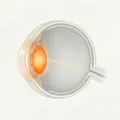
Intumescent cataract is a complex type of cataract characterized by lens opacification accompanied by swelling (hydration) and increased intralenticular pressure.
Like hypermature cataract, it appears white, but differs by the presence of prominent sectorial markings in the anterior cortex. It may also be associated with capsular fissures.
It can develop after ocular trauma or pars plana vitrectomy (PPV). Traumatic cataracts occur in 5–10% of all eye injuries, and systemic conditions such as diabetes increase the risk of progression to intumescent cataract.
Increased intralenticular pressure and loss of red reflex make surgery more technically demanding than standard cataract surgery. However, with appropriate preoperative evaluation and surgical strategy, good visual recovery can be expected.
QWhat is the difference between intumescent cataract and hypermature Morgagnian cataract?
A
Intumescent cataract is characterized by fan-like striae in the anterior cortex, and the lens nucleus often remains without liquefaction. In contrast, hypermature Morgagnian cataract is a condition where the nucleus sinks to the bottom of the liquefied cortex, and movement of the nucleus within the capsule is observed. Intumescent cataract is positioned as an intermediate type between immature cortical cataract and mature cortical nuclear cataract.
Tense anterior capsule: The anterior capsule bulges due to increased internal pressure, showing a tense, glossy appearance.
White opaque lens: The cortex becomes cloudy white, and the nucleus blocks the red reflex.
Anterior cortical fan-shaped striae: An important finding for differentiation from hypermature cataract.
Features in traumatic cases: Capsular tears or pigment deposits on the anterior capsule may be observed.
Imaging Findings
AS-OCT findings: Lens thickness ≥5.36 mm and spherical shape suggest intumescent cataract. It is useful for preoperative assessment of swelling and identification of fluid accumulation sites.
Scheimpflug densitometry: High-density findings suggest the presence of a large nucleus.
Loss of red reflex: The opaque nuclear material blocks the red reflex, significantly reducing visibility of the anterior capsulotomy during surgery.
QWhat is the significance of performing AS-OCT before surgery?
A
AS-OCT allows non-invasive evaluation of lens thickness, sphericity, and fluid accumulation sites. It helps identify areas at high risk of radial extension of the anterior capsulotomy during surgery, aiding in planning the capsulotomy start position and technique. It is also useful for objectively classifying the degree of lens swelling before surgery.
Diagnosis is based on slit-lamp microscopy combined with imaging tests.
Slit-lamp microscopy: Confirms the appearance of a tense anterior capsule and a white opaque lens. Fan-shaped patterns in the anterior cortex help differentiate it from hypermature cataract. In traumatic cases, capsular tears and pigment deposits are also evaluated.
AS-OCT: A lens thickness of 5.36 mm or more with a spherical shape suggests intumescent cataract. It is also used to identify fluid accumulation sites1).
Scheimpflug densitometry: High-density findings suggest the presence of a large nucleus.
Perform a complete preoperative examination and IOL power calculation. Intravenous mannitol administration to lower intraocular pressure and reduce the pressure difference between the anterior capsule and the capsular bag is effective 1).
Standard cataract surgery (phacoemulsification) is the basis, with the following modifications.
Mydriasis and side-port incision: Performed as standard.
Anterior capsule staining with trypan blue: After replacing the anterior chamber with air, inject trypan blue to stain the anterior capsule. This significantly improves visibility and facilitates control of capsulorhexis1).
Injection of dispersive ophthalmic viscosurgical device (OVD): Fill the anterior chamber to flatten the anterior capsule. Highly cohesive OVD is useful for reducing the risk of anterior capsule tears 1).
Capsule decompression: Puncture the anterior capsule and aspirate the liquefied cortex with a cannula or needle to decompress the lens capsule. The anterior capsule flattens, making continuous curvilinear capsulorhexis (CCC) easier to control.
Continuous curvilinear capsulorhexis (CCC): Performed after decompression. Phacocapsulotomy using an ultrasound tip with high irrigation pressure and low flow rate is also an option.
Proceed with the remainder of cataract surgery: Nucleus removal (often requiring minimal ultrasound energy in young patients), cortex aspiration, and IOL insertion.
Intraoperative Special Techniques
Vacuum rhexis: A technique using a 24-gauge needle and a 10 mL syringe for aspiration. It has been reported as an alternative for cases where continuous curvilinear capsulorhexis is difficult.
Two-stage continuous curvilinear capsulorhexis: A method where a small capsulorhexis is created first, then enlarged after decompression. This prevents sudden extension under high intraocular pressure.
Intraoperative OCT guidance: Perform capsulotomy while monitoring fluid accumulation sites in real time. Avoid areas of elevated intraocular pressure (high risk of radial tears) to proceed with the procedure.
Capsule Protection Techniques
Creation of artificial epinucleus: During phacoemulsification, inject a dispersive OVD behind the nucleus to protect the posterior capsule. In intumescent cataracts, a protective epinucleus is often absent.
Capsular tension ring (CTR): Insert when zonular weakness is suspected and the anterior and posterior capsules are intact. In cases of severe zonular loss, use a sutured CTR.
Alternative IOL fixation: If the capsule or ciliary sulcus is unavailable, choose scleral-fixated IOL or anterior chamberIOL.
6. Pathophysiology and Detailed Mechanism of Onset
In intumescent cataract, dysfunction of the sodium-potassium (Na-K) pump in lens epithelial cells plays a central role.
Dysfunction of the Na-K pump disrupts electrolyte and water balance, leading to inward osmotic pressure and swelling of epithelial cells, which results in cell lysis and cataract formation.
Transmission electron microscopy reveals the following: epithelial swelling, intracellular vacuolization, release of osmotic granules from lens epithelial cell membranes, and longitudinal breaks in the lens capsule. These changes reduce the tensile strength of the capsule, increasing the risk of complications during surgery.
In traumatic cases, intraocular hydrodynamic energy dissipates the traumatic energy, causing capsular rupture and immediate or delayed opacification.
Patients with intumescent cataracts are prone to the following complications:
Phacolytic glaucoma: Macrophages that have phagocytosed lens proteins directly obstruct the trabecular meshwork, leading to elevated intraocular pressure.
Lens-induced uveitis: Exposed lens proteins trigger an immune response, causing inflammation regardless of intraocular pressure elevation.
In young patients, the lens nucleus softens and the cortex becomes opaque, while the capsule tends to overstretch, becoming highly mobile and prone to rupture. Ultrasound energy requirements are low, and hydrodissection or hydrodelineation may be unnecessary. In elderly patients, the nucleus tends to enlarge and harden, with a higher risk of zonular weakness.
QIs urgent surgery necessary for intumescent cataract?
A
Early surgery is recommended if secondary complications such as glaucoma or uveitis occur. Without complications, urgency is low, but high intralenticular pressure carries a risk of spontaneous capsular rupture, so surgery at an appropriate time in a specialized facility is advisable.
7. Latest Research and Future Prospects (Investigational Reports)
Research is progressing on a technique that uses intraoperative real-time OCT to identify fluid pockets while performing anterior capsulotomy. By avoiding areas with particularly high intralenticular pressure when initiating the capsulotomy, it is expected to reduce the risk of the Argentine flag sign.
Standardization of the Two-Stage Capsulotomy Technique
The two-staged CCC, which creates a small capsulotomy initially and enlarges it after decompression, is attracting attention as a technique to prevent sudden anterior capsule tears under high intralenticular pressure. Standardization, including incorporation into surgeon education and training, is a future challenge.
Preoperative prediction model for intracapsular pressure
Research is underway on a model that uses AS-OCT data on lens shape and thickness to quantitatively estimate intralenticular pressure preoperatively. Its application to preoperative risk assessment is expected.