Melkersson-Rosenthal Syndrome (MRS) is a non-caseating chronic granulomatous neurocutaneous disease. It presents with oral and facial edema, and biopsy reveals granulomatous inflammation. It belongs to a group of diseases called orofacial granulomatosis.
The historical description of this disease is as follows. In 1928, Ernst Melkersson first reported in detail the presence of recurrent facial nerve palsy and edema. In 1931, Curt Rosenthal added a description of fissured tongue (lingua plicata), and in 1949, Lüscher first used the name “Melkersson-Rosenthal syndrome” 3).
Epidemiologically, it is estimated to occur in 0.08% of the general population 2). It is most frequently seen in the 20s to 30s, with an average age at onset of 39 years (range: 8–79 years). It is considered to have a female predominance (approximately 3 times).
The classic triad consists of the following three features.
Recurrent orofacial edema: especially lip swelling (granulomatous cheilitis)
Recurrent peripheral facial nerve palsy
Fissured tongue (lingua plicata)
All three symptoms are present in only 8–25% of cases. Most patients present with only one or two symptoms, and the monosymptomatic form is sometimes described as granulomatous cheilitis (Miescher cheilitis)1).
Some researchers suggest that this condition may be a manifestation of sarcoidosis or Crohn’s disease, and whether it is an independent disease remains unresolved.
QCan it be diagnosed without all three symptoms?
A
The classic triad is present in only 8–25% of cases. Diagnosis is possible even when 1–2 symptoms are confirmed by history and physical examination, or when granulomatous cheilitis is found on biopsy. Definitive diagnosis is rare, and long-term follow-up is necessary.
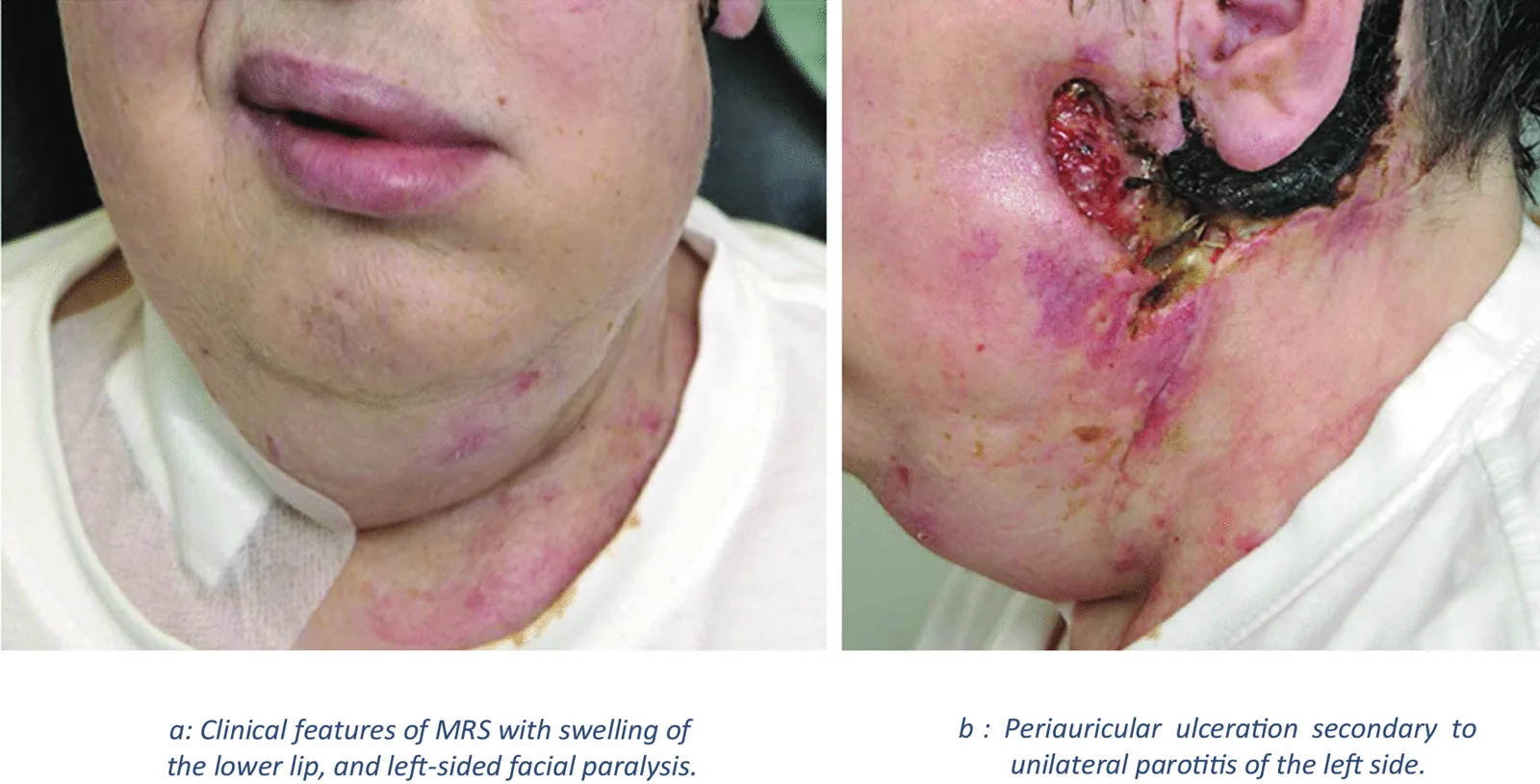
J Casper, S Mohammad-Khani, J J Schmidt et al. Melkersson–Rosenthal syndrome in the context of sarcoidosis: a case report . Journal of Medical Case Reports. 2021 Oct 4; 15:488. Figure 2. PMCID: PMC8489098. License: CC BY 4.0 (https://creativecommons.org/licenses/by/4.0/).
Clinical presentation of Melkersson–Rosenthal syndrome. a: Lower lip swelling and left facial nerve palsy. b: Periauricular ulcer secondary to left parotitis.
The three components of the triad differ greatly in frequency and characteristics.
Orofacial edema
Frequency: Most common, occurring in 80–100% of cases.
Typical features: Unilateral, painless, non-pitting. Predilection for the upper lip.
Course: Initially transient and intermittent, but may become persistent later. Can lead to tissue fibrosis.
Differential diagnosis: Similar to angioedema, but MRS is more persistent and unresponsive to antihistamines. Complement levels are normal.
Facial nerve palsy
Incidence: 47–60% of cases (up to 90%). Unilateral or bilateral.
Course: Initial episodes often resolve, but with recurrence, duration may lengthen and become permanent. Recurrence rate is 3–11%.
Relationship with edema: It may appear several years before or after orofacial edema. In 13–50% of affected individuals, edema and facial nerve palsy coexist.
Epidemiology: The incidence of MRS-related facial nerve palsy is 0.36 per 100,000 person-years5).
Fissured tongue
Frequency: 30–35% of cases.
Characteristics: A groove approximately 2 mm deep and 15 mm long. May be congenital.
Diagnostic significance: Since it is observed in 5% of the normal population, it alone is not a diagnostic criterion.
Ophthalmologically, a monosymptomatic form of MRS presenting only with eyelid edema has also been reported3). Other associated ophthalmic findings include retrobulbar optic neuritis, corneal opacity, keratoconjunctivitis sicca, and blepharochalasis3). Systemic complications such as diverticulitis and uveitis have been reported, suggesting an association with Crohn’s disease and sarcoidosis.
QHow is facial nerve palsy differentiated from Bell's palsy?
A
Bell’s palsy is not accompanied by orofacial edema. In contrast, in MRS, orofacial edema is observed in 80–100% of cases. When recurrent facial nerve palsy is accompanied by orofacial edema, MRS should be strongly suspected.
Regarding genetic factors, autosomal dominant inheritance with a causative gene on the short arm of chromosome 9 (9p11) has been reported. An ATP1 (FATP1) gene mutation was reported in a Chinese family, and a heterozygous SLC27A1 (FATP1) mutation has also been reported, but it has not been confirmed 3). In reported cases of familial MRS, fissured tongue was observed in the patient’s brother, son, mother, and sister 5).
Regarding infections, viral infections (EBV, VZV, CMV, HSV) can be triggers. A case of recurrence after 4 years triggered by COVID-19 infection has been reported, suggesting that mast cell activation may be commonly involved in the inflammatory response of COVID-19 and the pathology of MRS 2).
Immunologically, involvement of Th1-type cellular immune response is considered 1). Allergens include gluten-containing foods, chocolate, cinnamon, food additives (monosodium glutamate), toothpaste, metals (gold, mercury, cobalt, zinc), and dental amalgam 1).
Overlap with Crohn’s disease and sarcoidosis has been discussed as related conditions. In the diagnosis of sarcoidosis, MRS is listed as one of the “other granulomatous skin diseases” that should be excluded, and differentiation between the two is required.
QIf a family member has the same symptoms, is there a genetic link?
A
MRS has been suggested to have autosomal dominant inheritance, and cases with fissured tongue or facial nerve palsy have been reported within families 5). However, the clinical and genetic diversity of the disease is large, and the genetic cause has not been determined 3).
Clinical diagnosis based on medical history and physical examination is fundamental. If two or more of the three cardinal features are present, or if granulomatous cheilitis is confirmed by biopsy, the diagnosis is considered sufficient 5). Definitive diagnosis is rare, and long-term follow-up is necessary.
The following tests are performed for differential diagnosis.
Serum calcium and ACE activity: Normal levels rule out sarcoidosis1)
Chest X-ray and HRCT: Check for hilar lymphadenopathy (to rule out sarcoidosis)
CT and MRI: Confirm soft tissue thickening. MRI is also used to evaluate the facial nerve3)
Neuroelectrophysiological testing: Decreased compound muscle action potential amplitude is observed in motor nerve conduction studies of the facial nerve5)
If sarcoidosis is suspected based on ocular findings, blood tests (serum ACE, soluble IL-2 receptor) and chest X-ray should be performed, and referral to a respiratory medicine or dermatology department should be considered as needed.
Other differential diagnoses include hypothyroidism, superior vena cava syndrome, lymphangioma, erysipelas, and lymphoma. Diagnosis may require multidisciplinary collaboration involving ophthalmology, dermatology, immunology, and gastroenterology.
There is no curative treatment, and recurrence is inevitable. Spontaneous remission has been reported, but if left untreated, symptom episodes may become more frequent and prolonged. Standard treatment has not been established, and the following stepwise approach has been reported.
Intralesional steroid injection: Triamcinolone acetonide 10–40 mg/mL. It has been shown to be as effective as systemic administration1)3).
Oral steroids: Prednisone (1 mg/kg/day for 10 days, then tapered). Remission rates are high, but recurrence occurs5).
NSAIDs and antihistamines: Used as initial treatment.
Second-line and beyond
Antibiotics: Minocycline 100 mg/day (effective in combination with steroids)1)2). Azithromycin pulse therapy (500 mg/day for 3 days/week) has also been attempted.
Immunosuppressants and biologics: Clofazimine, methotrexate, dapsone, sulfasalazine. Infliximab (based on similarity to Crohn’s disease)1).
Tacrolimus ointment 0.03%: Effective for eyelid edema in cases unresponsive to steroids3).
Antiviral drugs (acyclovir 400 mg every 4 hours) may be used in combination with steroids for facial nerve palsy5).
Facial nerve decompression: Indicated for persistent or recurrent facial nerve palsy refractory to conservative treatment. Considered for House-Brackmann Grade IV or higher. Improvement from Grade VI to Grade II has been reported (8 months postoperatively), and it may also prevent future recurrence5). Delayed decompression after 90 days is also considered effective5).
Cheiloplasty: Performed for refractory lip swelling.
Helium-neon laser irradiation: Reported to be beneficial in patients with disease duration less than 4 years.
Radiation therapy: No consistent efficacy has been demonstrated.
QIf drug therapy is insufficiently effective, is surgery effective?
A
For facial nerve palsy resistant to conservative treatment, facial nerve decompression surgery is an effective option. Dramatic improvement from severe palsy (House-Brackmann Grade VI) to Grade II has been reported5), and a preventive effect against future recurrence is also suggested. Although no controlled trials comparing it with conservative treatment have been conducted, surgery should be considered for persistent palsy of Grade IV or higher.
6. Pathophysiology and Detailed Mechanism of Onset
The basic pathology of MRS is chronic granulomatous inflammation primarily composed of non-caseating epithelioid cell granulomas. Histologically, it involves multinucleated Langhans-type giant cells, perivascular mononuclear inflammatory infiltration, lymphedema, and fibrosis.
Immunological mechanisms involve Th1-type cellular immune responses 1). Mast cell activation promotes the release of cytokines (IL-1, IL-6), which is thought to induce local granulomatous inflammation and edema 2).
The mechanism of facial nerve palsy is compression of nerve tissue due to granulomatous infiltration and edema. With each recurrence, the nerve is progressively damaged, leading to prolonged duration of paralysis 5).
Genetic basis suggests involvement of the 9p11 region and FATP1 (SLC27A1) gene mutations, but due to significant clinical and genetic diversity of the disease, no definitive conclusion has been reached 3).
It has been discussed that MRS, granulomatous cheilitis, sarcoidosis, and Crohn’s disease may form a continuous spectrum 1). These diseases are all characterized by non-caseating granulomas due to Th1-type immune responses and share clinical and histopathological similarities.
7. Latest Research and Future Prospects (Research Stage Reports)
Talidere et al. (2021) reported a 51-year-old woman whose MRS recurred after 4 years triggered by COVID-19 infection 2). She presented with all three classic signs: lip edema, right facial nerve palsy, and fissured tongue, and improved with hydroxychloroquine, azithromycin, and steroid therapy. It was suggested that mast cells may play a common role in the inflammatory response of COVID-19 and MRS, and this was the first report that COVID-19 infection could trigger MRS recurrence.
Estacia et al. (2022) reported improvement with topical tacrolimus 0.03% ointment in a 59-year-old woman with monosymptomatic MRS presenting only with right eyelid edema, who was refractory to five intralesional triamcinolone injections over one year and oral prednisone 3). This is attracting attention as a new topical therapy for steroid-refractory eyelid edema.
Outcomes of Facial Nerve Decompression and Familial MRS
Alencar et al. (2023) reported a case of familial MRS (38-year-old female) with a third attack (left-sided Grade VI palsy) treated with facial nerve decompression, resulting in marked improvement to Grade II at 8 months postoperatively 5). The patient’s brother, son, mother, and sister had fissured tongue, and the brother had a history of facial nerve palsy, suggesting an autosomal dominant inheritance pattern. This case did not improve with conservative treatment (prednisone 60 mg/day and acyclovir 400 mg), indicating the efficacy of delayed decompression and potential for preventing future recurrences.
Heterozygous mutations in SLC27A1 (FATP1) have been reported as candidate causative genes for MRS, but the clinical and genetic diversity is large, making it difficult to explain the entire disease with a single gene mutation 3). Advances in genetic research are expected to elucidate the pathophysiology of MRS and identify therapeutic targets.
Tummidi S, Nagendran P, Anthony ML, Ramani RJ, Shankaralingappa A, Gopinath H. Granulomatous cheilitis of Miescher: a rare entity. BMC women’s health. 2023;23(1):118. doi:10.1186/s12905-023-02280-9. PMID:36944970; PMCID:PMC10031989.
Taşlıdere B, Mehmetaj L, Özcan AB, Gülen B, Taşlıdere N. Melkersson-Rosenthal Syndrome Induced by COVID-19. The American journal of emergency medicine. 2021;41:262.e5-262.e7. doi:10.1016/j.ajem.2020.08.018. PMID:32829989; PMCID:PMC7428670.
Estacia CT, Gameiro Filho AR, da Silveira IBE, Gameiro RR, Barba ALSD. Melkersson-Rosenthal syndrome: a rare variant of the monosymptomatic form. GMS ophthalmology cases. 2022;12:Doc04. doi:10.3205/oc000191. PMID:35291587; PMCID:PMC8900159.
Aukerman E, List M, Avashia-Khemka N. Melkersson-Rosenthal syndrome of the vulva. JAAD case reports. 2022;27:35-37. doi:10.1016/j.jdcr.2022.07.006. PMID:35996444; PMCID:PMC9391513.
Alencar TN, Botelho MM, Carasek N, Bahmad F Jr. Surgical Treatment Outcome for Familial Melkersson-Rosenthal Syndrome. The American journal of case reports. 2023;24:e938670. doi:10.12659/AJCR.938670. PMID:36755481; PMCID:PMC9923774.
Copy the article text and paste it into your preferred AI assistant.
Article copied to clipboard
Open an AI assistant below and paste the copied text into the chat box.