Cortical blindness is the loss of vision and visual fields due to damage to the bilateral occipital visual cortex (primary visual cortex). The eyes themselves are normal, and pupillary reflexes and fundoscopic findings are characteristically normal.
Anton Syndrome is a state of visual anosognosia in which patients with cortical blindness are unaware of their vision loss and describe nonexistent visual experiences. Despite being blind, patients engage in confabulation, attempting to describe what they see in detail.
This disease is named after the Austrian neurologist Gabriel Anton. Anton reported a 69-year-old case with bilateral temporal lobe lesions presenting with acquired anosognosia and hearing loss. The term “anosognosia” was coined by Joseph Babinski, so it is also called “Anton-Babinski syndrome.” The first description of visual anosognosia dates back to the Roman slave Harpaste, who denied her blindness and complained that the room was dark.
Unilateral occipital to parietal lobe lesions may not lead to cortical blindness but can present with hemispatial neglect.
Difference from Charles Bonnet syndrome requires attention. Charles Bonnet syndrome involves visual hallucinations in patients with visual impairment, but insight into their visual impairment is preserved, fundamentally differing from Anton syndrome.
Epidemiology: The median age is 55 years (range 6–96 years), with no sex difference. The most common cause is secondary to cerebrovascular accident (CVA), often in elderly patients with multiple vascular risk factors. Posterior cerebral artery (PCA) stroke accounts for 5–10% of all strokes. 1) Between 1965 and 2016, only 28 cases of Anton-Babinski syndrome were reported, making it an extremely rare disease. 2)
QHow is Anton syndrome different from Charles Bonnet syndrome?
A
Anton syndrome is a condition in which patients with cortical blindness deny their own blindness and confabulate, lacking insight. In contrast, Charles Bonnet syndrome involves visual hallucinations in visually impaired patients, but they retain insight into their visual impairment. Both conditions involve visual impairment, but they fundamentally differ in the presence or absence of anosognosia.
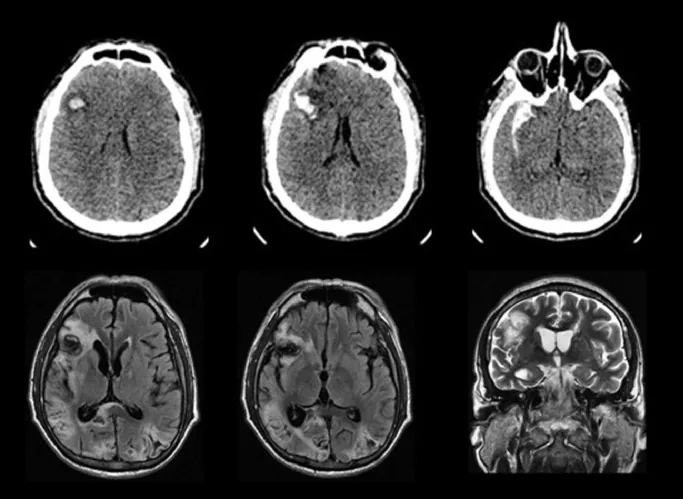
Ricardo BM, et al. Anton syndrome after subarachnoid hemorrhage and delayed cerebral ischemia: A case report. Cereb Circ Cogn Behav. 2021. Figure 1. PMCID: PMC9616440. License: CC BY 4.0 (https://creativecommons.org/licenses/by/4.0/).
CT shows haemorrhage and haematoma within the right frontal lobe; FLAIR and T2-weighted MRI show haemorrhagic infarction of both occipital lobes. This corresponds to the bilateral occipital infarction described in section 2, Main Symptoms and Clinical Findings.
Denial of vision loss: Patients do not recognize their own vision loss. Even when bumping into objects, they attribute it to external factors such as a dark room.
Confabulation: They provide detailed descriptions of nonexistent people or situations. When asked to shake hands, they reach in the wrong direction.
Partial preservation of color vision: Color vision may be preserved. They may be able to perceive moving objects but have difficulty recognizing stationary ones. This is due to subcortical fiber pathways from area V5 bypassing V1. 1)
Clinical Findings (Findings Confirmed by Physician Examination)
Visual acuity: Complete loss (NLP: no light perception), but the patient is unaware of it.
Pupillary reflex: Normal. Occipital lobe lesions are located posterior to the lateral geniculate body, so they do not affect the pupillary pathway. The afferent pathway of the light reflex goes to the pretectal area of the midbrain before reaching the lateral geniculate body.
Fundus examination: Normal. No organic abnormalities are found within the eye. 1)
Threat reflex: Negative.
Eye movements: Follows verbal commands normally, but unable to visually track.
Corneal reflex: Normal (does not depend on cortical input).
Riddoch phenomenon: Unable to recognize stationary objects but can recognize moving objects. This phenomenon was reported by Riddoch in 1917 and is known as a characteristic of cortical blindness.
Blindsight: A phenomenon in which a person unconsciously responds to visual stimuli despite being unable to consciously perceive them. Involvement of visual pathways other than the LGB-V1 pathway (V2, V3, V4, V5/MT, FST, LIP) is suggested.
QWhy is the pupillary reflex normal in cortical blindness?
A
The afferent pathway of the light reflex diverges to the pretectal area of the midbrain before the lateral geniculate body (LGB) and does not pass through the occipital lobe (primary visual cortex). Therefore, even if the occipital lobe is damaged, the light reflex is preserved. Together with normal fundus findings, this is a characteristic finding of cortical blindness.
The main causes and related risk factors for cortical blindness and Anton syndrome are shown below.
Vascular Causes
Bilateral PCA infarction: The most common cause. Infarction of both posterior cerebral arteries leads to extensive damage to the occipital lobes.
Post-trauma/tumor: May occur after head trauma, brain tumor, or surgery.
Cardiac surgery/cerebral angiography: Known iatrogenic risk factors.
Carbon monoxide poisoning / PRES: Can also occur in toxic and reversible posterior leukoencephalopathy syndrome (PRES). Anticancer drugs such as cisplatin are also causes.
Non-vascular causes
MELAS: Mitochondrial encephalomyopathy. Onset has been reported in cases with mt.3243A>G mutation. 2)
MS exacerbation / hypertensive encephalopathy of pregnancy / obstetric hemorrhage: Secondary to various systemic conditions.
Infectious diseases: West Nile virus (WNV) encephalitis, HIV-related PML, etc. 3)
Others: Adrenoleukodystrophy, central nervous system vasculitis, ischemia associated with subarachnoid hemorrhage, bilateral optic radiation lesions in Trousseau syndrome, etc.
An anatomical feature of the posterior cerebral artery (PCA) is that it branches from the basilar artery, supplying deep structures (posterior thalamus and midbrain) in its proximal segment (P1–P2) and the occipital cortex in its distal segment (P3–P4). Damage to the P4 segment is the main cause of visual field defects. 1) The occipital cortex is distant from the central vascular system and has a structure vulnerable to ischemia.
QCan Anton syndrome occur from causes other than stroke?
A
It can also develop from various non-vascular causes such as MELAS (mitochondrial encephalomyopathy) 2), MS (multiple sclerosis), West Nile virus encephalitis 3), trauma, and carbon monoxide poisoning. In all cases, bilateral occipital lobe dysfunction is the common pathological basis.
Clinical diagnosis is made by combining four elements: history of confabulation, clinical evidence of vision loss, normal fundus findings, and imaging confirmation of occipital lobe damage.
Head CT (NCCT): Useful for emergency evaluation. It confirms ischemic infarction (low-density area). For example, it appears as an ischemic infarction in the right temporo-occipital lobe. 1)
Head MRI:
DWI is useful in the hyperacute phase (within 6 hours). DWI can detect acute infarcts that are difficult to detect on T1, T2, and FLAIR.
FLAIR images are excellent for distinguishing cerebral infarction from cerebrospinal fluid.
Check for hyperintense areas in the occipital cortex and subcortical white matter on T2-FLAIR. 2)3)
Interpretation of DWI findings: DWI hyperintensity with isointense ADC (no reduction) suggests changes due to epileptic seizures and is differentiated from ischemic stroke (which shows reduced ADC). 2)
VEP (Visual Evoked Potentials): Useful for confirming complete cortical blindness. It can objectively demonstrate lack of response to stimuli and is also used to differentiate from malingering.
V-EEG (Video EEG): Useful when epileptic seizures are suspected in conditions such as MELAS. It can capture seizures originating from the occipital lobe. 2)
MRI shows reversible edema in posterior white matter; improves with blood pressure management
Differentiation from psychogenic visual disturbance is particularly important. Cortical blindness due to bilateral occipital lobe injury shows no abnormal findings in the eye and the pupillary light reflex is preserved, so it is easily mistaken for psychiatric disease or malingering.
MS-related: Steroid pulse therapy (IV methylprednisolone) + plasma exchange. Cases have been reported where recovery of insight precedes visual recovery, with gradual improvement over 2 years.
WNV encephalitis-related: Methylprednisolone 1000 mg/day for 7 days has been attempted but was ineffective in reported cases; no established treatment exists. 3)
After acute treatment, rehabilitation including visual compensatory training is important. This involves utilizing residual visual pathways (such as blindsight) and training compensatory strategies using other senses (auditory, tactile).
If the cause is reversible (PRES, hypotension, transient blood flow disturbance), partial recovery can be expected, but visual recovery is difficult in cases of extensive infarction. Young age and absence of underlying disease are considered good prognostic factors.
QHow soon after onset is treatment important?
A
In cases of stroke origin, tPA (thrombolytic therapy) is indicated within 4.5 hours of onset. 1) Beyond this time, prevention of recurrence and rehabilitation become the mainstays of treatment. The more time available, the greater the extent of salvageable neurons, so it is important to seek emergency care immediately upon symptom onset.
Bilateral extensive damage to the occipital lobes (primary visual cortex V1) leads to bilateral homonymous hemianopia and eventually cortical blindness. The occipital cortex is distant from the central vascular system and is vulnerable to ischemia. Infarction of the distal posterior cerebral artery (P3–P4) disrupts blood flow to the occipital lobes. 1)
Visual information processing involves the ventral stream (“what” pathway: V4 area, form and color recognition) and the dorsal stream (“where” pathway: V5 area, spatial location and motion recognition). Some subcortical fibers bypass V1 and directly connect to V4 and V5, so even when V1 is extensively damaged, these pathways may function, allowing color perception and motion detection. 1) This is the neurological basis of Riddoch phenomenon (seeing moving objects).
As for the mechanism of blindsight, studies using macaque monkeys have reported direct projection pathways from LGBd to V2, V3, V4, V5/MT, FST, and LIP, which may explain unconscious visual responses.
Several hypotheses exist regarding the mechanism of anosognosia.
Hypothesis
Content
Evidence
Simultaneous damage to visual cortex and association cortex
Primary visual cortex and visual association cortex are simultaneously impaired, leading to lack of insight into one’s own condition
Clinical picture of extensive occipital lobe lesions
Disconnection syndrome
Parietal white matter lesions disconnect the visual cortex from other areas
Occurs in cases with white matter lesions
Abnormal connection with language centers
The connection between the damaged visual cortex and the functioning language area is severed, causing the language area to generate confabulatory responses without visual input
Confabulation content includes visual details
Currently, the “abnormal connection with language centers” theory is the most supported. It is thought that when feedback from the damaged visual cortex to the language area is interrupted, the language area generates false reports of “seeing.”
QWhy do patients claim to see when they cannot?
A
The most supported hypothesis is the “disconnection from language centers” theory. Damage to the occipital lobe disrupts the feedback circuit from the visual cortex to the language area, causing the language area to generate confabulatory responses of “seeing” without visual input. This is not intentional lying but a neurological phenomenon resulting from brain circuit damage.
Mechanism in MELAS: Abnormal mitochondria accumulate in the endothelial and smooth muscle cells of small arterioles, leading to capillary proliferation. Seizures cause rapid energy depletion in the neurovascular unit, resulting in a Todd paralysis-like condition. The Fryer hypothesis proposes that “seizures trigger stroke-like episodes.” 2)
Mechanism of blood-brain barrier (BBB) crossing in WNV encephalitis: Three pathways are hypothesized: passive cellular transport, axonal transport, and inflammation-induced BBB disruption. 3)
7. Latest Research and Future Perspectives (Research-Stage Reports)
A case report by Ziaul et al. (2024) reported that COVID-19 patients have a 3.6-fold increased risk of ischemic stroke, and even mild COVID-19 increases stroke risk to about 1%. 1) High inflammatory response, hypercoagulable state, and medical severity are considered predisposing factors for thromboembolism. Delayed medical consultation during the pandemic was also a problem for strokes in the posterior circulation, including PCA.
Ewida et al. (2021) reported a case of Anton-Babinski syndrome complicated by MELAS, with characteristic MRI findings of DWI hyperintensity and ADC isointensity (inconsistent with ischemic changes). 2) This finding differs from DWI changes in ischemic stroke (with ADC reduction) and is interpreted as a combination of reversible energy metabolism impairment and hemodynamic changes due to epileptic seizures. Differentiation of DWI findings provides important implications for treatment decisions in MELAS.
Srichawla (2022) reported that interferon alpha and purified immunoglobulin preparations containing WNV antibodies may be future treatment candidates for neuroinvasive WNV infection. 3) Currently, response to existing drugs including methylprednisolone is poor, and no established treatment exists. Over 80% of WNV infections are asymptomatic, but less than 5% progress to neuroinvasive disease, making the establishment of treatment urgent.
Ziaul YH, Mittal J, Afroze T, Kumar V. Anton-Babinski Syndrome: A Visual Anosognosia. Cureus. 2024;16(3):e55679. doi:10.7759/cureus.55679. PMID:38586806; PMCID:PMC10997746.
Ewida A, Ahmed R, Luo A, Ghonim HT, Anilkumar AC. Mitochondrial Myopathy, Encephalopathy, Lactic acidosis and Stroke-Like Episodes Syndrome Presenting With Anton-Babinski Syndrome and Concurrent Occipital Lobe Seizures. Cureus. 2021;13(1):e12908. doi:10.7759/cureus.12908. PMID:33654593; PMCID:PMC7904536.
Srichawla BS. Neuroinvasive West Nile Virus (WNV) Encephalitis With Anton Syndrome: Epidemiology and Pathophysiology Review. Cureus. 2022;14(6):e26264. doi:10.7759/cureus.26264. PMID:35911357; PMCID:PMC9312882.
Copy the article text and paste it into your preferred AI assistant.
Article copied to clipboard
Open an AI assistant below and paste the copied text into the chat box.